Sandoval outlines how he wants to reform education

By Sean Whaley, Nevada News Bureau

CARSON CITY -– Establishing school choice for parents and ending social promotion for students are two top priorities in Gov. Brian Sandoval’s education reform agenda for the 2013 legislative session, an administration official said.

Linking pay to performance and providing professional development to ensure students have the best possible classroom teachers is a third major priority, said Dale Erquiaga, senior adviser to Sandoval.

Erquiaga briefed the Nevada State Public School Charter Authority last week on the governor’s education reform agenda being readied for the next session.

Erquiaga said Sandoval is a strong believer in parental choice for schools and that he will again pursue that objective. Whether it will be through a voucher system or by providing opportunity scholarships directly to parents to pick a private or public school has yet to be determined, he said.

Implementing a voucher program would likely require a change to the state constitution, a time consuming process. A scholarship option might circumvent the need for a constitutional change. Florida implemented school choice by giving tax breaks to corporations that provide scholarships to parents for private school, including those operated by religious organizations.

“Fortunately though, we now, really for the first time, have a superintendent of public instruction who supports those concepts and will be working hand-in-hand with the governor’s office to present the best bill,” he said in an interview after his briefing. “The superintendent the governor has hired is a national expert with a national network, and we’re going to bring all of that intellect to bear on providing the very best bill that we can.”

James Guthrie, formerly the senior fellow and director of education policy studies at the George W. Bush Institute in Dallas, Texas, was named by Sandoval as the new state superintendent of public instruction in March. He started his job April 2.

Erquiaga said Sandoval was disappointed that the 2011 Legislature failed to act on his proposal to end social promotion. His bill would have required children to be reading proficient by the end of third grade or they would not advance to the fourth grade.

The bill had a hearing but never made it out of the Democrat-controlled Assembly.

“We already provide class size reduction dollars in grades one, two and three,” Erquiaga said. “We have smaller class sizes and it is the intent of those dollars that those children receive the special attention. And yet we’re still passing on thousands of children who can’t read. We’re dooming them to failure.

“We may need to draw a bright line in the sand there,” he said.

Ensuring that each classroom has a highly effective teacher is Sandoval’s other major priority, Erquiaga said.

“We have a performance pay framework but the new superintendent has great ideas around a career ladder so that teachers can see a progression in their career and so we’re really going to look at that as well,” he said.

“We recognize that if we have an effective or highly effective teacher in the classroom, there is almost no better gift that we could give a child than that,” Erquiaga said.

The intention is to reward highly effective educators, including principals, and find ways to keep them, he said.

One element of Sandoval’s education agenda that was well received by the Charter Authority was the idea that many of the existing separate funds designated for specific needs such as textbooks, be placed instead in performance-based block grants that would give school districts more flexibility in how to use the money. Charter schools would be eligible for these block grants as well, Erquiaga said. A bill to accomplish this was introduced in the 2011 session but did not win approval.

The State Public School Charter Authority, itself created by the 2011 Legislature and viewed as a major education reform success by Sandoval, will have at least one bill draft, he said. The authority, created to focus on the creation and oversight of quality charter schools in Nevada, met today and had a discussion about what proposals to bring to the 2013 Legislature.

One of the key issues for the Charter Authority is the creation of “performance-based” charter contracts, which would link accountability to outcomes.

Erquiaga said Sandoval is a strong supporter of accountability throughout the public education system.


Tahoe Tails — Adoptable Pets in South Lake Tahoe

Portia is a sweet girl who was abandoned on the shelter doorstep with a note that said she was 6 years old.

She is a little scared here at the shelter, but she is very gentle. Portia is a dilute Calico who has been at the shelter since February, and she would very much like to go home.

Portia is spayed, microchipped, and vaccinated. She is at the El Dorado County Animal Services shelter in Meyers, along with many other dogs and cats who are waiting for their new homes.

Go online to see photos and description of all pets at the shelter.

Call (530) 573.7925 for directions, hours, and other information on adopting a pet.

For spay-neuter assistance for South Tahoe residents, go online.

— Karen Kuentz


Residential burn permits required

By Cathy Locke, Sacramento Bee

Permits for residential burning are now required within state responsibility areas of Nevada, Yuba, Placer and Sierra counties.

Residents must obtain a valid burn permit and burn only on allowed burn days as determined by their local air district, according to a California Department of Forestry and Fire Protection news release.

In the Truckee area, burning is allowed only during daylight hours to minimize smoke complaints due to nighttime inversions.

Read the whole story


Sierra Nevada range rising rapidly

By LiveScience

The Sierra Nevada mountain range in California and Nevada is rising at what scientists call a pretty good clip, geologically speaking: 1 to 2 millimeters per year. That’s roughly a half-inch every 10 years.

“The exciting thing is we can watch the range growing in real time,” said University of Nevada, Reno’s Bill Hammond, lead researcher on a long-term project studying the rise. “Using data back to before 2000 we can see it with accuracy better than 1 millimeter per year. Perhaps even more amazing is that these miniscule changes are measured using satellites in space.”

The Sierra Nevada range includes the tallest mountain in the continental United States, Mt. Whitney at more than 14,000 feet. Around Lake Tahoe, the peaks are in the 10,000-foot range.

The amount might seem small, but the data indicate that long-term trends in crustal uplift suggest the modern Sierra could be formed in less than 3 million years, which is relatively quick when compared to estimates using some geological techniques.

Read the whole story


LTN tidbit 7: Anonymous comments add flavor

May is 31 tidbits about Lake Tahoe News month.

LTN tidbit No. 7:

Anonymous comments are the one topic we get the most grief about. It’s also a service we receive many compliments about.

We could ask everyone to put his/her full name. But how do we know that is really Kathryn Reed writing a comment? The point of comments is real-time conversations. Verification, like what we do for letter writers and guest columnists, takes time. Time that we don’t have.

People have suggested going to a Facebook format so people have to use their real identity. Well, we are not that naïve. Most people have more than one email account. You can use any name on those accounts. Then you can create a Facebook account. So, really, there is no way to know someone is who she is via Facebook either.

We have in recent weeks taken a stronger stance regarding what comments are published. And even when something gets in, we can take it down. We – like many of you – are tired of the personal attacks. It’s fine to disagree with ideas. But to call someone names because they have a different belief is not necessary and won’t be tolerated. People are starting to be banned because they don’t know how to play nice.

To those who want to attack, we’d like you think twice before posting – Would you say that same thing to the person if she were standing next to you? Would you want your mother to know you wrote that? Why aren’t you using your full name?

People have said they like the comments because it gives them a quick way to say something, ask a question, offer advice, add to the story. People also like reading all of that. We like when the comments add to the story. So, thank you for doing so.

And for those who don’t like the comments. We don’t understand why you read them. Read the story and skip the comments. It’s pretty easy.

While Lake Tahoe News is the only news site in the basin to allow these types of anonymous comments, it is common practice in the industry. We like that it allows our readers to participate in news that is going on in Lake Tahoe. But that doesn’t mean if we keep being distracted from writing stories because of having to referee the comments section that one day it won’t exist. That will be up to you.

Here is information about becoming a paid subscriber.


Opinion: Higher education in Nevada shouldn’t bow to bullies

By J. Patrick Coolican, Las Vegas Sun

The Redfield name can be seen all over campus at UNR. The Nell J. Redfield Foundation has given about $40 million during the past three decades for gems such as the auditorium in the math and science building, a student health clinic and the Redfield Theatre.

So when a director of the foundation, Gerald Smith, wrote a letter to the Board of Regents recommending that interim UNR President Marc Johnson be appointed president permanently, no doubt regents noticed.

The foundation went one step further, however, warning of consequences if Johnson wasn’t appointed.

“Should the Regents select a stranger to fill the vacancy, there can be no assurance that current funding discussions will continue or that the projects currently being considered for funding will receive support in the future,” the letter said.

More than one regent found the letter threatening.

Dr. Mark Doubrava voted for Johnson and called him a “capable individual who will do a very good job.” (The point here isn’t about Johnson, who by all accounts is very capable.)

But Doubrava also said he found the letter “threatening” and reflective of a process that “appeared almost orchestrated” to anoint Johnson. The letter was dated April 5, one day after UNR boasted of receiving a $1.6 million gift from the foundation for the medical school.

Read the whole story


LTCC career fair for students, general public

What does it take to be a journalist?

Find out from Lake Tahoe News Publisher Kathryn Reed at the annual Lake Tahoe Community College career fair on May 8 from 10am-1pm at the South Lake Tahoe college.

A slew of businesses will be on the campus talking to students about various fields.

The event is an opportunity for students and community members to learn more about career paths, job openings, and internships at area businesses.


Nevada skier overcomes obstacles, helps others

By Dina Kupfer, KRNV-TV

Katie Lyons was 15 years old and at the peak of her ski racing performance when she learned she had scoliosis.

Beyond natural concerns about surgery, she needed to preserve her spine’s range of motion because she was a competitive downhill ski racer and wanted to remain one. She had recently been named #1 in her age group and was poised to assume a role on the U.S. Ski Team. But her scoliosis was so severe that it would eventually begin to put pressure on her lungs and her heart and would begin to cause a visible deformity.

Read the whole story


Survey: Drug Store Project makes a difference with kids

By Kathryn Reed

“I am concerned about kids my age (12) to be taking drugs and that they can cause death, lung problems, liver problems, and to make you look older than you are.”

That is what a sixth-grader on the South Shore said after attending the Drug Store Project this spring.

While plenty of people believe drug and alcohol education should be the responsibility of parents, the reality is that is not happening.

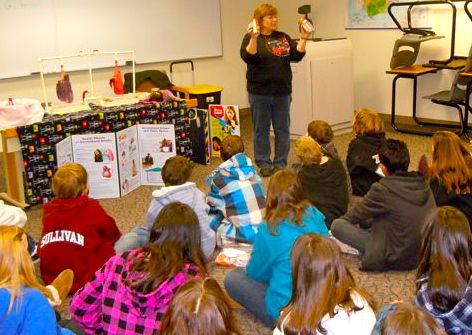
Students learn about gateway drugs in the Drug Store Project. Photo/LTN file

More than half the students at South Tahoe Middle, Zephyr Cove and St. Theresa schools said they get most of their information about drugs at school. About 20 percent get the info from their parents, while the next largest “educator” is TV, movies and books.

“The comments for me are the most important. You can tell from those they are not getting drug prevention in the schools,” Lisa Huard, who puts on the Drug Store project each year, told Lake Tahoe News. “They should know what gateway drugs are. They should know them by name. They should have that before they ever get to sixth grade.”

Huard was the safety coordinator for Lake Tahoe Unified School District until the position was eliminated a handful of years ago. She continues to do that work on a contract basis for Tahoe Truckee Unified.

Tahoe Youth & Family Services is now the lead agency for Drug Store Project.

These are the LTUSD drug and alcohol curriculum guidelines provided by the district. Superintendent Jim Tarwater was not available to talk about what is actually being taught in the classroom now that the emphasis is on ensuring students test well to meet state and federal requirements.

However, South Tahoe Middle School Principal Beth Delacour said, “What Lisa (Huard) does is amazing. It changes kids lives and it makes them think. I think Drug Store Project is really valuable. It gives them a glimpse of reality and helps them think.”

“One thing I learned was that one minute you’re trying to be cool, the next minute your parents are called to come to the hospital and the doctors have to tell your parent ‘we’re sorry, but your child’s gone’ and then your parents don’t know what to do. So my point is don’t do drugs. Never ever. One try could kill you.” – South Shore sixth-grader

The daylong event talks about how tobacco, alcohol and marijuana can lead to the use of stronger, more dangerous drugs. But it also talks about the danger of these three drugs are.

“The concern I have in the last two years has been the increase of kids with the acceptability of pot and saying it is not a bad thing,” Huard said. “People don’t want to see our kids drinking, but they don’t seem to be alarmed with marijuana because they smoke it.”

At an age when children are not mature enough to fully understand the consequences of their actions, they are getting conflicting information about what is OK to put in their bodies. They want to emulate the adults in their lives. They may see the marijuana shops dispensing medicinal marijuana, so youngsters see pot solely as a legal drug.

On the student survey one of the biggest differences in pre- and post-event answers was with the response to: Prescription drugs from someone’s doctor are safe to take. Almost half thought this was true before Drug Store Project, while more than three-quarters knew afterward that taking drugs prescribed for someone else could be lethal.

“I learned that most likely seven people in my class will be addicted to drugs by the time they graduate from high school.” – South Shore sixth-grader

Huard said, “It all centers around destructive behavior. They need to know what it does to their body. They need to be provided the opportunity to make better decisions. The majority of our kids, who if they knew more, they would make different choices.”


Nevada education still far from an A

By Jason Hidalgo, Reno Gazette-Journal

The hangover from Nevada’s budget crisis continues to impact the state’s education system, which still has a long way to go to fully prepare students for the jobs of the future, experts said in Reno on Thursday.

The event was the second town hall meeting held as part of the Reno 2020 project, a collaboration between the Reno Gazette-Journal and the University of Nevada, Reno’s Center for Regional Studies.

The second town hall, broadcast live on KNPB Channel 5, focused on education, one of several key areas identified by the project as a critical component in diversifying Nevada’s economy. Other needs include updating the state’s tax structure and diversifying its industries beyond gaming and tourism.

Education received a “C” grade from the Reno 2020 project, largely due to the lack of resources set aside for education programs. This includes the Knowledge Fund, which was created by the legislature to help boost research within Nevada’s higher education and research centers but was not allocated any funding.

“Certainly, we have a lot of progress to make so a ‘C’ (is fair),” said University of Nevada, Reno President Marc Johnson, a panelist for the event. “We’ve still got a lot of work to do to get a ‘B’ or an ‘A.’”

Johnson pointed out programs that were axed as a result of cuts to higher education, including the university’s highly rated logistics program.

Read the whole story