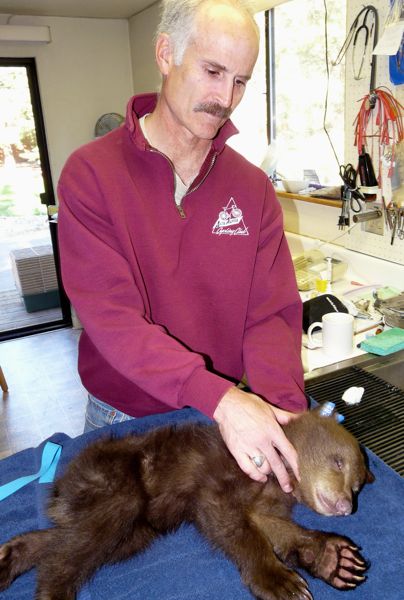
LTWC begins rehabbing first bear cub of the season

Lake Tahoe Wildlife Care received its first cub of the season on Memorial Day. This is just two months after the last bear was released.

Weighing-in at 9.8 pounds, the little guy was given a physical by Kevin Willitts. Willitts, who owns Alpine Animal Hospital, is also the veterinarian for the South Shore animal rehab center. Willitts takes blood, checks the bear’s ears and extremities.

The bear was found in Humboldt County. He was rescued because his mom had died.

When the little guy woke up he was fed watermelon, grapes and a special bear formula.

Today he will be placed in a temporary cage until he graduates to the bear cage later in the summer. By that time it’s likely he will have playmates. It’s common for LTWC to rehab several bears in a season.

“More than likely, this cub will be released next January or February, back in the Humboldt area,” Tom Millham, secretary-treasurer with LTWC, told Lake Tahoe News.

— Lake Tahoe News staff report

Because his mom died this cub will spend the next eight months at Lake Tahoe Wildlife Care. Photos/LTWC


Kevin Willitts examines the cub that came to LTWC on May 28.


LTN tidbit 29: Images tell a story all by themselves

May is 31 tidbits about Lake Tahoe News month.

LTN tidbit No. 29:

Sometimes images tell a story better than words. That is why the Gallery (accessed at the top of the page) has groups of photographs without words.

This is an easy way to look at images without reading the story.

You can view them as a slideshow or click on each one so they are larger.

In the future we anticipate adding a video component to the Gallery.

Here is information about becoming a paid subscriber.


History: Tallac House was the place to stay in its heyday

Publisher’s note: This is reprinted from the June 1989 Lake Tahoe Historical Society newsletter.

Many hotels have been built on the shores of Lake Tahoe in the past one hundred and thirty years. There were good ones and bad ones, rustic and primitive ones and there were also elegant ones. One of the most celebrated of the latter was Tallac House, or the Tallac Hotel, which was situated on a prime site at the southwest corner of the lake. It was in a favorable position and could easily be reached by steamer and later by stage or by automobile from Sacramento or Reno.

The first hotel to operate at this site was a large two-story rectangular building build by Yank Clement when he moved from Meyers in 1875. It offered a store, cabins, complete livery accommodations and even a dance floor mounted on springs. It was a well-established site when Clement sold the northwestern portion of the holdings, and the main hotel building to E.J. “Lucky” Baldwin in the 1880s. Baldwin, the legendary financier of the Comstock, altered the original building and opened the Tallac Hotel. Over the years a veranda and graceful portico were added. Large picture windows in the dining room faced the lake and give guests a spectacular view with their supper. Other buildings were added including a casino on the lake edge. There were paths laid out for leisurely evening strolls through gardens and portions of virgin timber, one of the few stands left in the basin. First class accommodations were offered for 150 guests and a choice of fishing, hiking, horseback riding or trips on the lake in one of the hotel’s launches a well as places for solitude and quiet contemplation.

Furnishings were a combination of rustic, in keeping with the setting, and elegant, to retain its flavor of class. Etched glass and polished brass did not seem out of place alongside rustic, twig chairs or tables. The whole place was often described as being “tony” and formal attire was required at all evening affairs.

Baldwin insisted that his managers keep the rates high to attract only the most genteel and affluent patron. The advertising brochure House that Tallac House was called the “Saratoga of the Pacific”.

The original building burned down in 1914, but others had been added meantime and Tallac House continued in operation offering excellent accommodations until 1920, when E.J. Baldwin died. His heir, Anita Baldwin, built a private estate on the grounds in the twenties, steadfastly forgoing all commercial operations on the property. What was left of the legendary Tallac Hotel was torn down. Today it survives in memories and in images that continue to draw attention and praise for the elegant Tallac Hotel.


Snippets about Lake Tahoe

• South Lake Tahoe Community Services Summer Activity and Facility Guide is available on the city’s website and at the Parks and Recreation center.

• Lake Tahoe Wildlife Care’s webcam is back giving people a view of three bobcats that recently came to the South Shore rehab facility.

• Mark Hardy has joined Truckee’s Van Dyke Law Group.

• Coalition for Recreational Trails is calling the Tahoe-Pyramid Bikeway one of the best use of federal trail grants. One day it will go the whole 116 miles from Lake Tahoe to Pyramid Lake.

• Here are the weekly El Dorado-Tahoe and Sierra roadwork schedules from Caltrans.


Opinion: Law governing loss of pet dog needs to change

By Kenneth Newman

Is the loss of a pet is akin to the loss of furniture, a computer or a car?

As a 33-year veterinarian and author of “Meet Me at the Rainbow Bridge”, I have proposed a law that answers this question. Gracie’s Law recognizes the emotional bond between pet and owner by entitling the owner of a pet killed through an act of malice or negligence to $25,000 in damages.

It’s time we change the laws to more accurately reflect what pets mean to the average American.

Gracie’s Law would not supersede current laws which entitle owners to the property value of their pet. And it would not replace criminal prosecution for acts of malice. And owners who decline a recommended veterinarian procedure to save a pet would not be held accountable under the law, he says.

My dog Gracie was killed in April 2008 when a negligent driver backed up 25 yards without looking, crushing me and Gracie between two vehicles. I escaped with a broken leg; Gracie saved my life.

An attorney looked me in the eye and said that my dog was a piece of property, that I wasn’t entitled to anything for the dog, and that this was a simple broken-leg case.

In every state, laws view pets as property. Owners are entitled to no more than replacement value; no law takes into consideration the loss of companionship, grief, or pain and suffering.

That doesn’t jibe with Americans’ attitude toward their pets. According to an American Animal Hospital Association survey, 90 percent of owners consider their animals part of the family.

Other findings:

• 52 percent of Americans would rather be stranded on a deserted island with their pet than with another person.

• 83 percent call themselves “mommy” or “daddy” in reference to their pet.

• 59 percent celebrate their pet’s birthday.

Cases involving pet owners’ bonds are increasingly showing up in the courts:

• Matrimonial law: Attorneys have experienced a 23 percent increase in pet cases, according to the American Academy of Matrimonial Lawyers. This includes custody battles over pets, veterinarian bills and visitation rights. Harvard now has a course dedicated to pet law.

• The North Carolina Court of Appeals: While the plaintiff’s wrongful death lawsuit was denied, animal activists applaud a judge’s willingness to at least hear a case involving a Jack Russell terrier that died while undergoing tube feeding at a state facility.

• Texas justice: On Nov. 3, 2011, Fort Worth’s 2nd Court of Appeals ruled that value can be attached to the love of a dog. That overruled a 120-year-old Texas Supreme Court case, which held that plaintiffs can only recoup the market value of their pets.

• Largest award: In April, a Denver judge awarded Robin Lohre $65,000 for the death of her dog, Ruthie. Lohre had accused Posh Maids cleaning service of negligence for allowing the dog to get outside, where it was hit by a car. Newman notes this sets a new precedent for pet value, but that such uncapped awards may threaten affordable veterinary care.

Kenneth Newman graduated from Purdue University with a doctor of veterinary medicine degree in 1979, and has since been a practicing vet.


South Lake Tahoe done with putting up with code violators

By Kathryn Reed

Snowmobiles stored across multiple lots in a residential area. Overturned garbage cans with trash strewn about. Boarded up abandoned houses. Businesses moving half their belongings to the outdoors. Junk cluttering yards so it looks like a mini landfill.

This is South Lake Tahoe.

While not every parcel is a visual nightmare, hardly any street is immune from having a lot that could be cited for a code enforcement violation.

Owners of this house on Primrose Road will have a code enforcement hearing in June. Photos/Kathryn Reed

City officials are done putting up with the eyesores. Aesthetics of the situation could be argued by the owners or renters responsible for violating the law, but the laws governing their actions are what police officials are going after.

In 2011, 200 nuisance cases were processed. That number is expected to increase this year as the city cracks down on offenders and more complaints file in.

It’s anticipated there will be some push back from residents as citations and fines start being written and levied. But these are not new rules. What is new is they are being enforced.

“It’s a question of what is legal and illegal,” Police Chief Brian Uhler said. It doesn’t matter if he likes what it looks like or not. He is going by the law.

“If the law is bad, then change the law. If the law is rational and sound, then enforce it.”

To make sure the council knows what’s about to happen each member is being given a tour of some of the more egregious properties. Councilmembers Tom Davis and Angela Swanson have been on the “scenic” tour with Uhler and Community Services Officer Bob Albertazzi. Albertazzi is the one who is tasked with talking to residents, writing citations and then dealing with council when people appeal the citation.

“My perspective is I think it’s time. Some of it is way beyond normal stuff in a yard. What I saw was pretty bad,” Davis told Lake Tahoe News. “The most important point I want to make is to make sure the city notifies the owner before we abate it. That is critical.”

Lake Tahoe News last week was shown some of the same areas the council will become acquainted with.

“Temporary shelters are a major issue of contention,” Albertazzi said. “They are not permitted and many do not comply with set backs and easement requirements in the code.”

He’s talking about the canopies people use as a carport.

Driving through town some of the canopies are tattered. Others look fine. But the condition isn’t the issue. It’s the fact that they are illegal no matter the condition they are in. There is nothing in South Lake Tahoe’s building codes that allow for these canopies.

On Primrose Road is a yard that is best described as a junkyard. It goes beyond clutter. Tires, television, sofa, rolled up carpet, broken furniture, torn mattress against a vehicle, shopping cart full of everything but groceries, empty aquarium – all visible over the fence.

A hearing regarding this particular property is scheduled for June 20.

Another “junk” issue is related to perpetual yard sales. People are starting to tarp their goods, and sell stuff each weekend as a means to make some non-taxable cash.

The problem is nothing in the code addresses these ongoing yard sales. If Albertazzi and Uhler have their way, that will change.

A house on Helen Avenue smells so bad from the mold inside that neighbors one time called thinking a dead body was inside.

Officers are allowed on properties when it comes to health and safety issues.

But resources are limited. For now, most of the violators come to the officers’ attention through complaints from neighbors.

However, a temporary 30-hour week employee is expected to be on the streets in mid-June to handle these types of code violations.

Abandoned structures litter the city. One on South Avenue has had the city’s attention for the last three years. It’s paid for. But the stairs are rickety, squatters have come and gone from it, and it looks like one strike of a match would bring it all down.

Uhler said safety is the biggest issue with this parcel. But it will take the city’s legal team to find a way to solve the problem.

The code says the owners are supposed to make it habitable or be fined $1,000. The owners can be taken to small claims court and a lien put on the property.

“But it doesn’t solve the problem,” Uhler said.

Driving down Highway 50 it’s easy to spot the businesses violating the outdoor display law. This rule makes is so store owners don’t turn their sidewalk or front area into another area to sell their wares.

Temporary activity permits are available for special sidewalk sales and things like that. But just moving stuff out front, well, that’s a big no-no that isn’t going to be tolerated much longer.

And with the sign ordinance finally passed, those sandwich boards – other than on holiday weekends – will be removed. Same with other non-permitted signs like banners and add-ons. The latter often say “now open” and are plywood additions to what was legally permitted.

Albertazzi said more than 300 businesses along Highway 50 have been given written notice about what the rules are governing signs.

“So there is no excuse why they use temporary signs,” Albertazzi said.

On the June 5 council agenda is likely to be an item recalculating the fines for the various code violations. Uhler would like this item brought back to the council once a year like the fee schedule is so the amounts are kept in check and reviewed for relevancy. Uhler also wants to streamline the process so abatement happens faster.

ngg_shortcode_0_placeholder (Click on photos to enlarge.)



U.N. agenda for sustainable growth riles El Dorado County residents

By Carlos Alcalá, Sacramento Bee

The United Nations is haunting El Dorado County.

Critics of a 20-year-old U.N. document called Agenda 21 are becoming more vocal, blaming it for any number of ills in the county.

Agenda 21 came out of a United Nations conference in Rio de Janeiro in 1992. It recommends a framework for nations to develop and grow sustainably – that is, with minimum damage to the environment.

Although it was accepted by presidents George H.W. Bush, Bill Clinton and Barack Obama, it carries no force of law here.

According to local critics, however, Agenda 21 is environmental extremism responsible for U.S. Forest Service road closures, onerous regulations on family farms, high-density low-income housing projects, a ban on dredge mining, a Highway 50 wildlife crossing, unemployment and maybe even traffic roundabouts.

Those issues resonate with many of El Dorado County’s 180,000 residents. The county has growing suburbs near its border with Sacramento County, but is largely rural, and largely federal forestland, as it climbs the Sierra to Lake Tahoe.

Read the whole story


Boomers coping with fragility of being middle aged

By Anita Creamer, Sacramento Bee

Rachael Mahoney is in the midst of a decade of loss. In the past few years, her father and her sister, her only sibling, died. Her marriage ended in divorce. And now her elderly mother’s health is failing.

“It’s tough,” said Mahoney, 50, who works for the state and lives with her mother in Sacramento so she can care for her. “But people have gone through these things for generations. It’s how we accept these circumstances that matters.”

In huge numbers, the nation’s 70 million baby boomers, now age 48 to 66, find themselves coping with a numbing range of expected and unexpected midlife changes, including divorce, the death of parents, the diminishment of health and youth, and these days the loss of jobs and homes as well.

The kids leave home. The body is less forgiving. Caregiving for ailing spouses and parents, although a necessity, can bring an unforeseen loss of freedom.

In many respects, loss could be considered the signature challenge of middle age. The question for boomers, a generation bred on optimism, is how to embrace the changes that occur as they launch more or less willingly into the next chapter of their lives.

“During midlife, there’s a confluence of events that can create depression and a sense of despair and loss,” said psychologist Douglas LaBier, who blogs on midlife issues for the Huffington Post and directs the Center for Progressive Development in Washington, D.C.

“It helps to see everything as something to learn from on our journey of evolution through life.”

While some losses, such as the deaths of elderly parents, can be absorbed as an inevitable part of the cycle of life, the unanticipated losses can reverberate more deeply: the death of spouses, siblings and same-age friends, perhaps, or people’s own health crises and career struggles.

In 2009, almost 22 percent of Californians in their 50s described their health status as less than good, twice the rate of people in their 30s, researchers found in the California Health Interview Survey. Other state data show that 50-year-olds were three times as likely to die that year as people a decade younger.

Almost 30 percent of Americans who lost jobs that year — more than 4 million people – were in the midlife age group, and they were unemployed twice as long as people in their 20s, Bureau of Labor Statistics figures show.

Read the whole story


Rogich: Time for Nevada to address collective bargaining

By Sean Whaley, Nevada News Bureau

CARSON CITY – Long-time Republican political consultant Sig Rogich said the 2013 Nevada Legislature has to take a serious look at collective bargaining reforms so that situations like the impending layoff of hundreds of Clark County teachers can be avoided in the future.

“I think we’ve got to look at collective bargaining in a real way in this legislative session,” he said. “We’ve got to stop some of these nonsensical things that are going on. You can’t tell me that it’s good government or good policy to lay off 1,200 teachers down here when you’ve got to stop a pay increase to do so.

“And I don’t think their fellow teachers agree that that’s the right thing to do as well,” Rogich said. “But this teachers union has dug its heels in to the detriment of those they represent.”

Rogich, interviewed on the Nevada NewsMakers television program, was referring to the layoffs anticipated in the Clark County School District as a result of a binding arbitration decision requiring the district to provide pay raises to teachers.

The school district lost an arbitration battle worth $63 million over teacher salary increases for education level and longevity. The district says the decision will force as many as 1,000 teacher layoffs unless money can be found to reduce the number.

Rogich said he believes there is a disconnect between the teachers union and teachers themselves.

Rogich, who was involved in the campaigns of Ronald Reagan and both Bush presidents, also weighed in on the national and Nevada political scenes.

Of presumptive GOP presidential nominee Mitt Romney, Rogich said his campaign needs to do more to tell voters how he would run the presidency differently from President Obama in order to attract independent voters in November.

The average voter might describe Romney as a Mormon, a successful businessman, governor of Massachusetts or mention his work on the Salt Lake City Olympics, he said.

“To get independent voters to look at him seriously they are going to have to offer reasonable alternatives and differences between the way he would run the presidency as president and what President Obama is doing,” Rogich said.

Romney will do well in Nevada with a strong turnout expected from the Mormon community on his behalf, he said.

“I think that it’s going to be very competitive in Nevada,” Rogich said.

He also expressed no objections to the amount of third party money in the presidential campaign.

“Why shouldn’t people be overwhelmed by TV commercials that have messages that are important for them to know about,” Rogich asked. “What does it harm as long as you disclose it fully and you play by the rules?”

On the race between Sen. Dean Heller, R-Nev., and Rep. Shelley Berkley, D-Nev., Rogich said it is a tight race but that it is Heller’s to lose because Romney should run strong in Nevada.

Rogich was also asked about the state Senate race between Sen. Greg Brower, R-Reno, and former state Sen. Sheila Leslie, a Democrat, in Washoe County. The Senate 15 race is one of five in Nevada expected to determine which party controls the Senate in 2013.

Rogich said Leslie has to be the favorite, given her long track record of successful campaigns.

But Brower is extremely capable and cannot be counted out, he said.


Judge: CalPERS can offer long-term care insurance to gay couples

By Dale Kasler, Sacramento Bee

In a major case involving gay rights at CalPERS, the nation’s largest public pension fund has been ordered to offer its long-term care insurance program to same-sex partners of California workers.

A federal judge in Oakland struck down portions of the federal Defense of Marriage Act that have prevented the California Public Employees’ Retirement System from extending the insurance to gay spouses and domestic partners.

In a ruling released Thursday, U.S. District Judge Claudia Wilken said the ban served no “legitimate governmental interest” and was apparently “motivated by anti-gay animus.”

CalPERS hailed the ruling, saying it had wanted to make the insurance plan available to gay couples but its hands were tied by federal law and regulations. About 160,000 state workers have bought long-term care coverage from the agency.

“We have been strongly advocating for the ability to administer our program for same-sex spouses and domestic partners,” said CalPERS Chief Executive Officer Anne Stausboll in a prepared statement.

It’s not clear how soon CalPERS could start offering the insurance to same-sex couples. The Alliance Defense Fund, an Arizona group that opposes gay marriage, said Friday that the ruling will surely be appealed. That would keep the existing policy in place for months if not years.

Read the whole story