Enviro groups want Angora burn area tree cutting stopped immediately

By Scott Sonner, AP

Rare woodpecker chicks in burned forest stands at Lake Tahoe won’t survive if the U.S. Forest Service proceeds with a contentious post-fire logging project, according to conservationists pressing the agency to postpone cutting around the trees until after the nesting season in August.

The John Muir Project is asking for the delay while awaiting a ruling on an appeal to the 9th U.S. Circuit aimed at blocking what’s left of the salvage logging operation where the Angora Fire five years ago burned more than 3,000 acres and 254 homes on the edge of South Lake Tahoe.

Chad Hanson, the group’s executive director, documented black-backed woodpecker chicks this week in at least one nest in the cavity of a standing dead tree at the project site and suspects there are more.

Trees in the Angora burn area have been taken out each year since 2007. Photo/LTN file

Forest Service officials said Thursday they were reviewing the matter. Lawyers for the agency indicated to the critics earlier this week the plans could not be changed.

Hanson’s group and others recently petitioned the Interior Department for Endangered Species Act protection for the black-backed woodpecker in the Sierra Nevada, eastern Cascades of Oregon and Black Hills of South Dakota and Wyoming.

The petition is the first seeking protection of a species tied to post-fire habitat. It says the woodpecker has survived for millions of years by eating beetle larvae in burned trees – 13,000 larvae annually – but is threatened by dramatic reductions in habitat resulting from fire suppression and post-fire logging.

At least 300 acres of partially burned and standing dead trees remain uncut in the Angora project area that calls for logging up to 1,500 acres – a total area of more than 2 square miles on national forest land on the west edge of town.

Hanson said the logging had moved within a few hundred yards of the actual nest tree where he identified a mother black-backed woodpecker feeding chicks on Memorial Day, accompanied by a photographer for the Associated Press.

Agency officials told the group normal procedures dictate any documented nest tree itself be spared but no additional protection currently is planned at the project in the works since early 2009.

Hanson, a wildlife ecologist at the University of California, Davis who has been challenging logging projects in the Sierra for more than a decade with mixed success, said a bare minimum buffer of at least 60 acres is needed.

With less, he said even if the chicks’ parents don’t abandon the nest they won’t have a big enough foraging territory to keep the young fed. He said the chicks won’t be able to fly for weeks and logging already is up against the 60-acre core.

“There are some other unlogged areas they could fly to as long as the nest core area was protected, but if that’s gone, the chicks would just starve to death,” said Rachel Fazio, a lawyer for the group who argued their case last May 14 before a three-judge panel at the federal appellate court in San Francisco.

Fazio said it is ironic that the Forest Service and the Tahoe Institute for Natural Science are co-hosting the third annual Lake Tahoe Bird Festival on Saturday at the Taylor Creek Visitor Center just a few miles from the woodpeckers’ nest.

“We confirmed the nest tree and the birds were there on Monday but I don’t know if they’ll be there next Monday,” she told AP. “It’s one of the rarest birds in the Sierra Nevada. We can’t have logging activities which basically kill off the next generation. It seems like this should be a no-brainer.”

Forest Service spokeswoman Cheva Heck said Thursday they still were examining potential alternatives but had no immediate response to the request for delay.

“As managers of public lands, we have the responsibility of balancing multiple priorities. We are still researching each of our options before deciding the most effective way to proceed,” Heck said in an e-mail to AP.

Fazio notified Justice Department lawyers representing the Forest Service in the 9th Circuit case on May 24 that they had spotted two pairs of black-backed woodpeckers in an area slated for logging. She said additional observations would be necessary to confirm nesting but requested in the meantime that USFS delay operations in the area until nesting season is over.

Justice Department lawyers told Fazio in an e-mail May 25 the agency’s normal practice is to protect nest trees but it would not be possible to protect 60 acres around nest trees without undermining the project’s goals, including forest restoration and public safety.

Fazio repeated the request May 28 along with photos of the nest and mother she hoped would prompt the agency to “reconsider its decision to not protect this nesting pair and their chicks.” She said on Thursday she understood the photos had been forwarded to Forest Service biologists but she had received no additional response.

It’s not clear if the 9th Circuit will rule by August on the appeal seeking to overturn a U.S. district court ruling in Sacramento denying the John Muir Project’s request for an injunction to block the logging. The group says the agency’s environmental assessment of the project flies in the face of the latest, best scientific research.



Tickets on sale for ‘Rocky Horror Picture Show’

Advance tickets are available for Lake Tahoe Community College’s production of “Rocky Horror Picture Show”.

Tickets are $15 general admission, and $12 for children, students and those older than 60.

For further information, call (530) 541.4660, ext. 207.

Performances are:

June 8 8pm

June 9 8pm

June 10 2pm

June 14 8pm

June 15 11pm

June 16 8pm

June 17 2pm.


Dogfight over proposed ban on treeing prey

By Peter Fimrite, San Francisco Chronicel

A proposed ban on using hounds to tree bears and bobcats has provoked yet another tussle between hunters and conservationists, who have already squared off this year over wolves and mountain lions.

The proposed law, which passed the state Senate last week, would prohibit using dog packs to chase bears and bobcats into trees, where hunters then stroll up and shoot the exhausted and helpless predators to death.

“It is an inhumane practice,” said Ted Lieu, D-Torrance (Los Angeles County), who introduced SB1221. “It’s been likened to shooting animals at the zoo. I think that’s a good analogy.”

Lieu, the chairman of the Senate Labor Committee, said he learned that hounding bears and bobcats was still legal after Daniel Richards, the president of the California Fish and Game Commission, created a furor by killing a mountain lion that had been chased down by dogs in Idaho. The commission voted Wednesday to change its process for selecting presidents and could decide in August whether to remove Richards from his post.

The legislation on dog packs, which passed 22 to 15 in the Senate, is expected to be taken up by the state Assembly’s Water, Parks and Wildlife Committee within the next few weeks.

The proposed ban has raised the hackles of hunters, who say the booming bear and bobcat populations in the state must be controlled. There are about 70,000 bobcats and an estimated 30,000 black bears in California, at least five times the number of bears that existed in 1980, according to the California Department of Fish and Game.

Read the whole story


Infected waters pose quandary for those not wanting to spread invasive species

By Henry Brean, Las Vegas Review-Journal

The enemy is invisible to the naked eye and exists in numbers hard to comprehend — hundreds of trillions of them at every depth and in every cove.

In the five years since they were first discovered in Lake Mead, the population of invasive quagga mussels has grown tenfold.

UNLV researcher David Wong estimates that more than 1.5 trillion adult quaggas and 320 trillion microscopic mussel babies now populate the reservoir.

That’s 80 to 160 quaggas for every gallon of water in the nation’s largest man-made lake. If mussels were dollars, there would be enough of them to pay off the national debt 20 times over, with a few trillion bucks to spare.

“They are everywhere in the lake,” says Wong, one of the nation’s leading experts on the aquatic invader. “Almost every single rock has some mussels on it.”

With no hope of eradication, Wong and other researchers are focused on protecting vital underwater infrastructure and keeping quaggas from spreading to other waterways.

Last weekend, the chips were stacked against them.

Memorial Day marks the first big boating weekend at Lake Mead, and it falls smack in the middle of a huge reproductive spike for the mussels.

Read the whole story


Paved trail through Martis Valley would connect Truckee-Lake Tahoe

By Barbara Barte Osborn, Sacramento Bee

A window of opportunity is starting to close for the public to comment on the environmental effects of a controversial plan to pave a 9.5-mile recreational trail through the scenic Martis Valley.

North Fork Associates, an Auburn consulting firm, completed a massive draft environmental impact report on the Martis Valley Trail in April, triggering a 45-day comment period that will end June 11.

The eastern Placer County trail would cut through the breathtaking open vista that lies between Truckee Tahoe Airport and the Village at Northstar. If approved, the trail – rising in elevation from 5,880 feet to 7,280 feet – would eventually end at Forest Service Road 73, which leads into the Lake Tahoe basin. The total cost of the project has yet to be calculated.

The idea is to eventually connect existing and planned trails so that a regional trail system links Truckee, Northstar, north Lake Tahoe communities, Squaw Valley and Alpine Meadows, said Wally Auerbach of Auerbach Engineering, who was hired to plan and design the Martis Valley Trail.

Cleared of vegetation for a minimum width of 15 feet – to accommodate a 10-foot-wide paved trail with 2-foot shoulders – the Martis Valley trail currently is intended for bicycles and all pedestrian uses. Horses would not be allowed, and the only motorized use would be powered wheelchairs.

So far, only about a dozen comments have been received on the environmental report – some at a May 16 meeting attended by about 50 people and a few afterward, said Katherine Waugh, a senior planner with North Fork Associates.

Read the whole story


LTN tidbit 31: Plotting a course for the future

May is 31 tidbits about Lake Tahoe News month.

LTN tidbit No. 31:

This is it, the final Tidbit of the series. The rest will remain up for a while under the LTN Tidbits category at the top of the page. We hope you have learned a bit about Lake Tahoe News – Tahoe’s only daily news source — this month.

So, what is next for Lake Tahoe News and our readers?

We plan to use video in the future. The first segments have been produced by Tahoe Production House to accompany a series of stories that will start running in June. More about that series will be disclosed on June 2.

A three-part series of stories are in the works for July. It’s about a divisive topic on the South Shore. We need for it to solidify more before we give away too many details.

We are figuring out where to have a booth at different events around the area this summer so we can have more personal contact with our readers. When those dates are locked in we’ll let you know where to meet us.

And the biggie is that we are going after adjudication. We need to get as many paid subscribers as possible before we go into court. Oh, and we need to be 3-years-old. That happens Labor Day weekend.

Here is information about becoming a paid subscriber.

And that’s just what we know is coming up in the next few months – keep reading because we’ll keep evolving.


Opinion: Measure F ensures funding for North Lake Tahoe projects

By Sandy Evans Hall

In 1996, North Lake Tahoe residents voted to increase the existing transient occupancy tax from 8 percent to 10 percent, which is paid by overnight visitors to the area. North Lake Tahoe residents do not pay this tax.

This 2 percent tax increase, which was renewed by voters in 2002, has been used to fund approximately $30 million in public improvement projects and services, such as beaches and bike trails, throughout the North Lake Tahoe region.

These monies have also been leveraged via local, state and federal funding to generate $160 million for projects the area could not otherwise afford.

Sandy Evans Hall

Since 1996, North Lake Tahoe’s 2 percent TOT dollars have helped pay for improvements at Commons Beach and Squaw Valley Community Park, the construction of the Midway Bridge to Squaw Valley Bike Trail and the Tahoe City Lakeside Bike Trail, funding for the North Lake Tahoe Express Airport Shuttle and area bus shelters, and the Tahoe City Beautification Project and regional way-finding signage.

On June 5, 2012, North Lake Tahoe voters will again put the 2 percent renewal to a vote. It is not a tax increase, but a renewal of an existing measure that will continue to be paid by lodging guests – not North Lake Tahoe taxpayers.

The approval of Measure F requires a 50 percent plus one affirmative vote, and the passage of Measure F ensures funding for the next 10 years – until 2022.

It’s important to note that Measure F funding will only be used for projects and services in North Lake Tahoe, and will continue to require an annual independent audit of all funds and expenditures by a non-county, private CPA firm.

If the 2 percent TOT is not renewed, North Lake Tahoe will lose more than $2 million in revenue per year for public improvement projects and services.

I encourage you to educate yourself about Measure F and what it means to our North Lake Tahoe community, and plan to vote on June 5, 2012.

Sandy Evans Hall is CEO-executive director of the North Lake Tahoe Chamber/CVB/Resort Association.


Barbecue sauces evolving from store-brand bland

By Jim Shahin, Washington Post

For some time now, commercial barbecue sauce has been progressing from its Dark Ages, when slow-smoked meats were tortured with bland, sweet, corporate slathers, to a more enlightened era of complex boutique sauces flavored with everything from habaneros to peaches. The homemade sauces in our second annual Smoke Signals barbecue sauce recipe contest reflect that evolution.

We received sauces that contained a pantry full of ingredients: cocoa powder, cider jelly, fresh plums, mangoes, apricots, chipotle peppers, tamarind paste, smoked beer, Asian pear, Mexican chocolate and more.

Such enlightenment — better than the bad old days, to be sure — has its own problems. It was tough sometimes to determine whether something could be considered a barbecue sauce, per se, or a different kind of sauce entirely.

The sauces seem to exemplify a paradoxical trend in contemporary barbecue. On the one hand, the craft sauce makers create flavors for niche tastes. On the other, taken as a whole, the anything-goes sauces speak to the homogenizing of this once fiercely regional cuisine.

This year, we changed up things. Rather than awarding the top three vote-getters from among all entries, we selected a tomato-based sauce winner, a mustard-based sauce winner and an alternative sauce winner.

Read the whole story


Tahoe Fund hires CEO

Amy Berry has been hired to be CEO of the Tahoe Fund.

The mission of Tahoe Fund is to restore and enhance the natural environment of the Lake Tahoe Basin by building broad support for projects and programs that increase the enjoyment of the region for current and future generations.

The focus is on conservation, recreation and education-stewardship.

Berry joins the Tahoe Fund from ACCIONA Energy, where she was the North America director of marketing and communications and regional management team member for one of the world’s largest renewable energy companies.

Berry is a nine-year resident of the Reno area. Before joining ACCIONA in 2010, she worked for Windspire Energy and the Bauserman Group in Reno, Tahoe Quarterly magazine, and was a partner at Ogilvy & Mather.


Tahoe pioneer continues to be an inspiration to others

By Hal Cole

It’s been two weeks since I last visited Margie. She has been ill for many months and this last visit was particularly impactful. I am very aware that every time we say a casual “goodbye” to family and friends it very well could be “farewell”. It was very obvious to both of us that this visit was special. Her squeeze of my hand was a little tighter, the look in her eyes a little sadder.

My family’s relationship with the Springmeyers began many years ago. In the early ’60s my father would have his International Scout serviced at the Springmeyer Garage in the building just east of Izzy’s where we first met Buzz, Margie’s husband. Probably the first significant encounter was in 1969 when my wife, Francie, was 15 and living with her family on Glenwood Way. She kept her horse Gypsy, in the backyard, but would occasionally let her out to graze with the Springmeyer’s cattle. Buzz would periodically chase her off, but at the same time seemed to like the young cowgirl and soon invited her to join his annual cattle drive from the Bijou Meadow up to High Meadows for the summer.

Growing up next to that meadow, it was always Francie’s dream to live there. As fortune would have it, soon after we were married a lot on Pioneer Trail bordering the meadow was listed for sale. The price was more than the two of us could ever afford, but the owner was willing to allow us to make payments so we both took on second jobs and managed somehow to pay it off and began planning our future. Soon after our purchase, Margie would come by and tell us tales about our new home site, which she used to own, and her life. It wasn’t long before Francie and Margie became quite close, sharing their love for the land, Indian jewelry and animals.

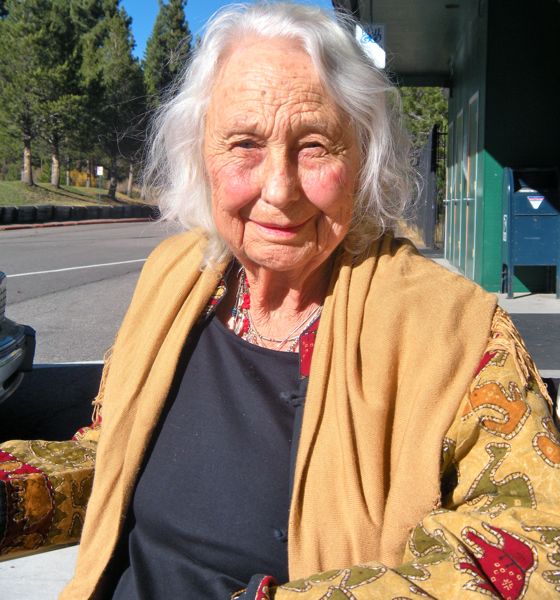
Marjorie Springmeyer is a pioneer of Lake Tahoe who now lives in the Carson Valley full time. Photo/LTN file

Our destinies began to merge soon after we bought that property. We had just sold our home, the first I had ever built, and for the first time in our lives had money in the bank and began to plan on building a home on the meadow. Just two weeks after our escrow closed Margie tracked Francie down at work and told her that the meadow property next to our lot was going to be sold at a court ordered sale. Her two brothers, Knox and Bill, had petitioned the court to sell the property over Margie’s objections. Margie told us if we showed up in court with a check we could buy her brothers’ share of the meadow and share ownership with her. It would take all of our money to do it and meant that building a home would have to wait. We agreed and our friendship became a partnership. I soon after realized that the timing of that event was more than luck.

Over the subsequent years our two families would share many more coincidences. Our daughter, Casey, was born on July 23, Margie’s birthday. Casey was a young child staring out at the meadow when out of the blue she told her mom that a dog had pushed her in to the creek and she had died, but now she was back. She had no way of knowing that Margie’s daughter, Connie, had drowned in the Bijou Creek when she was just 3 years old. Margie became Casey’s godmother.

Margie’s distrust of city hall and government in general inspired me to enter politics. I represented her on the Bijou Community Plan Committee and soon began my foray in local government, all the while using her as a sounding board.

I don’t want this article to be about me, rather my view of a woman who has had a profound influence on my life and was truly one of Tahoe’s pioneers. Her family, the Johnsons, was one of Tahoe’s original landowners. She saw a land unspoiled and beautiful beyond description, but also suffered through much hardship. She was injured in a car accident while in high school, giving her a permanent limp that kept her from the athletic life she so loved. She has also witnessed the loss of her husband, daughter and two sons (Fred and Jon). My sister had also died at 3 years old so I know the effect the loss of a child has on a mother.

Margie lived in a world where women weren’t supposed to be in charge. She stood up for herself to whoever crossed her. She is a survivor and to this day cares about Tahoe’s future. At the conclusion of my last visit, I assured her that I would keep our meadow open and full of the animals we both love. I also asked her if there is anything she hasn’t done or missed. She told me there were two things she hasn’t done. She said that she had never had a glass of beer. When I asked what the second one was she whispered to me with that twinkle I know so well, “I can’t tell you.”