Amateur Radio on Field Day

The Sierra Nevada Amateur Radio Society invites the community to learn about Amateur Radio on Field Day 2012 at Sky Tavern on June 23 from 11am-6pm.

Meet and talk with Reno’s ham radio community, check out their radio equipment, and see what Amateur Radio is all about. A special “Get-On-The-Air” station will be set up so people can try ham radio — including kids.

Reno’s Amateur Radio operators, or “hams,” will join other hams across the country in setting-up radio stations in unusual locations, using only emergency power, and then try to make radio contact with as many of those other hams as they can.

The Sierra Nevada Amateur Radio Society will be operating from the parking lot at Sky Tavern, 21130 Mount Rose Highway, 10 miles up Highway 431 from Highway 395.

For more information, call Jim Deahl at (775) 741.6937, or email field-day@snars.org.


Tahoe Maritime Museum fundraiser

Tahoe Maritime Museum is celebrating the ’20s in Tahoe. On June 30, the Homewood museum becomes the Swinging Summer Night Dinner and Dance place.

Cost of the 5:30-8:30pm event is $65 per person. RSVP to katena@tahoemaritime.org or (530) 525.9253, ext. 103 by June 25.


USFS moves Lake Tahoe logging for woodpecker; still criticized

By Scott Sonner, AP

U.S. Forest Service officials have agreed to move post-Angora Fire logging operations farther away from nests with rare, black-backed woodpecker chicks at the request of conservationists who’ve been fighting the overall project for years.

But John Muir Project members — who have documented one nest in the path of the logging and suspect there are more — say the no-cut buffers the agency is implementing are far too small to protect one of the rarest birds in the Sierra Nevada.

“No credible black-backed woodpecker scientist would say it is enough — not even close,” said Chad Hanson, a wildlife ecologist and executive director of the group who has filed a petition seeking protection of the bird under the U.S. Endangered Species Act.
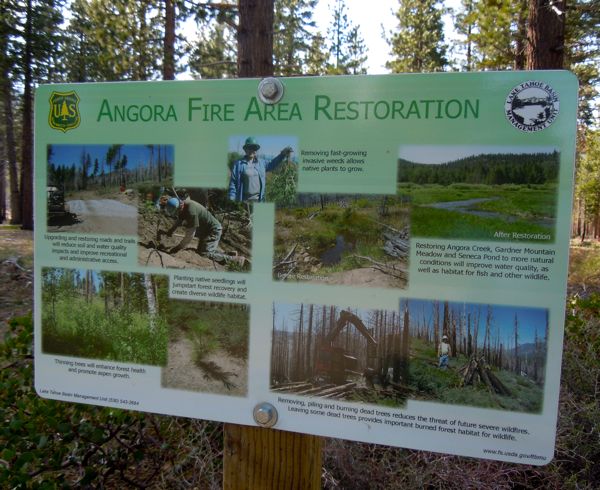
A sign at the end of Seneca Road explains restoration efforts by the U.S. Forest Service in the Angora burn. Photo/LTN

“It will kill them just as surely as logging right up to the nest tree,” he said.

Lawyers for the Forest Service told the group recently its proposed 60-acre buffers around each nest would undermine the 1,400-acre project’s goals of restoring the forest and reducing future catastrophic risks where the Angora Fire destroyed 254 homes in South Lake Tahoe in 2007.

But Deputy Forest Supervisor Jeff Marsolais said Friday the agency and the private logging contractor agreed to move the fuels reduction operations at least 10 acres away from the nesting area until the chicks leave the nest. One acre is a little less than the size of a football field.

“The relocation shows our ongoing commitment to balance ecosystem values and our intent to maintain efficient operations in completing our Angora restoration efforts,” Marsolais said in a statement the agency provided to the Associated Press late Friday.

In addition to no logging within 10 to 12 acres of the identified nest tree, an additional 25 acres of habitat will be preserved within one-quarter mile of the tree, until the chicks “fledge,” USFS spokeswoman Cheva Heck said.

The area includes some of the last of the 156 acres of forest that remains uncut in the overall 1,400-acre project first proposed in early 2009 and under way for more than a year.

A federal judge in Sacramento earlier rejected a request for an injunction to block the logging filed by the John Muir Project and its parent Earth Island Institute.

The 9th U.S. Circuit Court of Appeals currently is considering their appeal claiming the Forest Service’s environmental assessment ignores the agency’s own science suggesting the project will harm the bird without effectively reducing long-term fire threats.

Hanson said the Forest Service’s science consistently shows one pair of black-backed woodpeckers needs 100 to 200 acres of good habitat with a minimum 60-acre core for foraging. He said the latest logging will come so close to the nest tree that the noise alone may cause the adult birds to abandon the nest.

Rachel Fazio, a lawyer for the group who argued its case in the 9th Circuit last month in San Francisco, said it made no sense to rush to log the last remnants of the project area given it was more than 90 percent complete and therefore, based on the agency’s arguments, had already reduced fire threats accordingly.

Fazio said the chicks may “fledge” — or fly for the first time — within about three weeks but would remain dependent on their parents weeks longer and be especially vulnerable to predators.

“It will just be a little island of habitat so that maybe the birds survive for a week or so,” she said.

Hanson said the additional 25 acres of habitat retained within a quarter mile — approximately 400 meters — is too far away for a bird that historically won’t travel more than 150 meters at a time in unsheltered forest for fear of becoming someone else’s dinner.

Hanson said the Forest Service took the same approach — unsuccessfully — with a post-fire logging project in the neighboring Eldorado National Forest, leaving uncut three 40- to 50-acre patches of black-backed woodpecker habitat after the 2004 Freds Fire near Kyburz.

“They tested this exact theory before, and it didn’t work,” he said. “No one has been able to find woodpeckers near any of those patches since then.”

Heck said the agency is leaving intact about 1,168 acres of burned forest for the woodpeckers and other wildlife — approximately 43 percent of the area charred to varying degrees over more than 3,000 acres.

But Fazio said that less than 800 acres of that 1,168 is considered suitable for the black-backed woodpeckers, which are highly dependent on the most intensely burned forest habitat for the beetle larvae they peck from the bark.

Heck said she couldn’t comment directly on that claim because it’s part of the ongoing litigation. She said the district court has denied the group’s request for an injunction blocking the logging “citing the project’s benefits to the public interest.”


Bill would ban incarceration questions on job applications

By David Bienick, KCRA-TV

SACRAMENTO — The California Assembly has approved a bill that would ban cities and counties from asking about criminal history on initial job applications.

The bill, known as AB 1831, passed the Assembly Tuesday by a vote of 41-31.

The bill’s author is Roger Dickinson, a Democrat from Sacramento.

“Employment is the single biggest thing we can do to help people reintegrate into the community,” Dickinson told KCRA 3.

Dickinson noted that his legislation would only apply to city and county governments, not to private employers.

He also said it would only apply to the first step of the application process.

“But if a person then makes it through that initial screening, the city or county can subsequently ask about criminal history,” said Dickinson.

Read the whole story


Series of dinners at Sugar Bowl benefit various nonprofits

Sugar Bowl’s Lake Mary Cabin Dinner Series returns to Donner Summit this summer featuring Chef Alan Davis’ French-inspired California cuisine.

Dining will be offered most Saturday and Sunday evenings from July 22-Sept. 16, with seating offered from 5:30 to 9pm.

In addition, each Sunday evening will showcase a different local nonprofit partner from the Truckee-Tahoe community, with a portion of the evening’s proceeds benefiting that cause.

This summer’s Lake Mary Cabin Dinner Series dates:

July 22 Benefiting Donner Summit Historical Society

July 29 Benefiting Young Life

Aug. 12 Benefiting Truckee Trails Foundation

Aug. 19 Benefiting the Tahoe Institute for Natural Science

Aug 26 Benefiting the Truckee Donner Land Trust

Sept. 2 Benefiting Donner Summit Area Association

Sept. 16 Benefiting the Tahoe Forest Health System Foundation.

Every evening is open to the public, and reservations, strongly recommended by calling (530) 426.7002.


Nevada takes steps toward repealing antiquated state laws

By Sean Whaley, Nevada News Bureau

CARSON CITY – Two years ago it was the metric system. Now it’s communists.

The Legislative Commission this week took the first step toward repealing several antiquated statutes, including a provision of state law dating to the “Red Scare” days of the 1950s directed at the Communist Party.

The statute, NRS 613.360, is titled “Actions permitted against member of Communist Party or related organization.” It says that an unlawful employment practice “does not include any action or measure taken by an employer, labor organization, joint labor-management committee or employment agency with respect to an individual who is a member of the Communist Party of the United States or of any other organization required to register as a Communist-action or Communist-front organization by final order of the Subversive Activities Control Board pursuant to the Subversive Activities Control Act of 1950.”

Scott Young, a research analyst for the Legislative Counsel Bureau, said the section was dependent in part upon the federal statute, the Subversive Activities Control Act, the provisions of which have either been struck down by the U.S. Supreme Court or repealed by Congress. As a result, the state law no longer has any force or effect, he said.

It is also known as the McCarran Act for then-Nevada Sen. Pat McCarran, D-Nev.

“This is essentially a relic from the Cold War when there was concern about activities of the Communist Party and undermining freedoms in the West,” Young said.

The statute was one of five provisions recommended for repeal by the 2013 Legislature based on a state law requiring a biennial review of state statutes to look for outdated and antiquated laws. The recommendations were based on the requirements of the law, NRS 220.085, and do not reflect any advocacy by legislative staff.

Another statute recommended for repeal created the Columbia Basin Interstate Compact Commission in 1951. The compact was never adopted by the states of Washington and Oregon, Young said. There is no likelihood the statute will ever become useful, he said. Nevada was originally included because the Owyhee River is a tributary of the Snake River, which in turn is a tributary of the Columbia, Young said.

The Legislative Commission voted to move forward with the bills needed to repeal the obsolete provisions of state law.

“It’s good to get rid of some obsolete statutes,” said commission Chairman Sen. Steven Horsford, D-Las Vegas.

Two years ago the Legislative Commission agreed to introduce a bill to repeal the statute creating the state’s Advisory Council on the Metric System. The bill was passed in the 2011 legislative session.

The seven-member council was created in 1981 when the federal government was moving forward with a program of getting the states to convert to the metric system. Congress in 1975 passed the Metric Conversion Act to plan for the conversion. That effort was derailed in 1982 when President Ronald Reagan eliminated funding for the conversion effort.


Benefit raises money for Tahoe SAR team

The third annual El Dorado County Search and Rescue Appreciation Day is June 20.

The benefit is at Riva Grill in South Lake Tahoe from 5-9pm.

Proceeds benefit the El Dorado County Volunteer Search and Rescue Tahoe Team.

More information is on the flyer.


Chance to win $1,000 in dining certificate benefits Humane Society

The Humane Society of Truckee-Tahoe has joined forces with area restaurants to create an adventure in dining. For $10 people have the opportunity to win 10 $100 gift certificates to restaurants in the Truckee-Tahoe region.

The winner will receive $100 gift certificates to:

Campo in Reno

Chocolate Bar at Northstar

Graham’s

Jakes on the Lake

Manzanita at the Ritz-Carlton, Lake Tahoe

Mikuni at Northstar

Pianetta

River Grille

Tahoe Mountain Brewing

Wolfdale’s.

The winning ticket will be drawn July 12 at 8pm. A limited number of tickets will be sold. Six tickets cost $50 or they are $10 each.

Call HSTT at (530) 587.5948 to purchase tickets.


Bike ride to impact travel in Lake Tahoe Basin

America’s Most Beautiful Bike Ride participants will be riding clockwise around Lake Tahoe and from Tahoe City to Truckee and back to Tahoe City, starting and finishing at the Horizon Casino Resort at Stateline on June 3.

Traffic will be delayed on northbound Highway 89 from 6:30am to 8:30am at Spring Creek Road. Southbound Highway 89 will remain open. The remaining roadways will be open and motorists are asked to share the roadway and plan a little more time to get to their destinations.

Below are the highways, locations and times that bicyclists will be sharing the roadways on Sunday:

Hwy 50 westbound Stateline – South Lake Tahoe 6-8:30am

Hwy 89 northbound South Y – Camp Rich – Emerald Bay 6-10am

Hwy 89 northbound Emerald Bay Road — closed — 6:30-8:30am

Hwy 89 northbound Emerald Bay – West Shore – Homewood 7-11am

Hwy 89 north/southbound Tahoe City – Truckee – Tahoe City 9am-1:30pm

Hwy 28 eastbound Tahoe City – Kings Beach – Incline Village 8:30am-2:30pm

Hwy 28 southbound Incline Village – Spooner Junction 10am-4pm

Hwy 50 westbound Spooner Junction – Stateline 11am-5pm.


Birds change nesting routines as new species arrive in Tahoe

By Cheryl Millham

Living in Lake Tahoe gives us the opportunity to witness the changing bird habitats and to take part in helping the Steller’s Jays, the most dominant songbird in the Sierra.

A gentleman called, totally confused, so I am going to share his story with you.

He and his wife keep their garage door open for most of the day. Two jays decided to build a nest in their garage. Well, if you have ever witnessed Steller’s Jays building a nest, they make a big mess before any twigs start to adhere together. The couple kept cleaning up the mess. He finally called Lake Tahoe Wildlife Care to talk about his problem with his jays.

He didn’t mind if the birds nested in his garage. However, they close the garage door every night and were afraid the birds wouldn’t be able to feed their babies.

I explained to him that birds sleep at night (with a few exceptions). If they opened the garage door each morning and closed it each night, the birds would be fine.

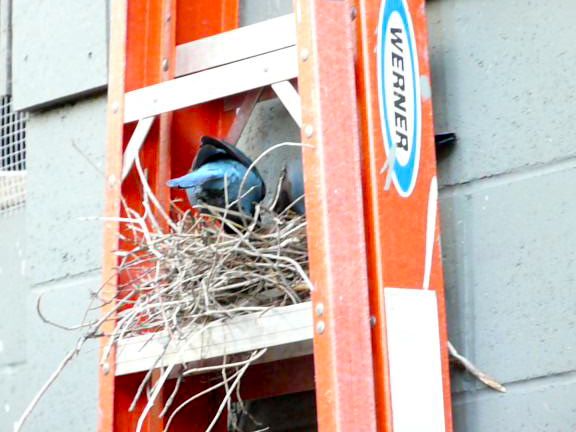
Steller's Jays are changing their nesting habits to guard against ravens. Photo/LTWC

Then I explained to him why the jays were building a nest in his garage.

Twenty years ago there were very few – if no – ravens in Tahoe. But with many years of drought and mild winters, the ravens have moved here.

What do the Ravens eat and feed their babies?

You guessed it — newly hatched baby birds. If they are flying over some trees and see a nest with chicks in it, they would swoop down and grab the just hatched babies, then fly off to feed their own babies.

The gentleman on the phone then told me he witnessed this behavior. He told me there are a lot of ravens by his house and he saw a raven fly down and pull a baby robin right out of the nest, even while the mom was screaming.

But there was nothing she could do.

That is why you will see jays making nests where they have never made nests before. It is no longer unusual to see nests under eaves or in garages to hide their nest from the hungry ravens.

I hope the robins also learn to change their nesting habits.

Be patient with nesting birds. They are just trying to raise their babies safely.

But, remember this, in just 23 days after their eggs have hatched, the (songbird) babies will be too big for ravens to eat and will have left the nest.

Cheryl Millham is executive director of Lake Tahoe Wildlife Care on the outskirts of South Lake Tahoe.