Meyers chiropractor offering free posture screenings

In response to Posture Awareness Month,  Joshua Welch is offering free posture screenings this month at Safe Haven Chiropractic in Meyers.

Included is a free report and exercises to reverse poor posture in young children and adults.

Welch teaches that, “Maintaining correct posture and correct alignment is one of the foundations to healthy living. It can reduce injuries, decrease flare-ups and allow athletes to maintain elite performance.”

The monthlong awareness effort educates professionals and the public about the negative health consequences of bad posture, particularly related to modern technology, and works to highlight resources and health information to correct these issues.

Call 530.577.5433 to schedule an appointment.


Fire consumes condo in Tahoe Keys

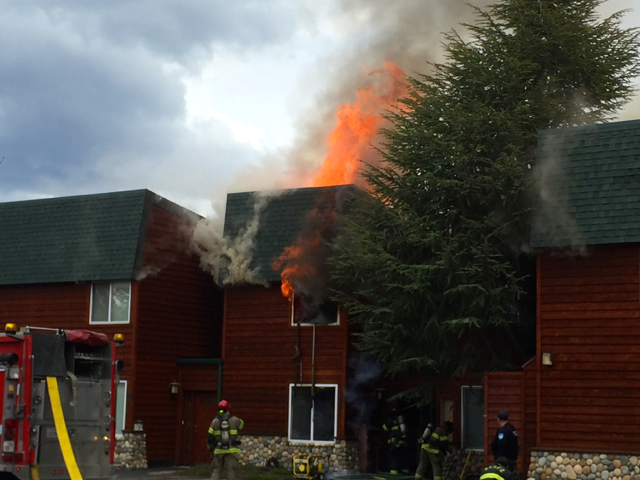
Flames shoot up from a condo in the Tahoe Keys on May 3. Photo/Kathryn Reed

Flames shoot up from a condo in the Tahoe Keys on May 3. Photo/Kathryn Reed

By Kathryn Reed

A fire is raging out of a control at a condo in the Tahoe Keys this afternoon.

Firefighters are working to get a handle on the blaze that erupted about 2pm May 3.

Flames were shooting at least 10 feet into the air from a middle unit on Ala Wai, just down from the four tennis courts. Smoke was coming from the attics of the adjacent condos.

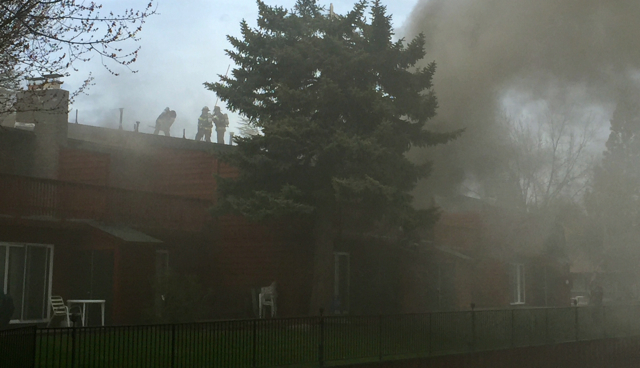
Before the flames shot up firefighters were on the roof with a chain saw to gain access. A second story window blew out and flames were coming through it as well.

John Dean told Lake Tahoe News he was working on the unit to get it ready to be rented. The city inspector had told him the washer and dryer could not block the circuit breakers, so he was moving the appliances and the plumbing to conform to code.

South Lake Tahoe firefighters gain access to the unit via the roof. Photo/Kathryn Reed

South Lake Tahoe firefighters gain access to the unit via the roof. Photo/Kathryn Reed

“With a torch, I took the fitting off,” Dean said. “It hit insulation. I put water on it. When I left there was no indication of flames.”

He was gone for 90 minutes to get a bite to eat and buy some materials.

On Tuesday he was sitting in his vehicle, dejected, wishing he had never left because he said the damage probably wouldn’t be anything like it will end up being.

Fire officials estimate the damage to be more than $3 million on the eight-plex. Initial reports are that six were damaged. The extent is still being assessed.

It was a neighbor three doors down who called 911 when she saw smoke.

She and about a half dozen other people were evacuated, as were some animals.


Barton offers variety of support groups

Barton Health has created three new support groups targeting diverse populations.

  • Perinatal Challenges Support Group

Being a mother is one of the hardest jobs. If you are an expecting or new mom looking for people who understand what you are going through, join this support group. All parents with perinatal mood and anxiety challenges are welcome. The group meets every Wednesday, 5:30-6:30pm, 1077B 4th St., South Lake Tahoe. For more information, contact Bridget Demaree at 530.543.5549 or bdemaree@bartonhealth.org.

  • Tobacco Free Support Group

Share experiences and get support from others on the journey to a tobacco-free lifestyle.  Learn additional strategies and tools to help you through challenges. Starting June 1, meetings will be Wednesdays, 5:30-6:30pm at 1077B 4th St., South Lake Tahoe. Sign up at fit.bartonhealth.org under Addiction Resources.  For more information, call 530.543.5549.

  • Mommy and Me Support Group – Toddler (12-36 months)

This group meets every Thursday, 10am-noon at 1077B 4th St., South Lake Tahoe. Share experiences and discuss the joys and challenges of parenting. Get support from other mothers as well as professional support from a childbirth instructor and guest speakers. Speakers and topics vary. For more information, contact Bridget Demaree at 530.543.5549 or bdemaree@bartonhealth.org.


Tahoe’s threatened meadows get a lifeline

By Benjamin Spillman, Reno Gazette-Journal

They’re some of the best places in the Tahoe basin for wildlife habitat or a picnic.

But if the region’s meadows are going to survive climate change and other threats they’re going to need some human help.

That’s why the U.S. Forest Service selected six meadows for a restoration project set to launch by summer of 2017.

Read the whole story


Lush Nevada could be trouble later on

By Benjamin Spillman, Reno Gazette-Journal

Instagram isn’t having a filter malfunction.

Nevada’s valleys and hillsides really are carpeted in lush, green vegetation.

Science, in the form of satellite data, is showing us that the country’s driest state is much greener than normal thanks to El Nino-fueled storms that dumped rain and snow across the Sierra Nevada and Great Basin all winter.

Read the whole story


Snippets about Lake Tahoe

·       It All Affects the Lake: Stormwater Pollution is the title of a talk on May 18 from noon-1:30
in the Aspen Room at Lake Tahoe Community College in South Lake Tahoe.

·       Nevada Beach Campground on the South Shore is open.

·       The 16 annual Tahoe Truckee Snapshot Day is May 14 from 9am-noon. This annual event takes a picture of a moment in time of the Tahoe-Truckee-Reno watershed. For more info, go online.

·       Incline Village Community Cleanup Day is May 21 from 8am-noon. Volunteers are needed to help spruce up Incline Village and Crystal Bay by picking up litter and debris from along local streets, trails and streams. Meet at the Incline Village Recreation Center (980 Incline Way) for site assignments and tools. Participants of all ages are welcome, however an adult must accompany children under 18. Call 775.832.1284 for more information.

·       Douglas County planning commissioners on May 10 at 1pm will consider a tentative subdivision map for the Tahoe Beach Club to create 48 air space condominiums for the first phase of the residential condominium and beach club development project.


Future of Tahoe’s transportation to be discussed

Is transportation going in the right direction will be the topic of two meetings being hosted by the Tahoe Regional Planning Agency.

Protecting Tahoe’s beauty while accommodating all who enjoy it is a balancing act. Projections show the number of annual visits increasing by up to 20 percent in the next 20 years, according to TRPA. What will the impacts be on air/water quality and transportation?

The agency wants people to share potential solutions for connecting Tahoe’s transportation corridors and improving access for residents and visitors. Input will help shape the update of the TRPA Regional Transportation Plan.

Meetings are:

  • May 17, 5-7pm, North Tahoe Event Center, Kings Beach.
  • May 24, 5-7pm, Lake Tahoe Resort Hotel, South Lake Tahoe.


Threat of fire ignites concern in Tahoe basin

Wildfire Awareness Week runs from May 26 to June 3. Photo/Susan Wood

Wildfire Awareness Week in the basin runs from May 26 to June 3. Photo/Susan Wood

By Susan Wood

The Lake Tahoe Basin Management Unit expects to get the Super Scooper fire-specific aircraft staged here again for good reason – California and Nevada are not out of the woods when it comes to experiencing another bad fire season.

That’s the word from a number of fire agencies that protect the basin and Sierra Nevada Mountain Range every year. Just because Mother Nature provided a better, closer-to-normal winter, the moisture windfall fails to make up for four years of drought.

The shrubs, brush and small trees known in fire circles as ladder fuel to the tall pine trees do not have enough moisture in them to keep from going up in flames from a carelessly-discarded cigarette butt or neglected campfire or lightning.

The other concern is just as devastating. The trees are getting eaten alive by bark beetles. Clumps of trees in groves all around the lake are dead, have snapped limbs and in many cases fallen to the ground. These dead and dying trees are brittle-bone dry, making them susceptible to erupting with any type of combustible.

Then, there’s the double dilemma. The plants and trees are either dry from drought or the rain and snow have created more of them, hence providing additional fuel on the ground.

“We can’t win with nature on that one,” LTBMU acting Fire Management Officer Steve Burns told Lake Tahoe News.

With this multiple threat, the U.S. Forest Service isn’t messing around with beefing up its resources – given the federal agency consumed half its budget last year fighting fires.

The Tahoe arm of the agency plans to be fully staffed with four engines, one hot shots 20-person crew, two 20-person hand crews on call and four prevention officers.

“We’ll be at a maximum efficiency level,” Burns said.

About the only saving grace in Burns’ eyes lies in the water level of the reservoirs in case of fire breaking out.

“It’s hard to predict what the season could bring. It’s warm and dry,” Burns said. “The one thing in California is trees are dying at an unprecedented rate. That has got CalFire and us and other groups looking at that.”
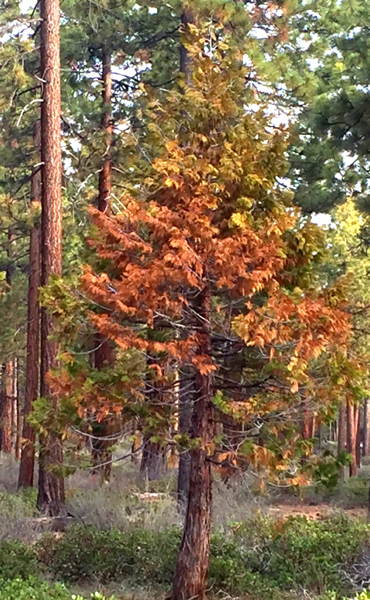
Tree mortality in the basin adds to fire concerns. Photo/Susan Wood

Tree mortality in the basin adds to fire concerns. Photo/Susan Wood

Being smarter

The Forest Service will begin aerial surveys to look at the tree mortality – now standing at a record high of 27.6 million trees. Aerial Survey Program Manager Jeffrey Moore discovered about 10 times more dead trees than previously recorded.

Patricia Maloney, U.C. Davis Department of Plant Pathology and Tahoe Environmental Research Center forest ecologist and conservation biologist, is talking at Sierra Nevada College on May 10 about her studies in tree species disturbances. It’s slated for 6pm.

Even private business has brought assistance. PG&E has awarded $2 million to California Fire Safe Councils to reduce the increased risk given the massive tree mortality.

Historically, wind has sparked the worst fires consuming forest and homes such as the arson-sparked King Fire near Pollock Pines.

“The rain has been great, but no amount will bring back the trees that have died to the drought and bark beetle,” said Brice Bennett, CalFire spokesman for the Amador El Dorado Unit.

Stationed in Cameron Park, Bennett knows all too well what fire can do – especially in high-wind situations.

Last year alone churned out the worst wildfire season in history for the West from Alaska to Lake County.

Tahoe has endured its fair share as well. Take the devastating Angora Fire in 2007, which burned 254 houses.

What worries many fire officials is the threat of more wind with climate change. Most climatologists predict more storms, meaning wind and lightning strikes may become more prevalent.

Fire agency officials insist they need help more than ever before. With that, CalFire has $3 million in grant funding for a variety of fire prevention projects aimed at reducing the elevated threat due to ongoing drought and significant tree mortality.

“This grant funding will help communities prepare for what is likely to be another challenging fire season,” said Chief Ken Pimlott, CalFire director and state forester.

And with that, fire agencies are becoming more organized, more methodical and more scientific than ever before. Some have turned to the study of science. Some have thrown more types of resources into the firefighting mix. Many have turned to each other – hence the formation of the Tahoe Fire and Fuels Team, a collaboration of 17 member agencies sharing notes at monthly meetings in fire season.

There’s even the “Firepit,” a public information team.

It’s a war, and these soldiers with water and retardant are determined to win it.

But many agencies on both sides of the state line are urging homeowners to help.
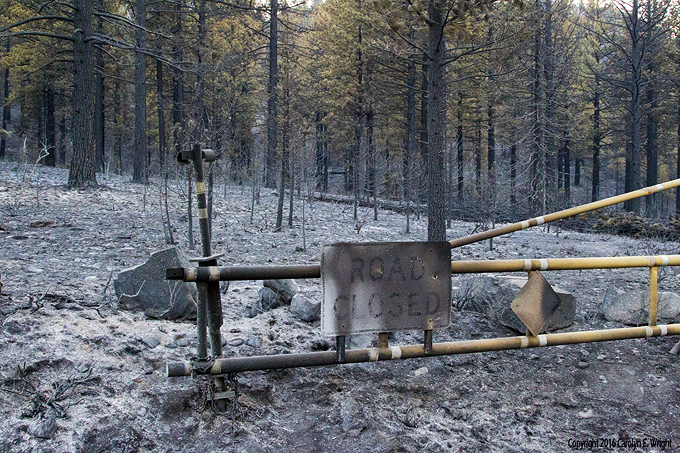
The lightning-induced Washington Fire that threatened Markleeville was the closest fire to the basin in 2015. Photo Copyright 2016 Carolyn E. Wright

The lightning-induced 2015 Washington Fire threatend to burn Markleeville. Photo Copyright 2016 Carolyn E. Wright

Not the time for awareness to smolder

Tahoe Douglas Fire Protection District officials are concerned there’s complacency among homeowners regarding the work necessary to keep their houses and loved ones protected.

For instance, the phones rang off the hook at the district after the Angora Fire to use the chipper to grind up wood debris, thus coaxing residents to clean up their yards. Now the phone barely rings.

It’s advised to provide a 100-foot buffer around structures. In some cases – namely Kingsbury Grade for example, Tahoe Douglas Fire experts expand the defensible space directive to 300 feet.

The cheat grass brought on by ample precipitation is expected to be a prominent threat to Nevada residents because of an ample amount of precipitation. Like manzanita, firefighters consider cheat grass primary fuel for fast-spreading wildfires. It blankets Spooner Summit and Kingsbury Grade.

The sun dries the Grade in the morning and cooks in the afternoon. So the district has been out thinning the area.

“Every day could be dangerous,” Tahoe Douglas Fire Marshal Eric Guevin said while scoping out the fire hazard on the Grade with district Forester John Pickett.

They stood in awe as the sun was setting feet from a house at the end of Bonnie Court at the notion of a major wildfire happening there. There’s a level of respect for the arch enemy, and Pickett talks about it with a lot of energy.

Despite all the work the homeowner did to the property, the topography is a bit of a challenge.

“We have our red flag days, and we’re definitely concerned. We can’t change the topography and the weather, but we can change the conditions,” Guevin told Lake Tahoe News.

“If anything starts at Van Sickle, it will be here in an hour,” Pickett said, motioning with his arm in the path of a chimney leading up to the cul-de-sac. The prevailing winds on a western facing slope are “by far the most dangerous.”

The air draft would pull the fire up like it’s ascending a chimney.

And worse yet, the fire doesn’t have to reach a neighborhood to consume it. The wind often pitches ahead embers that often land on roofs. During the Angora Fire, embers were reported to have landed as far away as Lake Tahoe Community College.
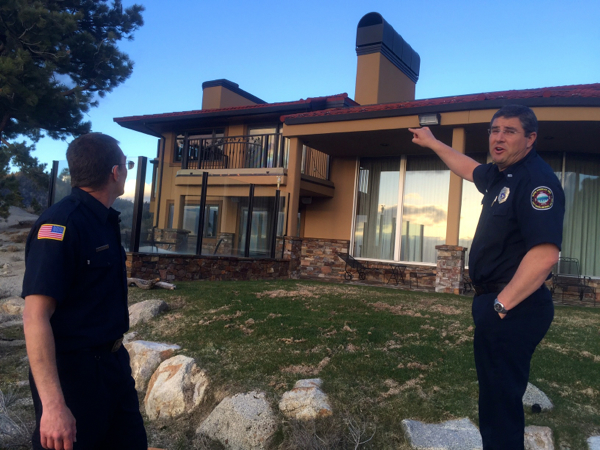
John Pickett and Eric Guevin with Tahoe Douglas Fire point out a home on Kingsbury Grade with good defensible space. Photo/Susan Wood

John Pickett and Eric Guevin with Tahoe Douglas Fire point out a home on Kingsbury Grade with good defensible space. Photo/Susan Wood

It takes a village

Sometimes homeowners can do all they can but have neighbors who are negligent.

“We can defend this house,” Pickett said, while roaming around a home at 100 Granite Crest Drive. The duo even noticed the homeowner had sealed the chimney and commended the resident.

“This is defendable, but in a dangerous neighborhood,” Pickett said.

Farther down, the forester pointed out a house with a shake roof, pine needles everywhere and tree limbs touching the house.

This is why Guevin and Pickett stressed the importance of all in a neighborhood to participate. There are even community work days sponsored by Tahoe Douglas in which clearing brush and limbing trees is done for free.

Guevin reported the district sits at 70 percent compliance in fire prevention and wants to see that number go up.

Pickett commended residents for being diligent about calling at every puff of smoke. Although signs have to be put out telling people not to call during control burns, Pickett welcomes the activism.

“People are doing a great job of being vigilant because the consequences are too high,” he said.

The bark beetle and drought are raising havoc with the trees, and he’s counting on residents to be just as diligent about ridding the beetle infestation if they can.

Homeowners may call pest control to inject the tree if they see color shift in the needles to a yellow-grey, but this is expensive and not always effective. If branches die at mid-crown, that’s also a sign of the bark beetle consuming a tree.

“It’s not if, it’s when, and we have got to be ready for it. That’s our responsibility of living in this great environment,” Guevin said, as if rallying troops before the next fire.
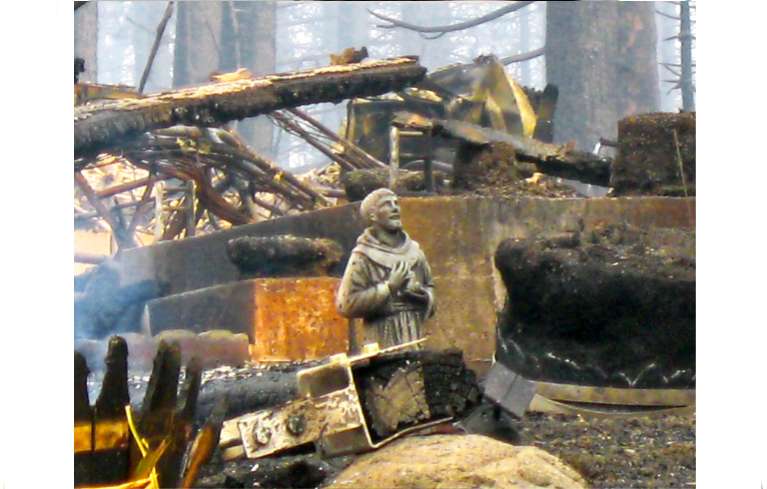
In 2007, 254 houses burned and bout 3,100 acres -- mostly USFS land -- on the South Shore of Lake Tahoe. Photo/Lake Valley Fire

In 2007, 254 houses were destroyed and about 3,100 acres — mostly USFS land — burned on the South Shore of Lake Tahoe. Photo/Lake Valley Fire

Fire knows no boundaries

Lake Valley Fire Protection District has its own areas of concern. Its focus in thinning projects revolves around the Meyers community off Pioneer Trail, with a close inspection of the heavily wooded Apache and Mandan pockets of the neighborhood.

The concern has become so serious the district is considering a new level of enforcement beyond inspections and warnings to negligent violators. But for now, education is a nice way of saying we’re all in this together.

The individual private vacant lots have prompted an extra level of concern given the property owners may be miles away and not present to see the fire threat every day.

“One good winter won’t erase … years of drought,” Martin Goldberg of Lake Valley Fire told Lake Tahoe News.

And the heightened awareness and anxiety isn’t limited to the more  sparsely populated areas – especially since there’s an increase in property owners building out in the forests.

“Some people are building homes in fire prone spots. It changes the way we fight fires, when we’re having to send more resources in to protect these homes,” said Mike Taormina, South Lake Tahoe fire wildland operations coordinator.

A good example would be South Lake Tahoe’s Needle Peak-Saddle Road neighborhood, whose residents watched in horror when a discarded cigarette from a Heavenly gondola car sparked a wildfire and gave chills to city residents in 2002. It roared up the east ridge from what’s now the Van Sickle Bi-State Park. Before it did, though, this reporter witnessed the wind swirl the fire toward the town.

That was as much a reality check as the Angora Fire’s back blaze that hopped over Highway 89.

“It all comes down to having a plan with pro-active thinning. We’re coming to a time when the fire season is getting longer. In Southern California, it’s year round. Obviously, we’re worried about it even though we got precipitation. But we’ve been in a sustained drought. It’s going to take time for the fuels to recover and for the fuels moisture to come back up,” Taormina warned. “Especially where we live, it’s not something to take lightly.”


Opinion: El Dorado County defends its roads

By Creighton Avila

California road funding has been in the news lately with state funding for local roads (i.e. which is a dedicated allocation that funds El Dorado County roads) projected to be cut due to plummeting gasoline tax revenue.

Per the Los Angeles Times: “The last month, the California Transportation Commission said the state would cut transportation funding by $754 million — a 38 percent decrease. Why? Because revenue from the state’s levies on gasoline sales, which provide much of that funding, plummeted as gas prices dropped and more fuel-efficient vehicles proliferated. Those falling prices cut the state’s gas excise tax revenue from 18 cents a gallon two years ago to 12 cents last year, and revenue is expected to sink to 10 cents in July. Every penny in revenue lost per gallon means a $140-million drop in transportation funding.”

Due to the cuts, for the first time in a decade the state has been asking counties to terminate some of the 200-plus projects previously offered funding according to Susan Bransen, chief deputy director of the California Transportation Commission.

El Dorado County has seen its gas tax dollars decrease, and the county will continue to see a decrease according to state projections. For example, in 2014, El Dorado County received $10.1 million and it is projected to receive just $6.5 million in 2017. It is difficult for the county to maintain current roads and plan for future road infrastructure when its state allocated road funds are continuing to decrease and there is no action at the state level to alleviate the problem.

The following are facts about the funding, resources, and assets that maintain the roads that are overseen by the El Dorado County Community Development Agency:

Funding

A large majority of funding for El Dorado County roads comes from state allocated gas tax funds and local Road District Tax funds (a small portion of property taxes).

At times in the past, the Board of Supervisors has allocated discretionary funds to roads. These funds are better known as “General Fund dollars.” General Fund dollars largely go to fund law and justice functions (e.g. Sheriff’s Office, District Attorney’s Office, etc.) while also funding some land use and development functions (e.g. planning and building development), and general government functions (e.g. Assessor’s Office, Veterans Department, Elections, etc.). When the Board of Supervisors has had savings, in the past, it has funded some transportation projects and road maintenance with General Fund dollars; approximately $6.6 million since 2010.

The county has allocated $3.75 million in local tribal funds since 2014 for road work. These funds must be spent within a designated area per an agreement as mitigation funding for impacts associated with the casino.

Staffing

Due to uncertainties in state road funding with the current state budget, the County’s Community Development Agency is holding several road maintenance and operation staff positions open until adequate state funding has been identified.

Quality of county roads and bridges

The Pavement Condition Index, or PCI, is a national measurement standard for the quality of roads. The index is measured from 1 to 100, with 100 being the highest score. Since 2009, El Dorado County’s PCI has increased from 53 to the current 64. Below is a table which compares El Dorado County’s PCI to surrounding California counties from a 2014 report completed by the California State Association of Counties and the League of California Cities:


2014 Pavement Condition Index
County PCI Rating
Alpine  44
 Amador  33
Placer  69
Sacramento  62
El Dorado  63
Median  62

As stated above, the 2016 PCI for El Dorado County is 64. The county continues to find methods to improve its roads, which has helped to increase the PCI. However, continued inaction at the state level could put the county’s road quality in jeopardy.

The county’s average bridge sufficiency rating has improved from 65 in 2012 to 68.3 in 2016. Bridge maintenance and construction funding is generally separate from funding utilized for road maintenance activities.

Accidents in the county, recorded in the Annual Accident Location Study, decreased from 1,271 in 2004 to 919 in 2015.

Examples of major road maintenance projects completed 2011-2015

Surface Treatment (crack seal, grind/pave, chip seal, slurry seal)

  • Ridgeview (2013, 2014), Park Village (2015), Crown Village (2011)  – subdivisions in El Dorado Hills
  • Grizzly Flat Road (2013)
  • Deer Valley Road and Kanaka Valley Road in Rescue (2011)
  • Rattlesnake Bar Road in Pilot Hill (2011)
  • Cold Creek subdivision in South Lake Tahoe (2013)
  • Green Valley Road (2013)
  • Old French Town Road and French Creek Road (2015)

Brushing projects

  • Omo Ranch Road in Mt. Aukum (2013)
  • Snows Road in Camino (2014)
  • Rock Creek Road in Placerville/Swansboro (2012)

Ditching projects 

  • Governor Drive in El Dorado Hills (2013)
  • Fairplay Road in Fair Play (2012)
  • North Canyon Road in Camino (2012)
  • Luneman Road in Lotus (2011)

Culvert replacement projects 

  • Deer Valley Road in Rescue (2015)
  • Cambridge Road in Cameron Park (2014)
  • Pioneer Trail in South Lake Tahoe (2014)
  • Newtown Road in Placerville (2011)

Sign retro reflectivity program throughout the county 2013-2015

  • 7,830 signs out of 15,172 signs have been updated (51.6 percent complete).

Annual Maintenance of Mosquito Bridge (2011-2014); major maintenance (2015)

Curb, gutter and sidewalk repairs in El Dorado Hills (2011-2015)

Road maintenance completed with tribal funding, 2014-2015

Asphalt Overlay – Gold Hill Road
Slurry Seal – Longview Subdivision and Emerald Meadows subdivision
Sign Retro-Reflectivity Program – signs completed throughout the tribal area
Minor and major rehabilitation – in the tribal area

Salida Way
Wilkinson Drive
Estepa Drive
El Tejon Road
Granada Drive
Greenstone Road
Springvale Road
Forni Road
Meder Road
Sunset Lane
Gold Hill Road
Sections of French Creek Road
Sections of Old French Town Road
Sections of South Shingle Road
Mother Lode Drive
Life Way
Longview Subdivision
Emerald Meadows Subdivision
Highland Subdivision
Cameron Woods Subdivision.

Examples of transportation related assets that need to be continually maintained 

  • 1,080 centerline miles of roadway
  • 76 bridges
  • 100+ box culverts
  • 17,000 feet of guardrail
  • 1,600 feet of timber wall
  • 464 miles of double yellow centerline
  • 302 miles of white edge line
  • 14,822 warning, guide, regulatory and informational signs
  • 137.6 miles of raised pavement markers (RPMs)
  • 48 signalized intersections
  • 131 pieces of heavy equipment.

The county is dedicated to continuing to maintain its roads even with continued lowered funds from the state, as shown above with the increased PCI.  The state funding issues are ongoing and one-time state funding will not be a solution to this problem with the reoccurring maintenance needs that are required to maintain roadway infrastructure in the county. The County encourages the state to find a solution to the ongoing road funding issue, so El Dorado County can continue to provide a safe and effective road system for its citizens and visitors. To that end, the Board of Supervisors, through a resolution adopted at the April 5 board meeting, urged the state to provide sustainable funding for local transportation infrastructure.

Creighton Avila works for the El Dorado County Chief Administrative Office.


Global obesity is on the rise

By John Tozzi and Jeremy Scott Diamond, Bloomberg

Humanity is putting on weight. Across the globe, in wealthy countries and developing nations, among children and adults, an increasing number of people are overweight or obese.

Today, nearly 40 percent of the world’s adults fall into one of those categories, according to estimates by a global network of researchers called the NCD Risk Factor Collaboration.

Economic forces are conspiring to cause the great global weight gain. Countries grow wealthier and increase consumption. People move from rural areas to cities, where they have ready access to inexpensive, processed foods. Machines do work that humans once did, decreasing the amount of energy people use.

And global trade means the reach of junk food has never been greater. Up against these trends, no country has figured out how to reverse the rise of obesity.

Read the whole story