Road beat: Tucson Sport, new best in class?
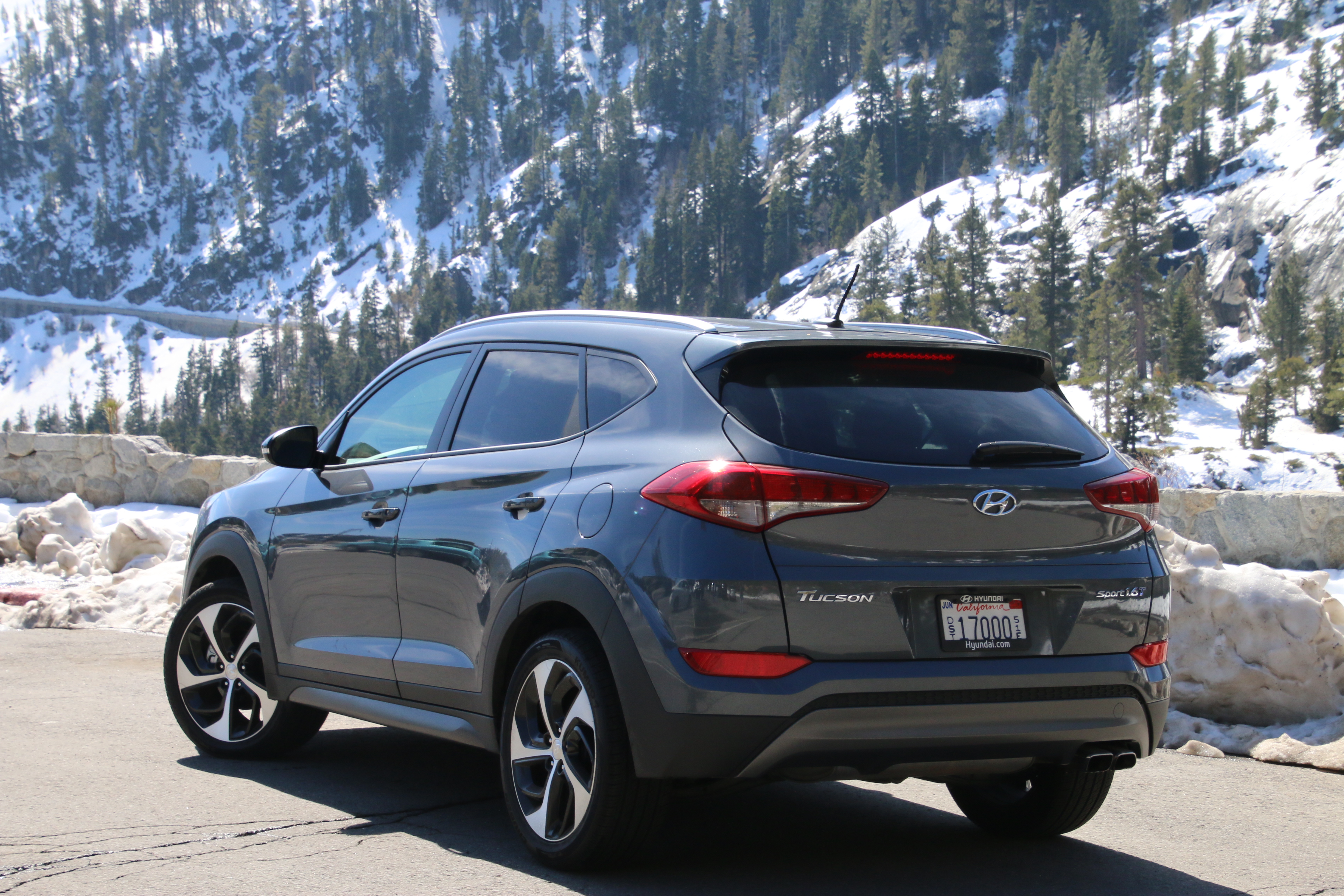
 

Hyundai is giving Mazda competition with its Tucson. Photos/Larry Weitzman

Hyundai is giving Mazda competition with its Tucson. Photos/Larry Weitzman

By Larry Weitzman

Hyundai is on a roll, now making not just good cars, but world-class vehicles that can achieve best in class status as this new Tucson Sport demonstrates in the compact SUV class.
IMG_0334

Specifications Price $27,170 Engine Turbo-direct injected DOHC, 16 valve, 1.6L inline four 175 hp @ 5,500 rpm 195 lb-ft of torque @ 1,500-4,500 rpm Transmission Seven Speed Dual Clutch automated manual Configuration Transverse front engine/FWD/AWD Dimensions Wheelbase 105.1 inches Length 176.2 inches Width 72.8 inches Height 64.8 inches Track (f/r) 63.3/63.8 inches Ground clearance 6.4 inches Fuel capacity 16.4 gallons Weight 3,369-3,580 Steering lock to lock 2.71 turns Turning circle 34.9 feet Wheels 19X7.5 inch alloys Tires 245/45X19 Cargo capacity (rear seats/up/down) 31.0/61.9 cubic feet Tow capacity 1,500 pounds (with trailer brakes) Co-efficient of drag 0.33 Performance 0-60 mph 6.97 seconds 50-70 mph 3.84 seconds 50-70 uphill 5.43 seconds Top speed Plenty fast (well into triple digits) Fuel economy EPA rated 25/30/27 mpg city/highway/combined. Expect 29 mpg in rural country, suburban driving. 34-35 mpg on the highway at legal speeds.

Stealing a bit of styling from its bigger brother, the Santa Fe, the new Tucson has a sleeker shape with edgy, defined character lines, a swept back window line, what’s becoming a Hyundai characteristic, an aggressive snout grille which makes a powerful statement and creates an excellent brand identity. If you study the grille’s design, you can see how other parts of the front end are tied in like the headlights, the lower fog and parking lights all working together to create a complex focal point that says muscle and athleticism. Tucson has a slick co-efficient of drag of a low 0.33.

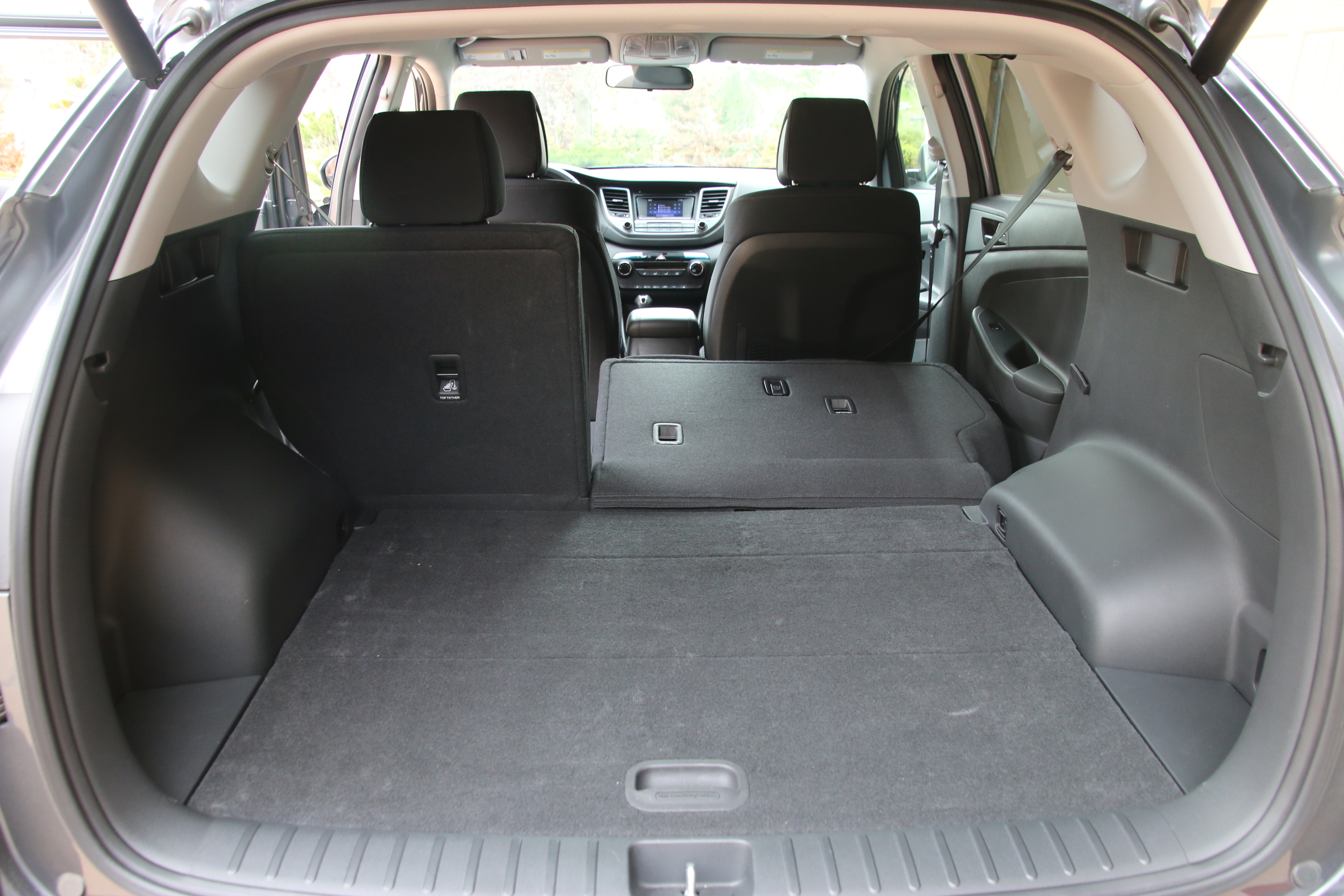
Being a compact SUV, the Tucson is only 176-inches long. But it is wide at 73 inches, which allows for a super wide track of 63.5 inches. That will pay dividends later. Height is deceiving at 65 inches, it looks lower. Ground clearance is good at 6.4 inches. Inside, Tucson is voluminous relative to its diminutive exterior, having a total volume of 133 cubic feet (large cars need to have 120 cubes in the cabin and trunk to meet that EPA class) and 62 cubic feet of cargo capacity with the second row 60/40 split seating folded flat. Upright, the cargo area still holds over 30 cubes.

What motivates the Tucson is a big part of the reason why Tucson is such a tremendous vehicle. It is powered by a diminutive 1.6L DOHC, 16 valve turbo inline four, first used in the Sonata Eco, but as in the Sonata Eco, don’t get the idea it is a performance slouch. As in the Sonata, this engine is a runner and a quick one at that. With a 175 ponies at a low 5,500 rpm and 195 pounds of twist between 1,500 to 4,500 rpm plus its super trick seven speed dual clutch automatic, the Tucson can scoot from Tucson to Phoenix in a nano second.

How quick you ask? How about 0-60 mph in 6.97 seconds. Want more? Passing performance is stellar with a 50-70 mph simulated pass stopping the Chrondek in 3.84 seconds. Up a steep grade it only slows the Tucson a second and a half to 5.43 seconds. That’s a heady bunch of steam from just a 175 hp and a curb weight of 3,500 pounds. But there is a reason for that flat torque curve and the efficient tranny. As you figured by now, this Tucson feels more like 225 hp with an incredibly responsive mid-range. What’s wrong, then? There is a bit of turbo lag, but once on the boost (which takes a couple of tenths) you start thinking about interstellar transportation. It rocks.

Now for the best news, fuel economy. You would think with that high of a performing SUV you would need to buy stock in an oil company. Not quite. EPA rates the Tucson at 25/30/27 mpg city/highway/combined, but during my testing the overall mpg was 29 mpg and at 70 mph on a level highway it returned 35 mpg. In a 175-mile roundtrip run from Placerville to South Lake Tahoe, the Tucson averaged 35.4 mpg. Interestingly, the Tucson Eco with identical specs to the Sport except for tires is EPA rated 1-3 mpg more than the Sport, so maybe it is in the EPA testing procedures as their mileage should be almost the same. My test proves that point. This is an absolutely “no-guilt” SUV that runs like a gazelle and eats like a cat.
The vehicle handles well in a variety of conditions.

The vehicle handles well in a variety of conditions.

As a handler, you never expect much from an SUV. Mazda with its CX-5 showed it could be done and while I can’t tell you which is the better handler unless driven back to back on a track, this new Tucson feels like it would give the CX-5 a serious run for the money. It is that good, maybe even better.  Suspension is state of the art all wheel independent, MacPherson struts up front and a dual control trailing link are in the rear with Sachs dampers in all four corners. Even the bushings have been optimized. Drive Mode allows the driver to select and control some of the dynamics, like steering, tranny and throttle mapping. Steering is very quick at 2.71 turns lock to lock. Then there are the wheels and tires, standard 19X7.5 in alloys shod with serious 245/45X19 rubber. While I have seen better looking wheels, this entire package goes around corners like water in a hose, flat with excellent feedback.

But while the Tucson shows it can dance with the best, maybe better, its ride is superb. You can barely hear the engine on the outside of the Tucson, on the inside the engine at idle is inaudible. You can actually feel the quiet, the sublime, controlled smoothness with not an ounce of float. It’s firm but anything but harsh. Tucson is one of the best riding SUVs considering its handling quality. The engine spins 2,200 at 70 mph and is silent as in wind and road noise.

Brakes are four wheel discs (front ventilated) with all the acronyms and arrested forward progress from 40 mph in 43 feet with a firm, linear pedal. Tucson also has all the electronic wizardry and airbags you would expect to find in any other automakers product. Headlights are excellent in depth and breath. Also standard on this Sport model are a color backup camera, blind spot detection and lane change assist.

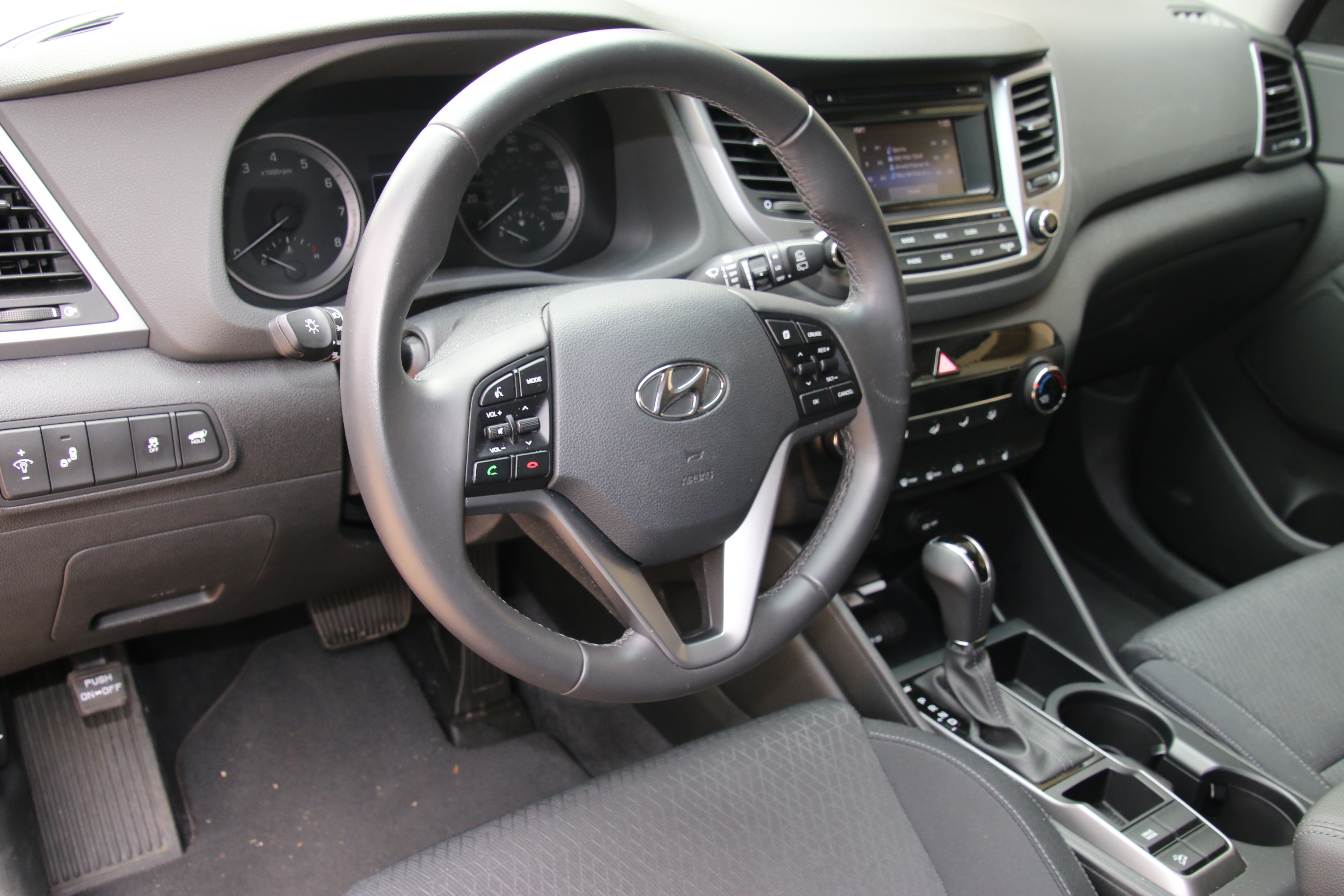
Inside is a well done interior in comfort and design. Seats are done in a subtle dark cloth that will undoubtedly look as good on the first day and the day 100,000 rolls past on the odometer. Even better is how they coddle your back side beautifully. Soft touch material is in most places and the whole package has a luxurious feel without being obvious. The instrument binnacle contains a large speedo and tach flanking an information center which is easy to use as is every device in the Tucson, including the media center and HVAC system in the center stack. Well done Tucson. While the interior is stylish, it is practical and easy to use. Rear seating is roomy for three.

Pricing is shocking, but in a reverse way. My loaded tester, a Tucson Sport, stickered for $26,150. The only add-ons were optional carpeted floor mats, $125, and the mandatory boat ride from Ulsan, Korea, of $895. Everything else was standard, heated power mirrors, pushbutton start, power remote lift gate and even the illuminated exterior door handles. AWD will add $1,400. Even though it has a center color center screen, a GPS is an option. There is no question that the Tucson has everything, including a 10-year/100,000 mile warranty, but a high price. The Tucson is one of the best deals on the market, even if you are looking for a sedan. It’s that good.

Larry Weitzman has been into cars since he was 5 years old. At 8 he could recite from memory the hp of every car made in the U.S. He has put in thousands of laps on racetracks all over the Western United States.


Kings Beach celebrates 10 years of beach music

This year commemorates the 10th annual Music on the Beach concert series at Kings Beach State Recreation Area.

To celebrate, NTBA is planning 10 concerts on Fridays starting June 17 and ending Sept. 2. There will not be concerts on July 1 and Aug. 12.

The free concerts feature a variety of music genres from 6-8:30pm.

2016 Music on the Beach lineup:
June 17 – The Blues Monsters
June 24 – The Wrinkle
July 8 – Coburn Station
July 15 – Sneaky Creatures
July 22 – Abalone Grey
July 29 – Buddy Emmers Blues Band
Aug. 5 – Paul David and the Drivers
Aug. 19 – Miss Lonely Hearts
Aug. 26 – Forget the Roses
Sept. 2 – Achilles Wheel.


Snippets about Lake Tahoe

·      TRYP will host a networking mixer on May 11 from 6-9pm at 968 Park Hotel in South Lake Tahoe. There will also be a mixer May 17 from 5:30-8pm at Bowl Incline. Cost is $10 for non-members, free for members.

·       The deadline to enter California State Fair’s canning and baking competition is June 15. More info is online.

·       Hannah Halvorsen of Truckee has been nominated to the U.S. Cross Country Ski Team’s Development Team for the 2016-17 season.

·       Here is the Sierra roadwork schedule from Caltrans for this week.

·       North Tahoe Regional Advisory Council will be discussing the Martis Valley West project on May 12 at 6pm, Tahoe City Public Utility District board room, 221 Fairway Drive, Tahoe City.


Tahoe Tails — Adoptable Pets in South Lake Tahoe

Walter

Walter

Walter is a 7-month-old with lots of energy who walks nicely on the leash and is house trained.

Some might say he’s a pointer mix, others might point to his similarities with the Vizsla. In any case, he is a nice boy who would fit into just about any home. He is a little shy to start with, but warms up fast if you have a cookie.

Walter is neutered, microchipped, tested for heart worm, and vaccinated. He is at the El Dorado County Animal Services shelter in Meyers, along with many other dogs and cats who are waiting for their new homes. Go to the Tahoe animal shelter’s Facebook page to see photos and descriptions of all pets at the shelter.

Call 530.573.7925 for directions, hours, and other information on adopting a pet.

For spay-neuter assistance for South Tahoe residents, go online.

— Karen Kuentz


Lake Tahoe bicyclist overcomes broken kneecap to compete in Tour of California race

Peter Stetina is eager to compete on his home turf  in the Sierra on May 19. Photo/Provided

Peter Stetina is eager to compete on his home turf in the Sierra Mountains on May 19. Photo/Provided

By Susan Wood

For professional cyclist Peter Stetina, the choice was a no-brainer – his leg or his life.

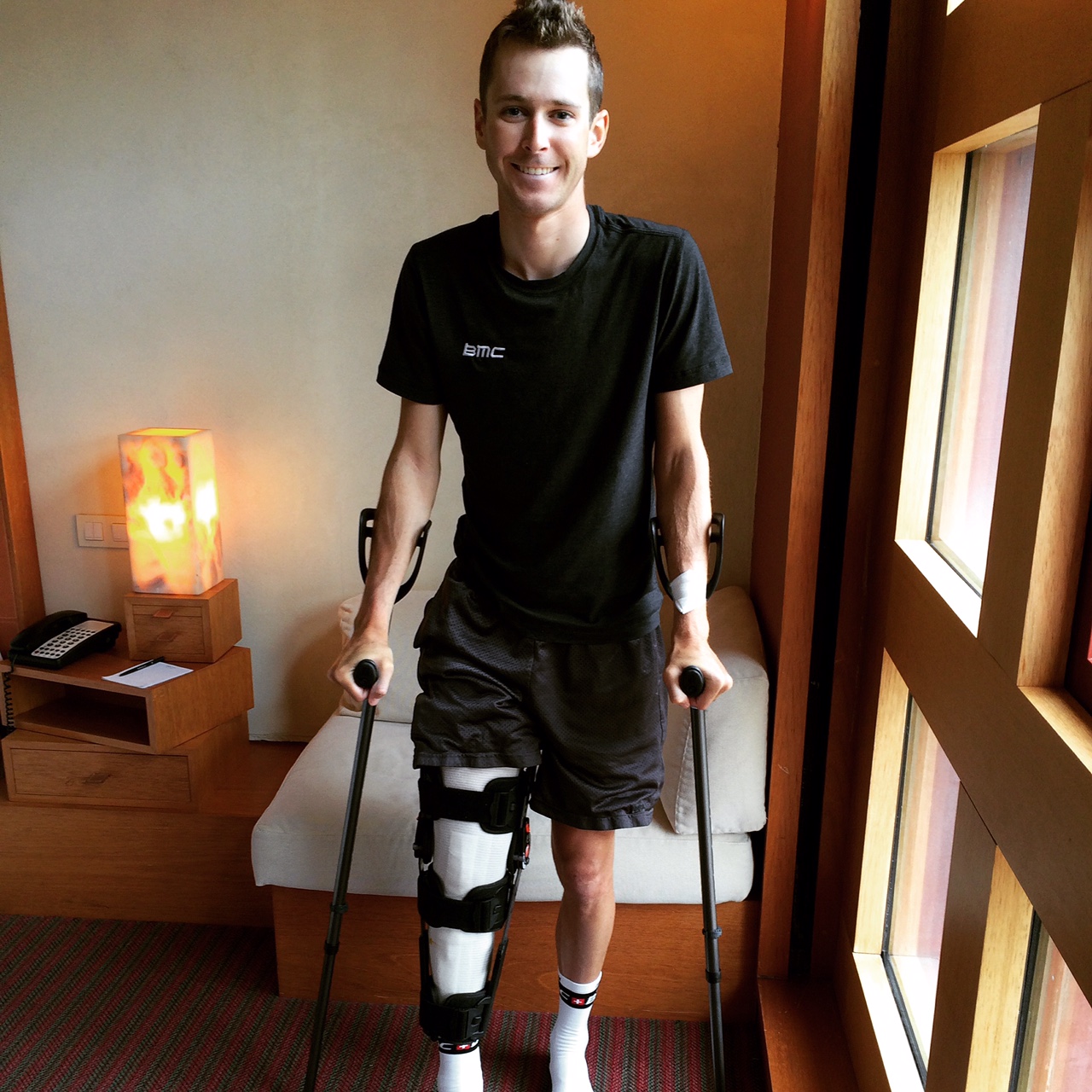
The rider, who is set to compete in South Lake Tahoe for the Amgen Tour of California on May 19, endured a near career-ending crash about a year ago. His rehabilitation is long and inspirational.

The 28-year-old athlete who splits his time between homes in Tahoe City and Santa Rosa remembers that time during the Tour of the Basque Country on April 6, 2015, like it was yesterday.

With only 1 kilometer to go in Stage 1, he came around a corner and hit a metal pole in the road at about 40mph with his right leg taking the full force.

“Anywhere else on my body, and I probably wouldn’t be here today,” he told Lake Tahoe News.

He shattered his kneecap, cracked his tibia, tore his ACL and broke five ribs. He was listed in critical condition in the hospital for 11 days and underwent four surgeries.

Beyond the physical challenges, Stetina was forced to overcome his condition with mind over matter.

“I had a lot of dark days initially in my recovery. I thought ‘whatever becomes of my cycling career, I want my leg use in everyday life’,” he said.

Still, Stetina admits he was hungry to return to the racing circuit after such the setback stalled one of the best cycling years he had had.

“I learned a lot about myself,” he said, referring to his will to survive and thrive.

For three months, he underwent two-hour physical therapy sessions five days a week.

His physical therapist, Dave Townsend, also got an education in Stetina’s will.

“I saw him pretty fresh. For me, I had my doubts about his return because I know the severity of the injury,” Townsend told Lake Tahoe News from his Santa Rosa home.

Stetina’s knee was held together by a multitude of screws. The duo worked on Stetina’s range of motion, and Townsend knew his therapy would hurt.

“He’s one of the toughest people I knew to take that kind of pain,” Townsend said, describing the pain threshold as “off the charts.”

“I had to bend his knee in many directions,” Townsend said.

At the time, the physical therapist knew how difficult it was, especially with the build-up of scar tissue following the surgeries, but admits “it’s the fastest I’ve ever gotten anybody back” to competition.

“It was 100 percent mental will. He was able to get his mind somewhere else. In a lot of ways, that makes him a great cyclist. I feel like he can push his body further now,” Townsend said. “I’d definitely put my money on Peter.”

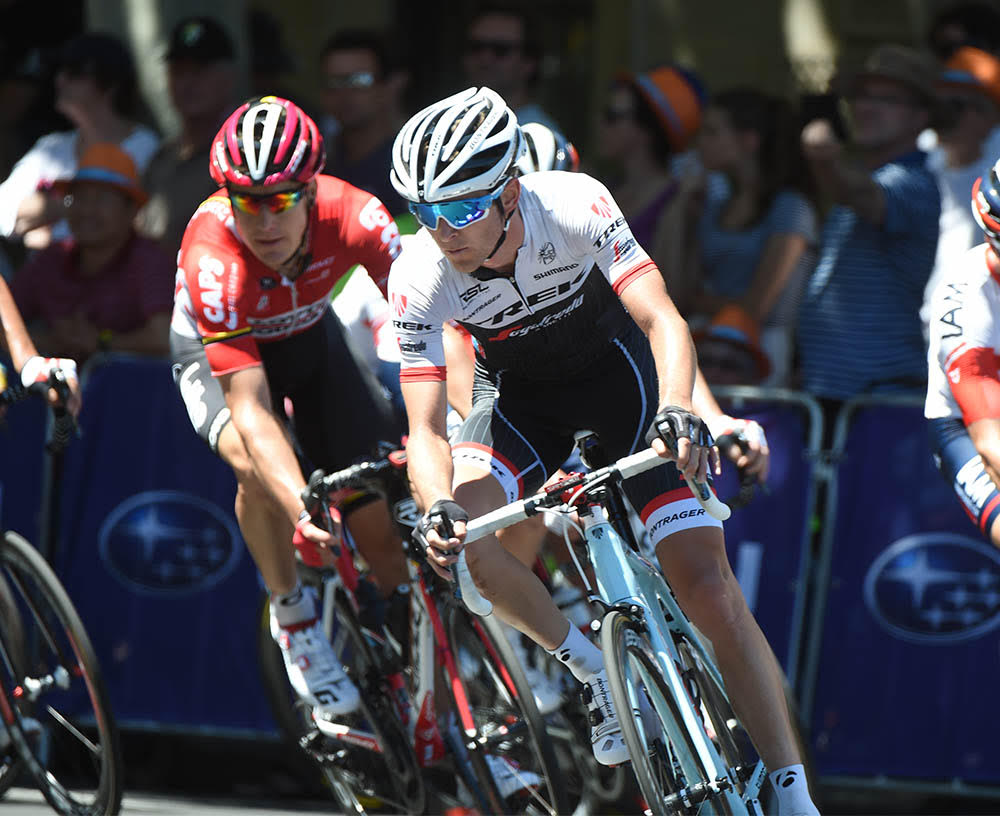
Stetina, who started his cycling career at age 15 and made the pro tour in 2010, will have a chance to prove himself again. When he takes on the Sierra Nevada Mountains this year, it will be like home to the cyclist who considers himself a “mountain goat” climber.

This will be his third Tour of California, the other two in 2010 and 2014. In Tahoe, he gets an altitude boost. He regularly takes his Trek bike out on interval training from the West Shore with climbs on Mount Rose, Black Canyon and Alpine Meadows and enjoys the diversity of the landscape and scenery.

Stetina grew up in the mountains of Colorado, so the terrain here reminds him of his roots. He bought a house in Tahoe City specifically to train.

“Tahoe is my power place – to breathe that thin mountain air is my mojo,” the team Trek-Segafredo rider said.

Stetina is at a place of peace these days despite knowing he’s uncertain about how long his knee will last the grueling nature of bicycle racing. He guessed he probably has at least five years to go.

Then what?

“When I was in my dark days in recovery, I had to think about what’s next,” he said, admitting he’d like to own a restaurant.

“To me, the only thing more competitive than cycling is the food industry, so I’m not so easy on myself,” he joked.

The two industries coincide, and he lives in the right place for the next chapter.

The Wine Country is indeed a foodie’s paradise.

“Sometimes I ride more so I can throw down another sandwich,” he said.

These multi-day rides like Amgen require cyclists to eat the equivalent to a Thanksgiving meal — between 3,500 to 7,000 calories a day to keep up their strength and stamina.

Amgen riders covering 800 miles over eight days will need that fuel more than ever since history will be made in Tahoe for the 11th annual event. Not only are 10 UCI WorldTour teams competing – a record – but the Tahoe leg encapsulating the men’s finish features a peak elevation of 8,600 feet – another record.

Stetina hopes to use the springtime event to go into the Olympic Games in Rio de Janeiro this summer. He expects to find out in late June. The South American course is particularly mountainous, making Stetina keenly interested.

In the meantime, Amgen represents one of the majors for those in the cycling world. The ride showcases California’s diversity of terrain from the Central Valley to the Sierra Nevada Mountain Range. It starts May 15, finishes Stage 5 at Heavenly’s California Base Lodge on May 19 and ends as an event three days later.

The women’s race starts at Heavenly, encircles Lake Tahoe and runs through the South Shore, featuring a climb at Emerald Bay. It ends in the same place nearly a few hours apart.

Last year, the women’s race brought out cycling enthusiasts to the expo and along the route.

Having the men’s and women’s races in tandem ups the ante for enthusiasm.

Rigorous physical therapy allowed Peter Stetina to be cycling competitively again. Photo/Provided

Rigorous physical therapy allowed Peter Stetina to be cycling competitively again. Photo/Provided

Lake Tahoe Visitors Authority Executive Director Carol Chaplin, herself a cyclist, believes the men’s finish this year will add to the attendance potential.

Moreover, being an Olympic year may also boost the energy level among wannabes and spectators.

It’s been an interesting relationship between the Amgen tour and Lake Tahoe weather. A few years ago, the ride was canceled because of snow.

The harsh weather can put the riders at risk of hypothermia and makes braking a challenge – but that’s “the call of the race director.”

The value of having the Tour here is already evident in the buildup to the event.

“It’s huge exposure for our destination. If something (like weather) happens, we got a lot out of it beforehand,” Chaplin said.

True. And if the race goes on as planned, Chaplin’s team is ready for it, having hosted it in prior years.

“If we learned anything, it’s in the actual support of the tour in law enforcement, activities and permitting process,” she said.

Now there’s a database where the event crew knows whom to call for what.

“We’re able to anticipate what needs to be done easier and faster,” she said.

The smoother operations have lent themselves to having more time to review the checklists of things to do.

And if Mother Nature decides to be difficult, the late starts help “even if there’s a squall” in the morning.

Tahoe residents and visitors are a gutsy lot. They stood out in harsh, cold night temperatures wrapped in blankets waiting for the Olympic torch to come down the street in January 2002.

A little threat of an on and off Tahoe winter won’t deter their fun.

For those wanting to see 300 tuned, top athletes compete in this grand, international cycling event, there are ideal viewing spots.

From 10:50am to 2pm, one can witness the women’s race at Al Tahoe Boulevard and Highway 50 and where the major thoroughfare meets Highway 89. Spooner Summit, Lake Parkway and at the intersection of Pioneer Trail and Ski Run Boulevard also round out the list.

Places to see the men race from 3:15 to 3:45pm are mainly in the Meyers area off Highway 89. The race continues down Pioneer Trail to the California Base Lodge.

Officials warn of parking impacts. Restrictions run along Pioneer Trail from Stateline to Black Bart, Tamarack, Blackwood, Spruce, Montreal and Chonokis avenues. Also, Glenwood Way along with Rocky Point, Keller and Saddle roads as well as Al Tahoe and Ski Run boulevards will be affected.

Pure Amgen followers may opt for a VIP experience that ranges from a behind-the-scenes tour to a special car ride with a Tour jersey. Go online for more details.


Opinion: California’s housing crisis deepens

By Dan Walters, Sacramento Bee

Three dry statistical reports issued simultaneously last week reveal the stark dimensions of California’s deepening housing crisis.

Dan Walters

Dan Walters

A Census Bureau report says that in 2015, California saw 98,188 permits for new units, up from 83,657 in 2014.

A deeper data dive reveals that during the 11-year period from 2005 to 2015, local governments issued permits for just under 1 million units, but there were wide variations during the period.

In 2005, at the height of the housing boom, California saw 205,000 housing permits issued, but as the bubble burst activity dropped to as low as 35,000 in 2009 before beginning a slow rise.

Read the whole story


Why a historic highway that united California’s two halves may never reopen to cars

By Charles Fleming, Los Angeles Times

Harrison Scott discovered the Ridge Route in 1955. Then 18, he was out freewheeling in a brand new Ford he’d bought with a loan from his parents.

The sinuous route, an engineering marvel that tamed the San Gabriel Mountains through the highway corridor that is now known as the Grapevine, was already a relic.

Opened in 1915, and credited by historians with uniting the economies of Northern and Southern California, the notoriously slow and dangerous roadway had been superseded in 1933 by Highway 99, itself to be replaced in 1970 by Interstate 5.

Scott liked the abandoned motorway, but did not return to the route until exploring it again in 1991, this time on a road trip with his son. Spurred by the boy’s interest, and retired from a long career with Pacific Telephone, Scott became an amateur historian and began collecting photos and stories of the highway.

He learned it had once been dotted with gas stations, diners, nightclubs and hotels that hosted gangsters and Hollywood stars. Clark Gable, Jean Harlow and Bugsy Siegel visited places such as Kelly’s Halfway Inn — set dead center in the 12-hour automobile journey between Bakersfield and Los Angeles — and Sandberg’s Summit Hotel, which had a sign by the front door that said, “No Dogs or Truck Drivers Allowed.”

Read the whole story


Report: Crime dropped overall in nation’s schools

By Carole Feldman and Jennifer C. Kerr, AP

WASHINGTON — The latest government snapshot of school crime paints a picture of safer schools with declines in violent crime, bullying and harassment because of sexual orientation.

Still, about 3 percent of students ages 12 to 18 said they were victims of crimes at school in 2014. About 1.3 million students were suspended for at least one full school day for alcohol violations, violence or weapons possession.

Middle school students were more likely to be bullied than high school or elementary school students, said the report, released last week by the National Center for Education Statistics and the Justice Department.

On college campuses, the number of sexual attacks more than doubled from 2001 to 2013. “There’s really no way to say whether those increases reflect an increase in actual forcible sex crimes or just that more people are coming forward and reporting them,” said Lauren Musu-Gillette, an author of the report.

Overall, the report showed progress, said Peggy G. Carr, acting NCES commissioner.

“Bullying is down, crime is down, but it’s not enough,” she said. Even before the report was issued, Ken Trump of the National School Safety and Security Services cautioned about reading too much into federal statistics on school crime.

“Federal and state stats underestimate the extent of school crime, public perception tends to overstate it and reality is somewhere in between,” he said in a presentation to the Education Writers Association national conference in Boston.

He said in an interview that there is no mandated crime reporting for elementary, middle or high schools.

However, NCES’ Musu-Gillette said the report was a nationally representative sample of school crime, taken in large part from surveys of students.

The report indicated that schools are taking steps to reduce crime.

About 75 percent used security cameras during the 2013-14 school year and more than 9 in 10 controlled access to their buildings. Schools also required students to wear IDs and mandated dress codes to try to make campuses safe.

“Our nation’s schools should be safe havens for teaching and learning, free of crime and violence,” the report said. “Any instance of crime or violence at school not only affects the individuals involved, but also may disrupt the educational process and affect bystanders, the school itself, and the surrounding community.”

Trump called security cameras a quick fix that leads to a “false sense of security,” and said there has to be a balance between the hardware and the human element of school safety. That includes having counselors and psychologists on hand and training staff to deal with bullying, verbal abuse and other threats.

He said too much focus is on the rare possibility of a shooting, rather than incidents that may occur daily. He asked, for example, whether schools know how to deal with a non-custodial parent trying to pick up a child.

“School administrators are a lot more pro-active about security than they were a decade ago,” he said. He said social media and an overall awareness have made it “harder to hide things that occur in schools.”

The federal Clery Act requires colleges and universities to report and distribute data on campus crimes.

The report said the number of criminal incidents on college campuses declined 8 percent in 2013 from the previous year. The most common type of crime was burglary. There were 23 murders on campus that year.

Despite efforts to improve security, schools still see violence.

The New Jersey Institute of Technology reported Monday that a student was fatally shot during a burglary at a fraternity house. And at the University of Arizona last month a man was shot near a campus building.

In recent years, sexual assaults and the response by colleges and universities have become a focal point of discussions about campus crime.

In a speech last month at the University of Pittsburgh, Vice President Joe Biden urged students to “change the culture” to combat sexual assault.

The Obama administration has an ongoing initiative aimed at reducing the incidence of sexual assault on college campuses.

“This is a character test; you have to pass it and our nation has to pass it,” Biden said.

The crime report said the number of campus sex assaults rose from 2,200 in 2001 to 5,000 in 2013.

A total of 781 hate crimes were reported on college campuses in 2013, most commonly vandalism. Second was intimidation. Many of those hate crimes were related to race or sexual orientation.


Spiritual talk, music at Unity at the Lake

Anton Mizerak and Laura Berryhill will be offering a talk with integrated music titled Music and Mythology: Stories of Transformation at Unity at the Lake on May 15.

Mizerak and Berryhill live in Mount Shasta. Since 2010 they have toured extensively as a duo, performing at more than 450 venues throughout the West.

The 10am talk will be followed at 11:45am with transformational healing music, Celtic song, and chants from around the world.

Unity at the Lake is located at 1195 Rufus Allen Blvd., South Lake Tahoe.

Donations will be accepted.


FDA imposes rules for e-cigs in landmark move

By Sabrina Tavernise, New York Times

WASHINGTON — After years of debate about the health risks of electronic cigarettes, the federal government on Thursday made it final: They need to be regulated and kept out of the hands of children.

The Food and Drug Administration issued sweeping new rules that for the first time extend federal regulatory authority to e-cigarettes, banning their sale to anyone under 18 and requiring that adults under the age of 26 show a photo identification to buy them.

The long-awaited regulations, 499 pages of them, shifted the terms of the public debate over e-cigarettes, putting the federal government’s heft behind a more restrictive approach to the devices. Many health experts fear that e-cigarettes will eventually hook a new generation on traditional cigarettes, while others worry that a tougher approach will make it harder for addicted smokers to get access to devices that may be their best hope of quitting.

Read the whole story