Cycling summit highlights South Shore’s growing prominence in world of mountain biking
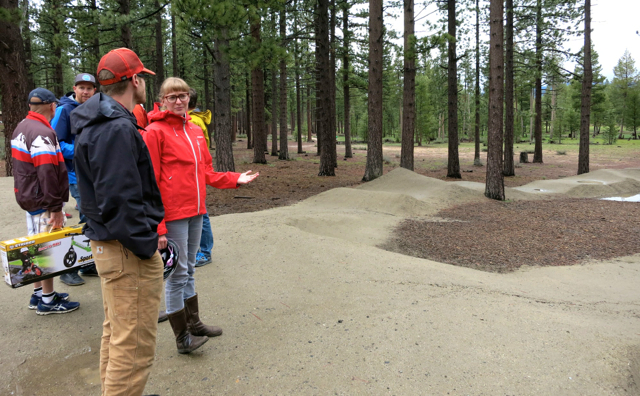
Amy Fish talks about the features of the bike park at Bijou that opened last year. Photo/Jessie Marchesseau

Amy Fish talks about the features of the bike park at Bijou that opened last year. Photo/Jessie Marchesseau

By Jessie Marchesseau

It takes more than a little rain to keep mountain bikers indoors. Riding enthusiasts donned rain jackets and jumped over puddles as they toured the Bijou Bike Park on Saturday afternoon as part of the 2016 Tahoe Trails Summit.

The Tahoe Area Mountain Biking Association in partnership with the U.S. Forest Service Lake Tahoe Basin Management Unit and the Beach Retreat & Lodge at Tahoe hosted the May 6-8 event.

Consisting of trail tech talks, presentations, panel discussions, Q&A sessions, social events and, of course, riding, the summit was designed to bring together a variety of trail users and experts to celebrate the progress made on Tahoe trails in recent years, introduce what’s happening now and open a dialogue about where to go from here.

The weekend’s speaker list was diverse, including South Lake Tahoe’s mayor pro tem Austin Sass; founder of Ibis Bicycles, Scot Nicol; Mammoth Lakes Council member John Wentworth; athlete and adventurer Chris McNamara; Sierra Buttes Trail Stewardship Executive Director Greg Williams; Tahoe Rim Trail Executive Director Morgan Fessler; and representatives from TAMBA, Heavenly and the USFS.

Gary Sjoquist, advocacy director for Quality Bicycle Products, the largest distributor of bike parts in the world, was also one of Saturday’s presenters. He spoke about the potential of Lake Tahoe becoming a true mountain biking destination.

Sjoquist has traveled to biking destinations all over the country. He said he sees a few things in Tahoe that make it truly unique, one being the amazing scenery the location offers pretty much everywhere you look. He said we also have a rare combination of officials who realize the importance of recreation to our local economy, forward-thinking individuals with the USFS and motivated community members who are all willing to work together to make a great trail system happen.

Ben Fish, president of TAMBA, is one of those people. Fish played a major role in organizing the summit, acted as a panelist, a presenter and host of Saturday’s bike park tour.
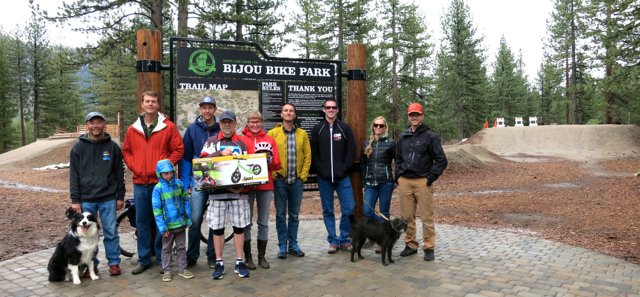
Cycling advocates are ensuring the South Shore is a destination for mountain bikers. Photo/Jessie Marchessea

Cycling advocates are ensuring the South Shore is a destination for mountain bikers. Photo/Jessie Marchessea

As the group walked the track, rain wetting the already muddy ground, Fish showed how the park has multiple lines to accommodate riders with a variety of skill levels and riding styles. The slopestyle track, he explained, the one with the bigger jumps, is by far the most popular. Riders have been known to perform a variety of flips and tricks over the jumps that were intentionally built in full view of Al Tahoe Boulevard.

The smaller pump track appeals more to BMX riders and the younger crowd. Fish’s wife, Amy, said the medium track is her favorite. And there is also talk of building an additional smaller track to accommodate still younger riders on strider bikes, two-wheel bikes kids push with their feet rather than using pedals.

Amy Fish said the bike park has also become a place for riders who were once out building illegal trails and jumps on USFS land to come and play. She is now seeing some of these riders help with maintenance in the bike park as well as TAMBA’s organized trail building events. Keeping these riders interested is one reason they intend to periodically alter and upgrade the bike park tracks.

“If they don’t feel like they can change things and have fun with it, they’ll go back to the woods,” she said.

When it comes to building bike tracks, they have learned some lessons, such as how adding a layer of glue on top of the track actually makes maintenance harder and putting a teeter-totter feature in the middle of a track isn’t such a good idea. These lessons will make the park better in the long run.

More than one attendee pointed out the current lack of connectivity to other bike trails, making it difficult for people to actually ride their bikes to and from the park. Current projects such as the Greenway bike trail should resolve that issue in the near future.

“That’s the dream,” Ben Fish said, “that everyone will be able to ride right from their hotel room or their house, and they can get to the bike park or go on an epic 35-mile ride.”

This summit was part of making that dream a reality.

Jacob Quinn, USFS trails engineer, pointed out the dramatic trail improvements the community has seen since the first trail summit in 2010. He said we are fortunate to have such active groups and productive partnerships when it comes to improving our trails system.

“As a trail community, we’re in a really good place right now,” he said.

Even so, Fish said he sees a new energy and more dynamic partnerships resulting from the weekend’s discourse. This energy could fuel area trail improvements and collaborations for the next five years, and possibly beyond.


Opinion: Understanding depressive disorders

By Betsy Glass

The common stressors of everyday life can result in feelings of sadness. But if a person feels sad more days than not and it causes a difference in social, academic, and occupational functioning, it may be signs of a depressive disorder.

Betsy Glass

Betsy Glass

The day may feel heavy or overwhelming, a person may lose track of time or forget what is important, and things that used to cause joy and pleasure no longer bring happiness. The steps to feel better may seem impossible, but it’s never too late to get support.

Commonly reported signs and symptoms of depressive disorders include:

·         Sadness or hopelessness

·         Agitation or irritability

·         Fatigue or low energy

·         Changes in appetite

·         Changes in sleeping patterns

·         Poor memory or concentration

·         Feelings of worthlessness or low self-esteem

·         Loss of interest or pleasure

·         Thoughts of death or suicide.

The most significant and concerning symptom is thoughts of death or suicide. Suicidal thoughts or intentions are often an individual’s way of coping with or escaping from the unpleasant and unbearable experience of their symptoms. If left unrecognized or untreated, these signs and symptoms can impact the quality of life for individuals and their loved ones.

Everyone has unique experiences with mental health concerns, and may not experience all of the symptoms identified. Developmental stages and age can also affect how someone experiences depression. However, anytime we notice an abrupt or significant change in mental or physical health lasting more than two weeks and interfering with everyday life, it’s important to consider an assessment with a qualified mental health professional and primary care provider.

Feeling better is possible, according Neuroscientist Richard Davidson, as “happiness is a skill that can be learned.” Depressive disorders are manageable through following the recommendations outlined by a qualified mental health professional and primary care provider, which may include psychotherapy, medication management, lifestyle changes, and other alternative methods.

What can you do?  It’s important to:

·         Know the common signs and symptoms of depressive disorders.

·         Demonstrate empathy and compassion toward yourself and others.

·         Encourage yourself, friends and loved ones to seek support, possibly requesting or offering assistance in coordinating or attending appointments.

·         Develop a care plan with your qualified mental health professional and primary care provider, addressing all the dimensions of your wellness.

·         For those most at risk, please seek emergency services when in crisis, either by calling 911 and requesting a welfare check or the National Suicide Prevention Lifeline at 800.273.8255, or by visiting your local emergency room.

The Centers for Disease Control and Prevention suggests that up to one in five Americans will develop a mental health disorder in their lifetime. Locally, the 2015 Community Health Needs Assessment identified mental health disorders as one of the top three most significant concerns.

Become more aware about how mental health conditions affect our loved ones and our community. Throughout the month of May, Barton Health and other community organizations are encouraging members of the public to participate in a 31-Day Mental Health Awareness Challenge. Get details about the challenge online.

Betsy Glass is a licensed clinical social worker at Barton Community Health Center in South Lake Tahoe. On May 12, she and other mental health clinicians will a free mental health talk at Lake Tahoe Community College’s Aspen Room at 6pm.


Lawmaker: TSA should focus on intelligence, not screenings

By Andrew Becker, Reveal

To prevent terrorist attacks against planes, railways and travelers, the Transportation Security Administration needs to focus on intelligence to identify and address threats – and leave screening to private contractors, a lawmaker said.

Rep. John Mica, R-Fla., described the agency as an unmanageable bureaucracy that can barely staff itself. The agency’s intelligence shortcomings are “absolutely scary,” he told Reveal from the Center for Investigative Reporting the day after an explosive House oversight committee hearing in April on TSA misconduct.

“The most important thing is the intelligence and analysis part – the government part: handling classified information, information on terrorists, the ability to track people, to make sure the (terrorist) watch list is up to date, so people are identified even before they get to the airport,” Mica said. “That is how we connect dots.”

TSA Administrator Peter Neffenger should not expend more resources to inspect people at airport checkpoints who don’t pose a risk, Mica said. Rather than managing the screeners themselves, he said, the TSA should supervise the screening process. He blamed a small group of fewer than 20 embedded, highly paid bureaucrats who protect the status quo, their positions and their salaries but don’t get the job done.

“It is a scenario of ‘The Three Stooges’ the way some of the operations operate,” the 12-term congressman said. “It’s not a pretty picture.”

Both a champion of the creation of the TSA nearly 15 years ago and a frequent critic, Mica said he was writing to Neffenger to express his concerns and expects to question him during an upcoming hearing.

It was a tough day for the beleaguered agency, as the TSA faced sharp criticism from three of its senior managers at the hearing. Media coverage highlighted the troubled intelligence office and reports that a top official in Minneapolis was instructed to target Somali Americans for screening as potential terrorists.

Saddled with low morale, high turnover and poor performance, the TSA has seen its checkpoint security lines grow. The agency has refocused on security after covert testing found a 95 percent failure rate to detect fake bombs and other weapons. Mica pointed out that the TSA’s performance has worsened in the last decade, despite an increase in screeners.

Several airports around the nation, including Atlanta, Minneapolis and Seattle, have begun to explore or are considering a shift to private contractors to conduct checkpoint screenings. The long screening lines, expected to get longer during the busy summer travel season, also pose a security risk, experts say.

Neffenger has traveled the country to address aviation industry concerns. He also was in Brussels around the time of the March 22 terrorist attacks that killed 32.

He turned his attention inward, as the agency tried to fend off the criticism. In an email sent to all TSA employees, a copy of which was obtained by Reveal, Neffenger praised the agency, which he said should not be distracted by media reports on long security lines and allegations of misbehavior.

“I am confident that we’re on a sound trajectory, and I’m optimistic about the future,” he wrote.

Whistleblowers have highlighted misconduct among top leaders and allegations of retaliation for drawing attention to various issues, from security gaps to discrimination.

Mica said the managers who testified were “three of the most incredible witnesses we’ve seen testify at TSA ever.”

“The degree of intimidation has gagged everyone,” he said. “I consider them very brave, and their testimony confirmed some of our worst suspicions.”

But the Florida lawmaker also said Congress bears some responsibility for the agency’s shortcomings. Lawmakers who hold the agency’s purse strings haven’t examined it closely enough, Mica said. He said a relatively inexperienced House of Representatives and a general lack of understanding about or interest in aviation security issues also played a part.

“I don’t think Congress does all it should in changing the M.O. (modus operandi) of TSA and DHS,” he said, also referring to the TSA’s parent agency, the Department of Homeland Security. “You can’t just blame the agencies. You have to put some of the blame on us. We will raise some Cain, but it is up to Neffenger to change.”


Tannins are the backbone of wine

By Bill St. John, Santa Rosa Press Democrat

Michael Twelftree, the proprietor and managing director of Two Hands Wines in Australia’s Barossa Valley, describes the experience of tasting a red wine this way: “The fruit is the engine and rail cars; the acidity is the rails; and the tannins are the brakes.”

When we sip many a red wine, its tannins draw the taste to a close with an astringent, palate-puckering sensation. It’s as if our tongue were sandpapered.

“Tannins don’t have flavor,” says Joel Aiken, winemaker for Amici Cellars in Calistoga and Aiken Wines in St. Helena. “They’re tactile.”

Tannins are phenols. In wine they come from the skins, seeds and stems of the grapes. That’s why they are more prevalent in red wines than whites; red wines receive their color from their grapes’ skins during fermentation.

Read the whole story


Blood drive to replenish dropping supplies

United Blood Services is having a blood drive May 18 at Tahoe Douglas Fire Station 23.

Donations have declined since mid-March and the demand has escalated, dropping the available supply of type O-Negative and type O-positive to extremely low levels. Blood center officials have concluded that an increase in Zika deferrals after spring break travels has caused a decline in donations.

Donors with type O (positive or negative) who are currently eligible are being urgently asked to donate at their nearest center, or blood drive; or to donate as soon as they become eligible. Those with other blood types are asked to keep to their routine schedule of donating three times per year, in order to maintain an ample and steady supply.

The blood drive at the Elks Point fire station will be from noon-5:30pm. Donors are asked to make an appointment by contacting Kate or Casey at 775.588.3591. Walk-ins are welcome.


Nev. reluctantly kills bighorn sheep to save them

By Scott Sonner, AP

Nevada state wildlife veterinarian Peregrine Wolff worked at zoos in the Midwest, with farm animals in Florida and exotic species on movie sets in Hollywood. She never dreamed she’d have to help pull the trigger on a contentious strategy to slaughter a diseased herd of bighorn sheep.

Ed Partee, a state game biologist who’s spent much of his 24-year career rebuilding bighorn populations, drew the grim task of tracking and gathering the carcasses of the 27 sheep. The animals were gunned down from a helicopter in February in an emergency attempt to save a neighboring herd.

“Having to kill an animal like that is probably one of the worst feelings I’ve ever had in this job,” said Partee, a native Nevadan who grew up fishing and hunting and knew by the time he was in junior high that he wanted to be a wildlife scientist.

Now, they wait to see if their gamble paid off in a race against the spread of pneumonia that’s also hit bighorns in Washington, Wyoming, Utah, Idaho, Montana and Utah, and threatens efforts to rebuild native populations that were on the brink of extinction a half century ago.

About 2 million bighorn sheep roamed North America before numbers started declining in the late 1800s to about one-tenth of that today due primarily to overhunting, habitat loss and disease — often transmitted by domestic animals.

“It’s been a concern since the Old World European settlers started bringing their domestic sheep with them across the West,” said Wolff, president of the American Association of Wildlife Veterinarians.

She suspects Desert bighorns in northwest Nevada contracted the biological agents that spread the pneumonia from domestic sheep or goats, as has been the case elsewhere. That’s been a point of contention in Montana and Idaho, where ranchers and conservationists have been fighting for decades over management of domestic sheep that biologists blame for transmitting the disease.

Livestock producers suffered a setback in March when the 9th U.S. Circuit Court of Appeals upheld a 2010 U.S. Forest Service decision to protect bighorns in Idaho’s Payette National Forest by closing 70 percent of the domestic grazing allotments.

The Idaho Wool Growers Association had argued that the service failed to consult the Department of Agriculture’s research service before it pushed 10,000 sheep out of the area, running many ranchers out of business.

It’s a “heated topic that has vast socio-economic and ecological impacts in the western United States,” said Maggie Highland, a USDA animal disease researcher at Washington State University.

She’s among those who question the science and wonder whether Nevada acted prematurely, “without really understanding all of the factors that caused the first outbreak.”

“I’d also question how we know for certain that none of the members of the affected herd hadn’t already intermingled with the herd that they were reportedly trying to protect,” Highland wrote in an email to AP.

Skeptics include Mark Thurmond, professor emeritus of veterinary epidemiology at the University of California-Davis.

“What they are doing is illogical — to say we found these agents therefore we’ve got to eradicate this entire herd,” Thurmond said. He says disease transmittal involves a complex combination of multiple agents and outside impacts, ranging from drought and wildfires, to extreme cold and snow.

“If the herd is doing well otherwise, why destroy the gene pool that has been able to handle these agents?” he told AP.

But by all accounts, the Nevada herd was not doing well.

State officials knew if they didn’t act fast, the sheep would disperse as the snowpack melted. Partee said they were lucky to get an early warning of trouble in December because they’d just fitted several sheep with radio-signal collars in a partnership with Oregon to monitor movement across state lines.

“You could tell right away there was something not right because of the fact they weren’t moving,” Partee said. “Within weeks we started realizing we were at the start of a devastating disease event.”

Necropsies confirmed the dead animals had pneumonia. Others were in such bad shape that Wolff was “surprised they were still alive.”

“In January, we started talking about the fact that if we lost this herd, it would be tragic, but if it spread to the neighboring herd to the south, we’d lose both of those,” Wolff said.

By the time the decision was made to kill the herd, fewer than a third of the 100 animals remained and those were so weak that they barely attempted to flee when the helicopter approached.

The move wasn’t without precedence. British Columbia killed a herd in hope of saving others in 2000. Utah officials killed 25 in 2010, and Washington 63 in 2013.

Wolff consulted experts, including those in British Columbia, before conceding that killing the herd was the only hope to keep the disease from spreading in the state with the most bighorns in the Lower 48. Nevada is the only state with all three North American species — Desert, California and Rocky Mountain.

Early indications are the kill may have kept the disease from reaching the neighboring herd.

Wolff stands by the decision.

“I take exception to anyone in the domestic sheep industry looking over my shoulder and telling the Nevada Department of Wildlife how to manage,” she said. “I totally understand the politics. But to deny the science because of the politics is sort of short-sighted to me.”


Letter: USFS crew volunteers at Bread & Broth

To the community,

Thanks to the U.S. Forest Service employees at the Lake Tahoe Basin Management Unit, the Bread & Broth diners on May 2 enjoyed a festive Mexican dinner at St. Theresa Church’s Grace Hall.

With funds from the Forest Service employee association’s Wellness, Recreation and Morale fund, the B&B cooks prepared beef tacos, Mexican black beans and Spanish rice to celebrate the upcoming Cino de Mayo holiday.

Representing the U.S. Forest Service employees at their Adopt A Day of Nourishment dinner were Barbara Drake, acting deputy forest supervisor; Robert Guebard, timber management officer; and civil engineers Barbara Shanley, Jordan Burge and Anjanette Hoefer.

“What a rewarding experience,” remarked Drake. “Thank you for having us. We enjoyed assisting B&B in your support of the community and we look forward to being a part of this event in the future.”

Partnering with the U.S. Forest Service employees that work so hard caring for our forestlands is a real treat for the B&B volunteers. These sponsor volunteers came in ready to help and enthusiastically packed food giveaway bags, cheerfully served the diners and cleaned and stacked tables and chairs after the dinner. Thanks to the Forest Service members for their loving care of our forests and their concern for our community members.

Carol Gerard, Bread & Broth


Tahoe man helps college team at eco-marathon

Mickey George of Stateline put his scientific skill to work during the Shell Eco-marathon in Detroit, a three-day event where a car’s performance is based on energy efficiency, not speed.

George served as his college team’s manufacturing lead. Achieving 1,215 mpg, Cal Poly, San Luis Obispo’s gasoline-fueled prototype vehicle was the top-scoring American entry and placed third overall at the 10th annual competition.

The event drew more than 1,000 students and a record 124 teams from seven countries to see which ultra-energy-efficient vehicle would travel the farthest using the least energy. First and second place were claimed by Canadian teams, the Université of Laval in Quebec and the University of Toronto.

Teams entered one of two vehicle categories. The Prototype class, which is for futuristic, streamlined vehicles, such as Cal Poly’s entry, and the UrbanConcept class, which focuses on fuel-efficient vehicles aimed at meeting the real-life needs of drivers. On the track, the cars were driven 10 laps, for a total distance of six miles, at an average speed of 15 miles per hour.

Cal Poly Supermileage team members credit their use of telemetry, a technology used to transmit data in real time, for much of their success this year.

Members of the Cal Poly Supermileage team also included Dorian Capps, mechanical engineering senior, president and powertrain lead; Sean Michel, mechanical engineering senior, treasurer; Chad Bickel, electrical engineering graduate student and testing lead; Eli Rogers, mechanical engineering graduate student and chassis lead; Lucas Rybarcyzk, mechanical engineering junior and steering lead; Kevin Bickers, aerospace engineering senior and aero lead; and drivers Laura Kawashiri and Zoe Tuggle, both mechanical engineering majors. Faculty advisors for the team are Joseph Mello, professor of mechanical engineering, and Art MacCarley, professor of electrical engineering and in bioresources and agricultural engineering.


Driver dies in 2-vehicle accident in Truckee

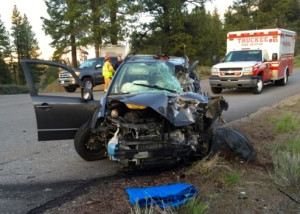
One person died and another was seriously injured May 8 in Truckee. Photo/Provided

One person died and another was seriously injured May 8 in Truckee. Photo/Provided

An Arizona man died Sunday night in a two-vehicle accident in Truckee.

Patrick Wayne Smiley, 36, of Chandler, Ariz., was going east on Glenshire Drive near Old Highway 40 when his Suzuki drifted across the centerline and struck a 26-foot truck, according to Truckee officers.

“Based on the initial information gathered, excessive speed appears to have played a role in the collision. It is unknown at this time if intoxicants were involved but that will be investigated further,” Sgt. Russ Walsh said in a statement.

Smiley was pronounced dead at the scene. Amber Harder, 30, of Truckee was a passenger in the vehicle. She sustained major injuries and was airlifted to Renown Medical Center in Reno after the 7:21pm May 8 collision.

The two occupants of the box truck were not injured.

The cause of the accident is under investigation.

— Lake Tahoe News staff report


Growing sport: Bikepacking the backcountry

By Brad Branan, Sacramento Bee

I was having a perfectly good time backpacking the Tahoe Rim Trail last year, when I became unnerved by all the people passing me on mountain bikes. The reason for my frustration: They were clearly having more fun than I was.

So I did what any self-respecting outdoor enthusiast would. I bought a full-suspension Marin mountain bike the next week.

My interest in backpacking didn’t wane, though, with the purchase of the bike. I began to see mountain biking as an extension of the same love for exploration driving my backpacking. So I asked myself: How could I take overnight trips into remote areas like I did backpacking, except on my mountain bike?

Enter bikepacking.

Read the whole story