El Dorado water district ends drought restrictions

By Tom Miller, KCRA-TV

El Dorado County’s largest irrigation district is telling its customers the effects of the drought have subsided so much that they can stop conserving water.

The El Dorado Irrigation District, which has approximately 40,000 customers, voted to rescind all water restrictions Monday.

“Now that the drought stage has been rescinded, currently our customers no longer need to conserve,” district spokesman Jesse Saich said.

Read the whole story


BLM stops Nevada mustang fertility project

By Scott Sonner, AP

The Bureau of Land Management has pulled the plug on a public-private partnership in Nevada aimed at shrinking the size of a wild horse herd southeast of Carson City through the use of contraceptives.

Unlike most mustang conflicts pitting protection groups against ranchers, the dispute in Nevada’s Pine Nut mountains is fueled largely by a division among horse advocates themselves over the use of fertility drugs on the range.

BLM approved a pilot project in 2014 working with the American Wild Horse Preservation Campaign and a neighborhood group to treat a herd that a federal judge has forbid the agency from gathering.

But an internal email obtained by the Associated Press shows BLM suspended the project Monday after leaders of Friends of Animals threatened to sue. That group says the drug harms horses and violates the judge’s order.


Warming-fueled wildfires are increasing

By Seth Borenstein, AP

Alberta’s unusually early and large fire is just the latest of many gargantuan fires on an Earth that’s grown hotter with more extreme weather.

Earlier this year, large wildfires hit spots on opposite ends of the world — Tasmania and Oklahoma-Kansas. Last year, Alaska and California pushed the U.S. to a record 10 million acres burned. Massive fires hit Siberia, Mongolia and China last year and Brazil’s fire season has increased by a month over the past three decades.

It got so bad that in 2009, Australia added a bright red “catastrophic” to its fire warning index.

“The warmer it is, the more fires we get,” said Mike Flannigan, a professor of wildland fire at the University of Alberta.

Last week, temperatures pushed past 90 degrees Fahrenheit in Alberta, which is unusual for May in northern Canada.

It’s not quite so simple though. Many factors contribute to the complex increase in big fires, Flannigan and several experts said. They include climate change, the way people use land and firefighting methods that leave more fuel — trees and brush — to burn.

But the temperature one stands out, Flannigan said.

“The Alberta wildfires are an excellent example of what we’re seeing more and more of: warming means snow melts earlier, soils and vegetation dries out earlier, and the fire season starts earlier. It’s a train wreck,” University of Arizona climate scientist Jonathan Overpeck wrote in an email.

Worldwide, the length of Earth’s fire season increased nearly 19 percent from 1979 to 2013, according to a study by Mark Cochrane, a professor of fire ecology at South Dakota State University.

Fires had steadily been increasing, but then in the late 1990s and early 2000s, “we’ve suddenly been hit with lots of these large fires we can’t control,” Cochrane said.

In terms of acreage burned, the worldwide total may be dropping because of better firefighting, but in North America and Siberia “fires have grown quite a bit due to warming,” Columbia University climate and ecology scientist Park Williams wrote in an email. “My estimate is that global warming has been responsible for about half of this increase.”

For the entire U.S., the 10-year average number of acres burned in wildfires has more than doubled from about 3 million acres in the mid-1980s to 7 million acres now, according to an analysis of government data by the Associated Press.

Twelve years before the Fort McMurray fire set northern Alberta ablaze, a study by Flannigan and University of Victoria climate scientist Andrew Weaver found that “human-induced climate change has had a detectable influence” on a dramatic increase in wildfires in Canada. Flannigan said the area burned in Canada has doubled since the 1970s “and we think that’s due to climate change.”

“Globally we are seeing more fires, bigger fires, more severe fires,” said Kevin Ryan, a retired U.S. Forest Service scientist who is now a fire consultant, with a recent stint in Indonesia, where fires were big last year.

Fires in some places, such as Indonesia and Canada, are bad when there’s an El Nino — a warming of parts of the Pacific that changes weather worldwide — because it triggers drought in those regions, Ryan said. In Indonesia, changes in land use are a bigger factor than climate, Ryan said.

But elsewhere, it’s temperature and moisture, too much of one and not enough of the other, scientists said. As the air warms, it gets “more efficient at sucking the moisture out of the fuels” which makes them more prone to burn, Flannigan said. Then add in lightning. A study found that lightning increases 12 percent with every degree Celsius and that can trigger more fires. Flannigan said there’s evidence of fire-triggered clouds in Alberta causing at least two more fires because of lightning.

The U.S. National Academy of Sciences earlier this year in a study determined that “climate warming has resulted in longer fire seasons.” But other factors, such as the way fires are fought and land use, make it difficult to scientifically attribute individual fires and regional fires to climate change, the report and other scientists said.

“This is absolutely a harbinger of things to come,” said Canadian climate scientist Weaver, now a Green party legislator in the British Columbia parliament.


North Lake Tahoe hands out slew of awards

North Lake Tahoe honored local leaders and businesses during the 62nd annual Community Awards Dinner at the Resort at Squaw Creek.

Numerous awards were bestowed to community members who have excelled in multiple areas throughout 2015. Awards included the hospitality award, ambassador of the year, distinguished community service, regional marketing award, and more.


The winners included

Best place to work — Auerbach Engineering

Citizen of the year — Patti Boxeth

Public servant of the year — Mike Brown

Best new business — Moe’s Original BBQ

Nonprofit organization –Tahoe Nordic Search & Rescue

Business of the year — Bridgetender

Regional marketing award — Resort at Squaw Creek

Hospitality award — Trunk Show

Distinguished community service award — Kay Williams

Ambassador of the year — Ambera Dodson.


Construction on LTWC center to resume in summer

Work on Lake Tahoe Wildlife Care‘s rehab center on Al Tahoe Boulevard in South Lake Tahoe is expected to resume in mid-July.

At that time the underground work — sewer, water, gas, electric, video — will be completed.

Work on the foundations should resume about the same time.

“We expect to have all underground work and all foundations completed by summer’s end,” Tom Millham, co-founder of the facility, told Lake Tahoe News. “Funding will determine if we can expand further with framing of cages/buildings.”

LTWC cares for sick and/or injured wildlife, with the goal of returning the animals to their natural environment. The new rehab facility will include multiple cages on 27-acres, with the end goal of having an education center that is open to the public.

— Lake Tahoe News staff report


Pete MacRoberts — 1937-2016

Pete MacRoberts

Pete MacRoberts

Longtime South Lake Tahoe hotelier Peter Belyea MacRoberts died April 22, 2016, in Fresno. He was 78.

He was born in Cambridge, Mass., on July 12, 1937.

In his growing years, Pete achieved the rank of Eagle Scout. He was an officer in the Navy in the 1950s. After completing his service to the Navy, Pete attended Cornell University and graduated in 1959.

Many will know him from his work in hotel management. Pete and his wife, Patricia, lived in San Diego for 25 years before they moved to South Lake Tahoe, where they lived for 20 years.

In 2014 they moved to Dunlap, retiring to live on a horse ranch.

Pete is survived by his wife, Patricia; brothers David, Paul and Stuart; sons Patrick, Brandon and Shawn Brooks; grandchildren Victoria, Brandon, Aaleah and Vanessa.

Pete’s service was May 7 at the Dunlop Baptist Church. In lieu of flowers, the family requests donations be given to Dunlap Baptist Church, P.O. Box 578, Dunlap, CA 93621.


Douglas County woman to vie for Miss America

A Douglas County woman was crowned Miss Nevada last week.

Bailey Gumm, a 2013 Douglas High School graduate, became the third county resident to have the statewide title.

Gumm will compete in the Miss America Pageant in Atlantic City on Sept. 11.

Gumm started her ascension in the beauty pageant world by becoming Miss Douglas County’s Outstanding Teen in 2010, then Miss Nevada’s Outstanding Teen in 2011, and Miss Douglas County 2013.

Her sister is following close behind. Carli Gumm, a sophomore at Douglas High, was first runner-up in the teen division at the state competition this year.

— Lake Tahoe News staff report


Squaw-Alpine gondola project raises questions

By Kathryn Reed

OLYMPIC VALLEY – Planners and landowners must balance recreation, economic development and protection of natural resources as they consider whether to allow the proposed gondola that would link Squaw Valley and Alpine Meadows ski resorts.

Eight members of the public voiced their concerns Monday at the initial scoping meeting for the environmental documents.

Resort owners want to build a gondola that would go from the base of Alpine, have two midstations, and end at the base of Squaw.

(KSL Capital Partners bought Squaw in November 2010. JMA Ventures bought Alpine in 2007. Squaw Valley Ski Holdings Inc. was created in September 2011 to operate both resorts.)

For decades there has been talk of combining the resorts. One of the main stumbling blocks has always been the private landholding. An agreement was reached with Tony Caldwell in April 2015 to have the towers erected on his land near the Granite Chief Wilderness Area.

Building anything so close to a wilderness area is one of the more controversial aspects of the project. While the gondola is designed to only operate during the winter, the towers would always be there. The eight-person cars would be detachable.

Already portions of the two resorts are visible while hiking in the area.

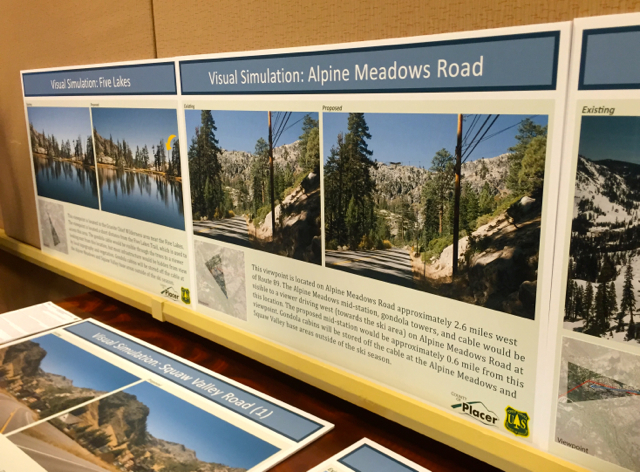
Proponents have images of what the visual impacts may be if the gondola between  Squaw and Alpine were built. Photo/LTN

Proponents have images of what the visual impacts may be if the gondola between Squaw and Alpine were built. Photo/LTN

Judy Bruner, who lives part time in Alpine Meadows, questioned the permanent loss of wilderness area if the gondola goes in. Caldwell’s property is technically in the wilderness area, but he was there first. If he were to sell the land and the gondola is there, it could never be wilderness area again.

“I believe the visual quality will forever be impaired,” Bruner said at the May 9 meeting at the Resort at Squaw Creek. Eleven of the 37 towers are slated to be on Forest Service land.

She would like the project proponents to create state-of-the-art modeling to better visualize the impacts.

For Dan Heagerty of the Granite Chief Wilderness Protection League, he worries Placer County will be as receptive to concerns of locals as the agency has been to the Squaw Valley base plan – which in his estimation has been silence.

Resort officials say the gondola will reduce by 100 the number of vehicles on the road between the resorts.

Heagerty challenged that assertion, saying, “This $35 million project is clearly designed to induce visitor visits to both resorts.”

He also brought up the proposed chairlifts in the Alpine master plan and Caldwell’s desires.

Heagerty and others want the gondola project not to be studied in isolation, but with consideration of projects already in the pipeline as well as those being bandied about.

Isaac Silverman, attorney with Sierra Watch, contends some of the lift proposals would not get built without the gondola because the midway station would provide access to them.

Joe Flannery with the Forest Service told people during the breakout session that the assumption is skiers-snowboarders will be able to get off at the midstations. This means new terrain would be accessible via the gondola.

One person asked why a joint EIR-EIS wasn’t being created. No answer was given. The speaker said having to review two documents was more cumbersome for the average person.

Placer County will be dealing with the environmental impact report and California Environmental Quality Act issues. The USFS will handle the environmental impact statement and National Environmental Policy Act requirements.

Comments must be made to both organizations. The feds hope to have the draft EIS done by the end of the year or early 2017, while the county wants the EIR completed sooner.

—–

Notes:

·      The project overview is online.

·      Comments to Placer County may be emailed to cdraecs@placer.ca.gov. The deadline is May 23.

·      Comments to the U.S. Forest Service may be emailed to scoping_comments@squawalpinegondola-eis.com; deadline is May 31.


Opinion: California highways leading nowhere

By Dan Walters, Sacramento Bee

Driving north from Bakersfield on Highway 99, a motorist soon encounters an offramp onto Highway 65, which runs up the east side of the Central Valley – but not very far.

Dan Walters

Dan Walters

The pavement ends about 70 miles north of Bakersfield, near the farming town of Exeter.

However, 200-plus miles farther to the north, another 35-mile stretch of Highway 65 connects Marysville, north of Sacramento, with Roseville through a region that has seen explosive residential, commercial and industrial growth in the last few decades.

These two widely disconnected pieces of Highway 65 hint at what was once seen as a major north-south route – a twin, so to speak, of Interstate 5, which carries traffic along the Central Valley’s west side.

Read the whole story


Flying? Budget hours, not minutes, for security

By Jad Mouawad, New York Times 

Security lines at airports are getting longer — much longer — and wait times could reach epidemic levels when air travel peaks this summer, according to airlines, airports and federal officials.

A combination of fewer Transportation Security Administration screeners, tighter budgets, new checkpoint procedures and growing numbers of passengers is already creating a mess at airports around the country.

While federal security officials say they are hiring and training hundreds of additional screening officers, matters are not expected to improve anytime soon.

Airline and airport officials have said they feared that the current slowdown would last through the year, and could cause summer travel chaos when more than 220 million passengers are expected to fly during the peak travel months of July and August.

Read the whole story