By Joann Eisenbrandt
Proponents of Measures E and G say these measures will:
“Restore the purpose of zoning, which is to segregate uses that are incompatible and to implement the policies which will preserve the rural character of the county.”
Opponents of Measures E and G say these measures will:
“Threaten our open spaces, water and rural way of life.”
El Dorado County’s 2004 General Plan lists as its objective, “To foster a rural quality of life.” The difficult question for voters on June 7 is whether voting “yes” or voting “no” on Measures E and G will protect the rural nature of El Dorado County the General Plan envisions. To do this, they must be able to make sense of the proliferation of roadside signs, advertisements, flyers, online videos, editorials and community meetings trying to convince them to vote one way or the other.
Measures E and G are complex because they focus on the county’s 2004 General Plan and Zoning Ordinance. These often-technical documents outline how land in the county can be used. In December 2015, the Board of Supervisors approved the Targeted General Plan Amendment/Zoning Ordinance Update (TGPA/ZOU) which made limited amendments to the 2004 General Plan and extensive updates to the Zoning Ordinance. The TPGA/ZOU was challenged in court by Rural Communities United, a local nonprofit. That litigation is pending.
Measures E and G make specific changes, additions or deletions to some of the county’s land-use policies. But beneath the details lies the bigger question: How will Measures E & G affect the future physical, economic and social development of El Dorado County, and is this a future that voters support?
Measures E and G: A two-year process
In early 2014, Sue Taylor of Save Our County and Laurel Stroud of Residents Involved in Positive Planning filed a notice of intent to circulate a petition with the county elections office for two ballot measures. At that time, they were called Initiative 3 and Initiative 5. Petitions were circulated, signatures obtained, counted and certified by county elections, and then forwarded on to the Board of Supervisors, but the entire process was not completed in time to make the Nov. 4, 2014, ballot.

No on E and G signs are mostly found on the West Slope.
What the initiatives propose
Measure E, titled “Initiative to Reinstate Measure Y’s Original intent – no more paper roads,” amends policies in the Traffic and Circulation Element of the 2004 General Plan as well reverses changes made to Measure Y in 2008.
In 1998, voters first approved Measure Y, the “Control Traffic Congestion Initiative.” It added policies to the 1996 General Plan prohibiting residential development projects of five or more units that would cause or worsen level of service (LOS) F traffic congestion. LOS F is at the bottom of the traffic flow measurement scale and is essentially gridlock. Measure Y also prevented adding new roads to the list of roads that the 2004 General Plan allowed to operate at LOS F without voter approval; required developers to pay fees that would mitigate the traffic impacts of their new developments and prohibited county tax revenues being used to mitigate these traffic impacts without voter approval. Measure Y was to remain in effect for 10 years.
In 2008, the Board of Supervisors put Measure Y on the ballot for an extension, but with modifications. These allowed the board to override by a fourth-fifths vote the prohibition against developments creating LOS F and enabled the county to use tax revenues to pay for needed road improvements caused by new development as long as the roads projects were in the county’s capital improvement program.
Measure E would undo these 2008 changes, and return with several modifications to Measure Y’s 1998 configuration. It would remove the board’s four-fifths vote override. No new roads or segments of roads could be added to the list of roads permitted to operate at LOS F without voter approval. Infrastructure improvements needed because of residential developments that could create LOS F would have to be built first, not just put into the CIP before “any form of discretionary approval can be given to a project.” Measure E would not allow county tax revenues to be used to pay for building these road capacity improvement projects, but would allow state and federal grant funds to be used.
As Taylor told Lake Tahoe News, “We wanted to hold developers’ feet to the fire and make them pay for their own infrastructure upfront instead of putting the road improvements needed to meet the new demands of development into a five-, 10-, or 20-year capital improvement program.” She called these CIP projects “paper roads” because when or whether they would actually be built “exists only on paper.”
Measure G, the “initiative to retain El Dorado County’s current zoning and rural assets”, changes some policies of the General Plan back to what they were in the 2004 plan, adds a number of policies and deletes others. It requires that where a land use designation is inconsistent with current zoning, the land use designation is amended to match existing zoning. Land use designations are broad categories, like agriculture or residential or commercial, while zoning refers to more specific land uses allowed within each area, such as high-density residential, or agricultural grazing or timber production.
Which specific uses are appropriate in each broad category and which uses are compatible adjacent to each other is where much of the controversy over zoning and zoning changes lies. Measure G includes a land use compatibility matrix showing which uses are compatible or incompatible with each other.
The measure also provides for a minimum 200-foot setback between agricultural zoned and adjacent agriculturally-incompatible uses. It restores the Mixed Use Policies (residential, business and retail) to the lower units per acre densities in the 2004 General Plan, and does not allow for such properties to have only a residential use. It further requires the implementation of the General Plan’s Cultural and Historical Resource Policies.
It modifies or deletes several General Plan water supply policies to “ensure an ongoing balance between water supply and demand in El Dorado County.” Medium-density, high-density and multifamily residential projects as well as commercial, industrial and research and development projects in both community regions and rural centers would have to connect to public water systems. Community regions and rural centers are the areas where more intense development is likely to be directed.
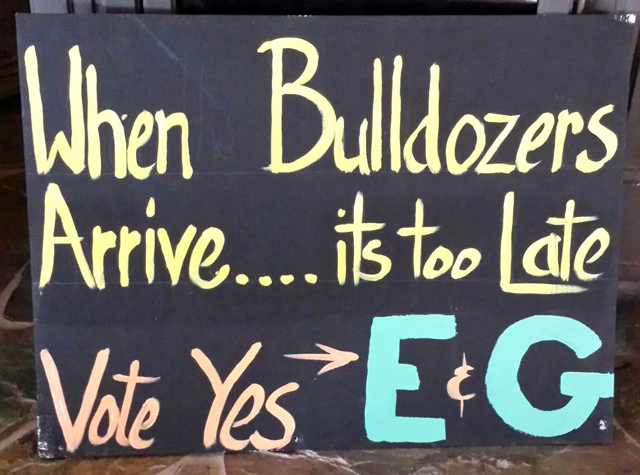
The Yes on E and G supporters want to regulate growth.
On this side of the ring we have
Supporters of Measures E and G include such community groups as Save Our County, Shingle Springs Community Alliance, Rural Communities United, and Residents for Responsible Planning, plus a range of local residents and businesspeople.
Opponents of Measures E and G include the El Dorado County Chamber of Commerce, El Dorado Hills Chamber of Commerce, Farm Bureau, El Dorado Winery Association, Citizens for Water, Alliance for Responsible Planning (EDCARP), and Parker Development. They also include individuals and business owners.
There are many complex layers of interaction among the organizations and individuals who support or oppose Measures E and G. These are not intended to be comprehensive lists. Complete information on committees for and against Measures E and G, their members and their funding sources is available on the elections’ website.
Key points of disagreement
A full-page ad appearing in West Slope publications points to the most-debated potential impacts of Measures E and G. It says, “… these careless, poorly written measures undermine our county’s water rights and hurt our ability to maintain a safe, clean and reliable supply of fresh water for local farms, vineyards, ranches and homes. They also push development into our rural areas, reduce funding for local roads and highways, and make our economy more ‘volatile’.”
Conforming land use to zoning
How land will be used is the “bedrock” issue. Opponents of Measure G are concerned that in the case of conflicts, it would change land use designations to match zoning. What the TGPA/ZOU did in 2015 was the opposite. It changed the zoning ordinance to conform to the General Plan land designations. California Government Code Section 65860(c) says, “In the event that a zoning ordinance becomes inconsistent with a general plan by reason of amendment to the plan, or to any element of the plan, the zoning ordinance shall be amended within a reasonable time so that it is consistent with the general plan as amended.”
The impartial analysis prepared by County Counsel Mike Ciccozzi as part of the ballot materials for Measure G says, “The measure would require that El Dorado County amend General Plan land use designations to match zoning. Although such action would ensure consistency between the General Plan and the zoning ordinance, it would do so in an atypical way … accordingly, implementation would likely require additional analysis and action by the county.”
Measure G was written in 2014, before the TGPA/ZOU was approved, so it refers to the situation as it existed then. Proponent Sue Taylor told Lake Tahoe News, “When we did this initiative, the county was still working on the General Plan overhaul. Land use and zoning didn’t match. We were told by planning that these conflicts would be looked at individually to check for compatibility. Now (with the TGPA/ZOU) they have made decisions based on their own judgment instead of using the criteria in the General Plan. They say the way Measure G is going to conform uses is illegal because land use should trump zoning. I say that the board has total power over land use and they could have matched them earlier.”
Precisely how Measure G would be implemented were it to pass depends on whether the existing lawsuit against the TGPA/ZOU is upheld or denied.
Defining discretionary development
EDCARP has devoted an entire page of its website to the no on E and G effort. Alliance President Maryann Argyres described the organization to Lake Tahoe News as a volunteer organization that is focused on research. “We don’t start out with a premise.” The website describes them as a “coalition of the middle — those who feel the dialogue on land use has been dominated by no-growth advocates on the one hand and development interests on the other.”
They do not support “ballot box planning and initiatives promoted by personal interests and agendas,” but have formed a committee to actively oppose Measures E and G. They believe the Initiatives, “contain ‘poison pills’ that obstruct General Plan implementation, along with economic development, expansion of agriculture, housing and jobs.”
A main concern for EDCARP and other opponents is that E and G would prohibit “discretionary projects.” What discretionary projects are and how E and G would affect them depends on who you ask. Opponents paint it with a broad brush. EDCARP’s website says the Initiatives will “stop discretionary actions by the county needed to allow job centers, research parks, tourist recreation businesses, lighted ball fields, home occupations, hotels, wineries, retail stories, even the expansion of existing businesses. The list is virtually endless.”
In a letter to members of the El Dorado Hills Chamber of Commerce, President Debbie Manning says, “They effectively stop all non-residential uses (agricultural, public facilities, business park research and development, commercial, CSD and government actions) that require discretionary approvals. What project doesn’t need county approval?”
Lori Parlin of Shingle Springs Community Alliance and a member of the Yes on Measures E and G Committee, disagrees. She says, “Discretionary project means that the project is not allowed by right and would either need the Planning Commission or Board of Supervisors to pass legislation, such as a General Plan amendment, in order to allow the project. This measure does nothing to remove a property owner’s right to request a rezone or change. All of this only kicks in if the development creates LOS F (gridlock traffic).”
Asked for his definition of “discretionary projects” as applied by Measure E, County Counsel Ciccozzi responded in an email to Lake Tahoe News, “The interpretation of this language should the initiative measure pass will be one of the issues that must be addressed.”
Parlin agrees, “We have talked to County Counsel about all of this. The word discretionary will have to be further defined.”
Words matter
The EDCARP website says, “Words matter, especially language used in ballot measures and other laws.” Taylor agrees. She has concerns that the ballot title and language as prepared by the county do not accurately describe the measures’ purposes and may confuse voters. The resolutions to put Measures E and G on the June 7 ballot with the descriptions provided by the county came before the Board of Supervisors on Feb. 23 as part of the consent agenda. Taylor and other E and G supporters met with county counsel and staff on Feb. 22 to go over their concerns. Taylor had asked in writing that the resolutions be pulled from the consent agenda for full discussion before they were adopted. Anyone may request the pulling of an item from the consent agenda, but only a member of the board can actually pull it.
The resolutions were not pulled and were approved as presented with Supervisor Shiva Frentzen voting no. Taylor subsequently filed a writ of mandate in El Dorado County Superior Court to have the language changed. To uphold the writ, the court would need to find that the petitioner had shown by “clear and convincing evidence” that the county’s language was “false, misleading, or inconsistent with the requirements of [Election Code] section 9105.” On April 1 the court found Taylor had not met that burden of proof and denied the writ. Judge Warren Stracener said in the denial, “Also, there is no legal requirement that the ballot question be the most accurate, most comprehensive, or fairest that a skilled wordsmith might imagine.”
On April 5, the county put a press release on its website’s home page regarding Stracener’s decision. “The county is pleased with the court’s ruling,” it said, “and believes that the ballot questions are a fair representation of the proposed initiative Measures E and G.”
Déjà vu all over again
Measures E and G are not the first contentious land use-based initiatives to show up on El Dorado County ballots. In 2014, Measures M, N, and O focused on similar issues and proved equally confusing to voters. Measures M and O were supported by basically the same groups now in favor of E and G, and opposed by those who now oppose E and G. Measure N is a bit trickier. There was a committee opposed to M, N and O and also a committee in favor of N but opposed to M and O. Some who started out supporting certain measures ended up opposing them. Texts of these measures, as well as all the committees formed and financial contributions made are available through the county elections website.
All three initiatives failed.
Growth and staying rural
Opponents of E and G say that by putting restrictions on high-density residential development in community centers and along the Highway 50 corridor, it will have negative impacts on the county’s growth and economic development and will drive development into rural areas. Laurel Brent-Bumb, CEO of the El Dorado County Chamber of Commerce, told LTN, “We’re going to grow whether somebody doesn’t want it or not and it has to happen where the infrastructure can support it. If it doesn’t happen there, it will happen in our rural communities.”
Brent-Bumb believes the 2008 version of Measure Y still contains its original intent and has no problem with funding for road improvements going into the CIP or the board of supervisors overriding restrictions against projects that create LOS F road impacts by a four-fifths vote. “I trust in my elected officials,” she said. “I don’t believe that our elected officials would pass by a four-fifths vote something that would make you sit and eat your lunch on Highway 50 while you are waiting to get to work.”
Taylor counters, “Development moving into rural areas can only happen if the board votes to approve it regardless of issues with water or roads. That’s not what’s on the books. They would have to do General Plan amendments.”
This brings up the larger question of how “rural” is defined. Maryann Argyres of EDCARP, who is also on the Farm Bureau board of directors and past president of the Apple Hill Growers Association, explains, “I have lived in Camino for 43 years. I have a small apple ranch. I live in a rural area. I’m against E and G. If you live in a community region with a backyard and a back fence, you are not rural. You live in a county that is mostly rural, but a community region is designed to have 1 percent growth per year.”
Brent-Bumb and the chamber are members of the No on E and G Committee for which Parker Development and its affiliated companies, Marble Valley Company LLC and Serrano Associates LLC, are major funders, with contributions close to $500,000. Asked if this concerned her, Brent-Bump replied, “No on E and G is a very diverse committee and our objective is to defeat these initiatives. We can only do this by being funded and Parker has agreed to write those checks. I am quite comfortable with that.”
Asked by Lake Tahoe News why Parker Development was willing to spend so much money to defeat Measures E and G, Kirk Bone, director of government relations, said, “These measures would gut the county’s General Plan and would make it very difficult, if not impossible, to do something as simple as obtaining a building permit or any other minor discretionary approvals. We are proud to be part of a broad-based coalition including the Farm Bureau and chambers of commerce attempting to preserve the adopted General Plan.”
Sue Taylor doesn’t see it quite that way, “Parker Development says vote no on Measure E because what they want to do with open space is to build on it.”
Water, farms, apples and wineries
The Farm Bureau, El Dorado Winery Association and Citizens for Water oppose Measures E and G. The Farm Bureau’s mission is to, “Protect, promote, and enhance the economic opportunities and long-term viability for El Dorado County farmers, ranchers, and foresters.” Farm Bureau President Jim Davies told Lake Tahoe News, “Measure E will make development illegal. It will force people to move to those parcels of land in the open space. In some areas, like Rural Centers, Measure G forces any kind of development there to have a water purveyor supply them. There couldn’t be a grocery store in Mt. Aukum. In places in the south county, that little bit of commercial would help them dramatically with their agri-tourism. This will become incredibly expensive because it will be litigated to pieces.”
“If property is zoned by right to be developed, that’s a ministerial project,” Taylor said in defense of Measure G. “It doesn’t go before the board. There are 17,000 parcels that can be built on right now. Only the supervisors can decide when it’s time to open up more land for development. “
The Farm Bureau is also not concerned with the large financial role being played by Parker Development in the effort to defeat E and G. “Parker has been engaged with the General Plan process since the inception. We’ve also been engaged in that process and have tried to be at the table and help our members get what they need as ag entities, but we are not connected with Parker Development. Parker is defending their turf. We have problems with E and G for a number of reasons and they have them for different reasons. We are cooperating because neither party wants E and G to pass.
“We are only developers in the sense that we develop a piece of land to raise apples or graze cows. We are not trying to chop up the county so it looks like Daly City. I’ve been looking at those green hills (along the Highway 50 corridor) and it pains me to see houses going up, but people want to come here. I’d prefer they be there rather than in Camino, Coloma or Fair Play. The state would say your growth rate is 1 percent and if you don’t (grow that much) we are going to require you to grow.”
Former El Dorado County Supervisor Bill Center disagrees. “It isn’t a state requirement that we grow 1 percent. The state can only mandate that you provide enough zoned land for affordable housing. That’s it. The Housing Element, which the county has certified as being consistent with this requirement, says there is enough zoned land available to build affordable housing. You could not find a statement (in state law) that mandates that percentage of growth for El Dorado County.”
The media blitz
Bill Center is in a unique position, representative of the complex advertising campaigns being waged. The EDCARP website’s No on E and G page has a video of Center expressing concerns before the Board of Supervisors in 2014 regarding the impacts on discretionary projects of changing the 2008 version of Measure Y. He is also in a video on the Save Our County website expressing his support for Measures E & G. Measure E would make such changes. These appear to be contradictory positions.
“I’ve been on both sides of the field with that issue,” Center said. “I have had to decide what is discretionary and what is ministerial as an official. I was concerned about the breadth of (Measure M’s) language but I’ve had 18 months of perspective. The county has been arrogant and controlled by development interests. Those development interests, some of them like Serrano and Marble Valley, are paying for all the ads and signs. That money has had a big impact on the El Dorado County Chamber of Commerce, and promises have been made regarding water supply that have influenced the farmers and wineries.”
“I don’t think we can make progress,” Center believes, “until the county starts listening to the general public in a respectful way rather than essentially telling them to shut up and go home while rolling out the red carpet for developers. I’m voting in favor of E and G because I think it will help balance the scales.”
The El Dorado Winery Association and Citizens for Water have signed mailers that were sent out to voters. These mailers, along with the one sent out by the El Dorado County and El Dorado Hills chambers of commerce seem to point to county-generated documents as validation for their positions. The El Dorado Winery Association flyer says, “Please read the county’s official analysis of Measures E and G, which explains how they force development into rural areas, reduce funding for roads and destabilize our local economy.” The Citizens for Water flyer adds, “According to the impartial analyses prepared by the county, Measures E and G undermine our county’s water rights, hurting the county’s ability to maintain a safe and reliable supply of clean, fresh water for local farms and families.”
There are two sets of county-prepared documents on Measures E and G that these flyers might be referencing. One is the impartial analysis for each measure composed by County Counsel Ciccozzi, which appears on the elections website and in ballot materials. These are designed, Ciccozzi explained, “to describe the effect of the measure on existing law and the operation of the measure as information to the voters.”
The second set is the two reports written in 2014 at the request of the Board of Supervisors as part of their decision-making process on the initiatives. These reports were prepared by county counsel and county staff at the direction of the CAO’s office and offer their analysis of a broad range of the initiatives’ potential impacts on land use and finances for use by the board. “The best characterization of the reports would be informational,” the county counsel told Lake Tahoe News. “We will not speculate as to what the opponents of Measures E and G mean when they use the term ‘official county analysis’.” The county has put a link to these two reports on its website. Here is the one for Measure G and the one for Measure E.
Lake Tahoe News did not receive responses back from those who produced these materials.
Voters have an admittedly difficult task ahead of them. The vocal, and often confusing, fight over Measures E and G only serves to point out how central to the future of El Dorado County that land use decisions are, and how strongly so many feel about just what that future should be.

