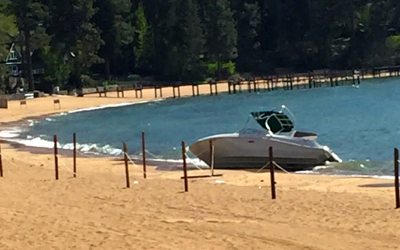
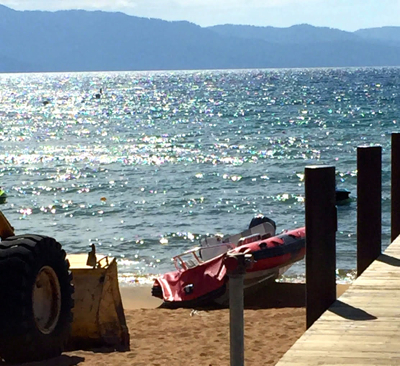
A boat washed ashore at Zephyr Cove on May 19. Photo/Provided
Wind toppled a boat May 19 at Zephyr Cove. Photo/Provided
It wasn’t a good day Thursday for boats at Zephyr Cove Marina.
Several turned up on the beach after becoming dislodged from their moorings in the high winds. The National Weather Service in Reno had issued a lake wind advisory for May 19. Wind gusts hit 55 mph in the basin on Thursday.
Local employees of Aramark, which operates the South Shore marina, deferred comment to corporate. No response still from them, so it is unknown how many boats were damaged or to what extent.
— Lake Tahoe News staff report
Facts about hepatitis lead to healthier life
By Erin Jones
May is Hepatitis Awareness Month. Do you know the facts about hepatitis and if you may have it?
Hepatitis is a viral infection of the liver. There are three major types: A, B and C. Vaccines are available to protect against Hepatitis A and B, but none are available for Hepatitis C.
Erin Jones
Hepatitis B and C can cause chronic infections that if left untreated can lead to liver damage, liver failure or even cancer. In fact, according to the Centers for Disease Control, Hepatitis C is the leading cause of liver transplants in this country.
There are 3.2 million people in the US with chronic Hepatitis C and the CDC estimates as many as 75 percent don’t know they are infected. Three out of four people with Hepatitis C are baby boomers and the CDC recommends that everyone born between 1945 and 1965 get tested for Hepatitis C. A blood test is the only way to know if you have it.
People are also at higher risk of contracting Hepatitis C if they received a blood transfusion before 1992, shared needles (even once) and nasal instruments for drug use, had sex with an infected person, or have HIV.
Unvaccinated people are at a higher risk for Hepatitis, especially if they travelled outside the country. While there is no vaccine available to prevent Hepatitis C, Barton Health providers can diagnose Hepatitis C with a blood test and treatment is available.
A new treatment can cure Hepatitis C in eight to twelve weeks. Previous treatments were not as effective and had many side effects, but the new treatment has few or no side effects. One clinical study highlighted in an FDA news release showed cure rates as high as 96 to 99 percent depending on the virus sub-type and if previous treatment was given.
People can live with chronic Hepatitis for decades without feeling sick, but the toll on the body can be devastating. Taking medication early to treat chronic hepatitis can decrease the chances of liver damage and liver cancer.
Schedule an appointment with a primary care provider at Barton Community Health Center at 530.543.5623 or Barton Family Medicine at 530.543.5660 to get tested or talk about treatment if you have been diagnosed. You can also visit cdc.gov/knowmorehepatitis for more information.
Erin Jones was born and raised in South Lake Tahoe and is a family physician at Barton Family Medicine.
Judge: Nev. can pay parents for private school
By Trevon Milliard, Reno Gazette-Journal
A Las Vegas District Court judge ruled Wednesday that Nevada’s program offering students $5,000 annually for private school is legal and does not violate state law forbidding the use of public funds for religious purposes.
Most private schools in Nevada are run by religious institutions and include religious curriculum.
“This is a huge and important step in getting certainty for the thousands of families waiting to participate in Nevada’s ESA (education savings account) program,” said Nevada Attorney General Adam Laxalt in reaction to the ruling, referring to the 6,000 students who’ve applied to the program.
Editorial: Nev. needs legislative sessions every year
Publisher’s note: This editorial is from the May 16, 2016, Las Vegas Sun.
A recent gathering of politicians, businesspeople and other civic leaders at UNLV offered an insightful peek behind the curtain to see how sausage is made in the Nevada Legislature.
The view was both uplifting and discouraging.
On the one hand, it was instructive to see how issues for the 2017 Legislature are identified. The city of Las Vegas and the Las Vegas Metro Chamber of Commerce hosted a series of meetings, open to the public and known as the Southern Nevada Forum, for interested residents to ruminate on the main issues that dominate political decision-making in Carson City: K-12 education, higher education, transportation infrastructure, economic development, health care and good governance, which goes to the heart of this editorial.
South Lake Tahoe hosted the women’s Stage 1 event of the Amgen Tour of California on May 19. The start and finish were at Heavenly Mountain Resort. The men finished Stage 5 at the ski resort.
Amgen bike race blows through South Shore
The women start the four-stage event May 19 at Heavenly Mountain Resort. Photo Copyright 2016 Carolyn E. Wright
By Susan Wood
In two whirlwind finishes Thursday, the Amgen Tour of California women’s and men’s bike races came down to a sprint at the end. San Francisco rider Megan Guarnier made her move over Sarah Storey and Latvian Toms Skujins barely beat Adam De Vos.
Lake Tahoe served up one of its usual weather-challenging days for the cyclists in this Tour de France-style ride. In 2011, the men’s race got snowed out. This year, it was the wind taking center stage – with gusts up to 55 mph.
Women racers approach Emerald Bay area during the 2016 Amgen race. Photo Copyright 2016 Lisa J. Tolda
“We knew it would be windy. We’re just glad it’s not snowing,” Lake Tahoe Visitors Authority Events Director Mike Frye told Lake Tahoe News. Executive Director Carol Chaplin agreed – and assured that professional riders know how to work through the elements.
The riders seemed to take it in stride and at times embraced it. Some mentioned relishing being able to use a tailwind.
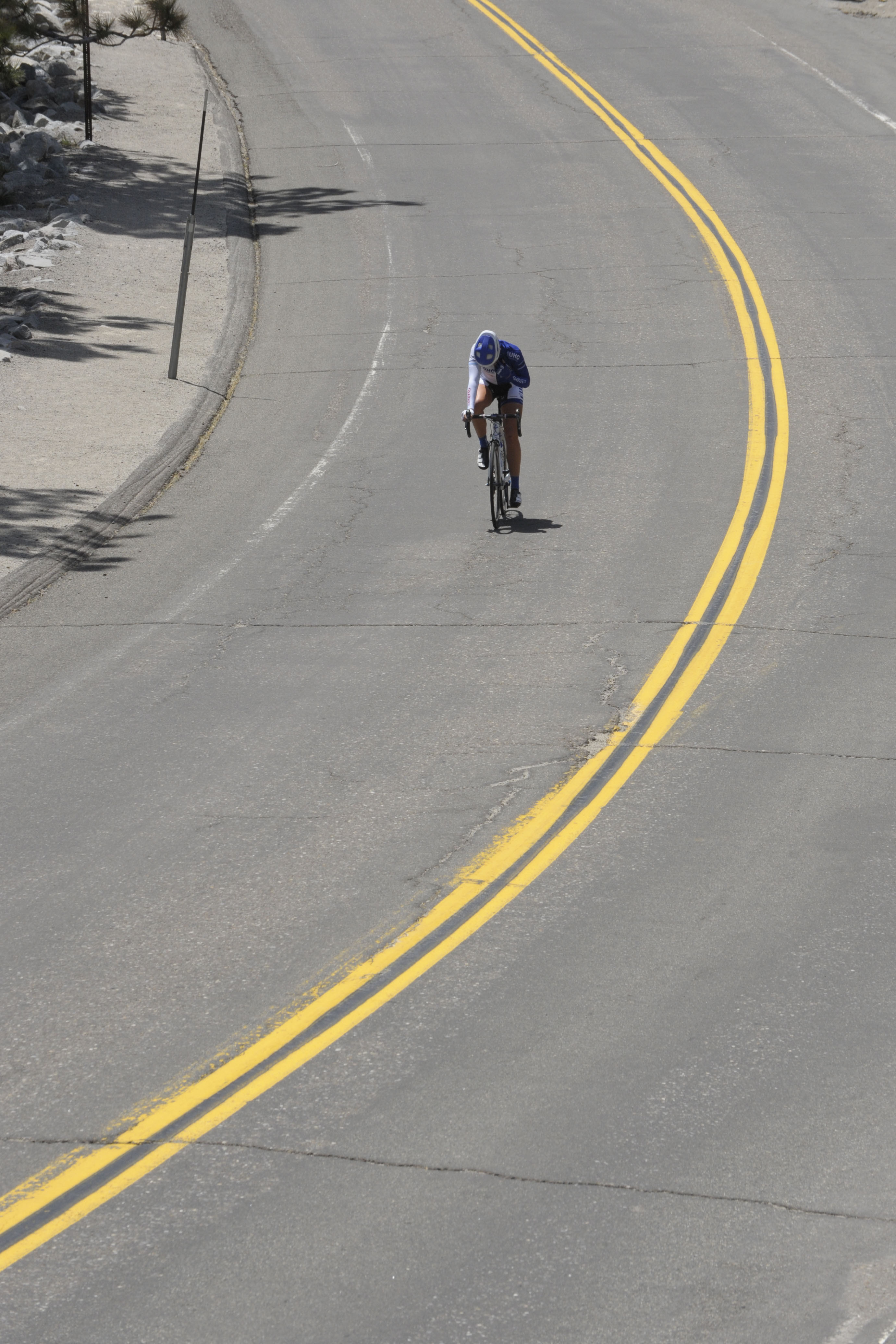
A lone woman at the end of the pack rounds a curve near Eagle Falls. Photo Copyright 2016 Lisa J. Tolda
The enthusiastic announcer called the wind “brutal” and the women’s finish “a throw down in Lake Tahoe.”
“You won’t win it in 1K, but you could lose it if you go too big,” he yelled over the speakers as the women seesawed into position.
Guarnier gasped as she pulled over the finish.
Megan Guarnier is surrounded by her teammates after winning Stage 1. Photo/Kathryn Reed
In the middle of the women’s race, Storey had a four-minute lead, then Guarnier decided to move in the last few kilometers. She came in at 3:04.57.
“It was a good finish. I got awesome support from my team,” Guarnier told Lake Tahoe News, as she rolled to a stop in the parking lot.
A field of more than 100 riders line up for the May 19 start at Heavenly. Photo Copyright 2016 Carolyn E. Wright
She admitted the wind “did neutralize” the ride, but she also welcomed tailwind at times. However, it was not her biggest concern at the start.
“It’s my first time riding in Tahoe. It’s beautiful. I was just afraid of the altitude,” Guarnier said. The women rolled up and down Emerald Bay and Spooner Summit, while the men came over Carson and Luther passes.
Lucinda Brand of the Netherlands is used to wind in her home country. Photo Copyright 2016 Carolyn E. Wright
“It’s not hard climbing here. The hills are rolling,” Rabo LIV Women Cycling Team rider Lucinda Brand told Lake Tahoe News at the start line. She said the altitude would be a bigger factor for her because her hometown is flat. One thing that Rotterdam and Tahoe shared May 19 was wind. She said she was riding two days ago here in the wind, where it was everywhere instead of being a distinct head or tail wind.
Toms Skujins, Stage 5 winner, makes his way up Luther Pass on May 19. Photo Copyright 2016 Carolyn E. Wright
In the men’s ride, Skujins took full advantage of the wind during this stage in the last five kilometers. He just wished he would have enjoyed the Tahoe scenery more. “I didn’t have enough time,” he said at the finish.
Skujins said “it wasn’t easy,” but his strategy in the last stretch worked.
The peloton makes the ascent up Luther Pass. Photo Copyright 2016 Carolyn E. Wright
“I didn’t want to start sprinting too early,” Skujins said at a press conference. He added that logically he couldn’t make his move in the pack because he’d endure “attack on attack” from challengers. He completed the stage in 5:54.45.
Frenchman Julian Alaphilippe is wearing the yellow jersey.
During the men’s race, the announcer said the leaders were stretched out from the pack in what might as well be “a different ZIP code.”
Renee De Vos almost missed her son cross the finish line less than two bicycle lengths behind the winner.
“As I was walking up the hill I found out he was in third place,” the British Columbia resident told Lake Tahoe News. De Vos came in second in Stage 5.
It is a tight race for women racers as they turn from Pioneer Trail onto Ski Run Boulevard. Photo Copyright Lisa J. Tolda
Several riders noted how they enjoyed the enthusiasm from hundreds gathered at Heavenly’s California Lodge for the start and two finishes. In some instances, spectators numbered about five deep from the barriers to catch a glimpse of 300 top professional cyclists giving it their all.
South Shore enthusiasts rewarded the athletes with support along the route from Meyers to the ski resort. Cowbells were clanging hard and spectators were beating on the barricades at Heavenly. The noise was accompanied by the commentator who got the crowd geared up with his play-by-play assessment with an education in how altitude makes it more difficult for recovery.
Missy Hansen of Chicago and Karen Pollack of Delaware camped out on the Heavenly Tram loading area steps to see the two finishes.
“You don’t have to be a cyclist to get into it,” said Hansen, who thoroughly enjoyed her Amgen event.
The last of the pack climb Ski Run Boulevard. Photo Copyright Lisa J. Tolda
Her friend, Pollack, is a regular as a spectator on the professional cycling circuit, having witnessed two Tour de France rides. It was her second Amgen, and she talked Hansen into coming to Tahoe just for this event.
“Our whole trip was to follow this race,” said Pollack, who rides on occasion.
Hansen said she’s learned a lot from Pollack, who even knows what a neutral start is. It’s essentially a warm up until the race director drops the flag, then “it’s game on,” she explained.
Pollack disagrees with some who call cycling boring to watch.
“It’s a fascinating sport,” she said, adding that it was a good idea to have the men and women finish in the same spot.
The women fly past Eagle Falls on May 19. Photo Copyright Lisa J. Tolda
The women did 72 miles around the lake to launch the UCI World Tour. The men completed the 130-mile route from Lodi, which made history for the Tour of California race with having its highest peak elevation of 8,600 feet.
“It’s so exciting. It’s pretty incredible, this route, because it’s so steep. And the wind was out of control,” Hilary Bailey said, standing near the finish line. She and husband Don make the race their vacation every year from their home in McMinnville, Ore.
Friday’s Tour of California race takes the men through Folsom before they hit the rolling, vineyard-lined hills of Sonoma County for Santa Rosa’s Stage 7. The women will have a time trial in Folsom for Stage 2.
Kathryn Reed contributed to this story.
Calif. moves to end unprecedented water restrictions
By Kurtis Alexander, San Francisco Chronicle
A greener yard and a more leisurely shower just might be in your future.
State officials, in a policy shift that reflects California’s easing drought conditions, decided Wednesday to scrap the emergency conservation mandates that have forced cities and towns to cut water use as much as 36 percent, often by hitting residents with unprecedented restrictions and fines.
Instead, the State Water Resources Control Board will allow urban water providers to set their own water-reduction targets based on their own customers’ wants and needs.
A hiker missing since Monday was found alive Thursday.
Cody Michael, 23, and his dog were expected back in Rocklin on May 16, but never showed. This was after Michael had texted a picture of the two of them to family.
They were in the Donner Pass area hiking the Loch Leven Trail.
Placer County sheriff’s deputies said both were “alive and well.” Michael was taken to a nearby hospital to be examined.
— Lake Tahoe News staff report
Road beat: Outlander a great example of high value
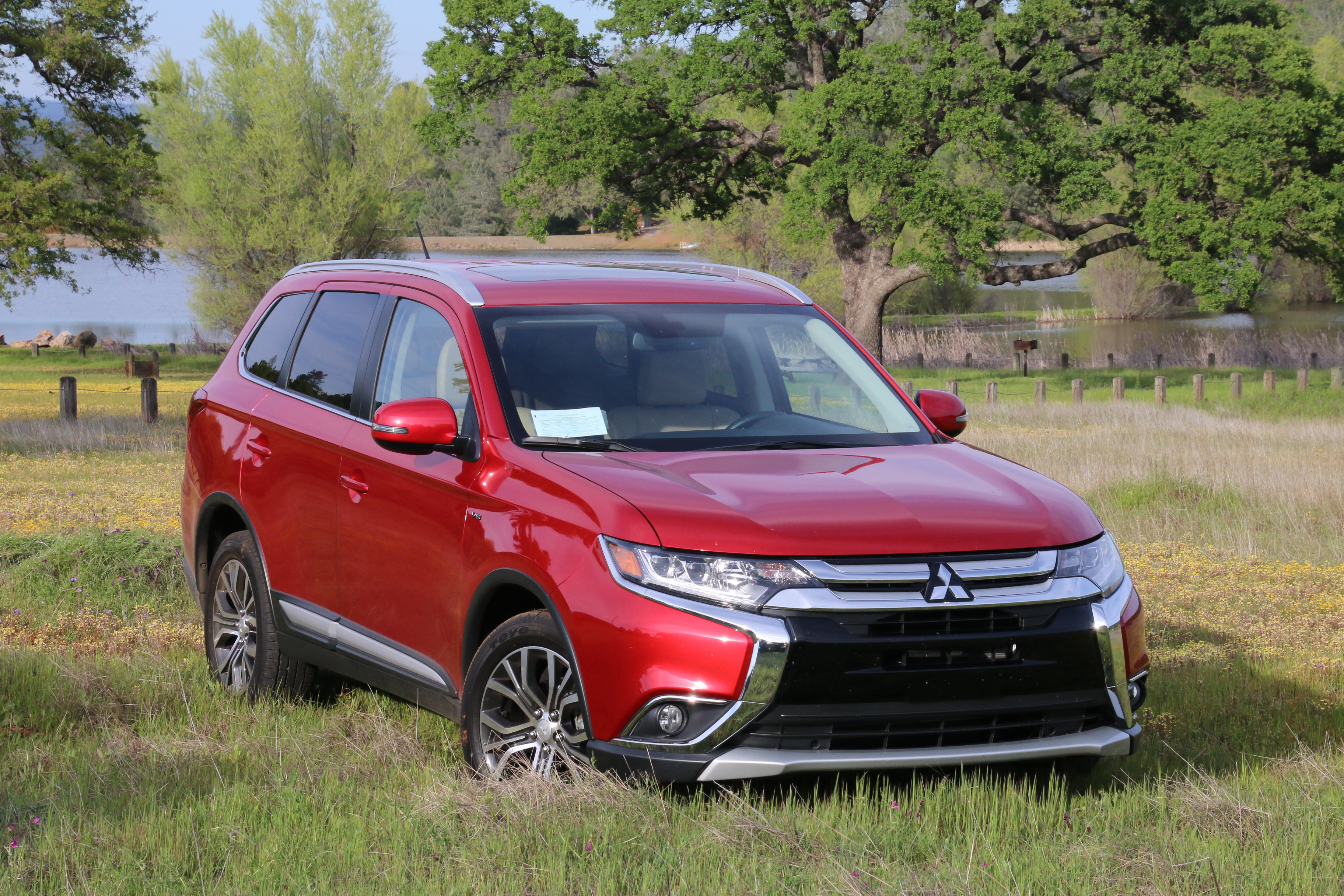
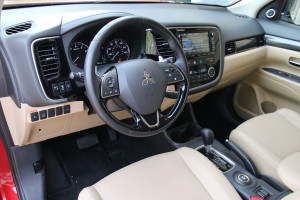
Mitsubisiy Outlander has nearly everything a driver would want. Photos/Larry Weitzman
By Larry Weitzman
As reported recently here, Mitsubishi is on a roll with a continuing sales growth exceeding 20 percent in 2015 and continuing into the first three months of 2016. Competition has made the automobile into the good car business. No one makes a bad car anymore. There are good cars and better cars, and the defining of better cars has also become more difficult. And they all are safe cars and as such “value” has become an important consideration. Customers also want attractive cars along with great interiors.
Mitsubishi highly refreshed new Outlander is a great example of high value. First are its looks. Its clean, simple shape has just enough detail and schmaltz to make it very pleasing to look at with a strong, well-done character line and superb window lines and shape done in perfect proportions with respect to the overall body. The front end is more detailed while cohesive, making a smooth, rounded transition into the rest of the body. Anyone who doesn’t like its appearance could be labeled a Mr. Magoo. But a real positive is that you don’t have to be a Mr. Magoo to own one.
Outside dimensions put the Outlander into the category of a small-midsize crossover SUV with a length of just 185 inches or about 5 inches shorter than your average mid-size car. But at 71-inches wide and 66-inches tall, it is of average dimensions. Wheelbase is 105 inches, which is identical to the smaller Outlander Sport (172-inches long) and both share a front and rear track of 61 inches and identical widths meaning that both vehicles share the same basic chassis and running gear, except for the Outlander GT tested here which receives a 224 hp 3.0L V-6 instead a 166 hp 2.4L inline four shared by the other Outlander models and all Outlander Sport models. While the bodies are similar, the Outlander gets the better looks because of the stretch of 13 inches and third row seating for two.
Specifications Price as tested $35,195 Engine 3.0L SOHC, 24 valve V-6 224 hp @ 6,250 rpm 215 lb.-ft. of torque @ 3,750 rpm Transmission Six speed torque converter automatic Configuration Transverse mounted front engine/FWD/AWD Dimensions Wheelbase 105.1 inches Length 184.8 inches Width 71.3 inches Height 66.1 inches Track (f/r) 60.6/60.6 inches Ground clearance 8.5 Weight 3,593 pounds Weight distribution (f/r) 57/43% Fuel Capacity 15.8 Wheels 18X7 inch alloys Tires 225/55X18 inch all season Steering lock to lock 3.3 turns Cargo capacity behind front row/second row/third row 63.3/34.2/10.3 cubic feet Tow capacity 3,500 pounds Performance 0-60 mph 7.37 seconds 50-70 mph 4.14 seconds 50-70 mph uphill 6.33 seconds Top speedwell into triple digits Fuel economy EPA rated 20/27/23 mpg city/highway/combined. Expect 23 overall in rural country driving 29-30 mpg on the highway at legal speeds.
Mitsubishi’s 3.0L SOHC, 24 valve V-6 has been in their stable for some time now and is one of the smoothest V-6’s in the business while creating a nice throaty sound. At full tilt boogie it will punch out 224 hp at 6,250 rpm with some serious mid-range torque which peaks at a low 3,750 rpm giving the throttle serious reflexes in normal driving. With a curb weight just shy of 3,600 pounds and a slick six speed torque converter, paddle shifting automatic it will scamper from 0-60 mph in a fairly quick 7.37 seconds. When I got my driver’s license, there were only a handful of production cars in the world that could do that.
With AWD and the V-6 comes a towing capacity of 3,500 pounds which should be equal to a 20-foot V-8 powered bow rider.
Passing performance is right on target considering the 0-60 mph time with a level 50-70 mph simulated pass taking 4.14 seconds and the same pass up a steep grade only slowing that time to 6.33 seconds. Even in aggressive driving there is no “brown out” to be found here. The throttle is very responsive. If there is anything lacking, it is the fuel economy with EPA ratings of 20/27/23 mpg city/highway/combined. It proved to be about 10 percent better than that with the trick radar cruise control set at 70 mph as it showed an average of 29-30 mpg. Overall the Mitsu averaged about 23 mpg as the EPA number shows. Those numbers are about average for most V-6 competitors in its class. According to the EPA, the four cylinder should improve economy by 3-4 mpg and FWD should add another MPG.
Suspension is state of the art MacPherson struts up front and a multilink system bringing up the rear. Both ends receive stab bars. Steering is an electrically powered rack and pinion but it is a bit slow at 3.3 turns lock to lock. Mitsu spent some time increasing structural rigidity and it shows as handling is sporty, with accurate steering, body roll control, good feedback and plenty of grip. It will dance with the best of them when darting through the twisties. Turning circle is a tight 35 feet. Great looking 18X7 inch alloys shod with 225/55 series rubber also increase driver confidence.
Another area of improvement is ride quality. It’s quieter, smoother and with less NVH than some competitors. It feels like an all new vehicle. Spinning just 2,000 rpm at 70 mph there is no engine noise and with particular attention given to window sealing and other details it is remarkably quiet with respect to wind and road noise.
Safety is second to none, four wheel discs, an alphabet soup of acronyms and with the GT Touring package ($3,350) you get Nav, forward collision mitigation, radar cruise and lane departure warning. It was the only option on my tester, even carpeted floor mats are standard. Stopping distance from 40 mph was a very short 41 feet.
Now it gets better. The Outlander has a beautiful leather interior, in this case a tan perforated leather. The overall theme is sophisticated, yet simple luxury. Most all panels are soft touch, hard plastic need not apply. Shapes and function are well integrated into a very easy to use complete instrument panel. It doesn’t take a three-unit college course to get up to speed, with about the only “complaint” being the radio volume and tuning knobs could be just a bit bigger, but other than that it is easy to use with plenty of simple presets.
Oh, and those seats are very comfortable and with three rows and seven seatbelts it can carry the load with still over 10 cubic feet of cargo behind the third row. There are over 63 cubes behind the front row and 34 cubes behind the second row. That should satisfy most Home Depot runs. My AWD tester had a reasonable 15.8 gallon fuel tank. Front wheel drive versions get a 16.6 gallon tank.
Now here is the value, pricing for this fully loaded, top of the line model is $30,995 plus the boat from Okazaki, Japan ($850). The GT Touring package brought the total to $35,195. That’s real value and Mitsu throws in a 5 year/60,000-mile bumper to bumper warranty and a 10 year/100,000-mile powertrain warranty.
Larry Weitzman has been into cars since he was 5 years old. At 8 he could recite from memory the hp of every car made in the U.S. He has put in thousands of laps on racetracks all over the Western United States.
No consensus on bike helmets
By Blair Anthony Robertson, Sacramento Bee
It seems like such a no-brainer. You get out your bike to go for a ride and you put on your helmet, a highly engineered and carefully scrutinized piece of equipment designed to protect you from serious brain injury, even death.
Helmets are lighter, more comfortable, more versatile and more stylish than ever. If you come out to watch the Amgen Tour of California this week, when the peloton of 100-plus riders will be speeding around the state, it goes without saying that all of the racers will be wearing helmets.
But helmet use at the recreational level does not enjoy that kind of consensus, something you’re bound to realize during May is Bike Month events, when thousands of local bike riders will be racking up close to 2 million miles commuting, touring, cruising, training and, in some cases, racing. For something that seems so obvious – helmets protect the brain in a fall or collision – it may surprise you that helmet use has been studied and studied again for decades.