Snippets about Lake Tahoe

·       BlueGo, the South Shore transit operator, is offering free rides on some routes May 28-30. For more info, go online.

·      The Bicycle Advisory Committee of the South Lake Tahoe Recreation Facilities Joint Powers Authority will meet June 1 from 9-11am in the downstairs conference room at Lake Tahoe Airport.

·      The nonprofit Project MANA, which provides food to about 3,000 people a year in North Lake Tahoe on Truckee, is in search of a new home after the Parasol Tahoe Community Foundation in Incline Village did not renew the lease.

·       On May 25 the Truckee Family Resource Center will be hosting a car seat safety check event from 2-6pm in the parking lot at 11695 Donner Pass Road next to Kid Zone. A limited number of car seats will be available to replace broken or expired seats

·      The League to Save Lake Tahoe is having and Eyes on the Lake trainings June 3 from 10am-12:30pm and June 21 from 5:30-8pm.


Drought parched Nev. warms up for fire season

By Benjamin Spillman, Reno Gazette-Journal

Nevada’s wildland firefighters are readying themselves for a treacherous fire season in months ahead.

That’s because a multi-year drought interrupted by El Nino moisture created conditions that cranked up the risk of wildfire in the Sierra Nevada and Great Basin.

The ramped up risk factors as well as measures fire officials will take to protect people and property were the topic of a briefing Monday for Gov. Brian Sandoval.

Read the whole story


Calif. water bill has three possible paths

By Michael Doyle, McClatchy Washington Bureau

House Republicans this week are adding a controversial California water bill to an unrelated Senate energy package, opening a new front in a fight that’s already put Democrats on the defensive.

The unexpected energy bill maneuver gives San Joaquin Valley lawmakers a third vehicle they might propel all the way to the White House. At the least, it builds up steam for the GOP drive to boost California water storage and divert more irrigation deliveries to Valley farms.

Today, the leadership-controlled House Rules Committee is scheduled to pack the California water bill and about three dozen other bills onto the Senate energy legislation. The full House will then take up the massive package, spanning more than 1,000 pages, later this week.

Read the whole story


Tahoe National Forest putting on photo contest

The Tahoe National Forest is hosting a photo contest from May 28-Sept. 30.

Photos must be taken on the Tahoe National Forest and may include such subjects as:  wilderness, wildlife and plants, recreation, rivers and lakes, lookouts, and landscapes, among others.


First, second and third place winners will be announced in October. Winners will be recognized on the Forest website, social media pages, and other publications.

For more information about the contest, go online.


Letter: Recognizing older Americans

To the community,

An Older Americans Day celebration took place at the South Lake Tahoe Senior Center on May 19.

Those in attendance were able to enjoy the music of bass player Al Botello, Tony the guitarist and singer/guitarist Jo Cain-Stiles. A wonderful roast beef dinner was served.

This year’s celebration included a Blaze a Trail contest, where seniors submitted stories on how they have reinvented themselves through new work and new passions, engaging their communities, and blazing a trail of positive impact on the lives of people in their communities.

Carol Olivas was recognized for her work during the Food Bank distribution and the American Legion Auxiliary. Arline Gordon was recognized for her efforts in producing and chairing several variety shows for the community.

Each were awarded a certificate and prize from local vendors, including Freshies Restaurant, Blue Dog Pizza and Magic Carpet Golf. Door prizes were also given thanks to Blue Dog Pizza.

Gerri Grego, commissioner El Dorado County Commission on Aging


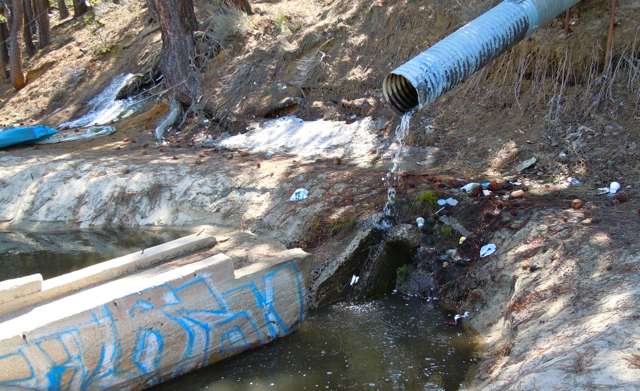
Stormwater collection in Tahoe keeps evolving

This storm drain and debris at El Dorado Beach were improved as part of the Lakeview Commons makeover in South Lake Tahoe. Photo/LTN file

This storm drain and debris at El Dorado Beach were improved as part of the Lakeview Commons makeover in South Lake Tahoe. Photo/LTN file

By Kathryn Reed

Those tasked with keeping gritty stormwater from reaching Lake Tahoe are looking into whether the roads are actually a problem.

“Pavement wear” is what Russ Wigart, with El Dorado County, called it.

“We completely annihilate our roads on an annual basis,” Wigart said. “Fifteen to 25 percent of fine sediment is from pavement. Maybe we could resurface our roads and call them water quality projects.”

Wigart, along with Jason Burke of South Lake Tahoe and Andrea Buxton of Tahoe Resource Conservation District, all stormwater coordinators, gave a presentation last week at Lake Tahoe Community College about what is going on with runoff in the basin.

Several years ago scientists determined that fine sediment is the main culprit for the diminishing clarity of Lake Tahoe. Much of this comes from runoff from roads, and some from tributaries carrying silt into the larger water body.

With so many roads throughout the Lake Tahoe Basin being categorized as near failing, it stands to reason that ground-up asphalt could be a problem.

The volatile suspendable solids found in the runoff are believed to be the road, Wigart said.

TRCD for three yeas has been monitoring eight catchments around the basin that deliver treated runoff into the lake. More oversight would be ideal, but funding is an issue.

The idea is that with more years of analysis true trends will be able to be established. This will prove if the various treatment systems are working.

TRCD staff sends samples to labs for analysis, monitors the amount of rain/snow that falls, assesses the turbidity (cloudiness), and measures the continuous flow during storms.

The varied erosion control measures that the large landowners are putting in cost millions of dollars. South Lake Tahoe spent $10 million at Sierra Tract and $7 million at Harrison Avenue.

Burke pointed out how retrofitting the city – and any location — after the fact is a more costly endeavor. Ideally, infrastructure like storm drains is put in when a jurisdiction is built. Plus, doing it all after the fact presents contractors with unknowns. When the improvements went in at Harrison a couple years ago five underground fuel tanks were discovered, with two of them being full.


Opinion: Understanding EDC measures E and G

By Larry Weitzman

A few days ago in the Lake Tahoe News was a story written by Joann Eisenbrandt, attempting to “untangle” measures E and G. In reading the story it appears the lead issue was buried unintentionally for both measures in the story as these measures are almost impossible to decipher without special knowledge and understanding. But after spending hours and days studying E and G, the intent is to shut down almost all county growth and development, but not government growth. So let’s get right to it.

Larry Weitzman

Larry Weitzman

Measure E would attempt to stop most all, if not all development through the use of its paragraph 3 which says: “All necessary road capacity improvements shall be fully completed to prevent cumulative traffic impacts from new development from reaching Level of Service F (LOS F) during peak hours upon any highways, arterial roads and their intersections during, peak-hour periods in unincorporated areas of the county before any form of discretionary approval can be given to a project.”

Without getting into the ambiguities of the language as written, this basically says before one building permit can be pulled relative to a project of five or more units and/or parcels, a developer would have to build all offsite transportation improvements to prevent a LOS F for even one minute as dictated by the government (including a nebulous Caltrans projection done by crystal ball) that such a development will be forecast to cause. It’s unclear if a LOS F on Highway 50 outside the county (it reads that way) could also be attributed to an EDC development that would require remediation as well, but this measure should be renamed “The lawyers full employment act.”

As you can see it will stop all development of five parcels or more as it will be argued that the impact of such developments will cause a LOS F and cost the developer tens or hundreds of million dollars before he can start construction. And what if a LOS F occurs because of unforeseen causes, traffic accidents, issuance of traffic tickets or some other cause? That’s a lot of authority for a couple of bureaucrats. The cost of housing is going up as litigation (maybe even payola) becomes a major housing cost.

Currently, builders pay the total traffic improvements required via adding on a proportionate cost to each building permit via TIM Fees, otherwise there will be no building industry large or small in EDC. This no growth faction has perhaps become extreme because our BOS and CAO’s office in the past have let developers off the hook of some of their obligations after or during the project. This measure would take any discretion out of the politically hyper BOS and leave all discretion with other non-responsible, state bureaucrats. The second choice could be worse. Measure E is fraught with legal issues and interpretations that are totally unknown at this time. It’s an open book for bigger government and control.

If you don’t think mistakes aren’t made by the BOS and staff, recently the BOS approved a Serrano build project that said it was being recommended by staff (the CDA and its head, Roger Trout). Nobody in the county administration or government understood that the development agreement had expired eight years ago and had no force and effect, but it was too late to protest. Let’s see who is going to be held accountable?

Measure G uses another tactic to stop development cold and that is water. It requires that all projects shall be required to be connected to a public water system. No private water need apply. A water connection could run in the tens of millions of dollars (see new water policy 5.2.1.3.). Policy 5.2.1.4 says rezoning, discretionary development and subdivision approvals dependent on public water supply shall be subject to the availability of a permanent and reliable water supply necessary for all uses including fire prevention and the water issues go on. EID has only so much water, so who is going to pay for additional water rights? As with LOS F, it could price development out of sight.

But there is more potential bad stuff having to do with zoning. The measure changes the general plan wherein land use must conform to preexisting zoning before the general plan adopted 12 years ago. To understand how it is supposed to work, a general plan sets land use throughout the county. Land use is a broader definition of how land should be used, an example being residential 1-5 acres. To further refine and define the zoning of the land use a zoning update ordinance will update zoning to a more specific number within the designated land use in that area.

So the zoning gets fixed at 2-acre zoning. The zoning defines the land use. The BOS could limit it to 5-acre parcels or one-acre zoning after many public hearings, but it will be between 1-5-acre zoning as prescribed by the land use.

Measure G wants the exact opposite to happen. If there were zoning prior to the General Plan that said it was 10-acre zoning before the General Plan, then G provides that it must be downzoned to 10 acres. This kind of thinking destroys the General Plan that was approved by the voters in 2004. The failure of the General Plan under these measures, if it could withstand legal challenges, could destroy the county. Measure G wants to do things backassward. This will also cost the county millions in litigation and raise the price of developed real estate.

While this small faction wants to take away development decisions from the BOS, this measure will make our current budget issues look like pocket change. These measures demonstrate that there is a small coalition in EDC that is just fed up with continuing illegal BOS actions and are looking for ways to stop it, even though Measure E and G are poor solutions that are off the end of the other side. What would work better is a better BOS and administrative staff that know what they are doing.

Just look at the problems now with the financing of the new sheriff’s facility. That’s what you get with a part time CAO who hasn’t got a clue and a CDA that seems to be asleep at the job. The first thing the BOS needs to do is hire a new CAO who knows the job and how to do it. That man is already in house. One thing you should know is that Shiva Frentzen is the only BOS member that understands what is going on. It’s a shame the recall didn’t work for the rest of the BOS.

Larry Weitzman is a resident of Rescue.


Do our genes ‘remember’ pain?

By Amy Ellis Nutt, Washington Post

You pulled a muscle in your back carrying groceries, took a shot to the shin in flag football or suffer from fibromyalgia. But it’s months later, and the lower back still aches, the leg still throbs, the body remains tender to the slightest insult. Welcome to the club of chronic pain.

Scientists have long thought that an overly sensitive nervous system is the culprit behind chronic pain. But how and why does it stay so sensitive over time?

In a recent study published in Cell Reports, researchers at King’s College London think they might have found an answer, or at least the beginning of one: Some of the long-term changes that occur with a painful insult appear to be recorded at the molecular level and preserved in some immune-cell genes.

Read the whole story


Gas prices on the rise

The average price of gasoline has jumped by a nickel over the past two weeks to $2.32 a gallon for regular grade.

Industry analyst Trilby Lundberg said Sunday that the hike is mostly due to a continuing increase in crude oil prices. The price at the pump has risen 55 cents since late February.

In the Lower 48, the highest average price of regular gasoline was $2.85 per gallon in San Francisco. The lowest was $1.98 in Tucson, Arizona.

The U.S. average diesel price is $2.32 per gallon, up 4 cents from two weeks ago.

— Associated Press


Placer County supe candidates spar over development

By Brad Branan, Sacramento Bee

Granite Bay has some of the region’s most expensive real estate, with big homes on large rural lots that have attracted well-heeled buyers who prize the area for its pastoral quality near Folsom Lake.

Though the area has seen its share of development in recent years, turning into an affluent suburb of 20,000 residents, some are fighting to preserve the area’s more rural properties in the face of plans by home builders.

That fight has become the central issue in the supervisor race to represent Placer County District 4, which covers Granite Bay and parts of Roseville.

Longtime incumbent Kirk Uhler thinks developers should be able to build more homes on low-density land in Granite Bay. His support for home builders has attracted a late challenge from financial planner Victor Bekhet, who lives behind one of the proposed developments and has gathered support from neighbors who think Uhler is too aligned with builders who have contributed to his campaign.

Read the whole story