Residents map transit plans for Tahoe basin
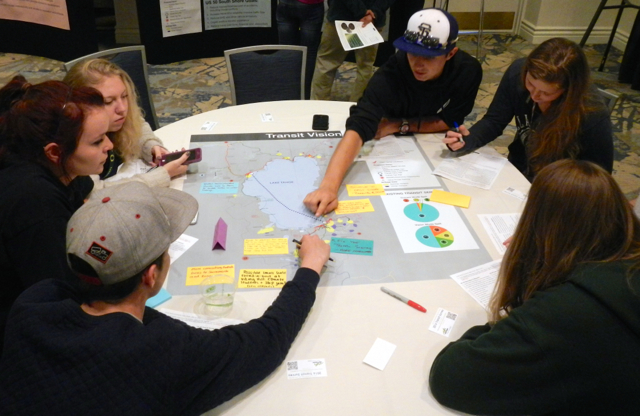
South Tahoe High School students talk about how to improve transportation on the South Shore. Photo/Kathryn Reed

South Tahoe High School students talk about how to improve transportation on the South Shore. Photo/Kathryn Reed

By Kathryn Reed

Traffic isn’t a problem on the South Shore – at least not compared to what it was like years ago.

Tim Fajen has been a valet since 1972, working most of the Stateline casinos in the last 40-plus years. In the 1970s there could be 700 cars a day to park at what was the Sahara. On Tuesday there were about 30 at the Hard Rock, he said.

The South Lake Tahoe resident was one of several dozen to attend a transportation meeting May 24 hosted by the Tahoe Regional Planning Agency and Tahoe Transportation District at Lake Tahoe Resort Hotel. The agencies had a similar open house on the North Shore last week.

When he saw the placard stating there will be a 20 percent increase in visitors in the next 20 years, he shook his head, questioning where this number came from and why its validity should be believed.

TTD used the numbers supplied by Airsage Analytics and modeling done by TRPA.

Fajen has only seen the number of visitors drop since 1990, so he wonders what in the next 20 years will make more people come to Lake Tahoe. That question was not part of the discussion Tuesday night.

The goal that night was to obtain input from residents about what they want transit and transportation to look like in the basin going forward. TRPA is updating its 20-year Regional Transportation Plan, which it does every four years to keep the document current and relevant. It should be done by the end of the year.

TTD was seeking input about its plans for the various corridors around the lake:

·      Highways 89 and 28 in California

·      Highway 28 in Nevada

·      Highway 50 on the East Shore

·      Highway 50 on the South Shore

·      Meyers/Y in South Lake Tahoe

·      Recreation along Highway 89.

A handful of South Tahoe High School students took the time to attend and give their input. (Plus, it meant extra credit for their environmental science class.) With a map of the lake on the table, they wrote ideas on sticky notes and filled out a survey.

Maia Smith, a junior, wants someone to deal with the congestion at Lake Tahoe Boulevard and Viking Way at the base of STHS.

“The four-way stop is really useless,” she told Lake Tahoe News. She said there have been a lot of car crashes and that inexperienced drivers don’t understand how a four-way stop works.

For senior Kylee Lyons she would like planners to address the backup in Camp Richardson along Highway 89.

“My idea is to put a skywalk in to cross above the traffic,” she said.

The problem, she and her classmates said, is that people jaywalk everywhere, thus bringing traffic to a standstill.

Karen Fink, TRPA transportation expert, told Lake Tahoe News an idea for Camp Rich is to have a bus lane to get tourists in particular to their destination faster. This would mean holding cars back to make this happen.

She said a bigger picture topic is looking at how visitors get to Tahoe and whether transit would be an option for them. She admitted this is only viable if there is a functioning transit system once they get to Tahoe, meaning it would be easier for them to not get in their personal vehicle.

On the North Shore officials are looking at increasing transit frequency, potentially having free bus service by 2020, completing the bike trail network and being a hub for waterborne transit.

The survey people were given in South Lake Tahoe asked:

1.     If it were your responsibility to decide how to invest in our transportation system over the next 20 years, in what order would you prioritize these tools?

·      Bike, pedestrian paths

·      Transit (more frequent and free)

·      Parking (to encourage transit)

·      Ferry (fast North to South shore)

·      Seasonal water taxi (connecting lake communities)

2.     Of the strategies listed below by corridor, which are the top 10 that you would like to see happen on the South Shore?

The answers late in evening revealed the following top 5 responses:

·      Expand bike trails

·      Cross lake ferry

·      Loop road

·      BlueGo enhancements

·      Transit oriented development at the Y.


Opinion: Time to stop Martis Valley West

By Ellie Waller

The community continues to deliver the message that they are unwilling to accept the Martis Valley West Parcel Specific Plan project as currently proposed.

But will the Placer County Planning Commission approve the project on June 9 anyway? Probably, unless we all stand up.

This is not the first time the community has resisted the plan. For more than three years, the community has consistently opposed efforts from East West Partners (now Mountainside Partners) to disturb 11 million square feet of soil on the ridge line.

Now, the 550-unit Brockway Campground is being proposed in the Lake Tahoe Basin as a separate project, although located immediately adjacent to Martis Valley West, and the impacts from both will be cumulative. Traffic and fire evacuation impacts, especially during peak hours, are some of the biggest concerns.

At the May 12 North Tahoe Regional Advisory Council meeting, NTRAC members were asked to make a recommendation to the Placer County Planning Commission for an upcoming June 9 hearing. Staff summarized the impacts and alternatives. Notably; when Alternative 1 (no project) was mentioned, the audience applauded wildly.

NTRAC questions/comments included:

  • There are many Significant & Unavoidable impacts.
  • Nine days is NOT enough time to review the Final EIR — therefore it is too soon to make a recommendation.
  • Last time, NTRAC specifically requested visual simulations be brought to the next meeting; however, the applicant had not done so.
  • Emergency evacuation — what are the nuts and bolts of how SR267 will handle traffic in emergency situations? (The applicant’s response was basically it’s Caltrans’ problem, not theirs.)
  • Concerns about night lighting impacts to Tahoe basin.
  • Affordable/workforce housing solution simply sets aside land for someone else to (maybe) propose workforce housing in the future: This does not guarantee workforce housing getting built.

Numerous motions were made by NTRAC. Finally, they approved “a motion to recommend the Planning Commission postpone their action on this item for 30 days to allow for ample time to review the final EIR. Further, that the Planning Commission be aware there are significant concerns with the project whether development is on the east or west side of Highway 267, as noted in tonight’s NTRAC meeting.”

Sierra Watch and Mountain Area Preservation representatives have said that with Brockway Campground included, the proposed project went far beyond what they agreed to in the Martis Valley Opportunity Agreement (MVOA) and pointed out it would be irresponsible to make decisions at such a fast pace on projects that will span generations. They noted that these decisions will “outlive us all”, and we shouldn’t rush this.

Modifying new Alternative 5 (418 units on 200 acres on the east side of Highway 267) by adding a conservation easement on the balance of the 6,100 acres would without a doubt eliminate any potential for Tahoe night sky light impacts and scenic violation impacts because it will not be located on a shared Tahoe basin ridge line, and there would be no recreational conflict to the Tahoe Rim Trail users.

The alternative would eliminate the sprawl of the current preferred alternative (418 units on 660 acres on the west side of Highway 267) and reduce traffic impacts by reducing the number of units by 45 percent.

Lastly, a majority of the public, agency and organization comments on the draft EIR requested changes in the FEIR to sufficiently examine the project’s impacts and possible ways to mitigate them. In most cases, these comments were ignored or insufficiently and unsatisfactorily addressed.

If this sounds familiar, it might be because a very similar situation is occurring with another large area development in Squaw Valley. Two things can be gleaned from these recent meetings:

1. We can still make a difference when we all speak up.

2. The developer will have a hard time selling any claims that the public supports these projects.

In closing, save the date, June 9, location and time to follow, for the tentatively proposed hearing before the Placer County Planning Commission on the Martis Valley West project — be there for Lake Tahoe.

Shame on Placer County for scheduling the Planning Commission meeting on high school graduation day. Many people have family coming to town, others will need to leave town to be with families.

I asked to have the meeting postponed to no avail.

Ellie Waller is a Tahoe Vista resident.


Group drops effort to repeal Nev. commerce tax

By Megan Messerly, Las Vegas Sun

A conservative group fighting for a repeal of a tax passed by the Nevada Legislature last session announced Wednesday that it is suspending its efforts.

The move comes just two weeks after the Nevada Supreme Court threw out more than 20,000 signatures to get the repeal on the ballot after determining that some of the summary language included on the group’s petition was inadequate.

The RIP Commerce Tax group determined that after the signatures were thrown out there was no way to gather the signatures needed before the June 21 deadline, said Controller Ron Knecht, who spearheaded the efforts, in an interview May 25.

Read the whole story


USDA adds warning label on beef

By Lydia Zuraw, Kaiser Health News

A new label on some of the steaks in your grocery store highlights a production process you may have never heard of: mechanical tenderizing.

This means the beef has been punctured with blades or needles to break down the muscle fibers and make it easier to chew. But it also means the meat has a greater chance of being contaminated and making you sick.

The labels are a requirement from the U.S. Department of Agriculture that went into effect this week.

Read the whole story


Nev. lawmakers discuss potential rules for the road

By Art Marroquin, Las Vegas Review-Journal

Making room for bicyclists, the potential impact of recreational marijuana and cellphone use while driving are among hot-button transportation topics that could be discussed when the Legislature meets in February, several Nevada lawmakers said Tuesday.

The aim, they said, is to create laws that will bring the 326 fatalities reported last year on Nevada’s roads down to zero.

Lawmakers may consider whether to increase fines for all drivers who hold their phone during calls and texts. For now, scofflaws pay $50 for a first offense, $100 for a second offense and $250 for a third offense, according to the Department of Motor Vehicles.

Marijuana was legalized for medical purposes in 2000, but voters will decide in November whether to legalize it for recreational use.

Read the whole story


Nevada approves energy-storing train

By David Z. Morris, Fortune

One of the biggest challenges of the shift to renewable energy like solar and wind is energy storage.

The wind or sun don’t always generate power exactly when it’s needed, so infrastructure needs to bridge the gap. Batteries are the most frequently discussed solution, but there are other options out there, many of them surprisingly low-tech.

In April, the Nevada Bureau of Land Management granted environmental approval and a land lease to Advanced Rail Energy Storage (ARES), a startup with an energy storage solution that’s both novel and old-school.

Read the whole story


Basic tips for living in bear country

With bears being out in force now, proper food storage and trash disposal is important.

There are an estimated 10,000 to 15,000 American black bears living in the Sierra Nevada and sharing habitat with humans.

Spring is the time of year when bears emerge from their winter dens in search of food. Bears are attracted to anything edible or scented. Once they get access to human food and trash, bears lose their fear of humans and can cause property damage and threaten public safety. Residents and visitors can help keep bears wild and reduce potential conflicts between bears and humans by properly storing food and trash.

The following are tips for safe-guarding a dwelling:

·         Purchase, store all trash in, and properly close bear-resistant garbage containers.

·         Freeze strong smelling left overs, such as fish, until trash day to reduce the smell.

·         Wait to put trash out until the morning of collection day.

·         Keep garbage cans clean and deodorize them with bleach or ammonia.

·         Don’t leave trash, groceries, or animal feed in your car.

·         Keep barbecue grills clean and stored in a garage or shed when not in use.

·         Refrain from putting out bird feeders from April through October.

·         Don’t leave any scented non-food products outside (or in your car), such as suntan lotion, lip balm, insect repellent, toothpaste, soap or candles.

·         Keep doors and windows closed and locked when the home is unoccupied.

·         Consider installing motion-activated outdoor lights, sprinklers and alarms, as well as electric fencing.

·         Harvest fruit off trees as soon as it is ripe, and promptly collect all fruit that falls.

·         Securely block access to potential hibernation sites, such as crawl spaces under decks and buildings.

·         Vegetable gardens, compost piles, orchards and chickens may attract bears. Use electric fences to keep bears out.

Tips for safe-guarding a campsite against a bear encounter:

·         Never feed wildlife.

·         Always store food (including pet food), drinks, toiletries, coolers, cleaned grills, cleaned dishes, cleaning products, and all other scented items as soon as possible after use in the bear-resistant containers (storage lockers) provided at your campsite.

·         Clean the barbecue grill after each use and store properly.

·         Always place trash in bear-resistant dumpsters in campground or in bear-resistant containers at your campsite and close and lock after each use. Never leave trash at a campsite.

·         Never leave scented items unattended in your campsite, tent, or car.


Snippets about Lake Tahoe

·      Early voting for the June 14 primary in Nevada begins May 28.

·      El Dorado County residents age 19 and older have an opportunity to get their high school diploma and career training through the library. For more info, go online.

·      Mountain Area Preservation is putting on a gathering June 1 from 5:30-7:30pm at the Truckee-Tahoe Airport that will focus on the Martis Valley West Parcel Specific Plan, final environmental impact report, and the June 9 Planning Commission hearing at Granlibakken. For more info, email info@mapf.org.

·      The Douglas County Public Library’s Toddler Storytime programs are June 7-July 26, Tuesdays at 10:30am at the Minden Library. Storytime is for children 18 months to 3 years old.

·       Mountain bikers are being asked to stay off Monument Trail because there was a substantial rockslide and the area is unstable. The U.S. Forest Service will be blasting soon.


SLT to have Memorial Day remembrance

The American Legion Post 795 of South Lake Tahoe is hosting a Memorial Day ceremony at 11am May 30 at the Happy Homestead Cemetery, 1261 Johnson Blvd, South Lake Tahoe.

After the ceremony, the public is invited to join Legion and Auxiliary members for refreshments at the American Legion Hall, 2748 Lake Tahoe Blvd.

Memorial Day honors men and women who died while serving in the U.S. military. Originally known as Decoration Day, it originated in the years following the Civil War and became an official federal holiday in 1971.

On Memorial Day weekend, members of the Auxiliary will be collecting donations for poppies, which have become a national symbol of Memorial Day. Poppy donation locations on May 27-28 include Raley’s and Safeway.

Happy Homestead is the final resting place to more than 560 veterans. Volunteers are encouraged to help place American flags at their grave sites starting at 9am May 27.


Study: Vegetation moving to adapt to climate

By Lake Tahoe News

Trees once found at lower elevations are moving higher in an attempt to adapt to climate change.

These are the findings of a study done by researchers at UC Davis.

The report was published this week in the “California Fish and Game” 2016 winter issue.

Signature tree species in the high Sierra Nevada forests – including mountain hemlock, red fir and western white pine – are shifting toward higher, cooler elevations, according to researchers.

They say the study foreshadows how climate warming may significantly alter entire habitats for multiple species. It will affect food supplies as well as forest soil.

The study says by the end of the century 16 of 29 vegetation communities in California, such as Pacific Coast salt marsh and high mountain conifer forest, are expected to be challenged by climate change.

Researchers at UC Davis completed the climate vulnerability study with funding from CDFW.