Haase hires ex-STHS coach for Stanford job

By Fresno Bee

Clovis West High boys basketball coach Tom Orlich, who won three Central Section championships and more than 300 games in 14 seasons, is retiring from his district job and will join the staff of new Stanford coach Jerod Haase.

Orlich’s retirement as a teacher and coach was announced in a Clovis Unified news release Friday. School administrators and Orlich met with players earlier to share the news and a timeline for hiring a replacement. A parent meeting is planned next week, according to the district.

His new job will be a reunion, having coached Haase at South Lake Tahoe High from 1988-92. Haase was hired away from the University of Alabama at Birmingham on March 25.

Read the whole story


Snippets about Lake Tahoe

·       Paradise Park in Meyers is looking for volunteers to help clean up the area on June 11 from 9am-1pm. Bring gloves, rakes and shovels.

·       University of Nevada Cooperative Extension’s Living with Fire Program team received the Great Basin Fire Mitigation, Education and Prevention Award at the Great Basin Fire Mitigation, Education and Prevention Conference in Boise, Idaho.

·       Drop off 1-gallon and 4-inch plastic plant containers that are in good condition in the bin provided at the South Tahoe Refuse transfer station located at 2140 Ruth Ave. in South Lake Tahoe, Monday-Friday during business hours through the month of June so they may be reused by the local master gardeners group.

·      The old Aviva Inn in Tahoe City is now a Basecamp Hotel similar to the one in South Lake Tahoe.

·       Incline Village Championship Golf Course will host glow-in-the-dark golf events on June 17 and Aug. 26. This family-friendly events will feature a nine-hole glow-golf putt-putt competition and a glow-in-the-dark chipping contest with special light-up LED golf balls. For more info, go online.


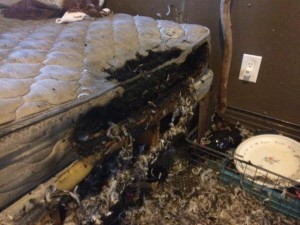
Mattress fire injures 2 in South Tahoe

Two people were hurt when a mattress caught fire. Photo/Provided

Two people were hurt when a mattress caught fire. Photo/Provided

An electrical short caught a mattress on fire Friday at a South Lake Tahoe hotel.

Two people staying in the room at the Sky Lake Lodge were taken to Barton Memorial Hospital with minor injuries.

The fire was contained to that one room.

— Lake Tahoe News staff report


Tahoe farmers markets ripe with action

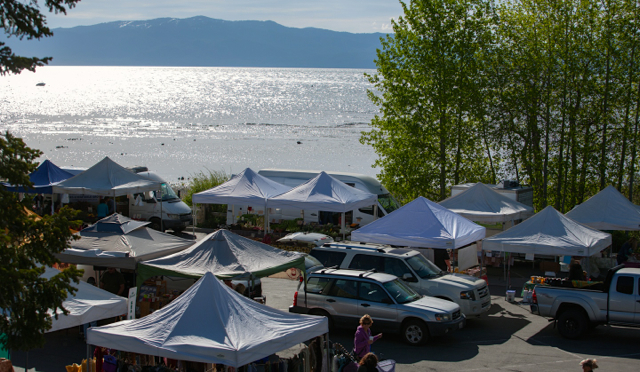
The farmers market in Tahoe City at Commons Beach is already open. Photo/Provided

The farmers market in Tahoe City at Commons Beach is already open. Photo/Provided

By Terra Breeden

Spring is upon us in Lake Tahoe, and with it, farmers markets are springing up all around the basin.

With the growth of the organic food movement, the popularity of farmers markets has exploded. Now, there are markets throughout Lake Tahoe all summer.

South Shore El Dorado County Certified Farmers Market  American Legion parking lot, South Lake Tahoe Tuesdays, 8am-1pm June 7-Oct. 11 Friday Evening Farmers Market at Kahle Community Center 236 Kingsbury Grade, Stateline  Fridays, 4-7pm June 3-Sept. 30 Ski Run Farmers Market 1132 Ski Run Blvd, South Lake Tahoe Fridays, 3-8pm June 3-Sept. 9 North Shore-Truckee Incline Village Farmers Market 995 Tahoe Blvd, Incline Village (Lake Tahoe School parking lot) Thursdays, 4-7pm June 2-Aug. 31 Tahoe City Farmers Market  280 N. Lake Blvd, Tahoe City (Commons Beach) Thursdays, 8am-1pm May 19-Oct. 13 Truckee Community Farmers Market 12047 Donner Pass Road, Truckee (in the Sears and Coffeebar Bakery center) Sundays, 10am-2pm June 5-Sept. 25
South Shore
El Dorado County Certified Farmers Market
American Legion parking lot, South Lake Tahoe
Tuesdays, 8am-1pm
June 7-Oct. 11
Friday Evening Farmers Market at Kahle Community Center
236 Kingsbury Grade, Stateline
Fridays, 4-7pm
June 3-Sept. 30
Ski Run Farmers Market
1132 Ski Run Blvd, South Lake Tahoe
Fridays, 3-8pm
June 3-Sept. 9
North Shore-Truckee
Incline Village Farmers Market
995 Tahoe Blvd, Incline Village (Lake Tahoe School parking lot)
Thursdays, 4-7pm
June 2-Aug. 31
Tahoe City Farmers Market
280 N. Lake Blvd, Tahoe City (Commons Beach)
Thursdays, 8am-1pm
May 19-Oct. 13
Truckee Community Farmers Market
12047 Donner Pass Road, Truckee (in the Sears and Coffeebar Bakery center)
Sundays, 10am-2pm
June 5-Sept. 25

“The markets are made up of a lot of really nice people,” Steve Rozier, who runs the Kahle Community Park and Incline Village farmers markets, said. “People are trying new things, seeing things they like, and buying them at a fair price – that’s why farmers markets are so popular.”

Each farmers market has its own vibe. They range from the relaxed, produce-specific farmers market like the Truckee Community Farmers Market to Ski Run Farmers Market, which is more family-oriented, and street fair like.

Some of the markets have been serving fresh fruits and vegetables to the local community for decades. The Tahoe City Farmers Market and the El Dorado County Certified Farmers Market in South Lake Tahoe are celebrating 21 years in the Lake Tahoe Basin this summer.

“The American Legion farmers market has been going for quite a while and we have quite a following,” co-owner Lois Coalwell said,” co-owner Lois Coalwell told Lake Tahoe News. “We try to do something special for the community and our mission is to sustain small family farms in El Dorado County.”

At the Tahoe City Farmers Market at Commons Beach, owner Bryan Kaminsky displays certified organic produce from his farm in Placer County such as tomatoes, squash, and free-range chicken eggs. Kaminsky began the Tahoe City Farmers Market in 1995.

“I wanted to create a place where people could eat good food, enjoy Lake Tahoe, and be with their family. The market is in the most beautiful location, it’s right on the lake and the booths are 100 feet from the water,” Kaminsky said.

A few farmers markets are new to the area. The Truckee Community Farmers Market is starting its second season and is already flourishing.

“Last year was a huge success and we’d love to see more people come out this year. We’re featuring some new vendors like the Kombucha Company, the Lobo Baking Company with artisan pastries and bread, and the Therapeutic Chef with homemade organic broths,” owner Jessie Phillips said.

Ski Run Boulevard's market opens June 3 in South Lake Tahoe. Photo/Provided

Ski Run Boulevard’s market opens June 3 in South Lake Tahoe. Photo/Provided

The Ski Run Farmers Market in South Lake Tahoe, now entering its seventh year, is known for its festival atmosphere. This family-oriented market features live music, kids’ karaoke, a bounce house, and face-painting as well as organic produce and craft vendors.

“We’ve been growing every year. We started with five vendors and this year we have 30,” owner Michaela Dickson told Lake Tahoe News. “We want to be more of a community gathering. People can listen to music and show their art. People aren’t just shopping, they are hanging out.”

Recently, Dickson considered moving the Ski Run Farmers Market to a new location because the event was blocking firetruck access from Ski Run Boulevard. However, instead of relocating, a fire lane will be opened alongside the market on Ski Run Boulevard to accommodate firetrucks.

“It’s made the market a little smaller, but we are hoping to expand another block,” Dickson said.

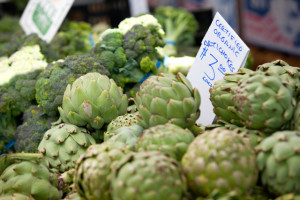
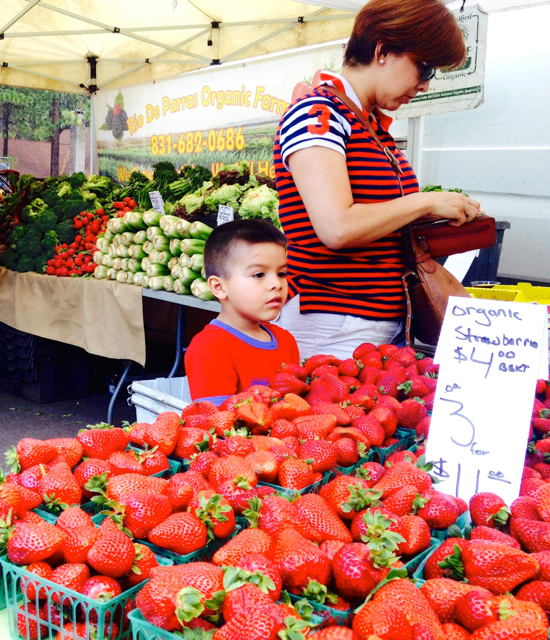
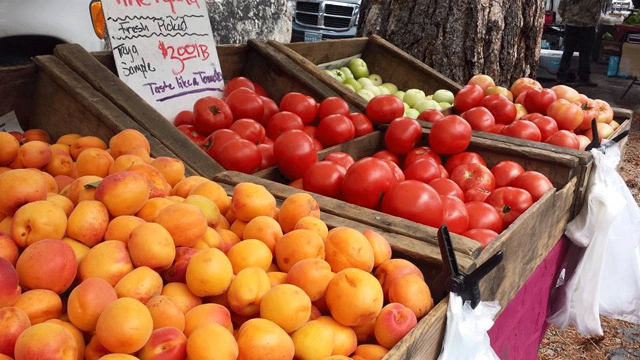
A variety of fruits and vegetables are available at all of the markets. Photo/Provided

A variety of fruits and vegetables are available at all of the markets. Photo/Provided

This year, the Incline Village Farmers Market has moved to the Lake Tahoe School parking lot, but will still be featuring all of the garden-fresh produce it’s known for.

“The Incline Village Farmers Market is geared toward promoting a healthy lifestyle for local people,” owner Rozier told Lake Tahoe News. “It’s a one-stop shop where you can grab organic fruits, veggies and meat.”

According to Rozier, last year was challenging for local farmers because of the lack of water. There were many fruits and vegetables that weren’t available at the markets. Strawberries, blueberries and raspberries growers were especially impacted by the drought because berries require a lot of water.

“When you farm in Nevada or California, you never know what the weather will be like” Rozier said. “Farmers have had to reinvent themselves and find drought resistant produce. Now they are using new farming practices such as drip lines, covering soil to keep moisture in the ground and finding ways to save water.”

However, this year’s wet winter has been good for local and regional farmers, and the selection of organic fruits and vegetables now available at local farmers markets is vast.


Opinion: Canada’s wildfire highlights trouble with fighting fire with fire

By Stephen Pyne

“And where two raging fires meet together, they do consume the thing that feeds their fury.” — William Shakespeare

The images are gripping. Horizons glow with satanic reds squishing through black and bluish clouds, as though the sky itself were bruised and bleeding. Foregrounds bristle with scorched neighborhoods still drifting with smoke and streams of frightened refugees, a scene more commonly associated with war zones.

But we’ve seen this before. Big fires are big fires, and one pyrocumulus can look pretty much like another. Communities with homes burned to concrete slabs, molten hulks of what once were cars alongside roads, surrounding forests mottled with black and green— these are becoming commonplaces.

What strikes me most about those Fort McMurray images making their way down from western Canada is the mashup of foreground and background, the collision of free-burning flames with a fossil-fuel powered society. The first form of burning dates back to the early Devonian, when life first colonized the continents. The second tracks the Anthropocene, when humanity changed its combustion habits and wrenched the Earth into a new order. At places like Fort McMurray the deep past and the recent present of fire on Earth rush together with almost Shakespearean urgency.

The plot is old, the stage setting and cast of players updated.

Monster fires are no stranger in the boreal forest. It’s a fire-ravenous biota that burns in stand-replacing patches. This is not a landscape where misguided fire suppression has upset the rhythms of surface burning and catapulted flames into the canopy. They’ve always been in the canopy and everything has adapted accordingly. White and black spruce and jack pine and aspen experience exactly the kind of fire they require.

How big those patches get depends on how dry the fuel is, how brisk the winds, and how extensive the forest. In northern Alberta there is not much to break a full-throated wildfire. The Chinchaga Fire started on June 1, 1950, and burned across northeastern British Columbia and most of Alberta until Oct. 31, a total of 3 million acres.

Nor is a burning city a novelty. In North America the wave of settlement in the 18th and 19th centuries paralleled a wave of fire. The surrounding lands were disturbed, and frequently alight with both controlled and uncontrolled fires. The towns were built of wood—basically, reconstituted forests. The same conditions that propelled fires through the landscape pushed them through towns.

Only a century ago did those urban conflagrations finally quell as urbanites turned to less combustible materials; fire codes and zoning regulations organized buildings in ways that discouraged spreading flames; fire services acquired the mechanical muscle to halt blazes early; and the wave of settlement flattened. Over the past century it’s taken earthquakes or wars to overcome these reforms in modern cityscapes, and unleash widespread conflagrations.

Meanwhile, a broadly rural scene morphed and polarized into an urban frontier of wildlands and cities that faced one another without intervening buffers. The middle, working landscapes, like the middle, working classes, shriveled at the expense of the favored extremes. In 1986 the term wildland urban interface appeared. It was a clumsy, dumb phrase, but it referred to a dumb problem. Watching houses, and then communities burn was like watching polio or plague return. This was a problem we had solved, then forgot to—or chose not to—continue the vaccinations and hygiene that had halted their terrors.

Initially, the problem appeared a California pathology. But it soon broke out of quarantine and has spread across western North America. The prevailing narrative held that the problem was stupid Westerners building houses where there were fires. Most of the vulnerable communities, however, are in the Southeastern U.S., and if climate change modelers are correct, we will see the fires moving to where the houses are. That will make it a national narrative. In truth, the problem is international, each country with its own quirky combination of fire-quickening factors. Mediterranean France, Portugal, Greece, South Africa, and Australia are experiencing similar outbreaks. North America has no monopoly over catastrophic conflagrations.

It’s tempting to appeal to climate change as the common cause. Yet the burning bush and scorched town are joined not just by global climate change, but by a global economy, and a global commitment to fossil fuel firepower. That makes the issue both more pervasive and, paradoxically, more amenable to treatment. It means that, while there is one grand prime mover, there are many levers and gears. Fire is a reaction that takes its character from its context. It’s a driverless car barreling down the road, synthesizing everything around it.

The enduring images of the Fort Mac Fire may, in fact, be its cars. Car-propelled flight, cars stranded for lack of gas, cars melted in garages, evacuation convoys halted due to 60 meter flames, relief convoys laden with gasoline. It isn’t only what comes out of the tailpipe that matters, but how those vehicles have organized human life in the boreal. The engagement (or not) with the surrounding bush. The kind of land use that cars encourage. The kind of industry that must develop to support those cars. The kind of city that such an industry needs to sustain it. The oil sand industry that has shaped the contours of modern Fort McMurray is in turn shaped by the internal-combusting society it feeds.

So there are really two fires burning around and into Fort McMurray. One burns living landscapes. The other burns lithic landscapes, which is to say, biomass buried and turned to stone in the geologic past. The two fires compete: one or the other triumphs. At any place the transition may take years, even decades, but where the industrial world persists its closed combustion will substitute for or suppress the open flames of ecosystems. The wholesale transition from the realm of living fire to that of lithic fire may stand as a working definition of the Anthropocene. Once parted they rarely meet.

At Fort McMurray they have collided with unblinking brutality. Wild fire burned away controlled fire. The old fires have forced the power plants behind the new ones to shut down and their labor force to flee. It’s like watching an open pit mine consume the town that excavates it. It’s tempting to regard the incident as a one-off, a freak of a remote landscape and a historical moment. But those collisions are becoming more frequent.

That’s not the deep worry, however. The deep horror is that the two fires may be moving from competition into collusion. They are creating positive feedback of a sort that makes more fire. Those images of fire on fire are the raw footage of a planetary phase change, what might end up as a geologic era we could call the Pyrocene. They will continue until, as Shakespeare put it, they “consume the thing that feeds their fury.”

Disaster is not always tragedy, and Fort McMurray and the industrial complex behind it may well escape lethal consequences. So if Shakespeare seems too elevated, consider Edna St Vincent Millay.

My candle burns at both ends
It will not last the night;
But ah, my foes, and oh, my friends—
It gives a lovely light.

We have in truth been burning both ends of our combustion candle, and if its light seems more lurid than lovely, there are yet texts to be read in the awful splendor of its illumination.

Stephen Pyne is a professor in the School of Life Sciences, Arizona State University, and author most recently of “Between Two Fires: A Fire History of Contemporary America”.

This article was written for Future Tense, a Zócalo partner. Future Tense is a project of Arizona State University, New America and Slate. A version also appeared on Slate.com.
More plastic than fish in oceans by 2050

By Ivana Kottasova, CNN Money
 
The world is flooded with plastic garbage.

There will be more plastic than fish in terms of weight in the world’s oceans by 2050, the World Economic Forum warned.

Plastic has become one of the world’s most popular materials, combining amazing functionality and very low production costs. Its use has increased twentyfold in the past 50 years and is expected to double again in the next 20 years.

Almost everybody in the world comes into contact with it — over a quarter of all plastic is used for packaging, the most popular use of the material.

Read the whole story


Yosemite waterfalls roaring after years of drought

By Tom Stienstra, San Francisco Chronicle

If item No. 1 on your summer to-do list is to witness the booming waterfalls of Yosemite National Park, you’re in for a treat. Water levels appear to have rebounded from four years of drought and we’re now in a window of peak waterfall conditions.

U.S. Geological Survey numbers indicate water under the Pohono Bridge at the west end of the Yosemite Valley has been climbing, and reaching heights not seen since 2012.

The water level has peaked between May 19 and June 29 in recent years, but the high water mark hasn’t crested above 8 feet in four years, according to the USGS.

Read the whole story


Master gardeners putting on educational plant sale

UCCE Master Gardeners of Lake Tahoe’s annual Jamboree and Plant Sale is June 11.

Master gardeners will be on hand to answer questions about gardening at Tahoe. Whether it is growing vegetables, learning which plants attracts butterflies and bees, finding out
how to keep a garden growing with less water, or learning about various phenology studies that are taking place in our area, the information will be available.

The event is form 9am-1pm at the Lake Tahoe Community College Demonstration Garden in South Lake Tahoe.

Tours of the garden will also be offered.

The funds raised through the plant sale will help offset program costs such as printing materials, seeds, soil and other materials used in teaching demonstrations.


Letters: Realtors take issue with SLT VHR rules

To the community,

The South Tahoe Association of Realtors (STAR) is opposed to the moratorium on multi-family units being allowed to operate as vacation home rentals (VHRs), recently adopted by the South Lake Tahoe City Council.

STAR, a not-for-profit trade organization that represents more than 300 Realtor members, wants to make it clear, to the City Council and the public, that we support affordable and workforce housing in South Lake Tahoe and recognize that there is a housing crisis; especially the lack of available long-term rentals. STAR is a member of, and supports the St. Joseph’s Community Land Trust, a nonprofit organization whose mission is to make home ownership and rentals affordable today and for future generations. SJCLT acquires or develops properties and programs to help address the lack of affordable housing. STAR collaborated with SJCLT to help them build their first demonstration home, including procuring
grant funds from the California Association of Realtors Housing Affordability Fund.
STAR members have also volunteered and served on various Affordable and Workforce Housing Task Force committees in the past, including with Tahoe Tomorrow, the chamber of commerce and other organizations, in conjunction with the TRPA.

These Realtor volunteers and community leaders collaborated to find and advocate for practical solutions.

These efforts halted when the Great Recession hit, and housing prices dropped dramatically. The focus shifted elsewhere.

STAR’s mission is to educate its members and the public; advocate for private property rights and home ownership; contribute to the community’s wellbeing; uphold professional standards; thereby providing resources enabling our members to serve the public and work together cooperatively.

While we support affordable and workforce housing development and retention, STAR is opposed to the ordinance recently adopted by the city, which is essentially a moratorium on allowing multi-family properties to operate as a VHR. We agree that these properties are good candidates for longterm rentals, but we take issue with the fact that the city is taking away an owner’s option to choose.

The city has already impinged on property rights to such an extent that there is little tolerance for further limitations.

It should be left up to each property owner to make the decision to long term rent or not. VHRs of this size typically are not revenue producers, and are not the source of nuisance issues such as excessive noise, trash or parking, due to lower occupancy.

Only 55 of 1,800 VHRs are multi-family units. Many owners, given the choice of leaving the property vacant or longterm renting, will opt to leave it vacant so that they will still have a place to stay when they visit Tahoe.

This ordinance will not achieve the results desired by the city. We cannot regulate our way out of this incredibly complicated problem that is faced by all popular resort destinations. We implore that the city appoint a special task force and allow Realtros to work with them, and all stakeholders, toward  finding alternate solutions to South Lake Tahoe’s housing availability problem. A viable solution will have incentives, rather than further limitations on private property rights, with more regulations for property owners to navigate.

Thank you for your time, attention and consideration.

Ellen Camacho, 2016 STAR president


Survey: Pot legalization, tax hikes backed in Calif.

By Christopher Cadelago, Sacramento Bee

With recreational marijuana headed for the fall ballot, a new poll finds that 60 percent of likely voters support the concept of legitimizing the drug in California.

The Public Policy Institute of California, in a poll out Wednesday, looked at the general popularity of other issues expected on the Nov. 8 ballot.

A majority of likely voters, 67 percent, back boosting the tax on tobacco purchases to fund healthcare programs. Separately, 58 percent support extending income taxes on annual earnings exceeding $250,000 for a dozen years to pay for schools and healthcare.

Read the whole story