Calif. law would allow people to smash car windows to rescue pets

By Jeremy B. White, Sacramento Bee

By the time Sharie Lesniak finished her errand at the bank, the dog she had noticed waiting in a car on her way in had started panting and showing signs of distress.

So Lesniak called 911. Before the authorities arrived to free the animal, the owners showed up. They weren’t pleased.

As the founder of mydogiscool.com, a website devoted to guarding against dogs overheating in cars, Lesniak was accustomed to explaining the law against endangering animals by leaving them in hot vehicles. She knew she could call the authorities.

But a new bill would give her another option, allowing Californians to smash car windows and break imperiled animals out of vehicles that are too hot or cold without facing a civil lawsuit.

Read the whole story


Park Service considers visitor caps

By Amy Beth Hanson, AP

As the National Park Service kicks off a centennial summer expected to draw record crowds, the agency is seriously considering caps on how many people pass through some of the country’s most iconic landscapes and historical sites each day.

Park managers have begun looking at whether, when and how best to manage the impact of more people on the parks, their features and the visitors’ experience.

“Fundamental to the mission of the National Park Service is preservation of natural and cultural resources, social and ecological values, for the enjoyment, education and inspiration of this generation and those to come,” said Rose Keller, social scientist at Denali National Park and Preserve in Alaska.

Denali and Yellowstone plan to survey visitors about their experiences this summer, hoping the responses will provide insight on what limitations visitors might accept.

Arches and Canyonlands national parks in Utah have been taking public comment on their plans for tighter rules about how many people can be in the park at the same time. Grand Teton National Park in Wyoming should announce by the end of the year how it intends to limit access to a popular roadway.

It’s not clear how individual parks would make up for any shortfall in revenue from letting in fewer paying customers. Some parks, including Mesa Verde National Park in southwestern Colorado, already employ congestion pricing, charging more per person and per vehicle during the peak season that begins this weekend.

Last summer at Grand Canyon National Park, park managers increased entrance fees and moved lines along by dedicating an entrance gate to people who already had an annual park pass. They also promoted the use of shuttles.

Nearly 4.1 million people visited Yellowstone National Park in 2015, a 17 percent increase in visitors over 2014 — or an additional 580,000 people. There weren’t enough bathrooms or parking spaces. Trash cans overflowed. Wildlife jams caused waits of up to two hours along park roadways. Staff and visitors reported pulses of crowding at popular spots, partially due to an increasing number of tour buses, Yellowstone social scientist Ryan Atwell said.

This season, the park hired extra workers and added bathrooms and trash cans in key locations. Yellowstone has seen a 60 percent increase in visitation in the first few weeks of the 2016 season, Park Superintendent Dan Wenk has said.

If the growth continues, Wenk told a gathering of business people last week, he could envision a peak-season limit on Yellowstone visitors, albeit not for at least a decade.

“We realize that currently we’re on an unsustainable course in terms of demands for visitation compared to the ability of the current park system to handle it,” Atwell said.

Last year’s record crowds pushed Yellowstone over some thresholds as far as employee and visitor safety and propriety, he said.

In 2015, interpretive rangers gave out 52,036 resource warnings for behaviors such as threatening thermal features, approaching wildlife too closely, hiking in restricted areas and “taking bathroom breaks outside of the restroom.” That number was a 19 percent increase over the 43,558 citations issued in 2014.

From 2014 to 2015, motor vehicle accidents with injuries were up 167 percent, emergency medical transports to facilities outside the park were up 37 percent and search and rescue operations were up 61 percent, Atwell said.

In anticipation of another record year, people who plan to check out Yellowstone’s grandeur are being asked to be patient and plan ahead, respect the park, consider entering the park before 9am or after 3pm to avoid larger crowds, drive responsibly and learn how to travel in bear country. Visitors are reminded to stay on the boardwalks, because hot springs have caused more injuries than wildlife. Park officials also urge visitors to “practice safe selfies” and not approach wildlife to take pictures.

Arches and Canyonlands national parks in Utah are looking at additional options to address increased visitor numbers, including a timed entry system, building more parking lots and other infrastructure, setting a daily cap on vehicle entrances and adding a private shuttle service.

Grand Teton expects a final decision by the end of the year on a proposal to limit visitor capacity on the 7.1-mile Moose-Wilson Corridor to 200 cars at a time, which would include implementing wait times during peak visitation days and times. Visitors to the Laurance S. Rockefeller Preserve in Grand Teton are limited by the 50 available parking spaces, park spokeswoman Denise Germann said.

“What we’re trying to create and manage is the experience that you come to the Moose-Wilson to enjoy, and protect the resources of that corridor,” Germann said.


Snippets about Lake Tahoe

·       El Dorado Winery Association is celebrating the repeal of Prohibition with the inaugural Blind Barrel wine event on June 25 from 6-10pm at Boeger winery. Purchase tickets online.

·       Volunteers are needed for the North Lake Tahoe business walk in June. Sign up online.

·       The 11th annual Tahoe City Wine Walk is June 18 from noon-4pm. Tickets are $40/person in advance – online.

·       The 27th annual Georgetown Kids Fishing Derby is June 4 from 8am-1pm at Lake Walton. It is for ages 12 and younger.

·       Here is the El Dorado-Tahoe roadwork schedule from Caltrans for this week.


Highway memorial to honor EDC resident

Caltrans is scheduled to install memorial highway signs to honor longtime El Dorado County resident and rancher Gene Chappie in recognition of his four decades of service representing the citizens of the county and state.

The Eugene “Gene” Chappie Memorial Highway signs will be installed along Highway 193 in Cool the week of June 13.

There will be a reception to honor Chappie on June 18 at 10am at Pilot Hill Grange, 1701 Highway 193 in Cool.

Chappie dedicated his life to serving his country, his county and the American people. In 1941, after graduating from high school, Chappie joined the Army and was promoted to the rank of captain while serving in the Pacific Theater during World War II. He would again serve his country during the Korean War. After the Korean War, Chappie returned to the family ranch in Cool.

In 1950, Gov. Earl Warren appointed Chappie to the El Dorado County Board of Supervisors. Chappie represented the residents until his election to the California  Assembly in 1964. As an assemblyman, Chappie represented the residents of the 6th and 3 rd Assembly Districts until his election to the House of Representatives in 1980. As a congressman, Chappie represented the residents of the 1st and 3rd Congressional Districts until his retirement in 1986, allowing him to return full-time to the family’s ranch in Cool.


Smartphones could fuel Internet gambling

By Wayne Parry, AP

Internet gambling has tremendous growth potential in the United States as ever-greater percentages of the public use smartphones, participants in a major gambling conference said Wednesday.

At the East Coast Gaming Congress and iGaming Institute in Atlantic City, casino and online gambling executives said the online gambling market has shown encouraging growth, but is still a fraction of what it could be.

They also said nearly three years of experience has shown that Internet gambling is not cannibalizing their existing brick-and-mortar casinos, but rather bringing in new customers, many of whom then visit the physical casinos as well.

“We’re seeing huge growth in mobile phone and tablet play,” said Luisa Woods, executive director of Internet marketing for Atlantic City’s Tropicana casino. “And we’re seeing huge cross-flows between players who visit the casino and then go home and continue to play online.”

Internet gambling brought in $160.7 million in 2015 in the three U.S. states that allow it. New Jersey is by far the largest market, at $148 million. Delaware brought in $1.8 million last year, and Nevada, which stopped reporting its Internet winnings publicly, is estimated at about $10 million in their poker-only market, said Eugene Johnson, senior vice president of Spectrum Gaming Group, an Atlantic City-area consulting firm.

The industry still needs to do a better job of marketing itself, many participants agreed. Itai Pazner, senior vice president of 888 Holdings, said when customs questioned him at Newark Liberty International Airport on his way to the conference, he told them he works for an Internet gambling company.

“Is that legal in New Jersey?” the agent asked Pazner.

“A lot of people are confused,” he told the conference at Harrah’s Waterfront Conference Center. “They don’t know if it’s legal, if it’s illegal, if it’s good, if it’s bad. We need to educate people.”

There was no mention at the conference of perhaps the greatest threat to the fledgling Internet gambling industry: the avowed opposition to it from casino billionaire Sheldon Adelson, who has promised to spend as much as it takes to enact a legislative ban on it in the United States.

Another major challenge is getting additional states to approve Internet gambling. Because only three states now offer it, the prize pools for online poker are small, and that is holding the industry back, participants agreed.

“Poker without enough liquidity isn’t viable,” Pazner said. “The markets are still relatively small. The U.S. needs more states (to legalize Internet gambling) and we need them urgently.”

He said Europe has more readily embraced Internet gambling, adding, “There is huge potential growth on both sides of the ocean.”

George Rover, deputy director of New Jersey’s Division of Gambling Enforcement, said unlicensed offshore sites still pose a major problem for legal Internet gambling sites by siphoning away customers and revenue to unregulated sites with no customer protections.

He said the state has been formulating plans to deal with such sites, promising a development on the issue soon.

Thomas Winter, vice president of Internet gambling for the Golden Nugget casino in Atlantic City, said his casino has seen good growth across its Internet platforms. But he said some customers still need to be assured of the integrity of Internet gambling.


Invasive species may be traveling on firewood

Californians can help protect urban and wildland trees this summer by buying firewood local to where they will be using it and not moving it from one place to another, according to officials.

“Time and time again we see invasive species spread long distances as a result of firewood movement. This is something we can all help stop. Keeping firewood local is such an easy way for all of us to help do our part to protect our trees and the forests we love,” Katie Harrell, California Firewood Task Force chair, said in a press release.

Invasive species such as the goldspotted oak borer, shot hole borers, sudden oak death, and pitch canker are killing millions of trees in California, and all can move on firewood. Over the past year alone, the goldspotted oak borer, Kuroshio shot hole borer, and polyphagous shot hole borer have spread to new counties in Southern California as a result of firewood and green waste movement, officials said.

For more information on invasive species in California’s forests or the risks of moving firewood, go online.


Tahoe Tails — Adoptable Pets in South Lake Tahoe

Kara

Kara

Kara is an 18-month old German shepherd-border collie mix who is very skinny right now. She is a very sweet dog with many shepherd traits, including that she is very smart, but she has had little training and will do best with some classes.

She is good with dogs, cats and kids. Kara has beautiful smooth fur despite being underweight and will make a wonderful pet.

Kara is spayed, microchipped, tested for heart worm, and vaccinated. She is at the El Dorado County Animal Services shelter in Meyers, along with many other dogs and cats who are waiting for their new homes. Go to the Tahoe animal shelter’s Facebook page to see photos and descriptions of all pets at the shelter.

Call 530573.7925 for directions, hours, and other information on adopting a pet.

For spay-neuter assistance for South Tahoe residents, go online.

— Karen Kuentz


Clear Creek: Varied landscape, fabulous views

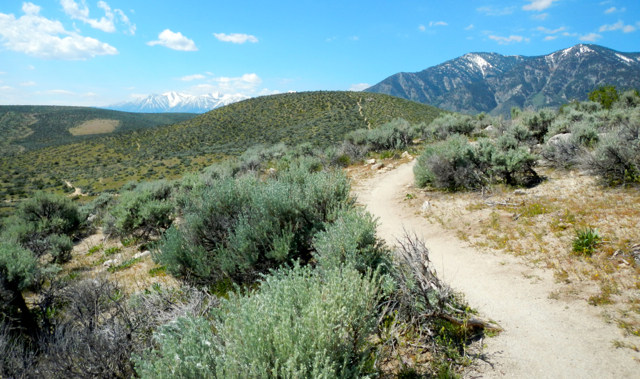
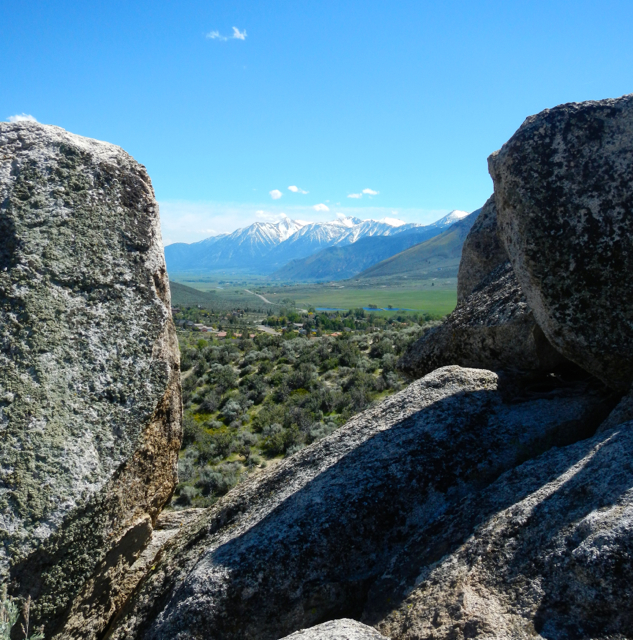
Dropping in elevation means being able to see the mountains instead being immersed in them. Photo/Kathryn Reed

Dropping down in elevation means being able to see the mountains instead being immersed in them. Photo/Kathryn Reed

By Kathryn Reed

CARSON CITY – Rugged, desolate, colorful, stark, verdant, snow capped. Clear Creek Trail has it all.

Sagebrush is everywhere at the start, then it starts to peter out as the trail keeps going west into the mountains. The pines bring welcome shade. But they are never as thick and tall as hiking in the Tahoe basin.

A swath of mule’s ear blankets one section. But this is not a wildflower hike. A few snow plants are protruding and tiny wildflowers are out. This hike is about the views in the distance, not what’s immediately on the ground.

Butterflies are the most prominent fauna. Photo/Kathryn Reed

Butterflies are the most prominent fauna. Photo/Kathryn Reed

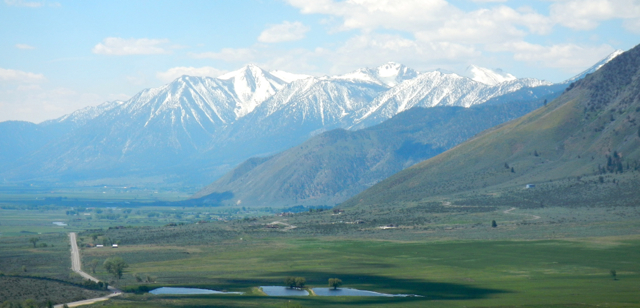
Still, the contrast in the landscape is welcome. As Sue put it, it was a nice change to be looking at the mountains instead of being in the mountains. The snow-capped peaks of the Carson Range were immediate, while the Pine Nuts were off in the distance.

The fertile Carson Valley seemed to never end. The lush green was clearly providing plenty of natural food for the cattle.

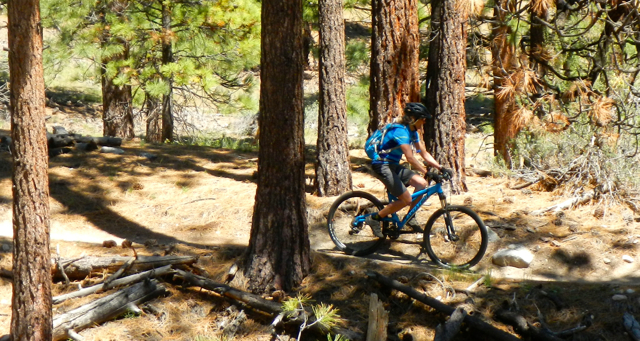
The trail is a mix of soft dirt and loose sand. It’s definitely single track. Most of the time there is enough room to comfortably get out of the way of mountain bikers. If sharing the trail is not your thing, this is not your hike. More mountain bikers were on this trail that is managed by the Carson Valley Trails Association than hikers.

Clear Creek is a popular mountain biking trail. Photo/Kathryn Reed

Clear Creek is a popular mountain biking trail. Photo/Kathryn Reed

At times the trail crosses private property. Signs say as much, and they ask people to stay on the trail. It proves public-private partnerships can work.

Our destination was The Knob. Having never been on the trail we didn’t know what outcropping we were headed to. I’m not sure it was ever distinct from the trail. It’s actually good there was a sign pointing us toward it.

From The Knob mostly the Carson Valley spills forth. Immediately to the left it’s possible to see vehicles coming down Spooner Summit, but it’s impossible to hear them. Greens belonging to the private Tahoe Golf Course seem within reach.

There is something to look at around every switchback. Photo/Kathryn Reed

There is something to look at around every switchback. Photo/Kathryn Reed

The 14-mile round trip hike in some ways feels less than that because the grade is gradual (5 percent or less most places) and the elevation gain (start 4,950 feet, highest is 6,200 feet) is not that much. Plus, the highest point is the same as Lake Tahoe’s elevation.

About 3,100 acres here are managed as winter deer range. After a fire in 1966, 700 acres were replanted for forage and ground cover. While this is mule deer country, we didn’t see any. In fact, other than hearing a few birds the fauna did not make themselves known.

Dogs are allowed off leash if they are under control. This is rattlesnake country, so that is something to consider. Clear Creek provides water, at least in May. This is one of those hikes, though, where I was glad I brought water for AJ. Even in May she needed more than just the stream crossing.

A gentle breeze cooled us off. This would definitely be a super hot trek in mid-summer.

Much of the trail is exposed. Photo/Kathryn Reed

Much of the trail is exposed. Photo/Kathryn Reed

—–

Getting there:

It will depend where you are coming from because the trail can be accessed from Kingsbury Grade or Spooner Summit.

The trail begins on the southwest side of Jacks Valley Elementary School.

Coming from Kingsbury Grade it is on the left side. It is well marked.


Opinion: Climate change poses risk to Nev. economy

By Andy Wirth

As the leader of a major destination mountain resort in North America, thankfully located in the Reno/Tahoe area, I am deeply concerned about the risk that climate change poses to our industry, and our entire region’s economy. Climate change has already begun to reveal itself as persistent drought in the Sierra Nevada, lower snowpack, increased number and scale of forest fires, and the substantially increased volatility of weather patterns across our great state.

Andy Wirth

Andy Wirth

None of this will help our local outdoor recreation economy and our region’s overall economy.

Meanwhile, the Reno/Tahoe area is still working to recover from a recession that hit our
community hard, in many ways much harder than the recent drought. Widespread economic downturns like the one we began to experience in 2008 impact tourist areas dramatically, since travel and recreation are often the first things cut from family budgets.
These two issues – climate change and a recovering economy – might not seem related, but
there is a very real nexus between the two.

Only by addressing those aspects of climate change that are already impacting our region can we ensure long-term economic growth and a sustainable economy. Fortunately, we are incredibly well positioned to do so in Nevada.

Nevada has such great clean energy potential that we can not only meet our own energy needs easily with solar and geothermal, but we also have the very real potential to export renewable energy to states like California. We can lead the nation on clean energy and build a stronger and more diverse local economy at the same time.

Unfortunately, our region finds itself on a different path.

NV Energy, our state’s largest utility, sends billions of dollars a year out of Nevada by importing coal and natural gas from other states. Earlier this month, NV Energy protected jobs for people in Arizona by announcing the purchase of another out-of-state natural gas plant. This is decidedly disappointing to all of us in Nevada and the region, as there is a very real, plausible and fiscally responsible alternative: investing in Nevada’s renewable energy. These actions would create jobs here for you and your neighbors.

So what’s standing in the way of Nevada’s transition to clean energy? Many Reno residents
probably don’t realize that over one-quarter of their electricity comes directly from a dirty,
expensive, outdated coal plant – North Valmy. This coal plant, far away near Battle Mountain, is quite literally NV Energy’s dirty little secret. Valmy generates more climate-disrupting carbon pollution than any other single source in Nevada.

Currently Valmy is scheduled to continue operating until 2025, importing coal from Wyoming, spewing air pollution and accelerating the climate change that’s devastating our industry and our future. It’s time to end coal burning at Valmy and replace it with clean, affordable renewable energy. We must continue the forward progress we’ve made by bringing clean tech businesses like Tesla, Switch, Apple, Patagonia and Faraday to the region. We can’t attract and retain these types of businesses if we are unable to supply them with the clean energy that is key to their business models.

Luckily, we have an opportunity before us right now to do just that. Gov. Brian Sandoval’s Clean Energy Industry Task Force is considering recommendations this month on legislation to accelerate our transition to clean energy. The most important recommendation they could make would be to end coal burning at Valmy by 2020. I hope the Task Force will take a hard look at Valmy (and the out-of-state coal that powers it) as an opportunity to keep our energy dollars here at home. Let’s transition away from polluting coal energy and build in its place the 100 percent clean energy that is our region’s indisputable future.

Sincerely,

Andy Wirth, chairman Reno Tahoe Airport Board of Trustees
Chairman, Regional Air Service Corporation
President and CEO Squaw Valley Ski Holdings


Hiring hurdle: Finding workers who can pass a drug test

By Jackie Calmes, New York Times

SAVANNAH, Ga. — A few years back, the heavy-equipment manufacturer JCB held a job fair in the glass foyer of its sprawling headquarters near here, but when a throng of prospective employees learned the next step would be drug testing, an alarming thing happened: About half of them left.

That story still circulates within the business community of this historic port city. But the problem has gotten worse.

All over the country are struggling to find workers who can pass a pre-employment drug test.

That hurdle partly stems from the growing ubiquity of drug testing, at corporations with big human resources departments, in industries like trucking where testing is mandated by federal law for safety reasons, and increasingly at smaller companies.

But data suggest employers’ difficulties also reflect an increase in the use of drugs, especially marijuana — employers’ main gripe — and also heroin and other opioid drugs much in the news.

Read the whole story