Kings Beach redevelopment subject of meeting

kings beachOwners of what has been known for years as the Ferrari Crown Resort in Kings Beach plan to modernize the lakefront area.

Laulima Partners of San Francisco this spring bought the acreage, which spans both sides of Highway 28.

They are proposing a lodging and commercial-residential redevelopment project for the 4½-acre site once owned by the Ferrari family. However,  no additional rooms are planned. Today there are 117 rooms for tourists and 34 residential units.

“We believe this project really continues in the spirit of the Ferrari legacy, of the Kings Beach Vision Plan and of the $44 million spent on the Kings Beach Commercial Core Improvement Project,” David Bouquillon, managing partner with Laulima Partners, said in a press release. “Our goal is to complement the character of the community and act as an economic catalyst for business and tourism in town.”

The new owners are putting on a community workshop in June 21 from 6-7:30pm at the North Tahoe Event Center.

More information about the project is available online.

— Lake Tahoe News staff report


Judge gives Caesars temporary reprieve

By Tracy Rucinski, Reuters
 
A U.S. judge on Wednesday temporarily halted lawsuits seeking $11.4 billion in damages from Caesars Entertainment Corp on Wednesday, urging the parties in the bankruptcy of its operating unit to settle before an injunction expires in August.

The bankruptcy of the operating unit, Caesars Entertainment Operating Corp (CEOC), in January 2015 has pitted some of the most aggressive investors on Wall Street against each other.

Several hedge funds that own bonds are suing the Caesars parent in New York and Delaware, alleging it reneged on guarantees from bonds issued by CEOC prior to the unit’s $18 billion bankruptcy.

Caesars is the parent company of Harrah’s Lake Tahoe and Harveys in Stateline.

Read the whole story


Foothill wines score at Calif. State Fair

By Chris Macia, Sacramento Bee

The sheer amount of sipping makes it look like a bacchanal of the highest order. We’re talking 2,854 wines from from than 750 California producers, a veritable ocean of fermented grape juice.

But for the 55 judges at the 2016 California State Fair Commercial Wine Competition, evaluating all these wines isn’t an excuse to get loose, but a serious exercise in wine sensory analysis.

Many local wines fared well in the “best of California” categories, which acknowledge the best wines by varietal.

Read the whole story


Calif. Legislature approves $171 billion budget

By Chris Megerian, Los Angeles Times

With concerns about the potential for another recession casting a shadow over this year’s budget negotiations, California lawmakers approved a new $170.9-billion spending plan on Wednesday that increases some funding for social services but stashes more away in a rainy-day fund.

Although lawmakers are finishing their work on this year’s budget, some of the most consequential decisions for the state’s financial future may not be made until the November election. Voters will likely be asked whether to extend higher taxes on the wealthy, increase the levy on cigarettes or borrow billions of dollars to build and renovate schools.

It’s a classic example of California’s dual-track system for managing its finances, with some decisions made in the Capitol and others at the ballot box.

Read the whole story


K’s Kitchen: Zucchini on the barbecue

By Kathryn Reed

Anyone who has ever grown zucchini knows that it is for sharing because there is no way one family, let alone one person, can eat an entire harvest.

Not only that, at some point it seems like you run out of ways to cook it.

But the nice thing about zucchini is that it is so versatile. It can go in Asian, Italian, Mexican and most any ethnic dish.

Barbecuing it is another alternative. The thing, though, about zucchini is that it is rather bland all on its own.

For this recipe, be sure to cut the zucchini the same thickness so the pieces cook at the same rate. You won’t need a super hot grill. While an oven would work for this recipe, there is something about having the grill marks that says summer.

Using the burner on the barbecue for the topping meant it stayed in a spreadable consistency. The concoction would work well on other vegetables, too.

zucchiniBarbecued Zucchini with Feta

1 medium zucchini

2 small yellow squash

¼ C feta, crumbles

2 T butter

¼ C chives, chopped finely

1 large lemon, juiced

Cut the ends off the zucchini and discard. Slice zucchini length-wise.

Melt the butter, cheese, lemon juice and chives together.

Baste one side of zucchini. Grill until there are char marks, baste the other side, then flip to get marks on second side.


CHP wants to hear from South Shore residents

On June 24, members of the California Highway Patrol Meyers office are hosting “coffee with a cop” at Aplina Cafe in South Lake Tahoe.

This is an opportunity for community members to ask questions and learn more about the department’s work in El Dorado County. The program aims to advance the practice of community policing through improving relationships between police officers and community members.

The event begins at 9am.


Placer County going after unpaid TOT

Placer County is getting aggressive with hotel tax collections.

Supervisors this month approved a $175, 000 contract with MuniServices of Fresno to assist with conducting more frequent inspections of records, and ensuring lodging operators are complying with the requirement. There are nearly 4,000 lodging operators in Placer County registered to collect transient occupancy tax. TOT must be collected by traditional lodging providers like hotels, but also by those who provide lodging through Internet-based services like Airbnb, Homeaway and Vacation Rentals By Owner.

In fiscal year 2015, the county collected nearly $14 million in TOT.

The county says it does not have the staff to do the job in house.

TOT helps fund public infrastructure projects, tourism marketing and promotion, public safety, transportation, libraries, parks, and historical and environmental preservation projects.


Trying to stop spread of non-native species

By Linda Fine Conaboy

INCLINE VILLAGE – There are always chores to take care of before launching boats, kayaks, paddleboards and all the other warm-weather stuff at Lake Tahoe, but there’s one more job to take care of that’s just as important as tuning up the gear.

Now’s the time to have everything inspected for the critters and weeds that may have wintered over—and that includes even the water wings.

Although any invasive varmints or weeds that spent the winter in storage attached to a rudder are probably dead and not capable of harming the lake (but they can survive up to 30 days), this is the time of year to clean up the gear and get it inspected before launching.

Zack Bradford, natural resources manager for the League to Save Lake Tahoe, was one of several speakers at the spring public forum June 14 at the Tahoe Center for Environmental Sciences at Sierra Nevada College, hosted jointly by Tahoe Regional Planning Agency, the League and Tahoe Resource Conservation District.
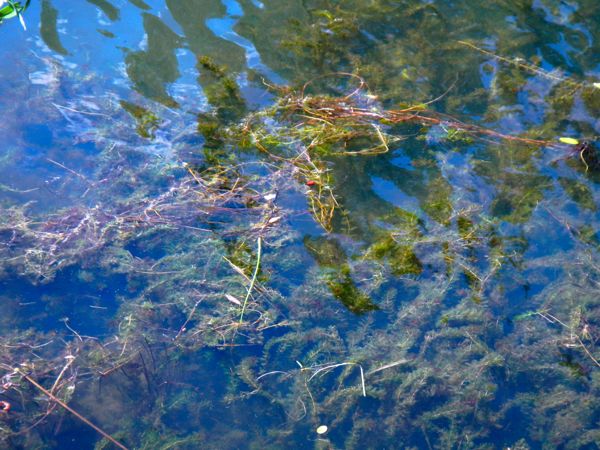
The Tahoe Keys is home to the bulk of the milfoil at Lake Tahoe. Photo/LTN file

The Tahoe Keys is home to the bulk of the milfoil at Lake Tahoe. Photo/LTN file

Bradford described the various intruders into the lake’s environment, including warm water fish, clams, Eurasian watermilfoil and curly pondweed, all of which have felt the full force of those driven to eradicate them before they can cause more damage.

Eurasian watermilfoil’s introduction into U.S. waters happened sometime between the 1880s and the 1940s, possibly through the aquarium trade or the transport of watercraft. It crowds out “good” plants, the native species, sucking oxygen out of the water, and is now spreading from Tahoe’s South Shore to other parts of the lake.

Curly pondweed, a lesser-known plant, is able to survive in open, more turbulent water as opposed to milfoil’s preferred environment, quiet lagoons such as Tahoe Keys.

Even a small piece of an unwanted plant found floating in open water is capable of creating another intrusion, said Rick Lind, a consultant for the Tahoe Keys Property Owners Association.

“Ninety percent of the Keys is infested with unwanted plants. The current methods have not been working,” Lind said. However, he listed other techniques that have been implemented that are helping to alleviate the problem.

They include: harvesting, water conservation, banning phosphorus-based fertilizers, turf conversion from grass to natural landscaping, bottom barriers, dog waste stations at convenient locations, homeowner education and labeling and monitoring all storm drains.

“With 1,500 home and 900 docks, a solution must happen,” he said.

To add to the woes, non-native warm water fish such as largemouth bass and bluegill have made their way to Tahoe’s waters.

Why care if these fish are happily integrating into the pristine lake?

According to the UNR’s College of Agriculture, they are breeding close to the shoreline in areas where native hatchlings live and grow. And because of the proliferation of invasive weeds and climate change warming the lake’s waters, they are able to thrive, preying on non-native crayfish among other tasty food sources.

UNR’s website said that warm water fish have been detected at 58 percent of the 16 locations monitored in various sites around the lake, leading to a continuing decline of native fish.

Although these aquatic invasive species are not exactly reeling from the full frontal attack, efforts to control them are beginning to pay off.

Nicole Cartwright, AIS program coordinator for Tahoe RCD, an organization supporting all aspects of conservation issues, said that although quagga mussels have invaded Southern Nevada’s Lake Mead, they have yet to find their way to Tahoe. She credits the diligence of the boat inspection program for keeping quaggas away as well as zebra mussels, also found in Lake Mead and other bodies of water.

In addition to Tahoe, boats launching at Echo and Fallen Leaf lakes are inspected.

“The program is proven; early detection is vital.” Cartwright said. “There have been no new detections since it started. The fee charged has caused people to stay clean. Tahoe is helping to change Western boating habits.”

Cartwright said since 2008, more than 50,000 watercraft have been inspected and 20,000 have been decontaminated using extremely hot water. She said the fees for inspection and possible decontamination vary according to boat size, although non-motorized craft, if they need inspection, are free.

She added that normally non-motorized craft don’t need to be checked, unless they’ve recently been in suspect waters.

“With clams and weeds, the implementation programs are helping to cure the problem,” Cartwright said, adding that slowly they are also getting the jump on warm water fish, with more than 9,000 of them electroshocked last year.

“We have a mechanism for management. We’re not exactly winning now, but we’re keeping them at bay and staying ahead of the game.”

The use of herbicides to eliminate invasive weeds was discussed at the forum, causing an outcry from some members of the audience who wondered why potential poisons need to be a part of the toolbox.

“Herbicides are a difficult topic for a lot of folks,” Cartwright said. “But we’re still in the analysis phase. We’re evaluating the effectiveness of herbicides as a potential method to kill plants, but it’s not been approved by regulatory agencies. We won’t know for another five years if it will be approved.”

The forum’s speakers all touted the implementation of various programs, which invite public participation, such as Eyes on the Lake, Tahoe Keepers, the Pipe Keepers programs and the Lake Tahoe citizens science app as effective methods to help in the invasion battle.

All of these programs are designed to engage citizens to care for the lake by keeping their eyes and ears open to new plant growths or other egregious encroachments by reporting what they find.

For more information on all of these subjects is available online.


Opinion: Importance of being fire safe

By Joanne Marchetta

June is wildfire awareness month at Lake Tahoe. And nine years later, the 2007 Angora Fire remains a vivid reminder that wildfire is one of the greatest threats facing our environment, our homes, and our businesses. We must prepare accordingly.

Joann Marchetta

Joanne Marchetta

Our region continues to take important steps to manage that wildfire threat, improve the health of our forests, and create fire adapted communities that are prepared for the next wildfire at Tahoe. But there is more work to do.

Last winter’s snowpack brought much-needed moisture to our region. But wildfire risk in the Sierra Nevada is greater than ever. Literally millions of acres of forests to our south are a sea of standing brown casualties. Forests are seeing unprecedented tree mortality because of drought and beetle infestations—major challenges that add fuel to our wildfire risk and will only increase as our climate continues to warm.

Adding to these challenges, past logging practices and a century of wildfire suppression have left our forests unnaturally thick and overgrown and at greater risk for catastrophic wildfire once a fire ignites.

We are not alone in facing this threat. Throughout the American West, wildfires are burning at intensities and sizes never before seen. A fire with the magnitude of the recent Rim or King fires would devastate our watershed, our forests, and our communities at Lake Tahoe.

TRPA, CalFire, the U.S. Forest Service, local fire protection districts, and other agencies on the Tahoe Fire and Fuels Team are working together to prevent such wildfires, implementing projects to reduce hazardous fuel loads in our forests to restore our region to a natural cycle where smaller, lower-intensity wildfires can perform their important ecological functions but not burn out of control.

By coordinating projects and working together, the Tahoe Fire and Fuels Team has reduced hazardous fuels on more than 60,000 of the 117,000 acres of forest surrounding our communities. We are working to treat the rest of this high-risk wildland urban interface over the next five to 10 years, and to develop a strategy to scale up these fuel reduction projects to treat other more remote areas in the Tahoe Basin.

This work by public agencies is crucial for forest health and resiliency in the face of our warming climate. Residents and visitors too have equally important roles to play in wildfire prevention and preparedness and the creation of fire adapted communities.

More than 90 percent of wildfires at Lake Tahoe are human caused and easily preventable with a little care. A new outreach campaign launching this month asks everyone, residents and visitors, to “Think First to Keep Tahoe Fire Safe.” The campaign reminds all of us that there are simple steps we can and must take to prevent and prepare for the next wildfire at Lake Tahoe.

To the millions of people who visit our region to enjoy its natural splendor and limitless outdoor recreation opportunities, first and foremost, please remember you are visiting a fire-prone area. Be responsible with campfires. Enjoy them only where and when they are allowed, keep a watchful eye on them, and make sure they are put out.

To all our residents and second homeowners, please work with your local fire department to create adequate defensible space around your homes. TRPA supports all properties having defensible space, so please rake up leaves and pine needles, clear out brush and ladder fuels, clean your roofs, and upgrade your homes with ignition-resistant materials as much as possible. And don’t forget, we all need a family plan to evacuate before the need arises.

As summer arrives at Tahoe, please visit the new website to learn more about wildfire prevention and preparedness and find links to important information. Sign the pledge to “Think First to Keep Tahoe Fire Safe” and share the information with your family and friends and neighbors. The time to prevent and prepare for the next wildfire is now.

The Angora Fire in 2007 showed what one illegal, unattended campfire can do at Lake Tahoe. Thin wisps of smoke quickly grew into billowing clouds with ash and falling embers as the wildfire spread, burning 3,100 acres of forest, destroying more than 250 homes, and causing millions of dollars in property damage. We know we live in an area with a natural wildfire hazard, and we know how that hazard can quickly materialize with grave consequences for our environment and our communities. Let’s continue to work together to “Think First to Keep Tahoe Fire Safe” and prepare for that risk as best we can.

Joanne Marchetta is executive director of the Tahoe Regional Planning Agency.


Study: U.S. obesity rates keep growing

By Karen Kaplan, Los Angeles Times

How do government agencies, private foundations, industry groups and professional societies squander hundreds of millions of dollars? By trying to fight America’s obesity epidemic.

Two new studies show that the best efforts of all these players – as well as schools, churches and individual healthcare providers – have largely failed to keep most Americans from getting fatter.

One report finds that 35 percent of men and 40 percent of women were obese as of 2014, the most recent year for which data were available. The other says that 17 percent of children and teens were obese as well, including nearly 6 percent who were morbidly obese.

Read the whole story