Fire damages house in South Lake Tahoe


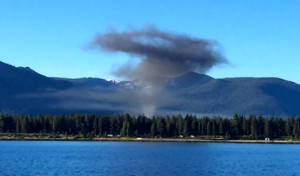
A plume of smoke can be seen from the lake early June 27. Photo/Andrew Lubrano

A plume of smoke can be seen from the lake early June 27. Photo/Andrew Lubrano

Two residential structures went up in flames this morning in South Lake Tahoe.

Firefighters were still at the scene as of 7:30am June 27.

“The main building looks to be in pretty fine shape. The second building is more significantly damaged,” Fire Chief Jeff Meston told Lake Tahoe News.

Flames were shooting several feet into the air, thus creating the threat of a wildland fire as well. Several trees were scorched. Crews from the city, Tahoe Douglas and Lake Valley were able to contain the fire to the property on Kubel Street.

Police were able to get the residents out of the dwelling just after it was called in about 6:54am. They then left in an RV.

The cause of the fire is still under investigation. There were a lot of belongings out in the open between the two structures that went up in flames. Because of that it will be harder to put an exact dollar figure on the loss.

— Lake Tahoe News staff report


Tahoe Tails — Adoptable Pets in South Lake Tahoe

Zeke

Zeke

Zeke is a 7-year-old pit bull who likes other dogs and cats. He is is house trained, and walks nicely on the leash. He likes to dig holes to bury his toys and he really loves to play fetch.

Half of his adoption fee has been paid, and he qualifies for our seniors for seniors discount.

Zeke is a big, friendly boy who is very sweet.

Zeke is neutered, microchipped, tested for heart worm, and vaccinated. He is at the El Dorado County Animal Services shelter in Meyers, along with many other dogs and cats who are waiting for their new homes. Go to the Tahoe animal shelter’s Facebook page to see photos and descriptions of all pets at the shelter.

Call 530.573.7925 for directions, hours, and other information on adopting a pet.

For spay-neuter assistance for South Tahoe residents, go online.

— Karen Kuentz


Changes in South Shore ambulance service

By Kathryn Reed

El Dorado County is hedging its bets when it comes to whether the ambulance service on the South Shore will keep operating as of Friday. Supervisors on Tuesday will be asked to bring in another company to take over the service if the Tahoe group can’t make it work by the end of the week.

“It’s specifically for standby services and a safety net so to speak in the event the JPA is unable to provide the services,” CAO Don Ashton told Lake Tahoe News.

The county per state law is required to provide ambulance services. El Dorado has a contract with the Cal-Tahoe Joint Powers Authority, which is comprised of South Lake Tahoe and Lake Valley fire departments. Two elected officials from the member agencies make up the Cal-Tahoe board, with Ryan Wagoner the executive director of the JPA.

The city and Lake Valley for years have been trying to come up with a different scenario either for fire services – there had been talk of a merger/acquisition; or ambulance staffing; and then the city threatened earlier this year to pull out of the JPA.

That threat prompted the county this spring to enter into a contract with Downey Brand LLP out of Sacramento as outside legal counsel. With the city staying in the JPA and a compromise being worked out, the threat of litigation by the county against the city and /or JPA is not imminent.

South Lake Tahoe initiated an emergency medical services-based service late last year, while Lake Valley continues to staff ambulances with firefighter-paramedics. Each believes their way of doing business is a more cost-effective model and provides better service for residents.

A few weeks ago the board voted 3-1 (Dave Huber of Lake Valley was the dissenter) to have the JPA take on the city EMTs as employees. This is to be in effect as of July 1.

The reason to do so now is that those city employees are temps and if they are to work more than six months, they then become eligible for Public Employee Retirement System benefits. That would be another expense the city does not want to take on.

The JPA is not a PERS agency.

The 12 city ambulance workers are now in the process of reapplying for their jobs with Wagoner. They will receive similar pay, health benefits and a 401(k), Wagoner said. Three of them just graduated from the Lake Tahoe Fire Academy this weekend. Keeping them in Tahoe will give them a better chance to get hired on by one of the local agencies as a firefighter.

An on call list will be developed to help with busy times – like the upcoming Fourth of July period, and to deal with vacations, sick time and when people leave.

Wagoner is hiring a firm that will handle the payroll and human resources aspect of the job. An operations person will also be brought in. There are a lot of pieces to the puzzle to get this off the ground. He was given 30 days to do so, when a few months would be the norm. The lack of time is the JPA’s fault because the city for months has been telling everyone what its plans were.

The Department of Motor Vehicles, workers comp, and a slew of state certificates are needed to make the transition. Some of this is just so a bank account can be opened.

Dave Olivo, who is the city’s elected treasurer, is now treasurer of the JPA. He is not a voting member and does not write the budget. Wagoner had the treasurer duties since he started in May 2014. State law dictates how the accounting and auditing oversight is to be handled.

Questions have been raised as to whether it is a conflict of interest for Olivo to represent the JPA when he works for one of the member agencies.

“I know (South Lake Tahoe City Attorney) Tom Watson was aware of this appointment because he was at the JPA meeting two weeks ago when the JPA board appointed Dave Olivo. This was actually suggested by (county Auditor-Controller) Joe Harn because Dave has experience,” Wagoner told Lake Tahoe News.

The JPA board meets this week to finalize everything. But just in case it doesn’t, the county – assuming supervisors OK the contract Tuesday – will have Regional Emergency Medical Services Authority on board to take over – even if it’s just for a short time. REMSA would come with its own equipment and workers.

As for the JPA vehicles, the city will allow the ambulances to remain at Station 2 through the end of the JPA contract with the county in August 2019.

Other items on the June 28 Board of Supervisors’ agenda regarding the JPA include authorizing the purchase of an ambulance for $160,000 and increasing the dispatch service fee to a maximum of $66,000/year until the contract expires on Aug. 31, 2019.


Opinion: What Ancient Greece tells us about U.S. democracy

By Daniel H. Foster

Times are hard for democracy. Trump wants a wall. Senators refuse to question judicial nominees. And anti-Hillary liberals seriously contend that she is “as bad as” the opposing party’s presumptive nominee, vowing not to vote if she wins the nomination.

But when were they ever otherwise than hard? Democracy has always been vulnerable to extreme opinions and dogmatic certainties. Sometimes the price of free speech is listening to things you don’t want to hear.

Theater holds a possible remedy, though, to some of our worst tendencies. It’s pretty simple. We need more tragedy.

Of course, tragedy might seem remote and irrelevant. To many it is dimly remembered as something to do with hubris, catharsis, and tragic flaws. We hear the word tragedy in the news mainly when it’s misapplied to some disaster, natural or otherwise. But it needn’t be either irrelevant or misappropriated. Tragedy is not just the stuff of English tests. It has a long and illustrious history as a salve for self-government. No coincidence that democracy and tragedy arose around the same time in ancient Athens.

While scholars disagree about exactly how tragedy arose, we are certain that it evolved alongside Athenian democracy. Athenians understood that what they saw onstage taught them truths and ways of thinking vital for their roles as citizens. Like the law courts, tragedy was a civic institution. Funded by the state, it was perhaps the greatest citizenship class ever.

The most important tragic lessons warn against extremism. Tragedy centers on heroes who, paradoxically, are passionate to do precisely what the gods decree. They are men and women who invite their fate with extreme self-regard combined with all-or-nothing thinking.

Consider Oedipus the tyrant, eponymous hero of Sophocles’ most famous tragedy. Witnessing a plague ravage his home city of Thebes, Oedipus boasts that he, “whom all men call the great,” is the only person who can save the day. Sound familiar? “I am the only one who can fix this,” tweeted Donald Trump last month. He was stumping on the loss of American jobs to Mexico, but it’s an attitude he uses throughout his political performance.

And tragedy offers its comeuppance. The plague in Thebes is caused by the unsolved murder of the previous king of Thebes, Oedipus’ father—who was slain by his only son. That is the very definition of tragic irony. Admittedly less tragic but no less ironic is the fact that, tweets to the contrary; Trump has been accused of outsourcing jobs to foreign employers. No one is the “only one” to fix anything, tragedy tells us. In fact, thinking that way is a trait of those who cause problems.

A related insight comes from Oedipus’ own headstrong daughter, Antigone. In her eponymous tragedy, having apparently learned nothing from her father’s example, Antigone is certain that she alone knows what piety is and what the gods want—the burial of her rebel brother. But self-righteousness runs in the family, on both sides. Antigone’s maternal uncle Creon, current ruler of Thebes, is just as adamant that he knows best. The gods do not honor traitors, he asserts, punctuating his assertion by burying his niece alive. Antigone, always swift to stress her independence, even in the choice of death, ends her own life by hanging before she can serve out Creon’s sentence. As Hegel almost said once, tragic heroes have one-line bucket lists. Once that item is crossed off, you can cross off the hero as well.

Such single-minded, black-and-white thinking dominates politics today. Pundits, politicians, and private individuals a like love to make noise about the doom that will overtake us if we even consider the opinions of their opponents. Overlooking his misuse of the term, there is nonetheless something tragic in the French Prime Minister Manuel Vall’s recent prediction that a UK “Brexit” would spell “tragedy” for Britain.

Like tragic heroes, such people are convinced that they alone know what’s what and what’s right. They are especially self-righteous when it comes to self-knowledge. Oedipus was positive he knew himself inside out: He was a simple man, a straightforward man, a self-made man. (“Men of the people” are a dime a dozen in American politics. Remember George W. Bush’s gestures of folksiness from atop a trust fund?)

But despite the Delphic injunction to “know thyself,” we never quite succeed. Even the brightest light, when shone against the self, casts a shadow. Oedipus may be able to solve the Sphinx’s riddle, but he must also recognize that he himself is a riddle that defies reason—his children’s brother, his mother’s husband, his father’s slayer, his city’s savior and its destroyer. The consequences of this forced recognition are horrific: He loses his sight, his homeland, and his wife and mother at one fell swoop.

Such consequences are not restricted to tragic heroes. Politicians are by custom if not by nature in the business of projecting false images of themselves. And then, when we find out the “truth,” that they are not really what they seem, we are horrified, ashamed, and feel betrayed. Richard Nixon swore he was not a crook. The White House tapes proved otherwise. John Edwards seemed a model of sympathy. The handling of his extramarital affair tells another story.

As classics scholar Jean-Pierre Vernant realized, tragedy teaches us that those who blindly adhere to a single-minded perspective will, like Oedipus, inevitably be forced to confront the opposite point of view, the perspective they had hitherto refused to even consider. In comedy we laugh. In tragedy we cry. But the cause of both is the same: We recognize a yawning chasm between what should be and what is. Tragedy teaches by negative example. The great stage and literary tragedies reveal the horrible consequences of seeing things in black and white and so encourage us to discern shades of gray. They promote what the Greeks called sophrosyne, one of those “untranslatable” words usually translated as “moderation.”

Smack dab in the middle of a speech in the middle of “Antigone” a character called Haemon advocates this middle-of-the-road approach to life. “Don’t think that you alone know the truth and everyone else is wrong. Such individuals, when they are opened up, are found to be hollow inside.” Unfortunately, it is often such “hollow men” who seem to make the biggest noise and to have the greatest courage of their convictions. But sometimes these people are heard above the rest simply because they are empty inside. Their souls are echo chambers, amplifying pin drops to thunder claps.

Tragedy diagnoses this hollowness—and listens for the softer voice of sophrosyne that might better guide our governments and our lives. Tragedy challenged Athenian citizens to question their own black-and-white thinking, to open their minds to the perspectives of others. This is not to say that ancient Athens was perfect. Far from it. It was rife with xenophobes, demagogues, and warmongers. It was propped up by slave labor. Its women residents not only did not have the right to vote, they were almost certainly dissuaded from attending those very tragedies that extolled democracy. It was a culture with a lot of work to do.

But so is ours. Which is why we can’t afford to discard the millennia-old art form that can help us address very contemporary problems. Athens needed tragedy. We do, too.

Daniel H. Foster is a senior lecturer in literature, drama, and creative writing at the University of East Anglia. He is the author of “Wagner’s Ring Cycle and the Greeks” (Cambridge 2010) and is currently at work on “The Minstrel’s Progress: British Bards to American Blackface, 1750-1850”.



Salty surprise in everyday foods

By Sabrina Tavernise, New York Times

Salt can lurk in surprising places.

Consider bread. One slice of Arnold Specialty Brick Oven Premium white bread has more sodium (160 milligrams) than about 20 Utz Kettle Classic Original potato chips (120 milligrams).

The average American adult, who consumes 3,400 milligrams of sodium a day — more than 1,000 milligrams more than the recommended daily allowance of 2,300 milligrams — may not know that more than 70 percent of the sodium consumed in this country is already in food before it reaches the table.

Too much sodium, a main component of table salt, can raiseblood pressure, which is a major risk factor for heart disease and stroke.

Read the whole story


Family rescued from PCT near Truckee

By Sammy Caiola, Sacramento Bee

A Sunnyvale family of four had to seek rescue from the Truckee Fire Department and California Highway Patrol when their youngest child became so ill from dehydration that she could no longer walk.

Father Kent Johnson and mother Patricia Johnson were on a four-day backpacking trip with their two daughters on the Pacific Crest Trail near Paradise Lake on Thursday when Adele, the younger of the two, became extremely nauseous and weak. She was dehydrated and had possibly ingested contaminated water, said CHP Officer Matt Calcutt.

Recognizing Adele needed help, Kent Johnson hiked out Thursday night and kept walking until he could call the Truckee Fire Command, which then called California Highway Patrol Helicopter 24, according to a CHP news release.

Read the whole story


Wind main culprit in keeping Lake Tahoe chilly

By Brant Allen

Does this year’s snowpack and cool spring rains mean swimmers will have to delay their summer Tahoe adventures? Not necessarily.

Interestingly, Lake Tahoe’s surface water warms at about the same rate each year regardless of the winter snowpack. As solar radiation increases during the longer days of spring, the surface water begins to warm. It may not be inviting enough for a swim in April but the shallow water will already be several degrees warmer than the water just a few meters below.

When the winter snowpack begins to melt and join the nearest stream, water in that stream becomes very cold—maybe just a few degrees above freezing. As the cold, dense stream water enters the lake, it “plunges” below the warmer surface water, to a depth where the lake water is the same temperature and density.

Though this happens all the time at stream mouths, we rarely get to see it. This spring, UC Davis researchers observed a thin layer of dark brown water suspended midway between the bottom and the surface of the lake while working on a nearshore water quality station. The water was stained with tannins (from fallen leaves), making it visible in Tahoe’s clear water.

Back to swimming and what can cause the lake to warm more slowly. Spring storms and especially the strength and duration of the wind, not the associated precipitation, is what keeps the lake cool. Wind adds energy to the lake, mixing cold water from depth back to the surface. It is not uncommon for the lake surface temperature to drop several degrees following a strong spring wind event.

So, if you are one of those Tahoe summer people who long for days in the water, don’t curse the big winters and extended snowpack. That keeps the lake level high. It is the wind that will prolong cold surface temperatures.

Brant Allen is a researcher with UC Davis TERC. This article first appeared in the TERC newsletter.


Sandoval against recreational marijuana

By Cy Ryan, Las Vegas Sun

CARSON CITY — Gov. Brian Sandoval said he has never smoked marijuana and is against making recreational use legal in Nevada, citing concerns about its impact on young people.

Sandoval said that as a former federal judge, he saw how marijuana use led young people to trouble with the law, and he is opposed to a ballot initiative to legalize recreational marijuana.

Asked if he had ever used marijuana, he answered, “No.”

Read the whole story


Feds financially helping farmers in Calif., Nev.

By Associated Press

The Obama administration is awarding $48 million in grants in 13 states, mostly in the West, to help farmers and others conserve water and energy amid drought and climate change.

The money will pay for improvements to irrigation and water delivery systems as well as provide technical assistance for planning and engineering conservation measures.

Agriculture Secretary Tom Vilsack announced the grants Thursday in Brighton, just outside Denver. He was in Colorado to speak at the Aspen Ideas Festival in Aspen on Friday.

The grants will help complete 76 projects and save 123,000 acre-feet of water, or about 40 billion gallons, each year, said Bureau of Reclamation Commissioner Estevan Lopez.

The projects are in California, Colorado, Idaho, Montana, Nebraska, Nevada, New Mexico, Oklahoma, Oregon, Texas, Utah, Washington andWyoming.

Vilsack said $15 million of the grants will come from his department and $32.6 million from the Bureau of Reclamation, part of the Interior Department.

He said the grants are an effort by the Agriculture and Interior departments to coordinate their drought-response efforts. President Barack Obama in March directed government agencies to cooperate on drought preparedness and planning.

“We’re not going to go off in one direction and have the Bureau of Reclamation go off in another direction,” Vilsack said.


Snippets about Lake Tahoe

·      Placer County planning commissioners on July 7 at 2pm will discuss the Martis Valley West project. The meeting is at the North Tahoe Event Center in Kings Beach.

·       West Shore Café in Homewood will offer Saturday morning SUP yoga classes from 8-9am from July 2-Sept. 3 (no class Aug. 6). The cost is $25 per class.

·       The League to Save Lake Tahoe is organizing beach cleanups for July 5 from 8:30am-noon. Go online to RSVP or to get more details.

·       Placer County supervisors this month voted 3-2 to limit marijuana cultivation to small, indoor grows by medical marijuana patients only.

·      Nancy Dalton, chair of the math department at South Tahoe High School, is running for the 4th District board seat for Lake Tahoe Community College.