Path to paradise is paddle-powered

By Tom Stienstra, San Francisco Chronicle

The summer horror story is a getaway or camping vacation that is overrun with crowds. The vision is fed by year-round traffic nightmares in the Bay Area, Sacramento and other cities, where people jammed shoulder to shoulder can start to feel like an omnipresent condition you can’t escape.

Yet with one small change in your life, you can find redemption.

It starts in a boat. Of the dozens of styles available, the cheapest, fastest and easiest boat that provides a gateway to freedom is a flat-water kayak.

With just a few strokes, you propel yourself to escape from every worry. That’s the thing about boats. No traffic jams. No red lights. Just open water in every direction.

Read the whole story


Kiosks provide mental health info in SLT

Mental health kiosks have been placed in several locations in South Lake Tahoe as an educational resource to help direct people to local services.

Each kiosk highlights local mental health services available and educational materials. Brochures are in English and Spanish, and will be updated regularly.

NAMI officials designed and implemented the kiosks in six South Lake Tahoe locations.

Locations include:

  • Barton Community Health Center lobby – 2201 South Ave.
  • Barton Family Medicine lobby – 1090 Third St.
  • Barton Memorial Hospital’s Emergency Department – 2170 South Ave.
  • El Dorado County Probation and Sherriff Office – 1360 Johnson Blvd.
  • Lake Tahoe Community College in the Commons Area – One College Way
  • South Lake Tahoe Library – 1000 Rufus Allen Blvd.


The kiosks were funded by the Barton Foundation’s Community Health Grants.


Truckee keeping tabs on registered offenders

Two out of the eight registered sex offenders that Truckee police officers checked on this month were found to be violating the law.

The violations were for failure to update their current addresses. Both cases have been referred to the Nevada County District Attorney’s Office.

Several times a year detectives conduct sex registrant compliance checks on the registered offenders in Truckee. The purpose it to ensure the safety of residents.

— Lake Tahoe News staff report


Barton Auxiliary doles out scholarships

Fourteen students from Lake Tahoe and Carson Valley received $19,500 in scholarships from Barton Memorial Hospital Auxiliary for their academic achievement and plans to pursue a career in medicine or science.

Scholarships were awarded to students from Douglas, Whittell, Mt. Tallac, and South Tahoe high schools, and Lake Tahoe Community College.

Three students received $2,000 from the Dan Kerr Memorial Scholarship, a new scholarship in honor of the late Dan Kerr, a past Auxiliary present. Recipients included Alec Jobbins from South Tahoe High School, Kelsey Kjer from Whittell High School, and Isaiah Sisk from Douglas High School.

In addition, eight students each received $1,500 from the Barton Memorial Hospital Scholarship. Recipients included Bailey Gansberg, Makayla Shaver, and Alexxaz Torres from Douglas; Kristen Harnett, Kylee Lyons, and Marin Underhill from STHA; Mary Sanchez from WHS, and Juan Vasquez from LTCC.

The Barton Hospital Auxiliary also awarded opportunity scholarships of $500 to students from Mt. Tallac High School who are continuing their education at a community college, continuing accredited education program, or trade school. This year’s recipients are Savana Bustos, Joselyn Rodriguez, and Carolana Welechenko.


Deadlock on immigration may boost Nev. Latino vote

By Alexander S. Corey and Ben Botkin, Las Vegas Review-Journal

The U.S. Supreme Court’s deadlock in a major immigration case Thursday adds another dimension to an already hot election cycle.

The question: Will the court’s nondecision — which continues to prohibit thousands of undocumented Nevadans from receiving work permits — galvanize Latino voters angered by it?

Some believe that the Supreme Court tie — coupled with presumptive Republican presidential nominee Donald Trump’s controversial statements on Mexican immigrants — could boost Latino turnout rates in the general election.

Read the whole story


PCT hiker rescued near Showers Lake

A Bay Area woman hiking the Pacific Crest Trail alone had to be rescued near Showers Lake on Sunday.

Jessica Drizen of Oakland called 911 on June 26 saying she was lost.

A California Highway Patrol helicopter found her standing near a reflective blanket. She was not injured – just not sure where she was.

Showers Lake is south of South Lake Tahoe.

— Lake Tahoe News staff report


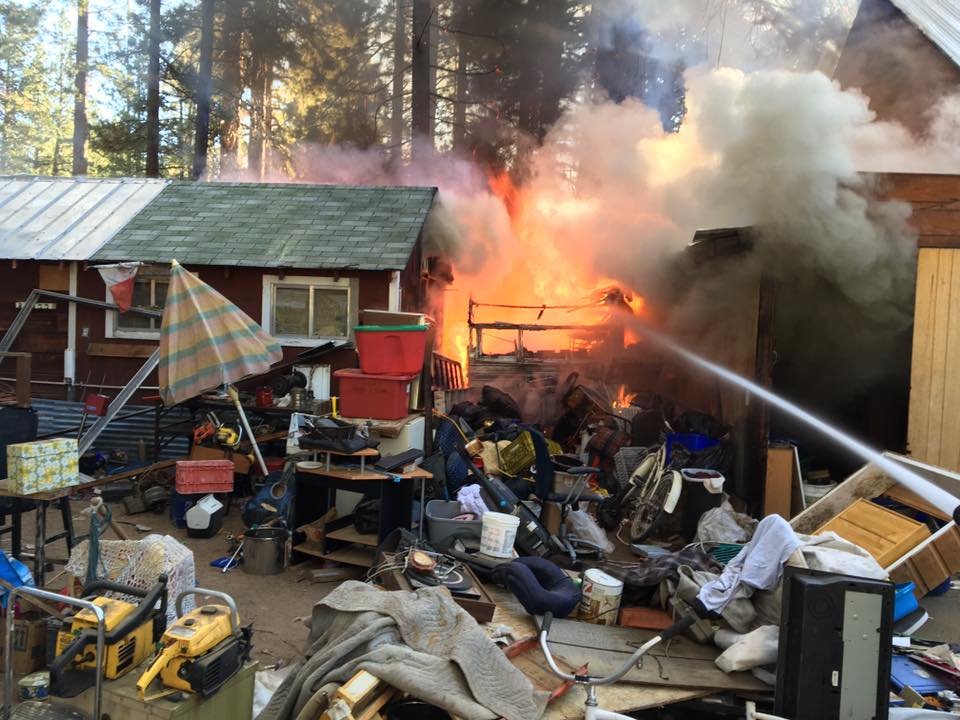
Destructive fire started in travel trailer

A slew of items filled the area between the two burning structures. Photo/Provided

A slew of items filled the area between the two burning structures. Photo/Provided

A fire in South Lake Tahoe on Monday morning claimed the life a dog and caused substantial damage to one of two buildings that were ablaze.

“We have determined that the fire started in the travel trailer located between the two buildings on the property,” Fire Chief Jeff Meston told Lake Tahoe News. “The exact cause is unknown, but our investigation will remain open should some new information become available.”

Police were able to get the residents out of the Kubel Street dwelling just after it was called in about 6:54am June 27. They then left in an RV.

— Lake Tahoe News staff report


Law requires new license plates in Nev.

By Sandra Chereb, Las Vegas Review-Journal

CARSON CITY — Most Nevada motorists will have to get new license plates every eight years under a new law that takes effect July 1.

Assembly Bill 484 passed by the 2015 Legislature and signed by Gov. Brian Sandoval was requested by law enforcement agencies because too many plates are unreadable or have lost their reflectivity to be viewable at night.

By law, license plates at night must be readable from about 100 feet, said Dave Wiley, services manager at the Department of Motor Vehicles and overseer of the inmate-staffed state license plate factory.

Read the whole story


Motorized vehicles damaging USFS land

By Kathryn Reed

Saying you didn’t know the rules isn’t good enough.

“They don’t understand if takes time and effort to rehabilitate the damage and it is taxpayer dollars that go toward that,” Frank Machler with the U.S. Forest Service said.

He’s talking about damage to forestland by motor vehicles.

Machler is a law enforcement officer in the Lake Tahoe Basin. He spent part of last weekend investigating damage done by motorcyclists near Griff Creek above Kings Beach.

It’s not severely rutted, but it is noticeable and undeniably a violation of the motorize vehicle regulations. Proving resource damage is more difficult, Machler said. For example, driving over alders actually helps them to propagate.

“We do get lot of motor vehicle violations, but rarely do we see bad resource damage in the basin,” Machler told Lake Tahoe News.

Motorcycles are allowed on 250 miles of roads in the Lake Tahoe Basin. Photo/LTN file

Motorcycles are allowed on 250 miles of roads in the Lake Tahoe Basin. Photo/LTN file

Even though there may not be signs in a given area saying motorized vehicles are not allowed, it is up to the user to know the rules of the land they are riding on.

The culprits in the Kings Beach incident have not been caught. If an LEO catches someone riding where they aren’t supposed to, at a minimum a $150 citation can be issued. If it goes to court, a judge has the authority to issue a fine up to $5,000 and six months in jail.

“The court has said recreation users need to know the rules of the land they are traveling on,” Machler said. “I’m not sure people are talking the time to find out who owns the property they are recreating on and what the rules are. People are not taking the time to read the signs that are in place. They walk past bulletin boards.”

To catch more of the scofflaws takes the public’s help because the number of LEOs and rangers in the woods is finite. Machler said there are ways to protect reporting parties.

One good thing about a more normal winter this year is people were not able to violate the motorized rules as blatantly as they did in drier years. Snow prevented a person from driving around the gates – which was happening in the last few years.

The basin has 250 miles of roads where motorized vehicles may travel. This is a small number compared to some forests, but the Lake Tahoe Basin Management Unit it also on the small side.

The USFS provides free motor vehicle use maps at its offices as well as online.


Opinion: Brexit played to Britons’ Imperial nostalgia

By Philippa Levine

Shortly after the result of Britain’s referendum on the European Union was declared last week, an academic colleague remarked to me, “the final curse of the Empire is that the imperial dream is destroying the imperial heartland.”

Britain’s long association with imperialism was a major undercurrent in the campaign to leave the EU. Disregarding the realities spelled out by economists and others as to the impact of a leave vote, the Leave campaign emphasized what Britain might once again become, if freed from what they described as the yoke imposed by the EU. (You could practically hear the strains of “Rule, Britannia!” in the background). The Leave campaign was a potent reminder of how imperial politics have long played out in Britain, the self-declared guardian of individual freedom bent on a civilizing imperial mission in the rest of the world.

The U.K. Independence Party’s notorious poster showing long lines of migrants allegedly clamoring to enter the country conjured a mythic colonizing era: a time when Britain controlled the regions from which today’s would-be migrants have fled, when Britain “ruled the waves,” when Britain truly was “Great.” That the migrant worker in the UK does the jobs that these voters don’t want and won’t do was lost in the dream of imperial greatness.

But what, realistically, would a return to empire look like almost two decades into the 21st century? After all, it’s obvious there can be no return to imperial conquest or dominance for Britain. But the Brexit dream worked precisely because it was steeped in nostalgia and regret for a past that many “Leavers” believe should never have been abandoned in the first place.

The Leave campaign’s appeal to patriotic imperialism was inevitable; it has long been used by those in power to rein in a fractious working class, and to conjure associations with white skin and nationalism. National pride in Britain has repeatedly rested on misty remembrances of the glory days of Empire, a vision already riven with the easy racism now rapidly re-emerging in an impossibly divided Britain. With a vote as close as we saw in the referendum (52 percent leave; 48 percent remain), the substantial divides in British society can only get worse.

Britain’s relationship to the EU itself—and its predecessor, the European Common Market— is rooted in its own imperial legacy. After initially opting not to join the EU in the late 1950s, Britain changed its mind and launched what became an increasingly desperate campaign to gain entry. The French leader Charles de Gaulle twice vetoed Britain’s application (in 1961 and again in 1967) for membership, largely on the grounds that its principal ties were more imperial than European. And Commonwealth leaders around the world did not look kindly on Britain’s bid for European recognition, fearing that it would diminish Britain’s commitment to trading relations with their countries.

It would be 1973, and after a change in French leadership, before Britain would be granted admission. Two years later, a referendum on whether Britain should continue its association with Europe was met with resounding approval—more than 67 percent, with a turnout approaching 65 percent.

The 1975 referendum took place as the empire was disintegrating and the greater part of Britain’s former colonial possessions had been lost. In light of this immense change, Britons overwhelmingly saw Europe as offering, in effect, a realistic alternative to what they understood to be a loss of power, economic prowess, and British dignity.

The reason empire mattered in 2016 was precisely why it didn’t 41 years earlier—remaking Britain in the image of imperial greatness was far more persuasive at a moment when it could be clothed in a nostalgic post-colonial glow than when colonies were disappearing at a clip.

How different were the issues in 1975 from those that have dominated in 2016? The Leave campaign, 41 years ago as now, was an odd mix of far-right and radical left concerns. In 1975, the British Communist Party and the white supremacist National Front, as well as the Scottish National Party and their Welsh counterpart Plaid Cymru, opposed membership as did about a third of Prime Minister Harold Wilson’s cabinet. (Only the radical shift in attitudes among the Scottish National Party, now firmly pro-Europe, has changed much since in this roster of opponents.) Back then the arguments for leaving Europe were not so different from the arguments heard in recent months—national concerns about the loss of British identity and sovereignty to critiques of an over-weaning capitalist bloc in Europe. In 1975 and again in 2016 the vote was cast in the shadow of de-industrialization, unstable employment outlooks, and a vocal anti-immigration lobby.

Margaret Thatcher, prime minister from 1979 to 1990, began as a pro-European but became increasingly unhappy about the direction of the EU. Only two years after she signed the Single European Act, designed to make European laws and policies more uniform, she expressed concern over a European superstate dominating local needs. Her ideas were increasingly rooted in a nostalgic idea of Britain’s former imperial greatness even as she implemented often-ruthless programs of economic modernization. In the campaign she waged in the Falkland Islands off Argentina in 1982, a vision of glorious imperial Britain stamping out foreign despotism and corruption captured the public imagination, and helped immensely in securing her re-election in 1983 even against the backdrop of relentless working-class immiseration. With most of the empire now gone, the business of yearning revival could begin in earnest. Under Thatcher, Britons were urged to admire and revive Victorian values and imperial dreams.

Notwithstanding the fact that the Thatcher years saw the final episode in the dismantling of Britain’s once vast empire—the last territories in southern Africa, most of the Caribbean, pockets in the Pacific and, of course, the agreement to return Hong Kong to Chinese rule—this idea of restoring the “great” in Great Britain was, and remains, a potent propaganda move.

Across England the theme heard most often in the past few weeks has been that an independent sovereign Britain could once more be great. Of course, that has been the battle cry of right-wing politicians and demagogues since the early 20th century. It was the message of pro-imperial politicians when Germany’s rise threatened British power in the early 1900s. It was again the message when migration from former colonies became substantial after 1945, giving rise to increasingly draconian immigration laws. And it was at the core of the success of the Leave campaign last week.

Philippa Levine teaches history at the University of Texas at Austin where she also co-directs the Program in British Studies.