Loneliest road in America comes of age

By Marilyn Newton, Nevada 

The view of Highway 50 looking west toward the waning sun gives insight into why AAA once warned motorists “not to drive there unless they’re confident of their survival skills.” Photo by: David Braun
It was 30 years ago, in July 1986, that Life magazine used the term “The Loneliest Road in America” to describe the stretch of Highway 50—more commonly known as Highway 50—from Fernley to Ely across central Nevada. AAA even advised against traveling the highway, claiming there was nothing to see. For those who were crazy enough to travel that lonely road anyway, they were advised to carry survival gear such as water and cold-weather clothes.

Is the Loneliest Road in America really as bad as Life magazine claimed?

The moniker could easily have been a slap in face, but savvy state officials adopted the phrase and turned it into something positive. The state created a survival passport that same year, which travelers could get stamped at locations along Highway 50 and redeem for a certificate.

Suddenly, the loneliest road wasn’t so lonely as people sought bragging rights to “I Survived the Loneliest Road in America.”

Tourism numbers began to climb and are continuing to do so, and the passport program continues to this day. The state’s response became a help to the economy of the towns along Highway 50.

Read the whole story


Opinion: Mosquitoes helped America win independence

By John R. McNeill

The spread of Zika virus by Aedes aegypti is not the first time a mosquito-borne virus has broken loose in the Americas. Mosquitos and viruses have shaped the history of the Western Hemisphere in surprising ways for centuries; the United States might not be an independent country without them.

After the arrival of Aedes aegypti from West Africa during the transatlantic slave trade, the mosquito colonized parts of the Americas and served as the primary carrier for yellow fever and dengue, viruses that are cousins of Zika.

Together these mosquitos and their fevers decided the fate of empires. In 1697 the kingdom of Scotland attempted to establish a trading colony on the Caribbean shore of Panama. Within two years, however, about 70 percent of the Scots were dead of “fever.” In 1707, Scotland accepted union with England partly to pay debts incurred by the disaster.

By the end of the 18th century, mosquitoes were not just intervening in imperial schemes; they were helping the Americas win their liberty. Yellow fever and malaria ravaged European armies sent to prevent revolution in what is now Haiti and Venezuela, leading to the creation of independent countries.

Even the U.S. owes its independence in part to mosquitoes. In 1780, the southern colonies, which had widespread malaria, became a decisive theater in the American Revolution. British troops had almost no experience with malaria, and thus no resistance to it. American militiamen, and much of the Continental Army, had grown up in the South and faced malaria every summer. So in the summer of 1780, the British Army hosted its own malaria epidemic, which was particularly intense in the South Carolina Lowcountry. At times, half the British Army was too sick to move.

In 1781, the British commander in the South, Lord Cornwallis, decided to move his army north to avoid “the fatal sickness which so nearly ruined the army” the summer before. His superiors, however, ordered him to move to the tidewater. So in June, Cornwallis dug in at Yorktown.

In the warm months, mosquitoes (including a malaria vector species called Anopheles quadrimaculatus) started to bite and by late summer of 1781, malaria had taken hold of his army once again. Fifty-one percent of his men were too sick to conduct the counter-siege operations that Cornwallis knew were required. American and French forces penned the troops in until Cornwallis surrendered in October, which in effect decided the outcome of the American Revolution.

Mosquitoes only lost their political importance after medical researchers realized that they were spreading the fevers. The first to publish the idea that Aedes aegypti could carry yellow fever was a Cuban doctor, Carlos Finlay. U.S. military doctors led by Walter Reed confirmed Finlay’s hypothesis. Armed with this knowledge, when the U.S. Army occupied Cuba (after 1898) and Panama (after 1903) they made life miserable for Aedes aegypti—covering up water containers and putting a drop of kerosene into those without covers. Within a couple of years, mosquito control had banished yellow fever from Cuba and Panama’s Canal Zone.

Over the next 70 years or so, mosquito control acquired ever more weapons. Insecticides, such as DDT—brought to bear in the 1940s—proved deadly to all mosquitoes (and other creatures).

But Aedes aegypti control proved too successful for its own good. Once the mosquito populations had fallen drastically, and the risk of yellow fever and dengue diminished, budgets were redirected away from mosquito control all over the Americas.

Had the Zika virus come to the Americas in the 1930s or 1950s its prospects would have been poor—Aedes aegypti was under control. But since the 1980s Aedes aegypti has made a dramatic comeback in the Americas. While the main reason is the lapse in mosquito control, the warming climate has extended the mosquito’s range. Today, Zika’s chances of spreading widely among human populations via Aedes aegypti are far greater. And it will have help from Aedes albopictus, another mosquito capable of transmitting the virus, which arrived from East Asia in the 1980s.

Confronting Zika requires mosquito control. Malaria may have helped Americans win the revolution in 1780-81, but their descendants cherish their liberty and say, in effect, “don’t tread on me” in response to pesticide spraying or orders to cover water containers. Perhaps a vaccine will sideline Zika, but until then mosquitos again have a chance to make history.

John R. McNeill is professor of history at Georgetown University. His book “Mosquito Empires: Ecology and War in the Greater Caribbean 1620-1914”, won the 2010 Albert J. Beveridge Award from the American Historical Association.


NV Energy rates to decrease on July 1

By Jessica Garcia, Reno Gazette-Journal

Resident, commercial and industrial electric customers of NV Energy will experience the sixth consecutive quarterly price decrease effective Friday.

The overall electric price decrease is 1.97 percent. Natural gas residential, commercial and industrial customers experienced an overall gas decrease of 9.17 percent.

These costs are associated with fuel used in power production and the company’s generating stations. Fuel and purchased power costs are passed through dollar for dollar with no profit to the company.

Read the whole story


Walk to highlight medicinal plants in Sierra

There will be a medicinal plant walk at Sorensen’s Resort in Hope Valley on July 3.

Kimball Chatfield, medical botanist and doctor of Oriental medicine, will lead the walk in hunt for plants including wild arnica, St. John’s Wort, various types of mint, wild blueberries, currants, yarrow, roses, wild onions and more.

Chatfield is author of “Medicine From the Mountains: Medicinal Plants of the Sierra Nevada”. He will talk about traditional Native American uses as wells as modern findings.

To sign up for the class, call 530.694.2203. Cost is $35. Bring water and a snack. The event is from 9:30am-1pm.


ZCTC celebrating Wimbledon with doubles event

Instead of green lawns to play on, Zephyr Cove Tennis Club has brand new resurfaced courts – which are all green.

The club’s annual Breakfast at Wimbledon event is July 9. Breakfast starts at 9am, with play at 10am.

Adults will be paired with a partner. The top four teams will win a prize. Wear white – just like the pros do at Wimbledon.

Cost is $15 for members, $20 for non-members, and $5 for spectators who want to eat. The first 32 paid entrants are guaranteed a spot. The deadline to sign up is noon on July 6. To do so, go to the pro shop at the courts.

While breakfast is included in the price, participants are asked to bring a dish to share and personal beverages.


Douglas County on stable financial ground

dc budetBy Susan Wood

GARDNERVILLE – Douglas County appears in adequate shape according to those who man the coffers, but it has a long way to go in returning to the pre-recession banner years in which revenues were more vertical.

That said, diversity may be just what the Nevada county surrounding highways 395 and 50 needs to surpass a marginal 2 percent growth officials project it will experience in at least the year going forward.

Friday begins a new fiscal year for Douglas County; a jurisdiction characterized by the geo diversity of sprawling Carson Valley farms and towering Lake Tahoe casinos.

With a population of 47,710 (as of July 2015) over 738 square miles, Douglas County on June 28 discussed the 2016-17 $175.3 million budget – roughly $7 million more than the prior year.

Douglas officials work with a five-year plan as a “priority-based budget,” the first county to do so in the United States.

Priorities include improving cost effectiveness, pursuing alternative service providers, having regional collaboration, and investing resources based on the critical areas.

To accomplish this, county officials sought well-rounded, all-inclusive assistance to come up with a list of goals and must-dos.
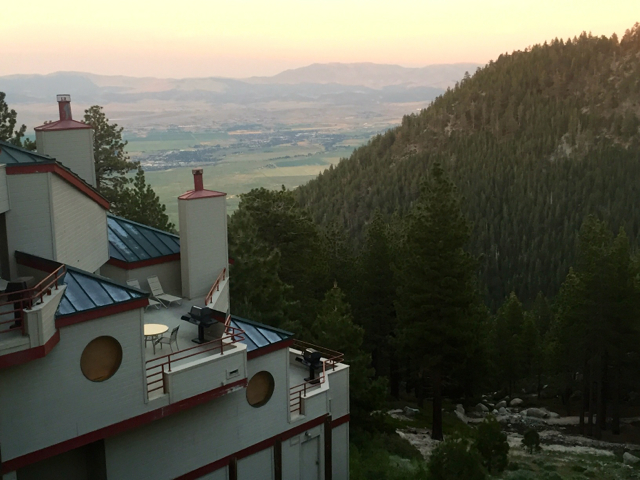
The Ridge Tahoe

The Ridge Tahoe was singled out by Douglas County officials June 28. Photos/Susan Wood

“We needed to engage policymakers, employees and the community,” said Assistant County Manager Christine Vuletich, who made the budget presentation to about 50 people at the Carson Valley Inn on June 28.

“The county is in good economic health, but that doesn’t mean we can rest on our laurels,” she summarized “We have challenges, but we also have opportunities.”

Back in 2009, county leaders knew it had mountains to climb in terms of overcoming weak economic growth, a drop in building permits, baby boomers retiring but spending less, and skyrocketing unemployment that peaked in 2010 at 14 percent. In comparison, it was 4.3 percent in 2005. This year, it came in at 6.2 percent.

Part of this Nevada unemployment had to come from Douglas County’s own labor force, which was reduced by 80 staffers between 2010-12 to sustain financial stability.

After all, the major portion of a county’s General Fund expense is personnel at 71 percent, which dwarfs other costs.

Public safety makes up the largest chunk of resources spent for county services at 30 percent, followed by culture and recreation consuming half that.

On the other side of the coin, General Fund revenue for the county is dominated by property tax at 45 percent. And the housing market also experienced a crunch in recent years.

As for other challenges, many local governments struggle with keeping afloat with rising costs from retiring personnel.

When asked how the county plans to balance those increasing expenses, Vuletich responded after the meeting: “We planned for that.”

Nonetheless, the county’s chief financial officer called the latest numbers highlighting more Nevadans entering or re-entering the workforce after a long-fought battle with the jobs market as “one bright spot” that the local economy is pulling itself by its bootstraps.

“Douglas County continues to make great progress despite the financial and infrastructure challenges we face,” interim County Manager Larry Werner said in a statement. “We must focus on capital improvement and asset projects and continue to invest in our greatest asset – a high performing workforce.”

More jobs in transportation, trade, construction and education mark a path to prosperity. These are things the task force hoped for when creating the county’s Economic Vitality Plan in 2010. They are keeping an eye out for possible trends, possibilities and opportunities to further nurture.

Other areas of potential revenue revolve around aviation, with the Minden Tahoe Airport being home to 20 businesses.

In the past, the economic drivers were limited to tourism and construction – but both industries plummeted in the recession. Now diversity is the key. And whereas tourism will always have a place in helping to boost revenue, the county is seeking and encouraging businesses that offer other options. This may mean tourism-oriented businesses reinventing themselves.

If the county’s “Spotlight” awards of businesses of the year are any indication, then entrepreneurs may be responding to the call. They were honored Tuesday night. Two are based at Lake Tahoe – one new, one seasoned.

·      Round Hill Pines Beach Resort received the award in the Sports and Recreation category

·      Ridge Tahoe received the award in the Tourism and Hospitality category

·      Continuum Packing Solutions received the award in the Manufacturing and Production Category

·      Battle Born Wine received the award in the Retail category

·      Jacobs Family Berry Farm received the award in the Entrepreneur category

·      Valley Eyecare and Eyewear Gallery received the award in the Business and Professional Services category

·      The Pink House received the award in the Restaurant category.

Lisa Granahan, the county’s economic vitality manager, highlighted a few points of interest driving the county economic engine that appear to echo some of the award winners.

“We have a real opportunity in the manufacturing sector, showing an 11 percent growth in the last few year,” she said, adding the industry has become a focus given its association with better incomes for county workers.

What tops the list?

Granahan cited outdoor, recreation and lifestyle.

Pertaining to the lake, the econ manager believes recreation and entertainment represent the keys to prosperity.

“Gaming is part of the economy, but it’s not the driver,” she said.

What is an area to improve on?

“Transit,” Granahan responded, without batting an eyelash. “Look at Park City,” she said of a successful example. “We leave a huge amount of money on the table from (transit).”


No holiday for Cave Rock construction crews

Crews are a quarter of the way finished with the overhaul of Cave Rock on Highway 50.

Work will continue through the holiday weekend.

Nevada Department of Transportation is constructing an approximately 60-foot long and 27-foot tall tunnel extension of the westbound, lakeside Cave Rock tunnel to enhance safety and reduce the potential of rock fall onto the roadway. Lighting and white paint will be added inside each tunnel for better visibility and two new radar-activated overhead signs will be installed to automatically notify drivers of bicyclists or potentially icy conditions in the tunnels.

Paving and water quality improvements will also be made.

Traffic has been reduced to one lane in each direction through the eastbound Cave Rock tunnel, with 25 mph speed limits.

Oversize and overdimensional semi-trucks are not permitted through the tunnel during construction.


Study: Calif. has more water than some think

By Shelby Grad, Los Angeles Times

Drought-stricken California might have a hidden water bonanza.

A Stanford University study released Monday said the state has three times more groundwater located in deep aquifers than earlier estimated.

According to a Stanford news release, the water is 1,000 to 3,000 feet underground. Until recently it was considered difficult to retrieve water from that depth. The quality of the water is questionable, researchers said, noting that desalination might be required.

Read the whole story


Illegal fireworks taken off streets in Truckee

More than 1,882 pounds of illegal fireworks were confiscated from the bug station in Truckee this month.

CalFire had a special investigation going on there and in San Bernardino to try to catch as many people as possible before the contraband could be used this holiday weekend.

At the sting in Truckee seven people were arrested on felony charges, while 20 others received misdemeanor citations.

In San Bernardino County, 25,406 pounds of illegal fireworks were found, which culminated in two felony arrests and 51 misdemeanor citations.

“Any person who starts a fire from fireworks — even accidentally — can be held liable for the fire-fighting costs as well as property damage costs,” CalFire Director Ken Pimott said in a press release.

Personal fireworks are illegal in the Lake Tahoe Basin year-round.

— Lake Tahoe News staff report


Trailhead Fire 12% contained, evacuations increase

The Trailhead Fire burning in El Dorado and Placer counties has charred 1,264 acres and is 12 percent contained.

As of 9am Thursday, there was a voluntary evacuation for the community of Volcanoville. There are 2,600 structures that are threatened.

On June 29, crews on the north side of the Middle Fork of the American River worked to construct containment line on the west and southwest sides of the fire, constructing line from Peachstone Gulch north up the Western States Trail to protect the communities of Todd Valley and Foresthill. That work is continuing today.

“Steep, inaccessible terrain in Otter Creek made firefighting in the drainage too dangerous, and crews will work today to build indirect from Fords Bar south to Bottle Hill and then east along the Hornblend Mountains, towards Jakeys’ Hill,” according to CalFire.

The cause of the fire that started the afternoon of June 28 remains under investigation.

There will be a public meeting June 30 at 7pm at the Golden Sierra High School where fire staff will give an informational update and answer questions.

— Lake Tahoe News staff report