Opinion: Eastern Sierra needs fire regeneration

By Char Miller

Sometimes it’s the small things that can best tell big stories.

Like the Marina Fire, which has burned a modest 654 acres to the north of Lee Vining, threatened but not burned any structures, and whose greatest disruption was periodically to shut down Highway 395. It hardly seems worth much attention.

Such minor fires in the Eastern Sierra have routinely received little note. Historian Robert Cermak has dubbed the region, home to the Inyo and Humboldt national forests, an “asbestos” terrain. It’s so fireproof that Stephen Pyne, in “California: A Fire Survey” (2016), pays it no mind.

This disregard, along with the Marina Fire’s diminutive size—and lack of headline-grabbing ferocity—is precisely why we should focus it and the lessons it conveys about the critical role fire can play in the Sierra.

The Marina Fire has blackened much a swath of land bordering Highway 395. Photo Copyright 2016 Carolyn E. Wright

The Marina Fire has blackened a swath of land bordering Highway 395. Photo Copyright 2016 Carolyn E. Wright

Start with the reality that many of the Eastern Sierra habitats which the Marina fire slowly worked through—in the official language it was characterized by “smoldering of heavy down fuels”– are similar to the more iconic pine forests on the western slope: fire can fuel their regeneration.

This biological process is also one that humans have helped shape. Ethnobotanist M. Kat Anderson argues in “Tending the Wild” (2005) that California’s first people used fire so routinely and for so long that they created “a carefully tended ‘garden’ that was a result of thousands of years of selective harvesting, tilling, pruning, burning, sowing, weeding, and transplanting.” The vegetation growing on the steep slopes rising above Highway 395 as it curves between the Sierra and Mono Lake may not be quite as “natural” as we assume.

That reality is also why the Marina Fire’s charring force was not destructive but custodial—a clearing away and a cleaning up. Aspen, one of the Eastern Sierra’s signature trees, thrives after fire chews through litter and competing species. The pinyon pine may have a fire-return interval of up to hundreds of years, but one way its younger trees can succeed the older is via fire. It can open the canopy, a flame-driven opportunity that makes the whole forest more vigorous.

Animals can be just as opportunistic. The speedy, post-fire resprouting of sagebrush, rabbit brush, and grass is manna to antelope, deer, sheep and other wildlife that range through the Eastern Sierra. Like domesticated livestock, they are drawn to these tasty greens, a biotic rejuvenation and nutritional boon.

These ecological benefits guided how firefighters have been managing the Marina Fire; which as of today is 95 percent contained. They have established control lines on its northern, southern, and eastern margins to protect communities, structures and Highway 395. Yet they have not suppressed it with fire-retardants because however insignificant the Marina Fire may seem, they know its import. They are stewarding it so that it can steward the land.

Char Miller is W.M. Keck professor of environmental analysis at Pomona College and author of “America’s Great National Forests, Wildernesses and Grasslands” (2016) and the forthcoming “Not So Golden State: Sustainability vs. the California Dream” (2016). This is an updated version of a commentary that first appeared in the Reno Gazette-Journal.


Snippets about Lake Tahoe

·       Mormon Station State Historic Park is putting on a Dutch oven cooking demo on July 9 at 9am in front of the museum in Genoa.

·       Internationally acclaimed muralist John Pugh will give a talk titled Creating a Sense of Place on July 13 from 6-8pm at the South Lake Tahoe Senior Center.

·       Wild Things, a live wild animal show, will be at the C.V.I.C. Hall in Minden on July 12 at 5:30pm and 6:30pm. These are free presentations for kids of all ages. Wild Things is focused on housing and caring for displaced wildlife.

·      Photographer and UC Davis Professor Terry Nathan is putting on a one-day workshop July 16 from 9am-1pm on how to capture the Hope Valley region’s landscapes and vistas. For class reservations, call Sorensen’s at 800.423.9949. Cost is $60 for people staying at the resort, $95 for others.

·       Caitlin Jemma & The Goodness is putting on a free concert at Jason’s Beachside Grille in Kings Beach on July 23 at 6pm.


Placer County wants voters to raise sales tax

Placer County voters in November are expected to be asked to raise the sales tax by one-half cent, bringing it to 8 percent.

The money would be used to address existing and future traffic and congestion issues, as well as improve public transportation. Three percent of the tax revenues would be earmarked for improvements in the Lake Tahoe area; including for bike and pedestrian trails.

Late last month the Placer County Board of Supervisors and the Placer County Transportation Planning Agency board voted to unanimously to support the plan. The supervisors need to take one more vote to make it a reality.

PCTPA estimates that over the next three decades, $3.5 billion will be needed to fund priority transportation projects. Existing funding mechanisms will covert $1.4 billion of those costs. The proposed tax increase would generate another $1.6 billion over 30 years.

Over the next 30 years, PCTPA projects 70,000 new homes, 180,000 additional residents and 32 million additional square feet of commercial and office space in Placer County.

— Lake Tahoe News staff report


Report: Nev. struggles with teacher absenteeism

By Ian Whitaker, Las Vegas Sun

Nevada’s long-running battle against student truancy is well known, but should we also be concerned about teachers missing class?

According to research by the Education Week Research Center, Nevada has one of the highest rates of teacher absences in the country.

As much as 49 percent of teachers in the Silver State miss 10 or more days during the school year, the second highest number of absences of any state. Hawaii comes in first, with 75 percent of its teachers taking 10 or more days off. The national average is around 25 percent.

Read the whole story


Opinion: Edge-of-Tahoe developments would increase gridlock

By Darcie Goodman Collins

Traffic congestion at Lake Tahoe and the associated pollution due to projects being developed just outside the Tahoe basin present a critical threat to Lake Tahoe clarity. Projects near the lake that are in the final stages of approval circumvent the standards that protect the Lake and will flood the area with pollution and gridlock.

Placer County records show that the large new projects at Martis Valley West, on a ridge overlooking Lake Tahoe, and Squaw Valley include units that will draw thousands of people to Tahoe but do not fall under the direct oversight of the Tahoe Regional Planning Agency.

The projects, located near the edges of the Tahoe basin aimed at Tahoe visitors and second home buyers, will deeply impact the lake. The project developers are offering no solutions to what they admit will be huge traffic impacts at Tahoe.

Additional traffic seriously threatens Lake Tahoe’s health by dramatically increasing air pollution that feeds algae. Recent science also found that the top cause of clarity loss in Lake Tahoe is fine sediment pollution, caused by cars crushing the road sands used to make winter driving safer.

Developer plans admit that their projects combined may add over 36,000 vehicle miles traveled per day in and around the Tahoe basin, comparable to 2,000 cars driving 18 miles each to get to lake destinations.

The League is concerned that nearby developments that circumvent Tahoe standards will become a new tactic for those looking to make a profit but hesitant to provide environmental benefits to the lake as required by the Tahoe Regional Planning Agency. Local government agencies and TRPA must insist on developers providing reasonable solutions — such as direct financial support for high quality public transportation — for the negative impacts to Tahoe posed by their projects.

Darcie Goodman Collins is executive director of the League to Save Lake Tahoe, also known by the slogan Keep Tahoe Blue. The League is Tahoe’s oldest and largest nonprofit environmental advocacy organization.


AG: Violent crime in Calif. up 10% in 2015

By Bettina Boxall, Los Angeles Times

After two years of decline, the number of violent crimes in California rose by 10 percent in 2015, although the overall crime rate remained among the lowest in decades.

The numbers were up in all major categories of violent crime compared with those of 2014, according to reports released Friday by the state attorney general’s office.

Homicides increased 9.7 percent, and robbery and aggravated assault climbed by more than 8 percent.

Read the whole story


Firefighters make headway on Trailhead Fire

Updated 9:40pm:

The Trailhead Fire has blackened 3,387 acres and remains at 12 percent containment. It grew by less than 200 acres on Saturday.

Placer County residents have been allowed to return home. There are still 2,600 structures in El Dorado County that are threatened. Mandatory evacuations are in place in EDC, with several roads closed as well.

“The fire was most active on the southeast side, near Quartz Canyon and Little Bald Mountain, and on the northeast side near Volcanoville. It is not active on the north side,” according to CalFire. “Tonight crews will finish burnout operations started by the day shift. Other priorities for firefighters tonight are to patrol, hold, and improve existing containment lines; secure fire lines around structures; and prepare areas for crews to conduct burnout operations tomorrow.”

Two firefighters have been injured. One was treated for a heat illness and the other for a laceration.

The only campground on the Eldorado National Forest directly affected by this fire is Dru Barner, which is within the closure area. There might be some smoke in the Crystal Basin and Lake Tahoe areas.

No cause has been determined in the fire that started June 28 in the middle fork of the American River canyon south of Todd Valley.

The forecast is for hot and dry weather to persist throughout the weekend.

There will be a public meeting July 3 at 7pm at the Golden Sierra High School in Garden Valley.

— Lake Tahoe News staff report


SLTPD looking for armed man

Updated 10:27pm:

South Lake Tahoe police officers are looking for a man who they thought led them to a trailer in the parking lot of Motel 6 in South Lake Tahoe on Saturday night.

When officers entered the trailer after 10pm the suspect was not there.

While the man is armed, officers are withholding his name and a description at this time. They don’t believe he is a threat to the public, but instead is probably more interested in getting out of town.

The initial call was that the man had threatened someone with a gun.

The man is a felon, but what gave him that status is unknown.

The hotel desk clerk told Lake Tahoe News she is not allowed to say anything. The hotel was never evacuated.

— Lake Tahoe News staff  report


Snippets about Lake Tahoe

·       Wine is a major industry in this part of the country but with the ongoing drought how can production become more sustainable? UC Davis has created a center to develop these technologies in order to address this issue. Learn how this industry can change at a lecture on Aug. 24 from 5:30-7pm at Sierra Nevada College in Incline Village. Cost is $5.

·       Nevada Commission on Tourism has awarded $895,770 in grants to entities promoting rural Nevada tourism.

·       Mormon Station State Historic Park is putting on a Dutch oven cooking demo on July 9, 9am in front of the museum in Genoa.

·       The Death Ride is July 9. Cyclists will be out in force in the Carson Pass area.

·       The Government Compensation in California website has been updated with city and county salaries.


Safety necessary; Tahoe can be deadly

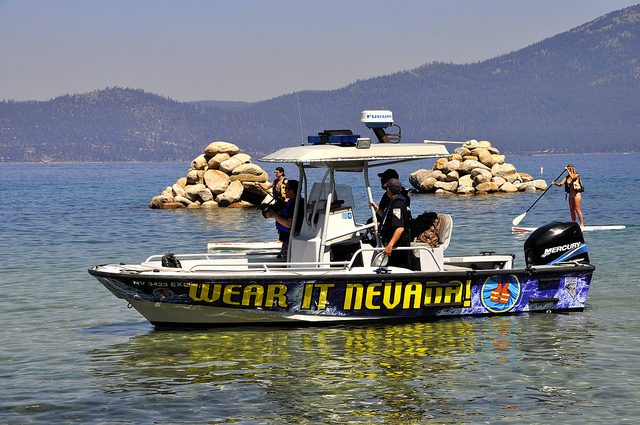
Wearing life jackets is being emphasized b officials at Lake Tahoe. Photo/Provided

The importance of wearing life jackets is being emphasized by officials at Lake Tahoe. Photo/Provided

By Carole Bernardi

INCLINE VILLAGE – Summer at picturesque Lake Tahoe is officially in full swing once the Fourth of July holiday kicks into gear. Boats line the shores, paddleboards compete with kayaks, and swimmers maneuver their way in between.

This year the long holiday weekend presents unlimited opportunities for water activities as healthy snowfall has allowed Lake Tahoe to rise slightly above its natural rim. It’s a recipe for fun, and pending risks.

People often believe hypothermia is the greatest risk of drowning in cold water, but it’s not; it takes hours. In Lake Tahoe, water temperatures can be anywhere between 68-70 degrees by mid-August in the shallower coves. Go down another 4 feet plus and it’s easily 10 degrees cooler. By the time you reach the thermocline (a thin, distinct layer where temperature changes more rapidly with depth than layers above or below) it’s a steady 45 degrees. This degree of shock can kill.

Cold water shock kills in minutes due to an involuntary gasp reflex caused by sudden immersion in cold water. Symptoms are rapid breathing, gasping, fainting, muscle failure, lungs fill with air and an immediate risk of drowning.

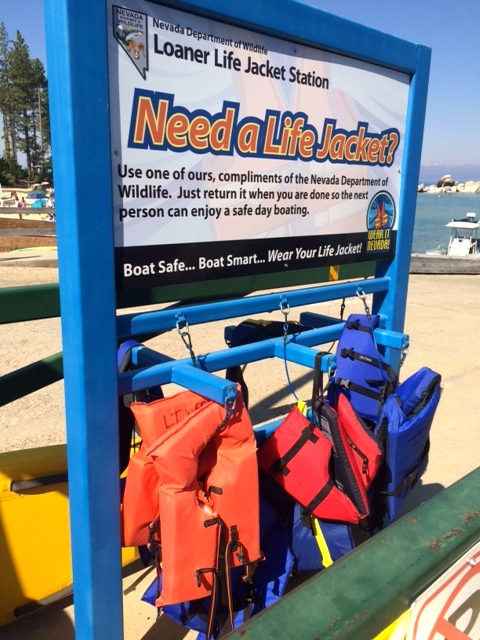
Loaner life jackets are available at Sand Harbor. Photo/Carole Bernardi

Loaner life jackets are available at Sand Harbor. Photo/Carole Bernardi

Officials from multiple state and district agencies (including Coast Guard, sheriff, state park, wildlife and TRPA) are monitoring Lake Tahoe and are bracing for possible fatal accidents during the crowded Fourth of July holiday. They are also out on the lake most other days of the summer.

Water safety is relevant in several situations from boating, paddleboarding, kayaking, Jet Skiing, swimming, diving off a boat or even walking into the lake.

“Your best inoculation against cold water shock is a life jacket. It will save your life,” Edwin Lyngar of the Nevada Department of Wildlife said.

Lyngar has helped spearhead a campaign called Wear it Nevada that unites these agencies in order to impress the importance about life vests. A personal flotation device (PFD) is the most important piece of equipment, so much so that “life jacket loan stations” are now located at Nevada State Parks (15 locations and growing). A grant with the U.S. Coast Guard provides these jackets. One is at Sand Harbor.

Once a life vest is on, there are a few other important tips to consider. Have you adapted to the altitude? Are you drinking plenty of water and staying hydrated? Are you walking into the lake after hours of sun exposure (body temp)? The most obvious for those in a vacation state of mind, what is your alcohol consumption level?

Nevada laws mandate that children 12 and under must wear a life vest, and 13 and older must have one in their possession. Even business owners renting water devices are obligated (insurance liability) to review, with each and every customer, the Coast Guard Navigation Rules and are responsible for providing each customer with a PFD.

“It’s all about team work and everyone’s jurisdiction having the same goal and responsibility to everyone on the water,” said Deputy Rob Buonamici of Douglas County Sheriff’s Department. If a water patrol boat approaches a paddleboarder or kayaker, with no life vest on their body or strapped to their water device, it is a $90 citation.

“Just like a DUI for road violations, a boat operator or person using a water device can be cited for an OUI, which is operating under the influence with an alcohol level of 0.08 percent,” Deputy Ron Skibinski of Douglas County said.

Other tips from the boat patrollers: never swim alone, tell a friend before entering the water, know your swimming limitations, wear a whistle, never jump into cold water, and prepare for accidental immersion by putting on a life vest.