Evacuation orders lifted for Trailhead Fire

Updated 9:50pm:

The mandatory evacuation notice for the Trailhead Fire has been lifted.

Containment is at 50 percent, with acreage burned not growing on Monday. It remains at 5,444 acres.

More than 2,000 people continue to fight the wildland burning in a remote area of El Dorado County.

It started June 28 in the Middle Fork of the American River Canyon in Placer county. The fire is now in El Dorado County and on the Eldorado National Forest.

The stable atmosphere has been good for crews to make progress.

Three firefighters have been injured; heat and lacerations.

The cause remains under investigation.

— Lake Tahoe News staff report


Bottomless bloody Mary bar a bit dangerous

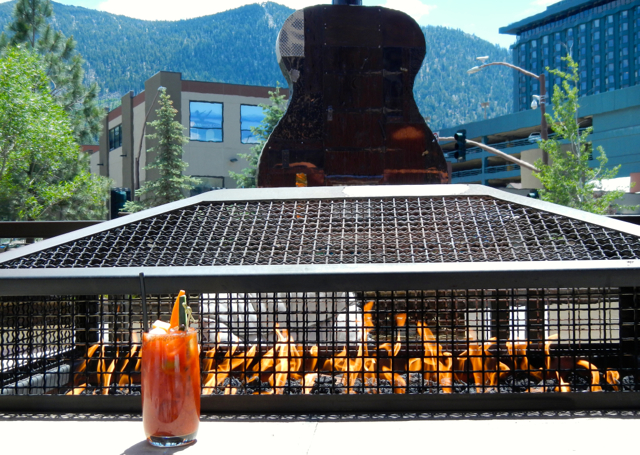
Bloody Mary's at the Hard Rock are original on weekends with consumers making them. Photo/Kathryn Reed

Bloody Mary’s at the Hard Rock are original on weekends with consumers making them. Photo/Kathryn Reed

By Kathryn Reed

STATELINE – The beauty of the bottomless bloody Mary bar at Fire Break inside Hard Rock Lake Tahoe is that if you don’t like the first one, the second can be totally different. And if the first was delicious, go make another one.

The Stateline eatery recently started the bottomless mimosa and bloody Mary bar on the weekends from 10am-3pm.

While every bloody Mary has the same basic ingredients, they don’t all have to taste the same.

What’s fun about this bar is the imbiber is in control of what the final drink tastes like. It can be a bit daunting, even dangerous (at least to the digestive system) with all of those choices.

On this particular Sunday Joey B. was the bartender. He is responsible for rimming the glasses with one of four salts (Sriracha is the most popular), adding ice and the Tahoe Blue Vodka (regular, bacon or jalapeno), and then the juice – one of which is green. (Stick with the red ones.)

“We make our mix here so it’s fresh,” manager Olivia Van Heusen told Lake Tahoe News. “The vegetables are cut fresh each morning for the bar.”

Once Joey is done, it’s up to the consumer to finish the drink.

It’s time to choose which hot sauces to add, as well as Worcestershire sauce. And the vegetables – it’s not quite like being at a farmers’ market, but the choices are better than any bar I’ve to. There’s cheese and Slim Jim’s, too. Who knew those were bloody Mary fixings?

The goal for the Hard Rock was to provide something different to consumers; there is no other bloody Mary bar on the South Shore, and to have something new to complement the revised brunch menu. (Not a drop of the burrito or carnivore skillet was left on LTN’s plates.)

The cost of the bottomless bar is $15. A single bloody Mary is $10, so it’s a bargain for the imbibers. Van Heusen said some people have stayed for the entire five hours the special is going on. Sitting outside, well, it’s hard to want to move even if you can.


4×4 fundraising event in Truckee

The second annual Sierra 4×4 Trails and Ales event, a 4×4 fundraising affair, will be July 16 at Northwoods Clubhouse in Tahoe Donner from 1-4pm.

This event is a chance for people learn about 4x4s and off-road experiences while participating in attractions.

Sierra 4×4 Trails and Ales includes a shine-and-show contest, live music, kids’ games, a raffle, a beer tasting, barbecue, 4×4 vendors and a trail ride the following day. Attending this event is free, while food and beverages will be available for purchase.

To participate in the signature shine-and-show contest, interested individuals owning any type of 4×4 vehicle may register for $35. Entry includes a commemorative beer mug, two beer coupons, a Tahoe Donner swag bag, an event logo T-shirt and a guided trail run to Bear Valley Loop Trail on July 17 at 9am. In addition, all shine-and-show participants will have a chance to win prizes in the following vehicle categories: cleanest, dirtiest, most rugged tires, best rims, ultimate beater, most trail ready, best stock (two minor modifications max), best classic and people’s choice.

Proceeds from the event will be donated to the Tahoe Donner Giving Fund, which will grant proceeds to the Boys & Girls Club of North Lake Tahoe.

To learn more about Sierra 4×4 Trails and Ales or to register a vehicle for the event, go online.


Nev. ready to boost drone industry to next levels

By Nicole Raz, Las Vegas Review-Journal

Nevada is at the forefront of pushing the national unmanned aircraft system or drone industry forward.

“We view all the UAS test sites as equals,” a Federal Aviation Administration spokesman said. “However, Nevada has one distinction: It’s the only site to have the ability to certify unmanned aircraft as an FAA designated airworthiness representative.”

Nevada’s FAA test site designation is giving state drone-industry players a boost to develop the industry to its limits.

Read the whole story


Deadliest roads for animals in California

By Robert Kuo, Sacramento Bee

Driving to San Francisco or Lake Tahoe for the weekend? Be careful not to hit the wildlife on these roadways.

A UC Davis professor who tracks vehicle-animal collisions found that in the Sacramento region, the most animals are killed on Interstate 80 from Davis to Sacramento, the stretch of road known as the Yolo Bypass, as well as on Highway 50 near El Dorado Hills.

In the Sierra Nevada, roadkill was spotted most often along state Highway 89 north of Lake Tahoe, and state Highway 49 in the foothills.

Read the whole story


Best places to eat between Tahoe, Bay Area

By Amy Graff, San Francisco Chronicle

Let’s face it. Bay Area residents rarely zip up to Tahoe. Most of the time, we inch and crawl through traffic that moves at the rate of molasses.

Food stops are a must on most weekend trips between the Bay Area and Tahoe (unless your boss lets you get off work at noon so you can be on the highway by 1 p.m.)—and so we’ve rounded up a collection of the best ones.

Our list that takes you from the Bay Area to the Sierra foothills (along Highways 50, 80 and 88) includes a variety of spots, from cheap and quick taquerias to fruit stands where you can pick up car snacks and groceries.

Read the whole story


Workshop to delve into ADA regulations

Lake Tahoe South Shore Chamber of Commerce is hosting an ADA Compliance Workshop on July 13 from 9-11am at its Stateline office.

Businesses will be taught how to protect themselves from ADA lawsuits and what to do if they have already been served with papers.

This is free for members and $10 for non-members.

The ADA Compliance Workshop is in response to a plethora of ADA lawsuits on the South Shore.

Workshop presenters include Brian Shinault, CASp (certified access specialist) and architect from Shinault Architecture, Dave Walker the CASp and building inspector from South Lake Tahoe, and Cris Vaughan a CASp and attorney.

For more information and to register go online.


Climate change could alter Tahoe’s chemistry

By Alexander L. Forrest, The Conversation

In an age of rapid global population growth, demand for safe, clean water is constantly increasing. In 2010 the United States alone used 355 billion gallons of water per day. Most of the available fresh water on Earth’s surface is found in lakes, streams and reservoirs, so these water bodies are critical resources.

As a limnologist, I study lakes and other inland waters. This work is challenging and interesting because every lake is an ecosystem that is biologically, chemically and physically unique. They also are extremely sensitive to changes in regional and global weather and long-term climate patterns.

For these reasons, lakes are often called “sentinels of change.” Like the figurative canary in the coal mine, lakes may experience change to their ecosystem dynamics before we start to see shifts in the greater watersheds around them.

In a study I recently co-authored with Goloka Behari Sahoo, Geoff Schladow, John Reuter, Robert Coats and Michael Dettinger, we projected that future climate change scenarios will significantly alter natural mixing processes in Lake Tahoe in the Sierra Nevada range that are critical to the health of the lake’s ecosystem. This could potentially create a condition that we termed “climatic eutrophication.”

While many groups have studied the long-term impact of climate change on lakes, this process can now be added to the growing list of drivers of eutrophication. This is a potentially damaging phenomenon that could affect a number of vital deep-water lakes around the world, degrading water quality and harming fish populations.

Eutrophication is a condition that occurs when lakes and reservoirs become overfertilized. Cultural eutrophication is a well-understood process in which lake and reservoir ecosystems become overloaded with chemical nutrients, mainly nitrogen and phosphorus. These nutrients come from human activities, including fertilizer runoff from farms and releases from sewage systems and water treatment plants. Natural weathering processes, atmospheric deposition of air pollutants, and erosion also transport nutrients that are already present in the watershed into the water supply.

In water bodies, these heavy nutrient loads fertilize algae, causing surface algal blooms. When the algae die, they sink and are broken down as they decompose. This decomposition process consumes dissolved oxygen in the water. As oxygen levels become depleted, hypoxic (dead) zones develop in the bottom waters where oxygen levels are too low to support life. Dead zones harm fisheries and tourism, and algal blooms can contaminate drinking water.

Over the past several decades, state and federal regulators have developed many initiatives to eliminate or reduce nutrient sources. In some cases, such as Seattle’s Lake Washington, water quality has improved through management. In other, larger watersheds – notably, the Great Lakes – nutrient pollution is still a major problem.

As anyone who has swum in a lake knows, the water is typically warmest on the surface where the sun shines on it. Cold water is denser than warmer water, so it sinks. For much of the year, deep lakes will remain stratified (separated into layers).

In fall and late winter, large storms disrupt natural stratification and cause lake waters to overturn. This mixes surface waters down into the lake’s depths and brings deep water up to the surface, where it can absorb oxygen from the atmosphere. This process, which transfers dissolved oxygen from the surface to the lake bottom, is critical for an ecosystem’s health.

But our study showed that surface warming in Lake Tahoe could cause climatic eutrophication by reducing or even ending mixing, thus interrupting the vertical movement of dissolved oxygen from the lake’s surface to the lake bed.

Scientists, spearheaded by UC Davis, have been monitoring conditions at Lake Tahoe for nearly 50 years, so we have good records of short- and long-term changes in water temperatures and quality. Since 1968, the average temperatures of the lake’s surface waters (down to a depth of 80-120 feet) have increased by nearly 0.5 degrees Celsius. That change has increased the lake’s stability – a measurement of how resistant it is to overturning – enough to reduce the probability that surface waters will mix all the way to the lake bottom.

To model possible future conditions, we estimated Lake Tahoe’s annual stability by combining a lake hydrodynamic model – representing how water is moved around the lake – with two different greenhouse gas emission scenarios published by the Intergovernmental Panel on Climate Change. In one scenario, emissions increased rapidly throughout this century; in the other, emissions leveled off by the year 2100.

Under both scenarios, meteorological conditions influencing the lake are projected to change. Notably, wind speeds would decrease by 7-10 percent, and air temperatures would increase by 2.5-4 degrees Celsius. These warmer, less windy conditions across the lake will extend and magnify the warming and stratification trends that we are already seeing.

As the lake remains stratified for longer periods each year and less overturning occurs, dissolved oxygen levels at the bottom will decline. Under these conditions, nutrients stored in the lake bed will be released to the water through chemical reactions that occur in low-oxygen environments. This new source of nutrients, known as internal loading, will further contribute to the process of climatic eutrophication.

Although all lakes are unique ecosystems, this process could also occur in other deep-lake settings around the world, such as Japan’s Lake Biwa or Lake Baikal in southeastern Siberia. Climate change is already shortening the periods each year when many temperate and polar lakes are covered with ice. As water temperatures rise in the upper layers of deep lakes, they will remain stratified for more of the year and will be less subject to mixing. Less dissolved oxygen will be returned to deep waters, which will stress fish populations.

And unlike cultural eutrophication, climatic eutrophication could affect entire watersheds or regions, since it is driven by climatic influences rather than by discharges of nutrients into a lake from farms or cities.

Climatic eutrophication has serious implications for long-term water supplies and aquatic ecosystem health around the world. To recognize and track it, we need to identify lakes in North America and around the world that could be at high risk.

In areas where scientists and regulators are working to reduce conventional eutrophication, these experts will also need to factor the possibility of climate-forced eutrophication into their strategies. The first step is to support more monitoring of lakes’ physics and chemistry so that we can recognize, track and predict climatic eutrophication of our lakes and reservoirs.

Alexander L. Forrest is an assistant professor of environmental engineering at UC Davis.


Majority of Nevadans could be minorities by 2022

By Adelaide Chen, Las Vegas Review-Journal

Nevada isn’t a majority-minority state quite yet. But it is projected to be in 2022 or 2023, according to the state demographer.

Part of the driving force is that more of Nevada’s 19-and-under population is Hispanic than white (non-Hispanic white). As of 2015, the estimate was 41 percent to 37 percent respectively, according to the U.S. Census Bureau’s latest figures released today.

Five years ago, the estimate was 40 percent white and 39 percent Hispanic.

The state demographer, Jeff Hardcastle, said about a third of the Hispanic population had lived in the state before 2000, a third were born between 2000 and 2010, and a third migrated from out of the state or country.

Read the whole story


Snippets about Lake Tahoe

·       Lorraine Turner, chief administrative officer for Lake Tahoe Resort Hotel in South Lake Tahoe, was selected by the hotel ownership group, Premier Hotel Collection, to be the first regional executive for the company’s two U.S. properties – Lake Tahoe Resort Hotel and Anaheim Majestic Garden Hotel.

·       Placer County Board of Supervisors will consider transitioning county-run medical clinics in Auburn and Kings Beach to private operation during a public hearing on July 12 at 1pm in Auburn.

·       “The Academy of Hay” by Julia Shipley, winner of the 2015 Bona Fide Books Melissa Lanitis Gregory Poetry Prize, has been nominated for the Vermont Book Award.

·       This is First Tracks Productions’ video from the Longest Day of Golf, a benefit for the South Lake Tahoe Cancer League.

·       The League to Save Lake Tahoe has a new website.