Function, looks part of Meyers road plans
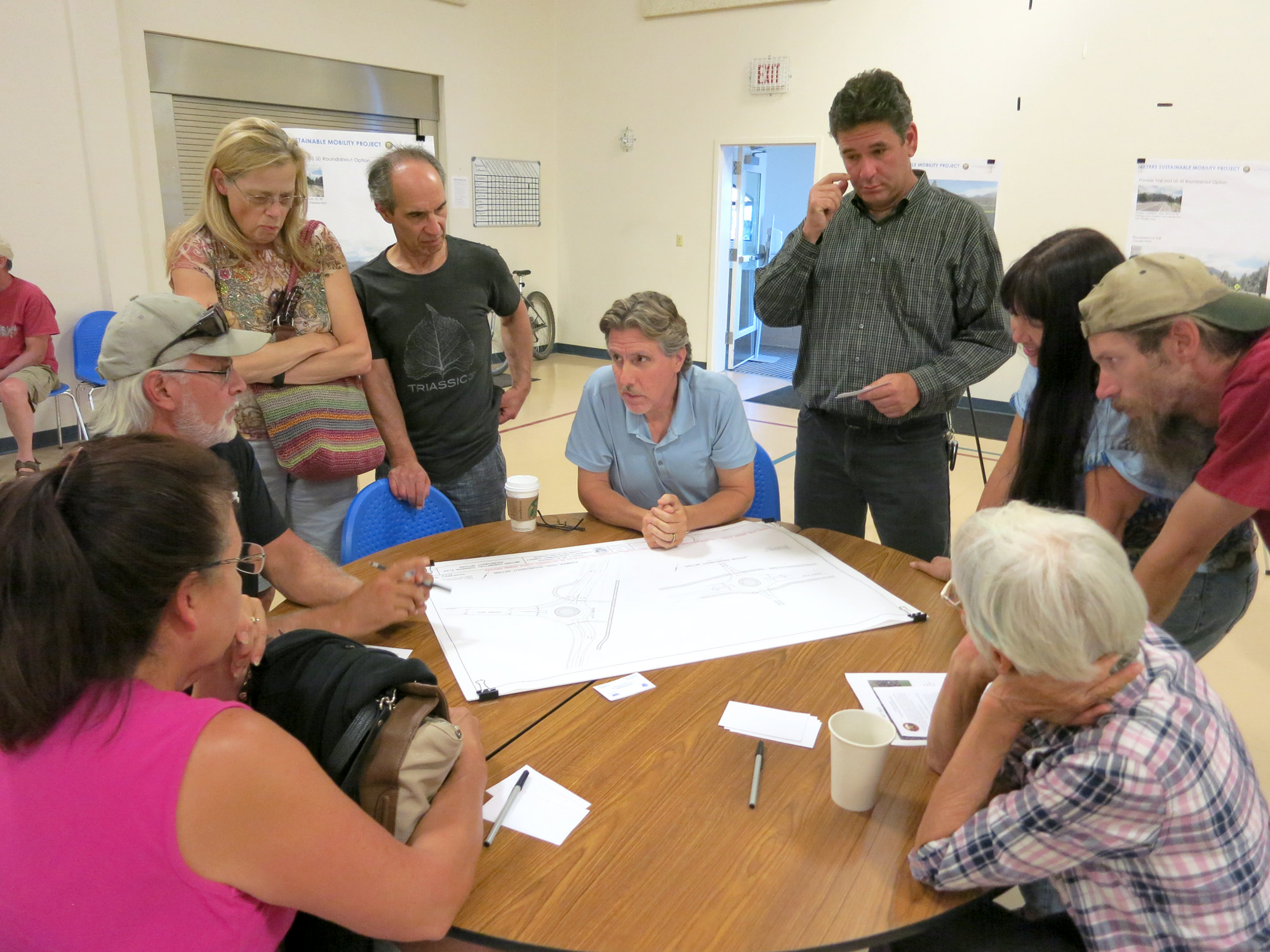
erry Champa, traffic safety liaison & engineer for Caltrans discusses the possible Pioneer Trail roundabout with Meyers residents at the meeting. Photo/ Jessie Marchesseau

Jerry Champa, Caltrans traffic safety liaison and engineer, discusses the possible Pioneer Trail roundabout with Meyers residents on July 21. Photo/ Jessie Marchesseau

By Jessie Marchesseau

MEYERS – A roundabout at the Pioneer Trail intersection, another one at the Highway 89 intersection, frontage roads flanking Highway 50 in between, and sidewalks and a bike path all the way down Apache Avenue. These are a few of the ideas planners had on display at Thursday’s Meyers Corridor Project public meeting.

On July 21, planners from El Dorado County, Tahoe Regional Planning Agency and Caltrans hosted the meeting at the California Conservation Corps building to present and gather input on preliminary concepts for improving the main transportation corridors through Meyers.

The goal of the project is to improve vehicle circulation on the roads, improve pedestrian and bicycle safety, manage traffic during peak times, create a Main Street concept and enhance operations such as snow removal.

For the sake of this project, Meyers is being loosely defined as the area between Pioneer Trail and the intersection of Highway 89. As such, planners have identified three main areas as the focus for major improvements: the intersection at Pioneer Trail, the intersection at Highway 89, and Apache Avenue.

Planning for this project began when TRPA awarded El Dorado County an On Our Way grant to improve pedestrian and bicycle alternatives, the streetscape and water quality along the Highway 50 corridor through Meyers.

For Thursday’s meeting, John Kahling, deputy director of El Dorado County Community Development Agency and Transportation Division, and Brendan Ferry, principal planner with El Dorado County, spoke briefly about the project before opening up the room for attendees to mingle about viewing schematics and talking with planners one-on-one. The two-hour meeting concluded with an open question and answer session.

Four stations were set up where attendees could interact directly with planners and view computer-generated pictures depicting what areas would look like if the proposed plans were put into place. The stations were for the Pioneer intersection, the Highway 89 intersection, Apache Avenue from Highway 50 to San Bernardino Avenue and the overall Highway 50 corridor, which displayed three options.

Planners stressed that the project is still in the early stages of planning and these are just preliminary ideas. However, they wanted to gauge how residents are feeling about their ideas so far and obtain feedback.

Kahling said the reactions he has received at this and other recent public presentations has been mixed, but overall seems pretty positive.

“People are generally receptive to the idea of improving Highway 50 through Meyers,” he said.

He has heard comments and concerns regarding drainage, private property and traffic spilling over onto the residential streets.

One Meyers resident expressed concern the project might be focused more on making the streets look pretty than helping traffic. She would rather see the residential streets fixed. However, a FAQ flyer available at the front door addressed the second part of her concern, explaining how the residential streets are maintained and funded by a different entity, and this project would not take any manpower or funds away from those projects.

John Garofalos, who lives on Apache Avenue, said he has no objections to improvements happening on his street. However, he believes the current plan may be a little short sighted and could be designed better. He would also rather see three timed stoplights installed instead of roundabouts; one each at Highway 89, Apache and Pioneer Trail. This was not one of the proposed options.

Presenters announced Meyers resident David Reichel is acting as the Meyers community representative for the project, offering local insight to planners. It was explained that this is not a political position, nor does he have authority to make decisions or design any plans. However, one attendee still expressed concern that Reichel had not been elected to the position.

In all, about 30 residents attended the meeting, and numerous questions and concerns were discussed. The overall impression seemed to be a positive one with residents embracing the idea of improving their small community.

“Like all of human nature, every person likes certain things,” Ferry said. “So, what we’re trying to do is find what is best overall for the community.”




Opinion: Time to focus on Tahoe’s shoreline

By Joanne S. Marchetta

Millions of people visit our region each year, and the shoreline is where most of them go to enjoy the beauty and the cold, famously clear water of Lake Tahoe.

The shoreline is also where a challenging mix of planning issues converge: Protecting the environment and our lake’s awe-inspiring scenery, managing recreation access, and respecting private property rights.

Joann Marchetta

Joann Marchetta

This year and next, TRPA will be working with the community to draft shoreline policies and regulations. The goal is to protect our lake’s environment and scenery and enhance recreation access for people to enjoy it. It will be a difficult balancing act, and we have tried to update these policies before.

Lawsuits, widely varying priorities, difficult questions about science and the environmental impacts of boating, and deeply held interests have thwarted such efforts in the past, leaving shoreline regulations the one element of our Regional Plan where consensus has been elusive.

New pressures confronting Lake Tahoe make it all the more important to update our shoreline regulations, and interviews completed last fall with nearly 50 shoreline stakeholders suggest the time is ripe for success.

More people than ever are traveling to Lake Tahoe each year, and we expect our region’s visitation numbers to continue to grow in the decades to come. Visitors and residents want to experience the unique beauty of our lake and we need to make sure that they have convenient, environmentally-friendly ways to do so.

And while an average snowpack this past winter brought Lake Tahoe back up to its natural rim this summer, many piers and boat ramps around the basin are still left high and dry. Climate change and predictions of longer, more frequent, and more severe droughts add a new layer of uncertainty to the shoreline planning initiative and raise difficult questions for the management of marinas, piers, buoy fields, and boat ramps.

TRPA is taking a collaborative and inclusive approach for this planning initiative. We have assembled more than a dozen shoreline stakeholders to work together and steer this process. That includes marina operators, environmental groups, multiple agencies involved in the review and permitting of shoreline projects, and private property owners. We are also reaching out to community members, homeowner associations, and other groups around the lake to get as many people as possible involved in this process and working together on this important issue.

TRPA has contracted with the Consensus Building Institute, a nationally-recognized mediation firm, to help stakeholders find common ground and agreed-upon solutions for managing Lake Tahoe’s shoreline in ways that enhance recreation access and protect our environment. We’ve also put together a team of experts to help stakeholders work through difficult questions about climate change, environmental impacts, and water quality conditions so policy questions are solved with the best-available science and information.

People can learn more about this ongoing planning process, find out about upcoming community workshops, and share their information and ideas through a new website.

Updated shoreline regulations for Lake Tahoe are one of TRPA’s highest priorities. As you enjoy Lake Tahoe this summer, please visit the website to learn more about this important planning process and get involved. We are confident that with everyone working together for a common cause—the protection and betterment of our beautiful, environmentally-sensitive mountain lake—we can craft new shoreline regulations that will protect our lake and help people enjoy it responsibly for generations to come.

Joanne Marchetta is executive director of the Tahoe Regional Planning Agency.


Wagner leads ACC tourney after 1st round

Putting practice on July 21 helped Jack Wagner secure the lead after the first day of the ACC on July 22. Photo/Kathryn Reed

Putting practice on July 21 helped Jack Wagner secure the lead after the first day of the ACC on July 22. Photo/Kathryn Reed

By Jim Krajewski, Reno Gazette-Journal

STATELINE — The fast greens suited Jack Wagner just fine.

Wagner raced around the Edgewood Tahoe Golf Course and emerged on top after the first day of the American Century Championship on Friday.

Wagner, known for his short game, scored 27 points to lead Mike Modano by 3 points. Defending champion Mark Mulder scored 23 points Friday, Mardy Fish has 22 and Sterling Sharpe has 23 points.

Read the whole story


175-plus tennis players set for annual ZC tourney

A who’s who of the Tahoe-Reno region will descend upon the courts at Zephyr Cove next week for the 33rd annual Tahoe Tennis Classic.

More than 175 players from multiple states are entered into the all doubles tournament. The four-day tournament (July 28-31) has 11 divisions.

Spectators are welcome to watch the action for free at Zephyr Cove Tennis Club.

Young sensation Angelina Spinnato is likely to turn a lot of heads. The 12-year-old from South Lake Tahoe is starting to make a name for herself. She is partnering with Robin Twining in the women’s C division.

However, that duo could face No. 1 seeds Becky Darrow and Donna Rockwood. Rockwood was one half of the winning team in 2015.

Tournament director Bob Beutenmiller calls Ryan Johnston Tahoe’s most skilled player. Johnston, who recently won the USTA NorCal Grand Prix singles title, regularly plays in Sacramento and San Francisco leagues and tournaments. He will partner with Mohamed Irfan Lakdawala of San Francisco. Their toughest competition will come from the Reno duo of Jeffrey Mullen and teaching pro Craig Gorbach. Mullen is the highest rated player in the Reno area.

The women’s A division features last year’s runner-up as the early favorite: Carol and Holly Tretten, a mother and daughter team from Reno. Local teaching pros Ginny Ungar and Susan Cowan will give them tough competition.

The most balanced division this year will be the women’s B division. Six teams have a legitimate chance to claim the championship: Mary Heller-Barbara Van Fleet, Maureen Snyder-Caryn Jones, Dawn Perkins-Carolyn Richert, Christy Wurster-Sara Catania, Joyce Youngs-Sally Huttenmayer and Kae Reed-Tracey Samoluk.

The largest event in terms of teams is the mixed doubles B division. A strong seeded team will be Lori and Tony Grbac from Roseville. Jim Bilicki and Lorraine Daniel from Rancho Mirage, Kathy Brown and Steven Reid from the Reno area, and Mark Silva with Christine Wurster from Placerville will dominate the division.

For a full list of the various divisions and competitors, go online.

There is also still time to enter. The deadline to do so is July 24.

The nonprofit Zephyr Cove Tennis Club Foundation runs the Classic and is responsible for the tennis facility owned by Douglas County. The tournament is the club’s largest fundraiser, which allows it to provide an array of tennis opportunities for the public, including free junior programs.


As summer heats up, gas prices stay cool

By Eli Blumenthal, USA Today

Even with the peak travel season in full swing, gasoline prices are stuck in reverse.

Gas prices have plunged to their lowest July level in 12 years, according to AAA, even as Americans are racking up more miles.

In fact, gas prices have dropped in 39 out of the last 40 days, lopping 20 cents a gallon off in total during that span, according to AAA.

Read the whole story


Meet the millionaires who bought Burning Man’s Fly Ranch

By Jenny Kane, Reno Gazette-Journal
 
The millionaires who helped the Burning Man Project buy Fly Ranch for $6.5 million include a cofounder of Airbnb, a cofounder of Cirque du Soleil, an Iranian photographer and one of the first investors of Twitter, Snapchat and Instagram.

On Thursday, Burning Man organizers announced the names of the donors who helped the organization fulfill a 20-year dream of buying a slice of hot springs heaven in Northern Nevada, just outside of the Black Rock Desert. The 70,000-person Burning Man arts gathering, coming up Aug. 28 to Sept. 5, is on the desert playa for a week each year.

Burning Man organizers for several years have been trying to seduce “cultural collaborators” who might be interested in helping the San Francisco-based arts nonprofit purchase the 3,800-acre property. The property will eventually become a year-round experimental arts haven where the art-centric culture of Burning Man will thrive via to-be-determined outlets.

Read the whole story


Tevis Cup continues horse health research

By Marsha Hayes, Horse

When the 61st Tevis Ride commences early on July 23, about 170 horse and rider teams will head down the historic Western States Trail across the rugged Sierra Nevada mountains in a challenging 100-mile journey. It will also allow equine researchers another opportunity to study elite endurance horses in a field setting.

Since 2012, and in addition to the required hands-on horse evaluations during the ride, researchers have drawn and analyzed equine blood samples at mile 36. They’ve been trying to uncover data that would objectively identify horses unlikely to finish the course within the allotted 24 hours.

Also since 2012, the researchers have reviewed the data after the ride and compared them with actual completion rates. They focused on potassium and chloride levels, which decrease as a horse sweats and serve as an indirect marker of hydration. In the first year, the team found that horses with specific potassium and chloride levels had a 25 percent event completion rate compared to a general completion rate of around 50 percent.

Read the whole story


Power line work to impact Pioneer Trail traffic

Expect traffic delays on Pioneer Trail on the South Shore as overhead lines are put underground.

Approximately 5,800 feet of power lines from Liberty Utilities as well as communication lines owned by AT&T and Charter Communications are being relocated underground along Pioneer Trail from Black Bart Court to south of Golden Bear Trail. The work is expected to continue through mid-October, and will be completed next year.


The California Public Utilities Commission requires an electric utility to provide undergrounding allocations each year for converting overhead power lines to underground power lines. Eligible areas eliminate unusually heavy concentrations of overhead lines, involve a street or road with a high volume of public traffic, benefit a civic or public recreation area or area of unusual scenic interest or are listed as an arterial street or major collector.


Report: Calif. least business-friendly state

By Kevin Smith, San Gabriel Valley Tribune

If you think California is a tough place to do business, you’re not alone.

A report from CNBC confirms what scores of companies have long suspected — California is the least business-friendly state in the nation.

CNBC’s 10th annual America’s Top States for Business study places the Golden State at the bottom of the list for 2016. California was also found to be one of the costliest places to do business, with a favorability ranking of 49 out of 50.

California’s educational system also ranked low on the scale, landing at 38, and the state’s network of roads and bridges, waterways, rail lines and other infrastructure was ranked the 33rd worst in the nation.

Read the whole story


AG’s Office drops case against EDC auditor

By Kathryn Reed

There was so little evidence to support any wrongdoing by El Dorado County Auditor-Controller Joe Harn that he wasn’t even asked to defend himself.

“I never spoke to anyone from the Attorney General’s Office. I was never informed by the attorney general that I was under investigation,” Harn told Lake Tahoe News. “I don’t know exactly what they would be investigating me for.”

Joe Harn

Joe Harn

This week the county released a press release saying in full, “The 2014-15 El Dorado County Grand Jury requested an investigation into the allegations and findings of its report in Case GJ-14-12. The office of the California Attorney General has concluded its investigation into the allegations, which were raised in the report, regarding the conduct of the El Dorado County Auditor-Controller Joe Harn with no charges being filed.”

That report in part talked about how the county as a whole was dysfunctional. It also called Harn a bully.

The District Attorney’s Office opted for the state to do the investigation so no one could claim there was any conflict.

“The specific allegations are confidential,” Michael Ciccozzi, county counsel, told Lake Tahoe News.

However, the county prior to the grand jury report had been doing an investigation on Harn that was started by Human Resources Director Pamela Knorr. She brought in Ken McHold with the law firm Prentice, Long & Epperson to conduct the investigation on a contract not to exceed $60,000.

That investigation, too, went nowhere.

Knorr and McHold knew each from their days working for Placer County. Knorr has used him before to go after auditor-controllers in other counties she has worked for when the keeper of the finances had told her they won’t be a party to illegal or unethical behavior.

The irony about this particular grand jury report is that it found Knorr’s department to be the most dysfunctional and yet no one has investigated her or the Human Resources Department.