Sink hole a problem in Carson Valley

A 6-foot sink hole near Genoa is being blamed on a broken water line.

The hole is on Jacks Valley Road between Montaña and the first entrance to Genoa Lakes Golf Course. The road is closed from these two access points.

A precautionary boil water notice has been issued to the residents in the Montaña development. The residents of Genoa have been asked to conserve water.

It is unknown what caused the line to break on July 24.

Douglas County officials say it could take a few days to fix the problem.

— Lake Tahoe News staff report


Bay Area seashore exudes national treasure

Publisher’s note: This is one in a series of stories about the National Park Service, which is celebrating its 100th anniversary in 2016. All articles may be found via the Home Page, select Special Projects, then National Park Service 100th.

Northern elephant seals sun themselves on the beach near Chimney Rock. Photo/Jessie Marchesseau

Northern elephant seals sun themselves on the beach near Chimney Rock. Photo/Jessie Marchesseau

By Jessie Marchesseau

POINT REYES NATIONAL SEASHORE – As a native Montanan, I grew up nowhere near a seashore. I was a teenager before ever even laying eyes on the ocean. Though I have since visited it numerous times, I don’t think it will ever cease to be a wonder to me: how so much beauty, life, power and even destruction can be combined into this one body, living, yet not living.

This summer, in observance of the 100th anniversary of our National Parks System, my husband and I decided to seize the opportunity of a recent three-day weekend to explore one of our nearby, and perhaps lesser-known, national treasures.

Just a few hours’ drive from Lake Tahoe we took in the sandy beaches, beautiful yet violent ocean waves, rolling coastal prairies and diverse wildlife of Point Reyes National Seashore.

One of just 10 national seashores within the National Parks System, Point Reyes is the only national seashore in California. In fact, it’s the only one on the West Coast, the other nine lying along the Atlantic and Gulf coasts.

The dairy building on the Historic Pierce Point Ranch was once the center of a thriving dairy business. It remains preserved within the Tule Elk Reserve at Point Reyes National Seashore. Photo/Jessie Marchesseau

The dairy building on the Historic Pierce Point Ranch was once the center of a thriving dairy business. It remains preserved within the Tule Elk Reserve at Point Reyes National Seashore. Photo/Jessie Marchesseau

These seaside preserves comprise a relatively small portion of the more than 400 sites which make up the National Parks System. And at just 70,000 acres, Point Reyes may seem almost tiny next to a 750,000 acre park like Yosemite. But the 80 miles of undeveloped coastline encompassed by Point Reyes National Seashore offers visitors an experience every bit as intriguing, delightful and awe-inspiring as one would expect from a national park.

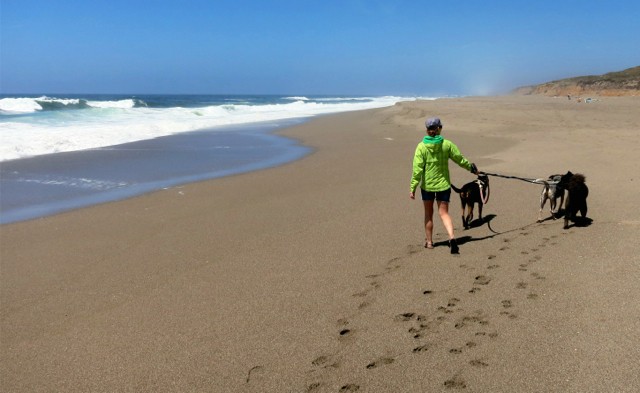
Whitewater waves more than 6-feet high crashed onto the shores at Point Reyes Beach while we enjoyed a picnic lunch on the sand, onshore winds ruffling our hair. A washed up log was a makeshift picnic table as our niece and nephew crawled in and out of a driftwood “fort,” our three dogs digging holes in the sand and hunting for crab carcasses at our feet.

As dog owners, we always enjoy our adventures a little bit more with furry family members at our sides, and Point Reyes proved to be pleasantly dog-friendly, at least as far as national parks are concerned. It offers three dog-friendly beaches accessible by car or foot, even more if you choose to boat in. Printable maps clearly depicting dog-friendly locations are available online, and the park ranger I chatted with at the Bear Mountain Visitor Center was more than happy to highlight the locations on my free park map where I could explore with my four-legged friends. They do ask you to keep dogs on leashes, clean up after them and stick to the designated areas. But with miles of seashore designated dog-friendly, we had plenty of room.

Point Reyes Beach is just one of the beaches in Point Reyes National Seashore which allows dogs. Photo/Jessie Marchesseau

Point Reyes Beach is just one of the beaches in Point Reyes National Seashore which allows dogs. Photo/Jessie Marchesseau

Most of the beaches at Point Reyes are not swimming beaches. Dangerous, often pounding surf and rip currents deem much of the water unsafe for venturing in. Moderate temperatures and steady winds typical of Northern California beaches don’t exactly beckon for bikinis and board shorts anyhow. But the sand is soft, and the views outstanding.

Piling back in the car, our next stop was Elephant Seal Outlook. The northern elephant seal is perhaps the most iconic of the 80 species of mammals known to reside within the boundaries of the national seashore, which also includes the water and land a quarter mile off shore. From the outlook, we peered down on two dozen elephant seals sunning themselves on the beach below and even a few pups frolicking in the water. The cooler temperatures and gusty winds were clearly not affecting their afternoon.

The following day we ventured to the north end of the park in search of the only animal which may rival the seal in its iconic status within Point Reyes: the tule elk. Once nearly extinct, tule elk at Point Reyes now number more than 400. At the far northern end of Point Reyes National Seashore, spanning a small peninsula called Tomales Point, is the Tule Elk Reserve.

Growing up in the Rocky Mountains, I know elk can be somewhat elusive animals, but upon reaching the reserve, we spotted three bull elk and one cow almost immediately. Continuing on to the designated parking area, we set out on a short hike in search of more. This proved not only a welcome opportunity to stretch our legs, but a chance to stroll through fields of wildflowers, pink, purple, yellow and white, and admire the picturesque coastline below, passing birds, butterflies and caterpillars along the way.

We were soon rewarded with the view of a small herd of elk, stopping to quietly observe as the majestic animals grazed contentedly on a grassy hillside. Returning, we had thought our luck pretty good on the day’s elk-viewing excursion. But driving out of the reserve we came upon yet another herd, this time all cows and calves, dozens of them so near to the road I felt I could walk out among them without an elk so much as noticing. I did not, however, and only invaded their privacy with my camera lens.

Our weekend coastal adventure was rounded out with a stop at pet-friendly Kehoe Beach and visits to a few historical locations within the park including the Historic Lifeboat Station, Point Reyes Lighthouse and the Historic Pierce Point Ranch, all glimpses into the colorful past life of Point Reyes.

In the end, I was glad we chose this as our national park trip of the summer. To have a place like Point Reyes National Seashore celebrating and preserving this awe-inspiring aspect of our earth right out our back doors is an amenity well worth taking advantage of. The size and location perfect for a quick weekend trip, the overall experience both relaxing and invigorating. Perhaps my favorite part though, was being able to enjoy it with family, both two-legged, and four.


Kokanee fingerlings planted in Lake Tahoe

The California Department of Fish and Wildlife recently released 138,099 kokanee salmon fingerlings into Lake Tahoe.

In all, 634,430 kokanee were released into 13 lakes and reservoirs throughout the state.

Kokanee were introduced into California waters to provide diverse recreational angling opportunities for anglers and have become an extremely popular sport fish. They are typically smaller than the landlocked Chinook salmon with the average size about 12 inches.

Due to the continuing drought conditions making it difficult to obtain kokanee eggs within the state, this year’s allotment was supplemented with eggs provided by Washington Department of Fish and Wildlife.

Instead of migrating to the ocean, adult kokanees inhabit large lakes before returning to their natal streams or gravelly shorelines to spawn. Like all Pacific salmon, kokanee die after spawning, the whole life cycle taking from three to seven years.

The fish were planted in the following waters:

Water                                                   County                             Fish Planted

Boca Reservoir                                  Napa                                 25,042

Bullards Bar Reservoir                    Yuba                                  70,140

Donner Lake                                     Nevada                              25,042

Hell Hole Reservoir                        Placer                                 25,042

Little Grass Valley Reservoir        Plumas                               15,052

Stampede Reservoir                       Sierra                                 60,027

Union Valley Reservoir                  El Dorado                         49,995

Lake Berryessa                                 Napa                                  50,111

Bass Lake                                          Madera                              50,064

Don Pedro Reservoir                      Tuolumne                         19,980

New Melones                                   Tuolumne                          55,524

Shaver Lake                                      Fresno                               50,312.


Snippets about Lake Tahoe

·       Smoke in the Tahoe basin and Truckee areas on July 25 is from the distant fires in Monterey County and Santa Clarita. No fires are burning locally. A strike team from Tahoe is on its way Monday to Monterey.

·       South Tahoe High School teacher Wes Berkshire if featured in an Outside magazine article about the cost of living in mountain towns.

·       Freedom from smoking classes with Barton Health are on consecutive Wednesdays from Aug. 17-Sept. 28, plus Sept. 9, from 6:30-8:30pm. Cost is $30. For more info, call 530.543.5549 or email fit@bartonhealth.org. Classes are at 1077B 4th St., South Lake Tahoe.

·       The Science of Gratitude Integrating Evolutionary, Neurobiological, and Psychological Perspectives is the subject of a lecture at Sierra Nevada College in Incline Village on Sept. 1 from 5:30-7pm. Cost is $5.

·       International Camel & Ostrich Races are in Virginia City Sept. 9-11. For more info, go online.


Rare Sierra sighting could be same wolverine spotted in 2008

By Associated Press

Once believed to have gone extinct in the Sierra Nevada, scientists believe a wolverine spotted this winter north of Lake Tahoe is the same one that in 2008 became the first documented in the area since the 1920s.

California wildlife biologist Chris Stermer set up remote cameras in the Tahoe National Forest after researchers sent him photos of unusual tracks in the snow in January.

One video clip captured Feb. 27 shows the wolverine scale a tree and tug at a baited sock near Truckee. The video is posted on the agency’s Facebook account.

Stermer is awaiting DNA test results. But he said he’s almost certain it’s the same wolverine that he suspects migrated to California eight years ago from the Sawtooth Range in Idaho.


Tahoe Tails — Adoptable Pets in South Lake Tahoe

Phoebe

Phoebe

Phoebe is a 2-year-old terrier mix who came to the shelter from a hoarding situation. She came with three other dogs, probably related to her, who look like terrier-pugs, or possibly Affenpinscher mixes.

She is a cute dog who will need a patient owner to help her see that people aren’t scary. She likes the officers at the shelter, but runs away from most others. Phoebe and the others are crate trained, but will need help with house training.

Phoebe is spayed, microchipped, tested for heart worm, and vaccinated. She is at the El Dorado County Animal Services shelter in Meyers, along with many other dogs and cats who are waiting for their new homes. Go to the Tahoe animal shelter’s Facebook page to see photos and descriptions of all pets at the shelter.

Call 530.573.7925 for directions, hours, and other information on adopting a pet. For spay-neuter assistance for South Tahoe residents, go online.

— Karen Kuentz


Lawsuit threatens tribe’s West Slope expansion

By Joann Eisenbrandt

PLACERVILLE – A lawsuit filed last week is designed to keep the Miwok Indians from developing land on the West Slope even though grading has already begun on Phase I.

On Friday the El Dorado Council filed a lawsuit against the county-approved encroachment permit for the Shingle Springs Village Project being developed by the Shingle Springs Band of Miwok Indians. The writ asks that the initial study and mitigated negative declaration approved by the El Dorado County Board of Supervisors for this project located on Shingle Springs Drive at Highway 50 be set aside.

This is a two-phase project, with Phase I being construction of a gas station, convenience store and car wash. Phase II would include a restaurant, retail and office space, an entertainment venue and an 80-room hotel and conference center.

While the land on which the project will be located is property held in trust for the Shingle Springs Band of Miwok Indians by the Bureau of Indian Affairs — “sovereign land”—removed from county tax rolls and outside most county land use jurisdiction, the county does have control over encroachments from that property onto county lands and roadways. The tribe has already prepared and circulated the needed federal environmental assessment under National Environmental Policy Act for the project itself situated on their land.

At its June 28 meeting, the El Dorado County Board of Supervisors approved the mitigated negative declaration for their encroachment permit part of the project. This was part of a limited review conducted by the county under California Environmental Quality Act. A mitigated negative declaration is at the low end of the totem pole of review options under CEQA and says in effect that the project will have impacts, but all of them can be mitigated to less than significant.

El Dorado Council strongly disagrees. This nonprofit has been following the issue of the relationship between the tribe and county residents for some time. Carol Louis, co-founder and spokesperson for the group, told , “We spent the last year and a half investigating all the Shingle Springs land issues and we found that the county has not represented the taxpaying citizens of El Dorado County in these matters. EDCI has diligently tried to work with the board on the Shingle Springs Village project and before that on the gun range and motocross issues, but the board has not cooperated with us at all. They are more afraid of losing money (through the county’s funding MOU with the tribe) than in working with the community.”

Recent significant increases in the amount of private lands purchased then put into trust by native American tribes and the consequent financial and environmental impacts on local jurisdictions has become an issue not just in El Dorado County, but throughout the country.

The writ filed by the Donald Mooney law firm in Davis on behalf of EDCI names El Dorado County, the Board of Supervisors, and the Shingle Springs Band of Miwok Indians and their development corporation as “real parties in interest.” It asserts that the county, as the lead agency, violated CEQA when it adopted a mitigated negative declaration instead of requiring a full environmental impact report. It also states that the board’s action violates the county’s General Plan as recently amended by the adoption of Measure E by voters in the June 7 primary election.

“Respondents have abused their discretion,” the writ contends, “and failed to act in the manner required under CEQA with respect to the project because they have failed to provide an adequate, stable project description, failed to adequately analyze the project’s environmental impacts, failed to identify necessary and feasible mitigation measures, and impermissibly ‘piecemealed’ the environmental review for the project … substantial evidence in the administrative record supports a ‘fair argument’ that the respondents’ approval of the project may result in a significant impact to the environment.”

Evidence supporting a public agency’s “abuse of discretion” and a clear showing that there is a “fair argument” to support significant environmental impacts that were not fully analyzed or mitigated are key components considered by the court in deciding whether or not to approve a CEQA-based Writ such as this one.

Although the Shingle Springs Village Project will be constructed in two phases, EDCI contends the county only analyzed the impacts of Phase I, the smaller part of the project, deferring consideration of the impacts of Phase II for a later time. This, they say, is a violation of CEQA.  The county’s staff report for the project states, “The improvements are limited to the water, sewer, and driveway access needed to serve the tribe’s proposed Phase I commercial development. The analysis concludes that the improvements are consistent with the applicable policies of the General Plan, provisions of the county codes, and poses less than significant environmental impacts with mitigation measures.”

Also missing, the writ contends, is an analysis of the cumulative impacts of past, present and future projects. While the Writ expresses concern for impacts related to noise, aesthetics, air quality and greenhouse gas emissions and hazards and hazardous materials, the traffic impacts of the entire project is the central issue.

The Traffic Impact Analysis prepared by KD Anderson & Associates gives projections of traffic impacts for roadways and intersections in the project area for both Phase I and Phase II. The Analysis addresses the Phase II buildout, but adds, “It is important to note, however, that a project specific traffic analysis will be required by El Dorado County when the balance of the project proceeds to identify the actual mitigation requirements for the build out condition.”

These are the deferred mitigation measures that EDCI says are not allowed under CEQA. The Traffic Impact Analysis found that implementation of Phase I of the Project would generate 807 new daily trips, but that Phase II of the Project would generate 8,549 new daily trips. “This tenfold increase,” the Writ tells the court, “will result in devastating traffic impacts that will not likely be possible to fully mitigate. Thus, the traffic impacts for Phase II are entirely foreseeable, and the County chose to ignore them in its review of the Project because a full Environmental Impact Report would obviously have been required ….”

This is where Measure E comes into play. It requires that developers of projects that could create LOS F on adjacent roadways would have to build the needed infrastructure to support that increased traffic before they could receive discretionary approval. LOS (Level of Service) F is the highest congestion level on the traffic flow designation scale and is generally described as “gridlock.” Measure E also removed the Board of Supervisors’ ability to override this requirement for a specific development project by a four-fifths vote of the board.

The Traffic Impact Analysis indicates that LOS F will occur at a number of roadway locations and intersections at project build out. This impact is compounded by the proposed development of 1,041+ homes on 645 acres by San Stino’s pending Mill Creek residential project in this immediate area.  EDCI believes the county’s approval of the encroachment permit for the Tribe’s project did not follow the Measure E guidelines and is therefore inconsistent with the county’s General Plan.

Sue Taylor of Save Our County, who was the proponent of Measure E, told Lake Tahoe News, “The voters passed Measure E to give the board yet another tool to protect the communities throughout El Dorado County from congestion due to over-development. The project being pushed by the Tribe is another example of the Board ignoring the desire of the communities they serve.  This project will forever change the rural nature of Shingle Springs. It is nice that other community groups are willing to hold our Board of Supervisors’ feet to the fire when it comes to the promises they have made to protect the County’s rural character. “

The county’s staff report for the project says it would, “allow the Shingle Springs Band of Miwok Indians to provide the population in the surrounding community with a fueling station/car wash/convenience store.” Members of EDCI, other Shingle Springs-area residents and business owners have made it clear both verbally at Board meetings and in written comments that they do not want to be provided with any of these services in their presently-rural neighborhood.

In the county’s Initial Study Environmental Checklist the surrounding land use types and settings are detailed. The site owned by the Tribe as well as properties in all four directions from the Project site are zoned Estate Residential 5-acre. The uses include rural residences, the California Montessori Project school, a church and Buckeye Elementary School.

When the project’s land was originally put from fee into trust, the tribe stated in their application to the Bureau of Indian Affairs that it was to be used for tribal housing. However, the tribe is not precluded from changing the use of the land as stated on their original fee-to-trust application as long as all needed environmental documents are completed for the revised use(s) and all applicable laws complied with.

A written comment submitted for the June 28, Board of Supervisors meeting from Sally and Jim Traub sums up area residents’ objections to this changed use. ”We write this letter from the viewpoint of 44-year residents of El Dorado County who are also parents, grandparents, a business owner, and a longtime educator . . . This would have a negative impact on so many things we hold dear in this county—increase in traffic, encroachment on rural lands, and more importantly put dubious businesses in close proximity to two elementary schools  . . . This is a rural, family area that should in no way be open to more commercial pursuits. Again this tribe is proposing something that is so far from the best interest of the community as a whole.”

The writ contends the county ignored such community input during the project approval process. Once all “administrative remedies” had been exhausted, the Writ says, the only option remaining for EDCI was to sue.

Pointing to the county’s failure to meet CEQA requirements and the project’s violation of the county’s General Plan guidelines, EDCI is asking the court for, “a stay and preliminary and permanent injunction restraining County and its agents, employees, officers and representatives from undertaking any activity to implement the Project in any way pending full compliance with CEQA, the CEQA Guidelines, and the state Planning and Zoning Law.”




Opinion: Is art mimicking life in California?

By Joe Mathews

How is California doing these days? The answer depends on whether you believe Gov. Jerry Brown or Blink-182.

This summer has exposed a divide in perception of California between the political triumphalism of our elected officials and the more anxious state of affairs depicted in the broader culture.

Joe Mathews

Joe Mathews

Our state’s political and media elites are selling the idea of a “California comeback.” They say, in speeches, op-eds and books, that the Golden State, not so long ago dismissed as dysfunctional, is now a global and national model of balanced budgets and progressive policies on climate change and gun control.

But this summer, the portrayal of California by non-political storytellers is far less triumphant—in music and film, we’re in a state of frustrations, forgotten places, and struggles.

No document speaks to this alternate view more powerfully than “California”, the new album from Blink-182, the Southern California pop punk bank. Blink-182’s “California” this month rose to No. 1 on the Billboard 200 Chart, which ranks the top albums across all genres.

“California” the album has no talk of comebacks. Its first song is called “Cynical” and it gets rougher from there, with tracks in which the narrator just tries to prevent decline. In “Home is Such a Lonely Place,” Blink-182 sings, “we’re falling faster than we can fly/Forgotten seconds out on Sunset Drive And I hold on tight/But not enough to hold you back.”

The hit “Bored to Death” is even bleaker in its sense of disconnection in a California in which “life is too short to last long” and people are “broken, lost and cold and fading fast.” The album’s title track begins: “Beige little boxes in a row/Neighbors and friends that you don’t know/Here’s a form go wait in line.” My favorite song on the album is “No Future,” with its infectious and taunting chorus: “You don’t know a thing about it/Hours lost to dawn from dusk/Yeah, they don’t care about you.”

Of course, Blink-182 is punk, of a sort, and punk isn’t supposed to be happy. But the same sense of anxiety and foreboding about California has been a strong recent theme even from more upbeat singers. Last year’s California-heavy album “Wildheart” from Miguel, the Grammy winner from San Pedro, was popular for its frankly sexual songs and mood, but couldn’t disguise an underlying fear of decline.  “Heart caught in a rip tide, cold Pacific waters keep on pulling me under,” he sang on the album hit “Leaves,” with its chorus juxtaposing “sweet California, sour California, bitter California.”

Blink-182 writes about not being able to go home again, the same idea at the center of the plot of the year’s top grossing movie, “Finding Dory”, from Emeryville-based Pixar. Dory, a Pacific blue tang fish with Ellen DeGeneres’ voice, rides a current to California, a scary journey. A giant squid tries to eat her fish friends, and she ends up confined to an aquarium.

Dory, it turns out, is from Morro Bay. And like so many Californians who grew up along the coast, she dreams of figuring out a way to return home and live near her parents. While this is very difficult for human Californians, given the daunting combination of stagnant incomes and sky-high housing prices, Dory is a fish in a movie fantasy so—spoiler alert!—she escapes the aquarium and finds her family in the waters of San Luis Obispo County.

Of course, these days, no California triumph can be celebrated whole-heartedly. The San Francisco start-up Niantic (a Google spin-off) had little time to celebrate the global triumph of its Pokémon Go, before a massive public backlash against the free smartphone game began. And then hackers shut it down, temporarily ruining everyone’s fun.

California’s mix of political triumphalism and cultural anxiety has left the public somewhere in the middle. In a new Field Poll, a narrow majority of voters says the state is “on the right track” even as other surveys show stubborn and broad concerns about the economy, drought and the country as a whole.

The best cultural approximation of this middle ground comes from a new song “The Other California,” written by Erin Friedman who along with her husband, Craig, make up the duo Still Married. Their song is a celebration of the far north part of the state—the musicians also run a shipping business in Redding—that’s “rugged, raw and real.”

During a phone interview, I asked Erin Friedman to name her favorite California song and she mentioned the Eagles’ “Hollywood Waltz,” which argues for finding a middle ground between California’s hype and disappointment.

“So give her this dance,” went the chorus of that 1975 hit, “She can’t be forsaken. Learn how to love her with all of her faults.”

Joe Mathews writes the Connecting California column for Zocalo Public Square.


True story behind this scary meme

Zoe Roth cannot escape being known as Disaster Girl. Photo/Dave Roth

Zoe Roth cannot escape being known as Disaster Girl. Photo/Dave Roth

By Amanda Green, Refinery29

Zoe Roth, 16, is not a pyromaniac. But it’s true that, a few weeks ago, she and a friend spent two hours trying to light a campfire in Lake Tahoe, where Zoe’s working a summer restaurant job.

“Everything was wet, and it was so frustrating,” she laughs. “I was, like, ‘C’mon, this is my meme!'” That meme, known as Disaster Girl, shows 4-year-old Zoe smiling slyly at the camera while a house burns in the background. She looks adorable … and creepy as hell.

For the record, Zoe didn’t start that fire in the photograph. She was watching TV with her brother, Tristan, one Saturday morning in January 2004, when her mom said a house down the street was burning. Dave Roth, Zoe’s dad, quickly gathered the kids and his new digital camera.

Read the whole story


Electronic dance music festival at Hard Rock

Bass Camp Festival, an electronic dance music event, is will take place Aug. 6-7 at Lake Tahoe Hard Rock.

It is an all-ages concert.

That Saturday acts include Krewella Live, Hermitude (live), Figure b2b Protohype, Justin Jay & Friends Live , Alvin Risk. Sunday will feature performances by Nero (DJ set), Borgeous, Arty, and Chill Harris.

Bass Camp Festival IV will feature three stages, including the return of the Dancetronauts and their Bass Station Sound Ship. New for 2016 is a silent disco, a grass-and-sod chill-out field, shade structures and sails, as well as a vendor village and artist paint wall.

General admission to the two-day festival passes are just $129 in advance, or $159 day of (if available).  VIP tickets will be sold at $199 in advance and include VIP ticket for both days private bar and outdoor lounge with tenting private restrooms, special main stage viewing area, and Bass Camp Festival commemorative VIP T-shirt.

Music is from 4-11pm each day.


For tickets and more info, go online.