
Editorial: Nevada should end adjusted diplomas

Publisher’s note: This editorial is from the July 28, 2016, Reno Gazette-Journal.

Nevada’s education system sets up students with disabilities for failure.

A principal issue driving this is the availability of “adjusted diplomas.” These glorified certificates of attendance are enshrined in state law, and yet they have zero value in the real world beyond allowing families to see their children walk across a stage.

According to Siobhan McAndrew’s two-year investigation into the Washoe County School District’s special education programs, Nevada ranks worst in the nation for graduating students with disabilities largely because of these alternative diplomas.

Read the whole story


Lighter weights can be just as effective as heavy ones

By Gretchen Reynolds, New York Times

Upending conventions about how best to strength train, a new study finds that people who lift relatively light weights can build just as much strength and muscle size as those who grunt through sessions using much heftier weights — if they plan their workouts correctly.

Strength training has long been dominated by the idea that to develop a physique like that of Charles Atlas or even Zac Efron, we — and I include women here — must load our barbells or machines with almost as much weight as we can bear.

In traditional weight training programs, in fact, we are told to first find the heaviest amount of weight that we possibly can lift one time. This is our one-repetition maximum weight. We then use this to shape the rest of the program by lifting 80 to 90 percent of that amount eight to 10 times, until our affected arms or legs shake with fatigue.

Read the whole story


Nevada has money for water pollution control projects

The Nevada Division of Environmental Protection’s Bureau of Water Quality Planning has approximately $1 million in federal money to provide assistance for projects that prevent or control nonpoint source water pollution.

Nonpoint source water pollution occurs when rain, snowmelt and irrigation water flows over developed or disturbed land, carrying with it contaminants including oil, sediment, pesticides, bacteria and nutrients. This contaminated water makes its way into Nevada’s waterways either directly or through storm drains.

The guidelines for the application are online. State, local and tribal governments, nonprofit organizations and educational institutions are eligible to apply. A non-federal match (cash and/or in-kind) of at least 50 percent of the total project cost is required.

Proposals will be accepted until Sept. 16.

For more info, contact Birgit Henson at 775.687.9550 or bhenson@ndep.nv.gov.


Road beat: Kia Sedona redefines minivan

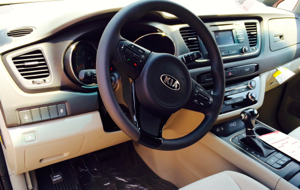
There is nothing mini about the Kia Sedona. Photos/Larry Weitzman

There is nothing mini about the Kia Sedona. Photos/Larry Weitzman

By Larry Weitzman

Thirty years ago they were all the rage. Almost every manufacturer made them. The field is now reduced to the Japanese manufacturers, Chrysler and one Korean brand, Kia. VW had one, but it was just a version of the Chrysler Town and Country. Ford and GM are out of the minivan business.

Mini-vans are a practical vehicle. Hardly mini, they occupy the footprint of a full size SUV. But they have a huge interior volume, capable of hauling eight people in comfort or nearly 150 cubic feet of cargo behind first row seating. This new 2016 Kia, now in its second year of production, may be the best of the best.

Size-wise, Kia carries dimensions that are fairly standard for a minivan: wheelbase 121 inches, width 78 inches, length 201 inches and height 69 inches. Track (and handling) benefit as it has 68 inches between the center line of the front wheels and the rear measures 69 inches. That’s enough data for now.

Not much you can do with a two box vehicle (one box in front with the engine pulling a bigger rear box of people), but Kia has done a great job in its subtle lines and shapes to create an interesting look, like Raymond Loewy did with the Greyhound Scenicruiser bus. Kia uniqueness is created in its third side window design and how it tapers into a smaller shape creating a natural sleekness. It is without question, the best looking of all minivans.

Under the first box mounted transversely or sideways, is one of the best V-6 engines in motoring, the Kia 3.3L, direct injected, high compression (11.5:1), 24 valve, DOHC V-6 knocking down 276 hp at 6,000 rpm and 248 lb.-ft. of torque at 5,200 rpm meaning the engine is also producing about 248 hp at that same 5,20 rpm. If you think this is weak, this same engine used in the Kia Cadenza produces 293 hp when spun to a higher rpm. This 3.3L unit may be half a liter shy of the competition, but its performance is miles ahead.
Specifications Price $26,400 to about $45,000 Engine 3.3L 24 valve, directed injected, DOHC V-6 276 hp @ 6,000 rpm; 248 lb.-ft. of torque @ 5,200 rpm Transmission Six-speed torque converter  Configuration Transverse front mounted engine/front wheel drive Dimensions Wheelbase 120.5 inch  Length 201.4 inches Width 78.1 inches Height (with roof rails) 69.1 inches Ground clearance 6.7 inches Trach (f/r) 68.3/68.6 inches Weight 4,656 pounds GVWR 6,085 pounds Tow capacity 3,500 pounds Fuel capacity 21.1 gallons Turning circle 36.8 feet Steering lock to lock 3.16 turns Wheels 19X6.5 inch alloys Tires 235/55X19 inches Performance 0-60 mph 7.37 seconds 50-70 mph 4.06 seconds 50-70 mph up a grade 6.47 seconds Top speed Well into triple digits (but not with me in it) Fuel economy EPA rated at 17/22/19 mpg city/highway/combined. Expect 21 mpg in rural county driving and 29 mpg at legal speeds on the highway

Specifications
Price $26,400 to about $45,000
Engine
3.3L 24 valve, directed injected, DOHC V-6 276 hp @ 6,000 rpm; 248 lb.-ft. of torque @ 5,200 rpm
Transmission
Six-speed torque converter
Configuration
Transverse front mounted engine/front wheel drive
Dimensions
Wheelbase 120.5 inch
Length 201.4 inches
Width 78.1 inches
Height (with roof rails) 69.1 inches
Ground clearance 6.7 inches
Trach (f/r) 68.3/68.6 inches
Weight 4,656 pounds
GVWR 6,085 pounds
Tow capacity 3,500 pounds
Fuel capacity 21.1 gallons
Turning circle 36.8 feet
Steering lock to lock 3.16 turns
Wheels 19X6.5 inch alloys
Tires 235/55X19 inches
Performance
0-60 mph 7.37 seconds
50-70 mph 4.06 seconds
50-70 mph up a grade 6.47 seconds
Top speed Well into triple digits (but not with me in it)
Fuel economy EPA rated at 17/22/19 mpg city/highway/combined. Expect 21 mpg in rural county driving and 29 mpg at legal speeds on the highway.

Performance matches the high output engine which sends power to the front wheels via a six speed torque converter tranny. Zero to 60 mph terminates in just 7.37 seconds while a 50-70 mph simulates pass lasts only 4.06 seconds and the same run up a 6-7 percent grade on slows that time to 6.47 seconds making this a high performance automobile and outstanding for an almost 4,700-pound minivan. One more point with respect to utility. This Sedona has a GVWR of 6,085 pounds meaning it has a whopping 1,400 plus pound payload capacity. Plus it’s rated to tow 3,50 pounds.

On the other side of the coin, the Sedona is rated by the EPA at 17/19/22 mpg. However, it did much better for the Road Beat averaging 29 mpg at 70 mph on the highway with the cruise control set at 70 mph. Overall the Kia averaged 21 mpg. Another thoughtful item with the Sedona is the large 21-gallon fuel tank. Think of the long legged road trips you could do.

Now for the really good stuff. The Sedona is one of the smoothest and quietest vehicles I have driven, and certainly the smoothest and quietest minivan on the market. Suspension is state of the art Macpherson struts up front and a multi-link system in the rear with coils in all four corners. Steering is a reasonably quick electronic power rack with 3.16 turns lock to lock. Wheels are a bit narrow at 6.5X19 inch alloys shod with wide 235/55X19 inch tires. While handling is predictable it tends to run a little wide in tighter corners which means if you are going to make like Lewis Hamilton at Monaco, pay attention. Turning circle is a tight 36.6 feet.

Braking is strong from four wheel discs with the larger front units being ventilated. Of course ABS and the alphabet soup of other acronyms of electronic safety devices are also standard. The brakes have excellent feel and power stopping the Sedona in 43 feet from 40 mph. Safety is second to none with a plethora of airbags and more.

Inside is a sublime, comfortable interior with the options of seven or eight seats. The front chairs are exceedingly comfortable with the option of two three place benches in the second or third row or captain chairs and a three place bench, your choice.

The instrument panel is stylish and complete. Tach and speedo are standard as is an easy to use trip computer. The entertainment system doesn’t require a semester at your local city college. Ditto for the A/C. Sedona is well thought out and to the Road Beat it is number one on the minivan list.

Cementing that choice is pricing. A base Sedona L starts at $26,400. Now there is a lot of vehicle for the money. My top of the line, fully loaded Sedona SX Limited stickers for $39,900, plus $895 for the boat from Korea. It had two options, the Technology Package ($2,800) and the Rear Seat Entertainment Package ($1,095) bringing the bottom line to $44,690. Considering the price of vehicles these days, the Sedona is a superb value. And remember it comes with a standard 10-year/100,000 mile warranty.

Larry Weitzman has been into cars since he was 5 years old. At 8 he could recite from memory the hp of every car made in the U.S. He has put in thousands of laps on racetracks all over the Western United States.


Blazes in the West reveal historic artifacts

By Jim Carlton, Wall Street Journal

SEQUOIA NATIONAL FOREST — Wildfires scorching the West are revealing an unexpected bounty: newly uncovered historic artifacts, some dating back thousands of years.

Looters and government archaeologists are scouring charred earth for the new archaeological treasures—sometimes even before all the embers are out.

Last summer, a fire that blackened about 150,000 acres in the mountains here above Fresno uncovered remnants of a 19th-century logging railroad that had been partially hidden by vegetation. Among the exposed artifacts: battered pails, rusted tin cans, and other vestiges of life from an abandoned logging camp.

“Camp dumps are cool because you can see what people were eating and drinking,” said Alex Verdugo of the U.S. Forest Service, as he recently picked through debris he estimates was discarded as long as 100 years ago.

Read the whole story


Affordable housing on South Shore to be discussed

TRYP is putting on a forum Aug. 17 about affordable housing.

The free event is an opportunity to learn the facts and openly answer questions concerning issues in the community and its progress. The first half of the event will feature local experts on affordable housing, how it impacts the community, and what is being done to address the issue.

Speakers are Heidi Hill Drum, Tahoe Prosperity Center; Sara Schrichte, Tahoe Truckee Community Foundation; and South Lake Tahoe Mayor Wendy David.

There will be a Q&A session after the panel presentation.

It will be from 6-7:30pm at Tahoe Beach Retreat.


Snippets about Lake Tahoe

·       V&T Railroad is putting on a Train to Danger dinner tour on Aug. 13, Sept. 10 and Oct. 8. Call 775.291.0208 for more info or to purchase a $55 ticket.

·       The Nevada Department of Transportation is seeking public comment on transportation projects and improvements outlined in the Work Program document, including updates to the Statewide Transportation Improvement Program. The deadline to comment is Aug. 26. For more info, email kverre@dot.state.nv.us.

·       Staff from the Board of Equalization’s Statewide Compliance & Outreach Program is coming to South Lake Tahoe to visit non-residential retail businesses. The purpose is to educate business operators about their tax and fee obligations, and identify those who sell or lease tangible personal property without a seller’s permit. Reps will visit businesses with ZIP codes 96150, 96151, 96155 and 96158.

·       Tahoe Beach Club, a143 luxury condominium project, will break ground Aug. 15 in Stateline.

·       South Tahoe Public Utility District has a new website.


LTWC to show off animals being rehabilitated

Lake Tahoe Wildlife Care’s annual open house is Aug. 7 from 10am-4pm.

This is the one time of the year people other than volunteers with the nonprofit organization are permitted on the grounds where the wild animals are rehabilitated.

The South Shore center has four bear cubs, a red-tailed hawk, 14 raccoons, six great-horned owls, five gray foxes, a bald eagle, a golden eagle and more.

Volunteers will guide visitors through the grounds and describe the reasons the various wildlife are at LTWC, and the prognosis for their eventual release back to the wild.

Information about the nonprofit’s new home under construction on Al Tahoe Boulevard will also be available.

LTWC is at 1485 Cherry Hills Circle off of Elks Club Drive in Meyers.


Climate change fingerprints all over Calif. wildfires

By Bobby Magill, Scientific American

Reports this week from the front lines of the Sand Fire in Southern California painted the scene as apocalyptic. The drought-fueled blaze was explosive, fast-moving and devastating, burning through 38,000 acres in the Santa Clarita Valley and forcing the evacuation of more than 10,000 homes.

If the state’s wildfire season holds true to forecasts, the Sand Fire will be one of many catastrophic wildfires to scorch drought-stricken forests and shrublands across California this year. So far, only one wildfire has been larger — the 48,019-acre Erskine Fire, which started in June in the Sierra Nevada Mountains and destroyed 250 homes and buildings.

None of the fires haa been among the worst or largest wildfires the state has seen in recent years, but they’re part of a dire global warming-fueled trend toward larger, more frequent and intense wildfires. The number of blazes on public lands across the West has increased 500 percent since the late 1970s, said LeRoy Westerling, a professor studying climate and wildfire at UC Merced.

The outlook this summer is sobering: Wildland fire potential for most of coastal California and the Sierra Nevada Mountains is above normal and is expected to remain that way through October, according to the National Interagency Fire Center.

Read the whole story


Federal money coming to North Tahoe for transit

Between $750,000 and $1 million will be allocated annually for North Lake Tahoe area public transit improvements.

The money is Federal Transit Administration funds that come to the Tahoe Regional Planning Agency that will be passed through to Placer County.

Placer County and the Tahoe Transportation District are now eligible for additional FTA funds following passage of the Fixing America’s Surface Transportation Act. Previously, Placer County received around $420,000 in FTA funds annually for the Tahoe area.

The FAST Act, passed in December 2015, is a federal law that provides long-term funding certainty for surface transportation infrastructure planning and investment. The FAST Act for the first time designates the Tahoe basin as an urbanized area, making it eligible for a larger portion of FTA funds allocated nationwide.

Placer County and TTD are now eligible for two separate FTA grants: one for bus and bus facility programs and another for an urbanized area formula funding program, which makes federal resources available to urbanized areas for operating costs and preventive maintenance.

Placer County will use these additional funds to help implement the Tahoe Truckee Area Regional Transit Systems Plan Update adopted by the Board of Supervisors in April. That plan lays out a five-year plan to increase service frequency and provide later evening service year-round.