By Joann Eisenbrandt
The New Placerville Courthouse Project has traveled a rocky and contentious road since a new court facility on the West Slope was first envisioned several decades ago. It just hit another bump. The approximately $1.4 billion reduction in state funding originally allocated in the budget for new courthouse construction in California has put the brakes on the project, at least temporarily.
Since 2002, California courts have been under the jurisdiction of the Judicial Council. This state agency created a list of “immediate and critical need” courthouse projects. These were to be the first projects implemented once funding became available. The New Placerville Courthouse Project is on this list.
In 2008, Senate Bill 1407 authorized up to $5 billion in bonds to build or renovate courthouses in the state. Funding for these projects comes from increased court user fees. State budget problems since have caused funds to be diverted from the funding accounts for these projects, causing a number of delays. Finally, a site was selected for the Placerville project and the Judicial Council prepared and certified an environmental impact report under the California Environmental Quality Act (CEQA) in June 2015. This paved the way for the next steps: the transfer of land from the county to the state and the putting out of construction bids. Completion was projected to be in the second quarter of 2021.
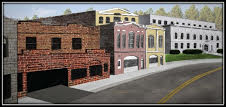
An alternative to a new courthouse is an annex. The two-colored building in the front to the left of the existing Main Street Courthouse are what used to be the Placerville City Hall. An additional building and a covered parking garage would be in back of that. Rendering/Placerville Historic Preservation League
The Placerville project will replace current court facilities on the West Slope with one new 88,000-square-foot courthouse facility next to the existing county jail just off Forni Road in Placerville. Superior Court services are now divided between Building C at the County Government Center on Fair Lane, a civil court facility in Cameron Park and the historic courthouse on Main Street in downtown Placerville.
State budget problems have once again affected the project. Redirection of $1.4 billion from the critical needs account and $250 million of annual funds from the construction account, and a dramatic decrease in court filing fees has now drastically reduced the amount of money available for the bonds to finance the 23 current courthouse projects.
On Aug. 11, the Court Facilities Advisory Committee met in San Francisco to consider recommendations to the Judicial Council on how to proceed given current financial circumstances.
Committee Chairman Presiding Justice Brad Hill told those assembled that, “We understand how concerned you all are and what all of you in this room have gone through to get to this point. After years of planning, we are here to transmit some bad news in terms of current financing.”
Judges, members of boards of supervisors and staff from 16 counties with current courthouse projects gave presentations, all advocating strongly that their particular project be allowed to continue. Hill acknowledged at the beginning of the five-hour session that, “These facilities are the worst of the worst … everyone in this room is desperately in need of a new courthouse.” The extent of their need, he noted, is why these projects remain on the list while others have been cut along the way.
Presentations were in alphabetical order by county, so El Dorado County presented first. Presiding El Dorado County Superior Court Judge Suzanne Kingsbury gave a PowerPoint presentation outlining the problems with the county’s current court system. The fact that court services are divided among a number of different facilities makes them “operationally inefficient.” Kingsbury went through a laundry list of structural, environmental and safety deficiencies, especially highlighting those at the 100-plus year-old Main Street courthouse in downtown Placerville. These ranged from lack of ADA compliance, to an old and often non-operational elevator, lead in the water system, asbestos, lack of holding cells for in-custody defendants and lack of on-site parking. Security for judges, jurors, witnesses and court staff is lacking. The abundance of windows gives direct line-of-sight to potential snipers from the nearby Highway 50 overpass and adjacent buildings. Security and space problems also exist at the facility in Building C at the county government center on Fair Lane.
All of the presenters from subsequent counties had very similar stories. The current Shasta County courthouse had experienced 108 elevator malfunctions; the courthouse in Siskiyou County can be so easily broken into that thieves got in and stole gold bars from a courthouse display. Many courthouses have serious seismic issues, with some rated so low, at Level 5, that the state declined to have them transferred to state ownership.
Kirk Smith of the Placerville Historic Preservation League spoke during the public comment session that followed the presentations. In July 2015, the organization challenged the Judicial Council’s certification of the EIR for the Placerville Courthouse Project in San Francisco Superior Court. The EIR failed, the writ stated, to adequately address or provide mitigations for the impacts on downtown Placerville that removal of court services from the Main Street courthouse would cause. The Main Street economy would be seriously affected, leading to “urban blight and decay.” The writ was denied by the court last month.
Smith told advisory committee members that given the current financial shortfall for critical needs projects, the construction of a courthouse annex and covered parking structure next to the existing Main Street courthouse would be a much more cost-efficient option. Smith had made similar presentations to the Placerville City Council and the El Dorado County Board of Supervisors, but noted, “They weren’t interested.”
The annex concept would provide for approximately 140,000 square feet of space as compared to the 88,000 square feet of the project as currently approved. It would not require the construction of roads, sewer lines and other supporting infrastructure and would preserve the historic Main Street courthouse. Smith presented the committee with architectural renderings of the concept.
Smith later confirmed to Lake Tahoe News that the Placerville Historic Preservation Society still intends to appeal the denial of thee writ. Such an appeal would be to the First Appellate District Court of Appeals in San Francisco. The last day to file the appeal is Aug. 30.
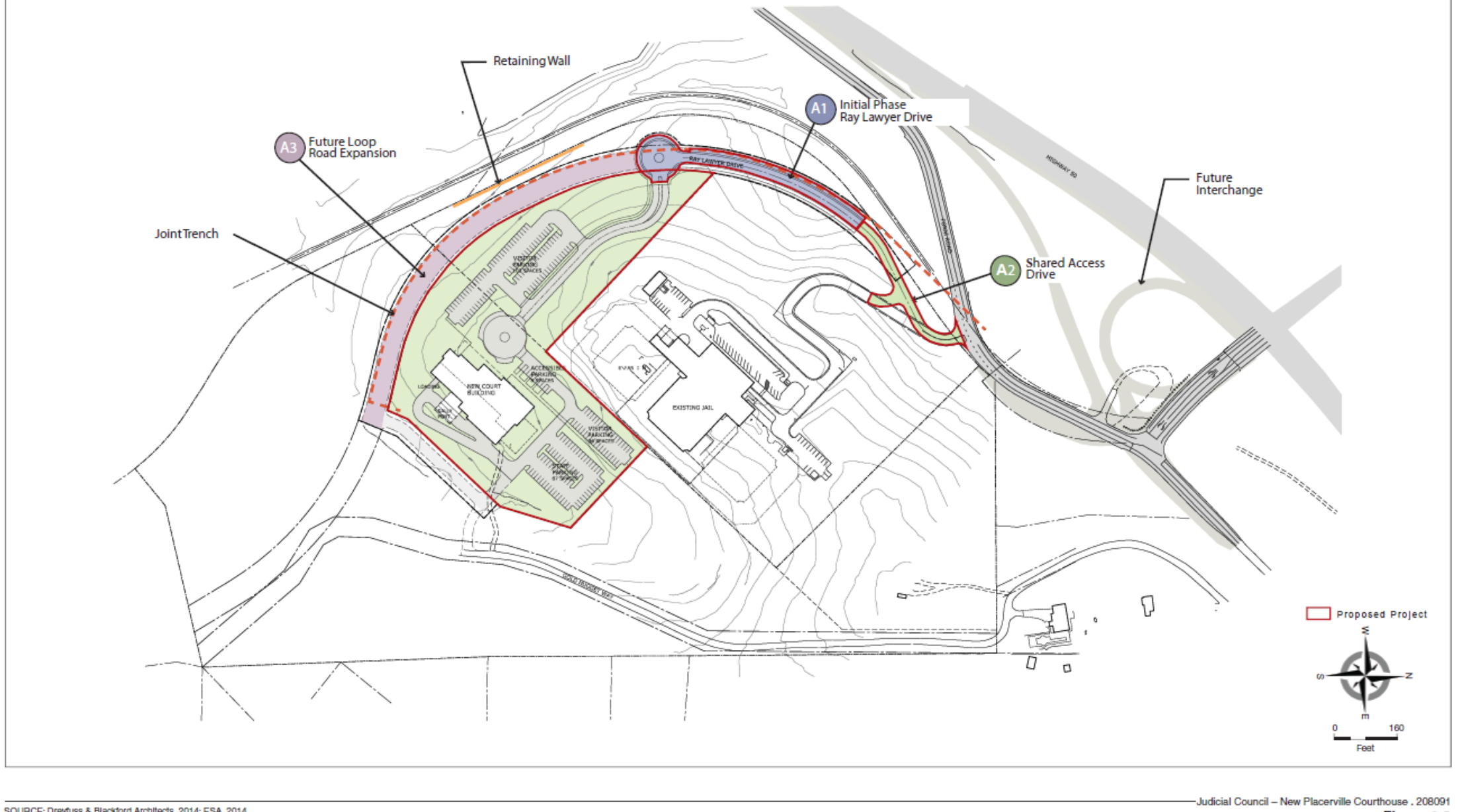
Architect’s rending of how the future El Dorado County Courthouse could look.
The Court Facilities Advisory Committee then received a report from Capital Program Director Mike Courtney outlining recommendations on how to proceed. The courthouse projects were grouped into four categories based on their current status: currently under construction, acquisitions, ongoing design work, and 2016-17 construction awards. The New Placerville Courthouse Project is in the “acquisitions” category. The recommendation for projects in this category is to, “complete site due diligence then hold.” Due diligence means that site analysis, environmental review and associated studies have all been completed. The Placerville project has completed its due diligence and would, under Courtney’s recommendations, be placed on hold until needed funding became available.
The six projects currently under construction would complete construction, but projects in the other two categories would continue until they reached the end of their existing phase and then be put on hold.
Hill emphasized that this was just “day one” of effort to secure the needed funding. Now that the state is back on firmer financial footing, he noted, “We’d like our money back.” Members of the committee and representatives from the affected counties will be going to Sacramento soon to lobby the governor and legislators for that very purpose.
“We need to demonstrate to the Legislature that we will be good stewards of the money they give us now and will be in the future … we’re building courthouses that are safe and secure but are economical and cost-effective,” Hill said.
The committee approved Courtney’s recommendations. A report will be compiled and presented to the Judicial Council for their Aug. 25-26meeting. The Judicial Council can then adopt the recommendations, modify them or propose new ones.
 · Phyllis Shafer, chair of the art department at Lake Tahoe Community College, is having a solo exhibition at Stremmel Gallery in Reno from Nov. 3-Dec. 3. There will be an opening reception on Nov. 3, 5:30-7:30pm.
 Corn Cakes with Salsa