FBI offers academy for high school juniors

The FBI’s Sacramento field office is accepting applications for the fall FBI Teen Academy.

This is open to high school juniors in the jurisdiction of the office, which include El Dorado, Placer and Alpine counties. Applicants don’t need to be interested in pursuing a career in law enforcement or law.

If selected for the one-day class, students will spend the day with FBI personnel engaging in activities and discussions about what the FBI investigates. Classes may include discussions about terrorism, active shooter situations, and color of law and civil rights investigations; participation in controlled evidence response team and bomb techs scenarios; and conversations about online communication and making wise choices in an online world.

The FBI Teen Academy is free. The application is online.


Unions plan massive Nev. election campaign

By Ben Botkin Las Vegas Review-Journal

Labor-backed groups are putting their organizing muscle and manpower into the 2016 campaign season in Nevada, an effort that will deploy thousands of canvassers and result in hundreds of thousands of voter contacts.

It’s a massive undertaking that labor leaders hope will tip the scales in Nevada, a swing state in the presidential election and ground zero for a hotly contested U.S. Senate race for the open seat of outgoing Senate Minority Leader Harry Reid, D-Nev.

Republican Congressman Joe Heck and Democratic candidate Catherine Cortez Masto, a former Nevada attorney general, are facing off for that seat.

The AFL-CIO’s 2016 effort is its largest compared with efforts during prior elections, the organization says. Nevada is one of six battleground states that the powerful AFL-CIO, which backs Democratic nominee Hillary Clinton, has made a priority. The other five are Florida, Missouri, Ohio, Pennsylvania and Wisconsin.

Read the whole story


Trump fund raising in Lake Tahoe

GOP presidential candidate Donald Trump is going to be in Lake Tahoe this month for a fund-raising dinner.

The Nevada Republican Party is hosting the dinner at Harrah’s Lake Tahoe on Aug. 26 at 6pm.

General admission is $200, with VIP tables running $5,000.


Truckee High boosters looking for members

Truckee Wolverine Booster Club is looking for help to raise money all Truckee High School sports teams, clubs and classes.

One of the largest ongoing fundraising activities for boosters is selling food and drinks at the school’s football, volleyball, soccer, basketball, softball and baseball games.

Winter and spring teams, and clubs will work the football and volleyball games starting the week of Aug. 26.

Aug. 18 is Wolverine Day at Truckee High School. It’s an opportunity to purchase merchandise and a booster membership, which allows entry to all regular season Truckee High football, volleyball and basketball games.

For more info, email truckeehighboosters@yahoo.com.


Scientists worried about rapid snowmelt

Researchers are using an exclusive modeling system to study the effects of slower snowmelt across various regions of the Western United States including the Cascade, Sierra Nevada, Wasatch and Rocky mountains.

All of these areas see significant seasonal snow accumulation and generate water resources for downstream communities. Sixty million people in the Western United States depend on snowmelt for their water supply.

Western communities are facing effects of a warming climate with slower and earlier snowmelt reducing stream flows and possibly the amount of water reaching reservoirs used for drinking water and agriculture, according to a study published in July.

“As the climate warms, there is actually a slower snowmelt – both in timing and rates, which makes for a less efficient stream flow,” Adrian Harpold, ecohydrologist at UNR, said in a press release. Harpold, who initiated the study two years ago at the University of Colorado, Boulder, is a co-author of the paper published in AGU publications Geophysical Research Letters.

“I know, it’s counterintuitive, but with a warming climate snowmelt starts sooner in the season, and at a slower rate because the warming occurs earlier when days are shorter and we have less sunlight,” he said. “What makes runoff less efficient is that slower snowmelt reduces the amount of moisture being pushed deep into the subsurface where it is less likely to evaporate”

Harpold, who’s Nevada Mountain Ecohydrology Lab is based in the College of Agriculture, Biotechnology and Natural Resources, continued to work with the team from CU Boulder after coming to UNR.

— Lake Tahoe News staff report


Tahoe Tails — Adoptable Pets in South Lake Tahoe

Mandy

Mandy

Mandy is one of several Pug-Schnauzer mixes who came to Tahoe from a hoarding situation. Two of them have found their new homes, but Mandy and Phoebe are still waiting.

Mandy is 20 months old, very cute, and is working hard at house training. She is a snorty, playful girl and would like a home with another dog and no small children.

Mandy is spayed, microchipped, tested for heart worm, and vaccinated. She is at the El Dorado County Animal Services shelter in Meyers, along with many other dogs and cats who are waiting for their new homes. Go to the Tahoe animal shelter’s Facebook page to see photos and descriptions of all pets at the shelter.

Call 530.573.7925 for directions, hours, and other information on adopting a pet.

For spay-neuter assistance for South Tahoe residents, go online.

— Karen Kuentz


Elite, novice BMX riders compete in SLT

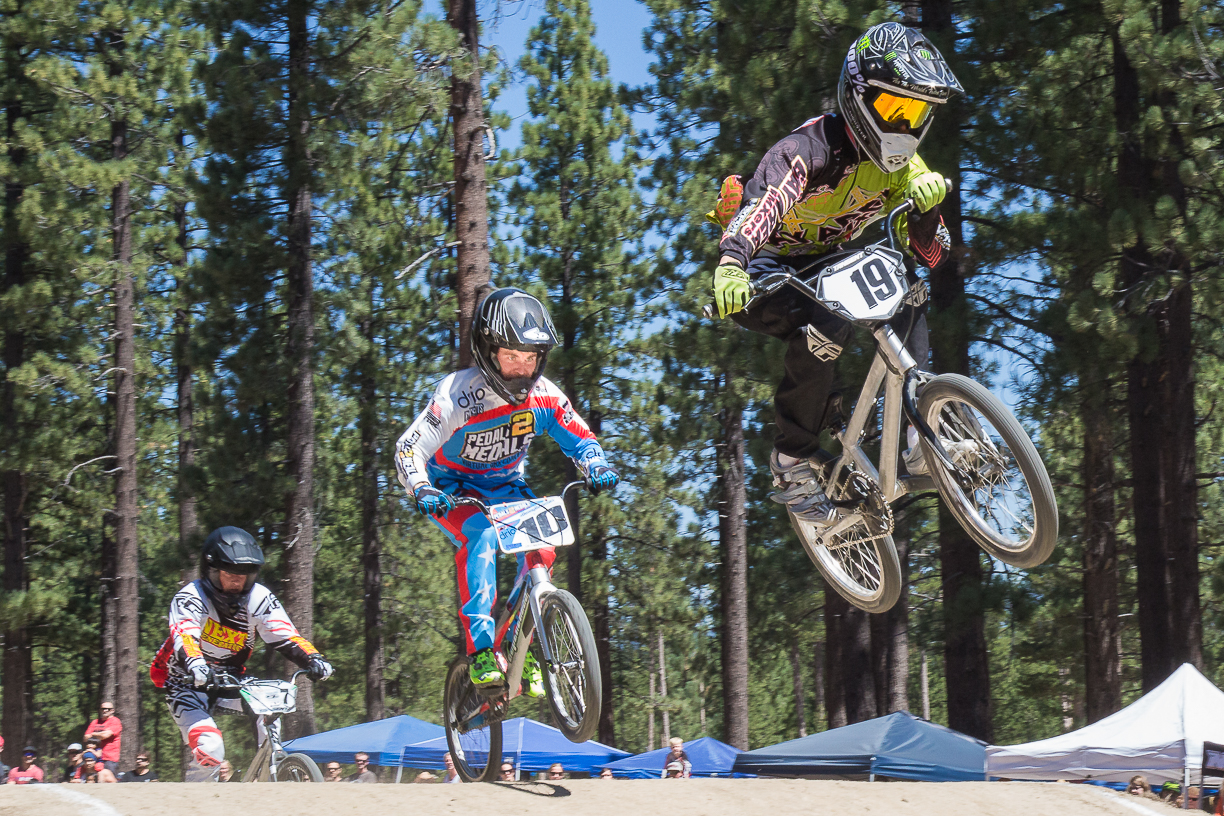
Donny Robinson (No. 10), 2012 BMX Olympic bronze medalist, competes in South Lake Tahoe on Aug. 13.  Photo Copyright 2016 Dale Roberts

2012 BMX Olympic bronze medalist Donny Robinson (No. 10) competes in South Lake Tahoe on Aug. 13. Photo Copyright 2016 Dale Roberts

By Dale Roberts

California Points Qualifier at Bijou Bike Park proved South Lake Tahoe is an up and coming venue in the world of BMX racing.

More than 300 riders from all over the state competed in the fast-paced, high-action cycling event on Aug. 13.

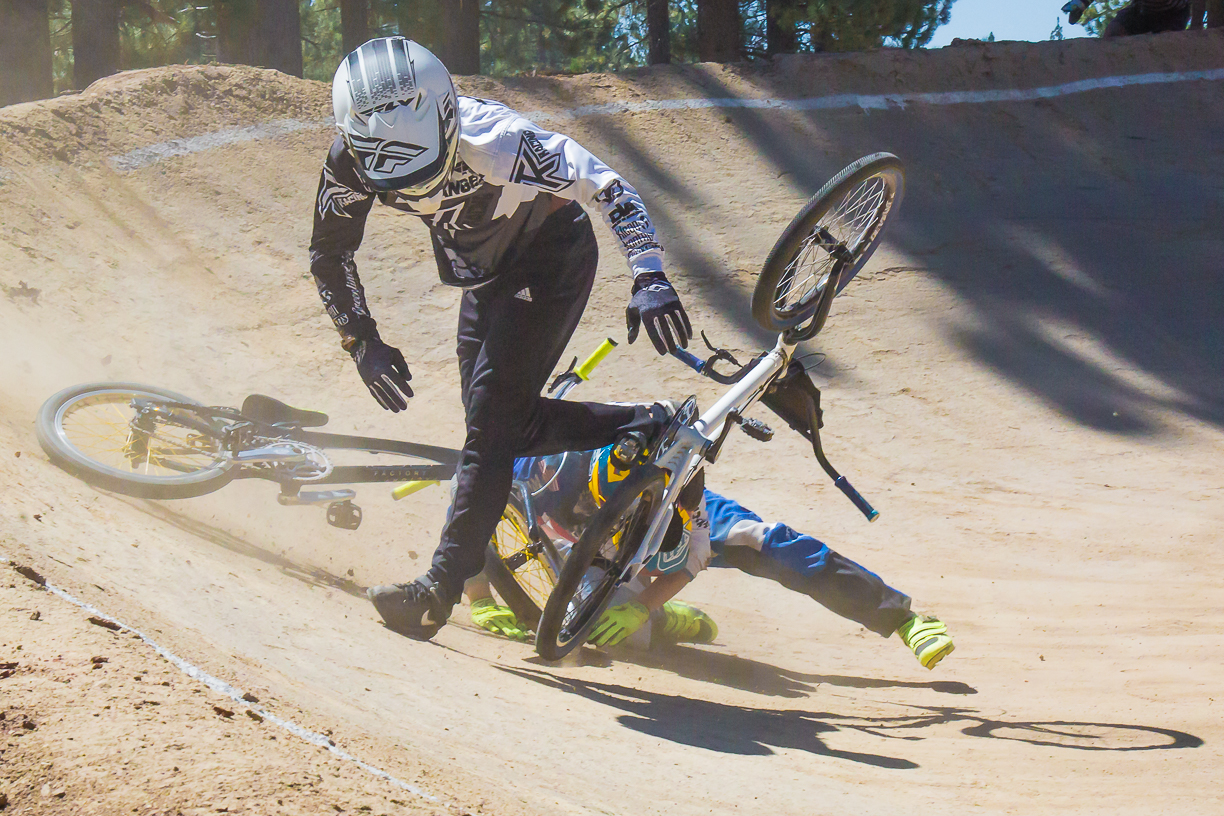
Crashes are fairly routine in BMX races. Photo Copyright 2016 Dale Roberts

Crashes are fairly routine in BMX races. Photo Copyright 2016 Dale Roberts

The main event of the day was the Tangent Pro-Am series with a $2,000 purse attracting top pros, including 2008 Beijing Olympic bronze medalist Donny Robinson.

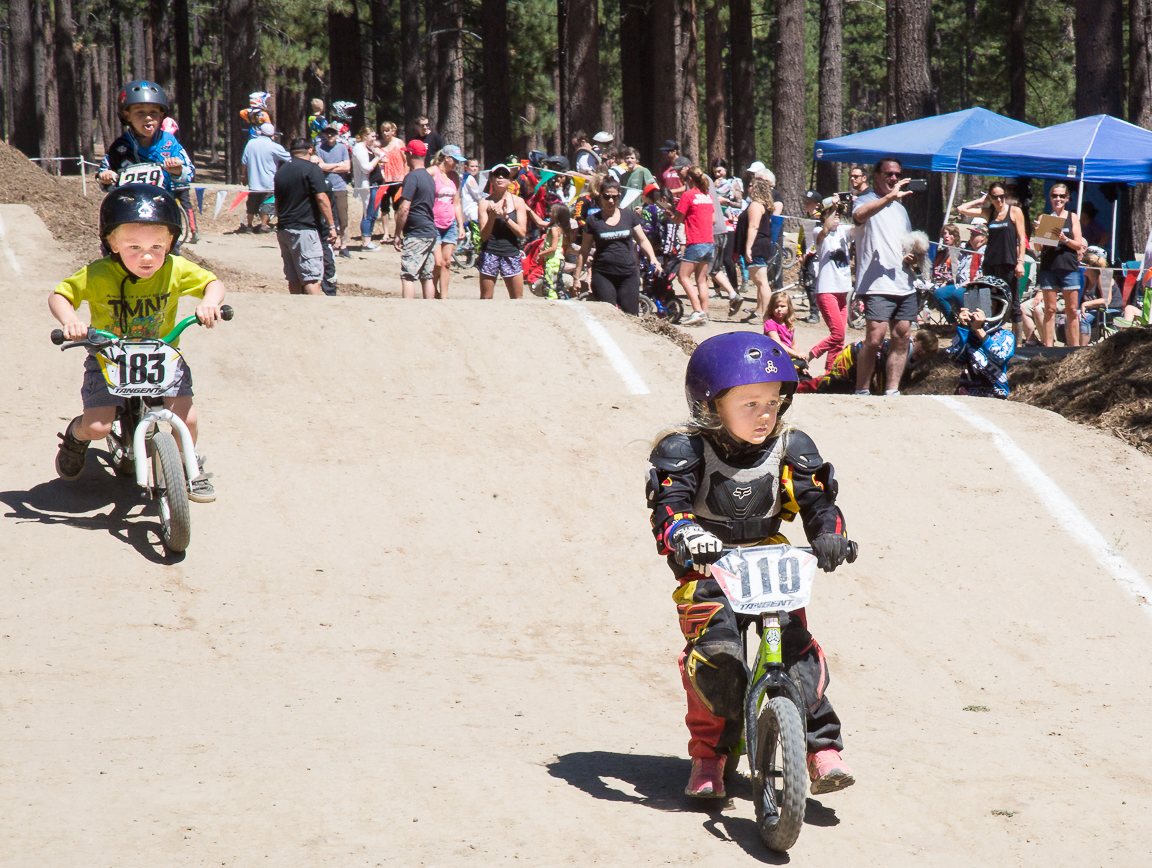
Youngsters get an early start in the Strider race. Photo Copyright 2016 Dale Roberts

Youngsters get an early start in the Strider race. Photo Copyright 2016 Dale Roberts

The riders raced in elimination heats with as many as eight on the track at a time. Shoulder-to-shoulder they sped around banked turns, over rollers, and flew off tabletop jumps. Each heat lasted 30-40 seconds, with the following heat starting as soon as the previous riders crossed the finish line.

The action only slowed down to clear the track of crashes, of which there were many.

A BMX rider has his eyes fixed on the next feature. Photo Copyright 2016 Dale Roberts

A BMX rider has his eyes fixed on the next feature. Photo Copyright 2016 Dale Roberts

BMX attracts riders of all ages, some as young as the “Diaper Derby” riders of 2 and 3 year olds on their Strider bikes, to athletes in their 50s; all separated into corresponding age groups so everyone races against their peers.

Of the pro-am riders, Jordan Miranda of Bakersfield took the top spot. For a complete list of results, go online.


Opinion: Combating housing and anti-growth

By Joe Mathews

Ventura County is the most glorious and verdant of California kingdoms.

Just ask its princes and princesses—those fortunate enough to be able to afford to live and vote there. The nearly 900,000 residents can pretend that they live in the country, with parks or farmland always nearby. The Kingdom of Ventura’s cities remain separate developments on the landscape—they haven’t sprawled and melted into each other, like cities do elsewhere in Southern California.

Joe Mathews

Joe Mathews

Their secret? “No other county in the United States has more effective protections against urban sprawl,” says the website of SOAR, aka Save Open Space and Agricultural Resources, a family of growth-controlling ballot measures.

Those SOAR protections have been fixed in the laws of the county and its cities for two decades. SOAR effectively permits development only within certain urban cores in the county and makes no allowances for population growth. If you want to develop protected open space or change the development boundaries, you need a vote of the people.

Ventura voters like the results so much they are expected to extend the SOAR protections through 2050 in the November elections.

In effect, they’ve made their Kingdom a mighty fortress. Those sprawling suburban housing developments that fill the San Fernando Valley to the east? They stop at the county’s edge. It’s almost as if Ventura County has built a wall against growth along its border—and made neighboring Los Angeles pay for it.

But there is a problem with that wall, and within the Kingdom. The princes and princesses of the Kingdom have enjoyed the benefits of anti-growth—while avoiding the related responsibilities.

Smart growth strategies like SOAR are not only supposed to preserve open space. They also are supposed to drive more creative, dense, multifamily and transit-oriented development in the urban cores where growth is still permitted.

But such infill development in Ventura County has lagged far behind what’s needed to serve the Kingdom’s growing population and its housing needs. The same citizens of the Kingdom who back SOAR also have opposed multifamily and denser developments, and resisted transit investments to connect their cities.

The results are as obvious as the choking traffic on the 101 Freeway and housing prices that make Ventura County one of the country’s least affordable places. The lack of housing for middle- and lower-income people forces them to commute from outside the county; and it makes it hard for companies to grow and locate there.

“There is an uncertain capacity within our urban boundaries to accommodate job growth,” Bruce Stenslie, president of the Economic Development Collaborative of Ventura County, said during a conference on SOAR. “Which doesn’t mean that we should tear down the urban boundaries, it means we need to be a little more mature about questions concerning in-fill development and higher density.”

Matthew Fienup, an economist with Cal Lutheran University’s Center for Economic Research and Forecasting, who talks about the joys of living across the street from orchards, says there are myriad ways to require more regular analysis and adjustments of the boundaries. Fienup suggests that the county would be better off establishing tradable development rights that would protect the same amount of land while bringing some flexibility to the boundaries.

Of course immaturity about growth—and high housing prices and traffic—is not limited to Ventura County.

But in its resistance to infill development, Ventura is an example of the California disease—grab your piece of the Kingdom, and keep out anyone who might come after you.

Local anti-growth bias is becoming a major statewide issue as California faces a crisis in housing affordability and availability—for anyone but the most affluent. To push back against anti-growth local communities, Gov. Jerry Brown is championing legislation that would exempt many urban housing developments from environmental or local government review.

Many localities have responded to this statewide push defiantly, via local ballot measures that block growth and housing, as the Voice of San Diego documented recently. The most reactionary of these ballot initiatives comes from Santa Monica, which would require a vote of the people on most developments taller than two stories.

The defense of those backing anti-growth measures is disingenuous: If you don’t like restrictions, you can go to the ballot. But that argument is an invitation for development to be determined by a showdown between NIMBY demagoguery and self-interested political money, as opposed to any rational long-range planning.

One lesson from Ventura County is that growth boundaries like SOAR shouldn’t be pursued in isolation. They need to be tied to rock-solid requirements for creating more housing in urban cores, both for low-income and middle-income people.

So if a county wants to protect open space from development, great. But it must be compelled to open gates in its walls big enough to bring much more progressive development into the Kingdom.

Joe Mathews writes the Connecting California column for Zocalo Public Square.



End of daylight-savings time in Calif. gets closer

By Tomikka Anderson, San Francisco Chronicle

A bill to scrap daylight-saving time has just made its way through another Senate committee, which means California may be closer to standard time year round.

In an interview with the Sacramento Bee, Assemblymember Kansen Chu, D-San Jose, – who authored the bill – said, “Daylight-saving time is an institution that has been in place largely without a question for more than half a century.” Chu continued, “I think we owe it to the general public to be given the opportunity to decide for themselves whether or not daylight saving time ought to be continued.”

Chu also cited statistics in the bill that link daylight-savings time to a higher heart attack rate, traffic accidents and fatalities and energy waste.

Read the whole story


Bay Area man dies in Jet Ski accident

A Jet Ski accident on the South Shore has left one man dead.

Raeshon Williams, 22, of Oakland was found under water near Timber Cove Pier in the early evening of Aug. 13.

His friend, whose name has not been released, was able to swim to the personal watercraft after they were both thrown from the vessel. They were reportedly about 100 yards from shore.

There is a 5mph, no-wake zone 600 feet from shore throughout the basin. Neither man was wearing a life jacket even though it is the law to do so.

The accident is under investigation.

— Lake Tahoe News staff report