Publisher’s note: This is one of several stories about mental health issues in the Lake Tahoe Basin that will be running through October. The other stories may be accessed from the Home page under Special Projects, then click on Mental Health.
By Susan Wood
El Dorado County Superior Court Judge Suzanne Kingsbury has learned personally there is no magic pill in terms of eliminating mental illness on our streets and in the judicial system.
Even with her steely resolve, calming demeanor and steady hand on the gavel that delivers justice in South Lake Tahoe, Kingsbury – who serves behind the bench of Behavioral Court among other disciplines — couldn’t save her sister from a debilitating struggle with bipolar disorder.
 She knew the fatal result of her sister’s well being when she got a call from the coroner in Sacramento a few years ago.
“It was heartbreaking,” Kingsbury told Lake Tahoe News.
Like many, Kingsbury has seen her fair share of people “out there screaming and yelling and pushing shopping carts” barely able to hold onto some semblance of reality.
That’s just how cunning mental illness is. Throw in alcohol and drug addiction, and the problem grows like it’s on steroids.
“Often there are substance abuse issues. That’s when it becomes difficult because you need these people to detox to get to the root of the problem,” the longtime judge explained.
Medication can only go so far. With bipolar disorder, aka manic depression, the pharmaceuticals have side effects that prompt many afflicted to want to avoid them. The period of elevated mood counters the down times enough that some people suffering from it don’t want to end the up feelings.
“They hate the lows and love the highs,” Kingsbury said.
In the 1980s, the bulk of psychiatric hospitals in California closed, leaving the mentally ill to fend for themselves on the streets. When they’re brought in, often from an episode with police, they can get an assessment and substance abuse help if necessary.
Transitional housing, including the few units available in South Lake Tahoe, provides for stability in the community for those just seeking another chance at life.
“Without the housing, a lot of folks will do OK for a while then things will go south,” Kingsbury said.
Jail is not the housing answer
“Do you know what the largest psychiatric hospital is?” El Dorado County Undersheriff Randy
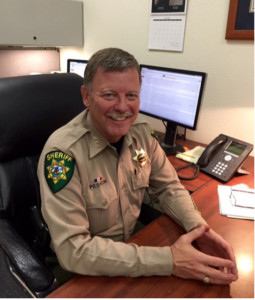
El Dorado County Undersheriff Randy Peshon recognizes the difficulties his deputies have with suspects who have mental health issues. Photo/Provided
Peshon asked rhetorically, answering: “State prison.”
“There is no easy answer. Part of the problems we face is the money we have for mental health is in a silo – some people might not fit the criteria,” said Peshon, who worked in the county jail in South Lake Tahoe for years. He now works in Placerville as second in command.
Peshon has viewed the double-edged sword of the mounting issue. Medical privacy laws have become stricter, while the stigma attached to mental illness has increased. The burden lies heavily on law enforcement trying to quell or at least reduce the perplexing problem.
“If law enforcement is aware somebody is suffering from mental illness, we have officers who are trained in crisis intervention,” Peshon said. “A lot of these situations are brought on because these people go off their meds.”
From the county jail and mental health to the state court system and local beats of police and sheriff’s departments, government continues to wrestle with the crisis.
In many cases, some refuse help. In others, the help fails to go far enough. Some are unaware of the assistance available – and sometimes, the system works for those who work it.
The highs and lows of fighting the good fight are as dramatic as the ups and downs of those struggling with mental illness.
Statewide, there are 112,300 people in California prisons, the Public Policy Institute reported. Last year 83,280 people were in county jails. Estimates are that 15 percent of those incarcerated are mentally ill.
In the entire state, California hospitals have about 7,500 beds, the Los Angeles Times reported in a recent study. The vast majority of these beds – 92 percent – is filled by patients from the criminal justice system and is no longer available for those in need of civil commitment. Only 600 beds are available for those just checking in, to say for example, to help themselves.
In other words, someone suffering from mental illness is apt to fall into law enforcement’s lap to gain safe harbor.
Officers want more tools
The lack of safe places to go represents a tough quandary for police officers who see the most unpredictable members of society who may either hurt themselves, loved ones or even those who may be passing by.
About a decade ago, a man who appeared to have a psychotic break stood in the middle of the street between the Taqueria and the former Tahoe Daily Tribune building and threatened to shoot himself in the head. At times, he laid down as if surrendering but kept a gun in his hand. Bystanders gathered around, exacerbating a pressing issue for police.
South Lake Tahoe SWAT Police Officer Brandon Auxier remembers the episode and points to it as just the tip of the iceberg in what police see almost daily.
“It’s a constant problem. We pick them up then sometimes Barton does not have any beds, and they’ve had to travel hundreds of miles,” Auxier said, adding he’s noticed more calls lately resulting in “5150s.” This term of condition relates to five-point restraints on the person who is suffering a mental breakdown.
“In the last couple of years, we’ve seen an increase,” the officer told Lake Tahoe News.
Many of those afflicted with mental illness are homeless. And with the popularity of the new winter warming center in the city, one can see there is a demand for a safe place for these people.
Auxier, a 13-year officer, has seen several repeat calls for those who are endangering themselves or others and create a scene. He’s part of a crisis intervention team, which prompts welfare checks on those who go through the county Mental Health program. Once a case is developed, restrictions abound on what caseworkers can do or say because of confidentiality issues.
Balancing the law of the land
And there lies a dilemma for law enforcement.
South Lake Tahoe Police Chief Brian Uhler would like to see more allowable communication between mental health caseworkers and police given the tenuous situations officers and the public are placed in when the call comes in.
 “When we know the situation, we can have empathy and some patience.” — South Lake Tahoe Police Chief Brian Uhler
“It’s a huge issue. The expectation is for us to manage or know a mental health breakdown. When we know the situation, we can have empathy and some patience. The issue is we face laws that prevent health care professionals from even talking to us,” Uhler said. “I’ve learned that even if we had the psychiatrist involved, we could not even confirm if this person is a patient. So we’re stuck out there with no help from the mental health community even if they want to help. It takes a change in state law.”
Law enforcement has a balancing act dealing with these calls.
Officers need to turn on a dime in terms of showing control and strength, while gently switching to empathy and heightening their listening skills.
When they pick these people up, some cases end well over time between bringing in the courts, transitional housing, medications, caring loved ones and police welfare checks.
But others break the hearts of officers – especially after they get to know the people behind the case numbers.
El Dorado County sheriff’s Sgt. Michael Yarbrough empathizes with Chief Uhler on wanting to gather as much information as possible on someone struggling with mental illness creating a threat in public.
He’s seen his fair share of crises as Officer of the Year honored by the National Alliance of Mental Illness.
Like Auxier, the county sheriff’s department recognizes Yarbrough as spearheading the county sheriff’s response through the CIT program. After all, he had three years on the police force on the rough streets of Stockton before landing in South Lake Tahoe in 1997.
Yarbrough said it’s tricky dealing with the mentally ill. Officers need to maintain that sense of control but show it in a kinder, gentler way. Communication – verbal and non-verbal as in body language — is key.
“It’s a different way of controlling, but you’re still in charge,” he said.
With “off-the-wall” individual behavior, Yarbrough has been trained and is experienced to see the body language and hear the responses of the subject of the call to be able to tell whether someone is undergoing a mental breakdown.
There’s such a new perspective in law enforcement to deal with these calls.
“It’s social services driven now,” Yarbrough said, comparing the situations to the old ways of handling a call where officers would just pick up the parties and throw them in jail to simply get them off the streets.
“Sometimes it would take six hospital visits before (the subjects) get it or for their families to get it,” he said.

El Dorado County sheriff’s Sgt. Michael Yarbrough is a leader in his agency when it comes to handling mental health issues. Photo/Susan Wood
Now officers are known to approach an individual with care, passing out pamphlets mentioning resources. Yarbrough reached in his desk drawer and quickly got out a county mental health brochure labeled “Guidelines for calling 911” in the event of a mental health emergency. Within the pamphlet, there’s even a script a family member may use to call in a mental health crisis at home. Also included is a list of critical phone numbers of resources.
The sergeant understands the call often doesn’t end with one response.
If he doesn’t have the answer, a member of a multi-disciplinary team that serves as a local think tank in dealing with mental health cases may have it. The think tank involves law enforcement, county jail, Mental Health Department and Barton Memorial Hospital.
The need is overwhelming. In three years, Yarbrough has seen 1,500 reports go through the system.
“It took some time to get (the caseload) managed,” he said.
He analyzed the cases to determine who would be best served by regular visits among his officer force. The dozen deputies who may go out on the welfare checks count medications, sit down with the subject for some positive reinforcement and talk to family members to get a sense of how the person is doing. They also keep an eye on whether clandestine substances appear.
“I’d say about 70-80 percent involve drugs and alcohol,” he said.
Yarbrough has become so keenly aware of the human condition he’s become an expert in the topic. He’s been invited to speak about the programs at a mental health conference in September in Sacramento.
“I can’t give enough credit to the whole collaboration. (The sheriff’s department) wouldn’t be able to do this on our own,” he said.
Beyond the agency resources, Yarbrough relies heavily on caring, knowledgeable family members.
Mental illness is a tricky condition to deal with because it comes with a stigma and emotions attached. Sometimes family members are reluctant to say something or intervene because they’re afraid of offending the loved one.
California AB1424, signed into law in 2015, requires any person who is authorized to have a person taken into custody for involuntary treatment consider available relevant information about the historical nature of the person’s mental disorder.
Upon the CIT visits, waivers are signed enabling family members to make critical decisions on the subject’s behalf. There’s a long questionnaire asking for information detailing the loved one’s historical condition, with a list of phone numbers to contact in the event of a crisis.
Yarbrough sees the slow-moving legislative changes as long in coming and necessary to a person’s well being because there is no easy fix.
“Why do we think the brain is the only thing completely immune to illness?” the sergeant asked. “That’s the hardest thing for people to understand.”
Help for those who help
The need to assist the mentally ill on the streets prompted retired San Rafael police Officer Joel Fay to make a business out of training officers to handle their calls.
The Marin County town has a plaguing homeless population with many classified as mentally ill.
“I thought: ‘Where do these people go?’” he said.
He found a way to balance being a police officer and psychologist.
“I knew that police needed to change the way we respond to calls,” he said. “For me, it was kind of like a mission in life.”
He moved into the field of psychology before fully retiring from the force five years ago. He contracts with counties to bring his specific expertise to their law enforcement units.
El Dorado County, which included Yarbrough, is among the jurisdictions that hired Fay’s business to assist them.
Fay trains the officers to look for signs of psychotic behavior such as the subjects reacting to other stimuli. There are clues of what to look for – whether they “see” the officer, can they feel the officer’s presence and do they comply with requests. If they can’t meet any of the criteria, there are other forces at work in the subject’s brain.
“At that time, the officer knows to slow it down and make them come around to their way of thinking,” he said.
There are also telltale signs of depression the psychologist trains officers to look for.
“There are things to say to work with these people. I tell (the officers) that it’s important for you to stay calm,” he said. “I tell them to pretend like it’s someone you know.”
Fay admits it takes a while for law enforcement to change their frame of mind on dealing with these types of scenarios.
“The goal of the training is to show how to use less force and for officers and the citizens to get hurt less,” he said.
Granted, the approach sounds simple and inroads are being made to treat the mentally ill differently. However, there are still cracks in the overall system.
Fay was empathetic to Uhler’s complaints about not having enough information to keep all involved safe from harm. He echoed the chief’s sentiment about the need to change the laws.
“There are so many road blocks. One problem is the law requires a person to be in imminent danger to get some help,” Fay told Lake Tahoe News. “It’s very frustrating because frequently we’re not allowed to collaborate.”
Mental health on the case
Sabrina Owen, the manager of the county’s mental health programs, sympathized with law enforcement wanting more information readily available on mental health cases. However, she reminded that privacy laws override the need to find an easier way to deal with public displays from those afflicted with a mental illness.
“It’s nice that family members can always call. We can take phone calls all day long and take information, but we can’t acknowledge a case or give it out unless a patient signs a consent form,” she said.
Nonetheless, the programs set into place seem to be working if one looks at the numbers.
Despite what law enforcement projects, mental health evaluations between jurisdictions in the city and county have trended downward in the last few years.
The sheriff’s department in South Lake Tahoe reported 543 cases assigned to subjects for 2014; 501 in 2015; and halfway through 2016 lists 187.
South Lake Tahoe 5150 evaluations number 404 in 2014; 381 the following year; and to date this year show 160.
Owen attributes the drop in statistics to the combined efforts of the CIT consortium and other similar programs.
The mental health professional views the well-being checks as a tried and true way of keeping a careful eye on people who face the very large swings in life’s ups and downs.
Owen strongly supports the idea of intensive case management. This means tracking the subject’s medication, meeting with the person and urging family and group therapy.
“And in respect to law enforcement as first responders, (the mentally ill) would just like to know someone cares,” she said.