Letter: PO boxes seem to subsidize home delivery

To the community,

Like many of you, I recently received my bill for my post office box this month. I was surprised at the amount, $34 for six months or $68 for 12 months. But why?

Let’s think about this for a minute. I have the option to get my mail delivered to my home. For this I pay nothing, in fact the person sending the mail has covered the cost. The Postal Service has to pay an employee to sort the mail in the post office, load the mail into a vehicle and drive to my neighborhood to deliver a letter or package to my door or curbside. Either the post office or the contract employee has to cover the cost to purchase the vehicle and then maintain it and have proper insurance. All of this, along with the many, many other costs associated with getting a letter or package from one place to another is paid for with a 47 cents stamp. Again, I pay nothing for home delivery.

The second option is to “rent” a post office box at the post office. The postal employee sorts the mail in the post office, loads the mail into some kind of cart and proceeds to deliver the mail to the individual mailboxes, all without ever leaving the building. There is no cost of a vehicle or its associated costs. Therefore, it is much less expensive to deliver mail to a box in the post office building than to any address outside the same building. So why are we forced to pay extra for the less expensive option?

The Postal Service was granted a temporary rate increase of 3 cents in 2014 to 49 centers and that was taken back by 2 cents in 2016 to the current 47 cents for a stamp for a 1 ounce first class letter. These rate fluctuations along with the requirement that the Postal Service pre-fund all future pension obligations have lead to massive operating losses, in the billions of dollars, at the post office.

Could it be that the Postal Service is jacking up the fees for a post office box to help make up some of its operating losses? In essence, the lower cost post office box users are being forced to subsidize the higher cost home delivery user.

Perhaps now is the right time to look at the proposal put forth by Bernie Sanders, and others, to allow the Postal Service to offer limited banking and financial services. This is a very common practice in Europe.

Thank you,

Jonathan Moore, South Lake Tahoe


Nevada students ‘worst’ in country on ACT

By Trevon Milliard, Reno Gazette-Journal

For the first time in Nevada history, all students in this year’s high school graduating class took the ACT so schools could gauge their success in college preparation. And the results aren’t good.

Only 11 percent of the 32,261 students scored high enough to be considered ready for college-level courses, according to ACT scores released Wednesday.

Nationwide, about 26 percent of students taking the ACT out of the 2016 class scored college-ready, meaning they demonstrated the skills necessary in English, reading, math and science to survive entry-level college courses. In most states, the college-entrance exam is voluntary with 64 percent of students participating nationwide for the 2016 graduating class.

State education officials expected Nevada’s ACT scores to reach new lows for the class of 2016. Such is the case when a state forces all students to take the ACT as part of its graduation requirements. As more students are tested, average scores decline.

Read the whole story


Radon poster contest for Nevada students

Nevada students are invited to showcase their artistic talents and promote radon awareness by entering the 2017 Nevada radon poster contest.

The deadline is Oct. 31.

The contest is open to ages 9-14 who are enrolled in public, private, territorial, tribal, Department of Defense and home schools. Children may also enter through a sponsoring group, such as art, computer, library, reading, science, scouting, youth or 4-H clubs.

Radon is a radioactive, colorless, odorless and tasteless gas that comes from the decay of uranium. It accumulates in homes and can cause lung cancer.

The poster contest is offered by the Nevada Radon Education Program and is sponsored by University of Nevada Cooperative Extension and the Nevada Division of Public and Behavioral Health. Cash prizes for the top three entries are $75 for first place, $60 for second and $45 for third.

Posters should convey one of these messages: 1) What is radon? 2) Where does radon come from? 3) How does radon get into our homes? 4) Radon can cause lung cancer, and 5) Test your home for radon. Posters will be judged on content accuracy, visual communication of the topic, reproducibility and originality. They can be created with crayon, markers, paint, collage, pencil, photographs or computer graphics.

Contact Susan Howe at 775.336.0248 or robertss@unce.unr.edu for more information.


Donner statue on list to be upgraded

The Donner statue in Truckee may be refurbished. Photo/Sierra State Parks Foundation

The Donner statue in Truckee may be refurbished. Photo/Sierra State Parks Foundation

The Sierra State Parks Foundation is looking at refurbishing the historic Donner Pioneer Monument.

The Donner Pioneer Monument, a designated California Historic Landmark, was dedicated on June 6, 1918, at Donner Memorial State Park in honor of the pioneer families who crossed the Sierra Divide in search for a better life. The monument was an effort conceived by local community representatives who formed the Donner Monument Committee including a contribution from the Legislature and finally achieved by the Native Sons of the Golden West in 1918.

A study in 2006 suggested the general condition of the pedestal base, pedestal and sculpture are in poor condition.

The parks foundation has commissioned an updated assessment report as the first phase of an ambitious project to restore the monument. Partnering with the Native Sons of the Golden West and California State Parks, plans include the restoration of the monument base and bronze sculpture, sustainable landscaping, and the creation of an outdoor group pavilion to host education and community events.


Truckee ceasing boat inspections for the season

Due to decreased boating traffic at Donner Lake after Labor Day, the Truckee-Tahoe watercraft inspection station will close Sept. 4.

All watercraft launching on Donner Lake must go to the Alpine Meadows’ station for inspections. Alpine Meadows will remain open until Sept. 30.

This season the Tahoe Resource Conservation District watercraft inspectors performed more than 1,400 inspections for Donner Lake vessels.

In an effort to prevent the spread of aquatic invasive species, Donner Lake users are being asked to participate in a survey to provide input about extending staff hours, installing an access gate, and invasive species self-inspection training for boaters. The survey is available until Sept. 5.

There will be a workshop about the program on Sept. 28, 6pm at the Truckee Town Hall.


Yosemite — a place for everyone

Publisher’s note: This is one in a series of stories about the National Park Service, which is celebrating its 100th anniversary in 2016. All articles may be found via the Home Page, select Special Projects, then National Park Service 100th.
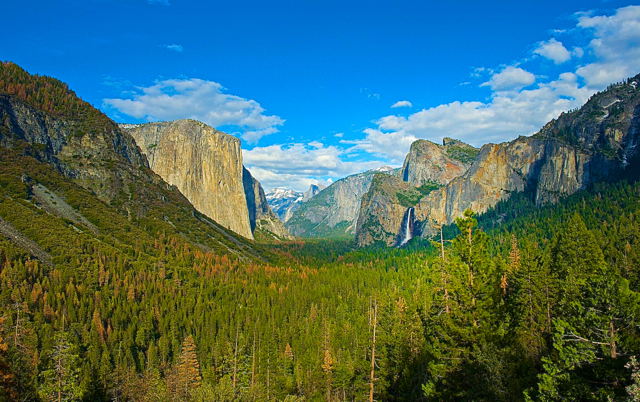
The grandeur of Yosemite is captivating no matter the season. Photo/Yosemite Hospitality

The grandeur of Yosemite is captivating no matter the season. Photo/Yosemite Hospitality

By Joann Eisenbrandt

I grew up loving Yosemite.

I first went there in the 1950s, well before 4 million people visited it each year. It was the best place of my childhood. Every summer, my father, mother and I spent my father’s vacation camping there.  We set up our campsite in Camp 14, alongside the Merced River and just across a big meadow from Camp Curry. You could walk out from amongst the closely spaced pines of the campground and stand in the meadow in waist-high grass and look up at the chiseled face of Glacier Point. Or walk across the roadway and through Camp Curry’s grizzled old apple orchard and parking lot to the popular ice cream vendor’s window just around the corner from the Camp Curry cafeteria.

Every evening, just before dark, we’d put on our light sweaters and stand in the meadow to watch the Fire Fall. A massive fire built atop Glacier Point 3,200 feet above was pushed over its steep face. “Let the fire fall,” the echoing call went out as it cascaded down the black and gray granite in a swoosh of blazing embers. The Fire Fall was permanently discontinued in 1968.

During the hot summer days, my mother and I would climb down the sandy banks to the cool Merced River and float downstream on large Army-green air mattresses. They smelled strongly of hot rubber, so we covered them with colorful beach towels. I always fought getting out of the river, even though my mother never failed to remind me what a long hike back upstream it would be. Guided horseback rides from the nearby stables came down a well-trodden path that followed the river’s edge. It was a narrow strip of powdery hot dirt full of stones churned up by years of pounding hooves and punctuated by often-steaming mounds of equine droppings.

My parents loved hiking and climbing and had done a lot of it in Yosemite before I was born. They were fearless. They’d scaled the rope ladder up the back side of Half Dome and gone up the steep trail that twisted from the valley floor to the very top of Glacier Point. They’d scrambled over the massive boulders beneath the bridge below Yosemite Falls all the way up to where the waterfall hit the riverbed. I still have my father’s Kodak camera and the crisp black and white photos of their adventures that it recorded.

Half Dome from Glacier Point. Photo/George Thomson

Half Dome from Glacier Point. Photo/George Thomson

I hiked up the 4-mile trail from the valley floor to the top of Glacier Point with my parents. The start of the trail is flanked by monstrous boulders, big as buildings, flung there carelessly by the glaciers that carved out Yosemite eons ago. It was so steep for me that there were many times when my father had to literally push me up to the next plateau. The view from the top was breathtaking. I still compare it to looking over the rim of the Grand Canyon. You can’t imagine what it is like from photos. You have to be there.

We also left Happy Isles and made it all the way up the 7-mile Mist Trail to Vernal and Nevada Falls. It is called the Mist Trail because the mist that rises up as the two falls plunge precipitously down to the rock-strewn riverbed below covers the twisting trail of carved rock steps in a shroud of wet fog and makes it terrifyingly slick. My parents told me that when they hiked the trail years before it was even worse. I found that hard to believe.

In the early 1970s, I moved to Oakhurst in the southern Sierra just outside Yosemite’s southern entrance and was reintroduced to the park as an adult. I reconnected with places from my childhood like Wawona, the Ahwahnee, and Camp Curry. In March 2016, a trademark dispute between Delaware North, Yosemite’s outgoing concessionaire, and the National Park Service brought ownership of those iconic names into question. Delaware North had trademarked them and other park names and wanted the NPS to buy them back for an estimated $51 million. The Park Service disputed the amount, and decided to change the names of these places, at least temporarily, when the new park concessionaire, Aramark, took over.

New place names don’t change the fact that enduring memories of Yosemite stretch back for generations. I certainly have my family memories, and I was lucky to share the even-earlier memories of Eleanor Crooks.

I first met Crooks in the late 1970s when she was already in her 80s. She lived in Ahwahnee, in the Sierra foothills outside Yosemite on a hilltop overlooking a sweeping pine and oak-filled valley. I was writing an article about Wawona for a local lifestyle magazine. She welcomed me warmly into her home. She was relatively petite, but had a lively presence, with the sparkle of youth still in her eyes.

Crooks was the daughter of William Sell. Sell was the first telegraph operator in Yosemite. At the request of Henry Washburn, one of three brothers who owned the Wawona Hotel, Sell built and ran the Ahwahnee Tavern, a rest stop for travelers going into the Yosemite Valley in the late 1890s and early 1900s.

No matter what it's called, there is something magical about this lodge at Yosemite. Photo/Yosemite Hospitality

No matter what it’s called, there is something magical about this lodge at Yosemite. Photo/Yosemite Hospitality

Crooks offered me tea and we sat down at a small table in her sunny kitchen to talk. She told me about her years growing up at Ahwahnee Tavern. In 1903, when she was about 7, President Theodore Roosevelt stopped there on his way to meet John Muir in Yosemite. Crooks remembered it as if it were just the other day. She described the chief of state as impatient, yet friendly. She recalled her mother’s dismay when one of Roosevelt’s aides ate all the carefully prepared cookies while the president was out back washing up with the ordinary folks. Despite all their elaborate preparations, Roosevelt didn’t stay the night, but instead rode on the same day, preferring to camp outdoors with Muir in the Mariposa Grove of giant sequoias just inside the park’s southern entrance.

Crooks took horse-drawn stage rides from Ahwahnee into Wawona in what she called a “mud wagon.” These open wagons had that name, she told me, because in wet weather, by the time the passengers arrived at the hotel, they were often so covered with mud as to be almost unrecognizable. “Toward evening,” she remembered, “we arrived at the hotel, with the fountain in the center as it is now. The stage drivers drove up to the steps of the hotel with a great deal of pride. The porters, who were all older men, took the passengers down, dusted them off, and then conducted them up the steps into the lobby.”

“On the porch,” she continued, “the women associated with the hotel would be sitting in their fancy clothes awaiting the arrival of the tourists.” After dinner, there would be singing and sometimes a dance in the dance hall. The next morning, the guests would tour the Big Trees and then continue on down into Yosemite Valley itself.

John Muir was an advocate for the creation of national parks well before his 1903 trip to Yosemite with President Roosevelt. In 1890, Yosemite National Park was established, but was under the control of the state of California. Muir was unhappy with the protection the state was giving Yosemite’s unique ecology and began publicizing the need to better protect it. Muir’s1903 Yosemite trip with Roosevelt convinced the president to remove the park from state control and make it a protected National Park in 1906.

Many things have changed in Yosemite since then. When I first lived in Oakhurst, a day pass was $5 and an annual pass was $15. Park rangers often let locals they knew pass through for free with only a friendly wave. A seven-day Yosemite vehicle pass is now $30 in summer and an annual park pass costs $60. Those older than 62 can purchase a lifetime pass for just $10. The most important things, however, have stayed the same.

The Long White at Wawona. Photo/Yosemite Hospitality.

The Long White at Wawona. Photo/Yosemite Hospitality

I visited the park hundreds of times, and found that you don’t have to go down into the valley itself to find wonderful places. Wawona is just eight miles or so inside the southern entrance. My favorite place in the park, it was first settled in 1856 by Galen Clark, who had come west to make a fortune in the California gold fields. He built an overnight lodging facility called Clark’s Station which he later sold to the Washburn brothers. Henry Washburn’s wife named it “Wawona,” an Indian word for big trees.

All the historic buildings at Wawona have names: the Main Hotel, the Long White, Clark’s Cottage, Washburn Cottage and Hill’s Studio among them. The past that Eleanor Crooks lived is still there. The bubbling fountain full of lily pads and the circular driveway leading up to the Main Hotel’s long covered porch are reminders of that quieter time. The nine-hole golf course, established in 1918, still stretches out along the meadow across the road from the hotel. You can relax on the expansive green lawn alongside the Long White which houses the pro golf shop on the bottom floor. I liked to lie on my back in the cool grass, looking up at the massive redwoods towering above me. I can still hear the clicking of the metal golf cleats on the stone paths leading up to the golf shop and the muted laughter and splashing of those in the white-fenced swimming pool set into the lawn just above.

Down the road from the Wawona Hotel is the Pioneer History Center, accessed via a covered bridge over the Merced River. Beyond it are the Wawona stables. I loved riding, but I was poor. The trail guides worked for the Yosemite Park and Curry Company in summer, but were wranglers in nearby valley communities the rest of the year. In a move that would set modern-day risk managers’ teeth on edge, they let me muck out the stalls, rub down the horses, fill the water trough and do other chores in return for free trail rides. The best rides were the night rides under a full moon. The heat of the summer day had been replaced with the refreshing coolness of a high-elevation evening. The trail winds from the stables alongside the Merced River, past the back of the hotel and up the hillside. The crisp night air carried the sounds of glasses clinking and the soft laughter of visitors sitting on the hotel’s inviting covered deck.

We would cross the highway, ford a small stream, then come back toward the hotel along the far side of the meadow and the golf course. Through the trees in the moonlight, you could see the herd of mule deer that make Wawona their home grazing contentedly on the lush green of the golf course. They barely looked up as we passed.

The actual community of Wawona is private land totally surrounded by Yosemite National Park. It has its own post office, several grocery stores and The Redwoods, a privately owned rustic resort near the end of North Chilnualna Road, a sharp right turn just beyond the Wawona Hotel. The food there was hearty, fresh and fabulous. I hear it still is. Just a ways up the road is the parking lot for the trail to the top of Chilnualna Falls. It’s a quick hike to the lower falls, but all the way to the top is a steep, twisting trail through lots of gnarly brush that does its best to reach out and grab you. It’s an effort, but worth it.

Another great “outside the valley” experience is the Mariposa Grove of giant sequoias. To get there, you take a right immediately after you enter the park from Highway 41. Centuries-old monarchs like the Grizzly Giant, the California Tunnel Tree and the Fallen Monarch make the trees that dot Wawona’s verdant lawn seem like sticks. One winter, I took a guided snowshoe hike with a small group from the Grove’s parking lot up to the Mariposa Grove Museum and back. I had imagined it as effortlessly gliding across the snow and certainly easier than my one failed attempt at downhill skiing at Badger Pass in a blizzard. Snowshoeing, it turned out, was more labor-intensive than I’d expected. What I remember most, apart from how badly my legs hurt, was the intensely bright blue sky, the shards of snow dropping down without warning from the branches stories above us and the absolute stillness.

The Mariposa Grove is undergoing a renovation now so full access to these wonders of nature won’t be available until spring 2017.

The Yosemite of 2016 is still the same spectacularly beautiful place I remember. There are 800 miles of trails in Yosemite and while the valley, Yosemite Falls and Glacier Point are always going to be crowded, there are many places that are not. If you can avoid arriving mid-day in summer or on weekends or holidays and enjoy the park during the shoulder seasons instead, the crowds will be less. Under the Merced River Plan, a comprehensive plan adopted in 2014 to protect the Merced River’s Wild and Scenic status, reduce congestion in the park and enhance the visitor experience, changes are starting to be made. Meadows and riparian habitat are being restored, species like the red-legged frog are being reintroduced, riverbanks protected and traffic circulation patterns and parking sites reconfigured.

The best thing you can do to protect the park and have a memorable experience, Yosemite’s public information officer Scott Gediman told me is, “Once you get to Yosemite, just park your vehicle and leave it. Ride a bike, hike, walk, or take the shuttles.”  There’s a “hikers’ bus” to take you from convenient locations on the Valley floor to more remote hiking or climbing destinations and then bring you back. YARTS, the Yosemite Area Regional Transportation System, offers public transport to Yosemite from Merced, Mammoth Lakes, Sonora, and just recently from Fresno, including the Fresno airport.

Once you wind your way north up and out of the valley, through Crane Flat to White Wolf, Glen Aulin, Tuolumne Meadows, Lembert Dome or Tenaya Lake, you find a different Yosemite—what I think of as the hardcore camper/hiker/climber’s paradise; Yosemite without frills or most urban amenities. The scenery there is starker, with bent, stunted trees from the high-elevation winter winds and giant slabs of granite butting right up to the road with boulders of all sizes strewn about atop them.

Beyond that is the park’s Tioga Pass exit. From there, the Tioga Road plummets from 11,000 feet to Highway 120 below. The Tioga Road closes each year after the first serious snowfall and doesn’t open again until late May or early June. One year, I drove from Oakhurst through Yosemite to Tahoe on the very first day the Tioga Road reopened after its long winter nap. The road was clear, the sky was blue, but the air had a bite to it. The still-melting snowpack created hundreds of streams splashing down enthusiastically from every high place; even down the steep banks and granite outcroppings alongside the road. Tuolumne Meadows was lush and wet, still covered with small patches of snow. In summer, there is a store made of thick canvas walls erected around a metal shell. It comes down when Tioga Pass closes each year. All that was there that day was the empty platform and a parking lot devoid of cars.

Across the road from the store is a meadow dotted with boulders—another legacy of an ancient glacier’s trek. In summer, it’s a great place to sit and eat lunch. On this day, dozens of ground squirrels sat perched atop the rocks. They had abandoned their burrows to enjoy a day in the warm sun, scampering back and forth, enjoying their privacy while it lasted.

To me, Yosemite is more than the best-known and often busiest national park. It’s an old friend. While the fact that it has become entangled in 21st century politics bothers me, it doesn’t change what makes Yosemite so special.

In July, there was hope of movement in the trademarked names dispute. Delaware North, the NPS and the park’s current concessionaire, Aramark, were working together to try to arrange a mediation schedule and hopefully avoid playing the dispute out all the way in the legal arena. Aramark is involved in the mediation but is not a party to the lawsuit. They asked the court to put off the next step in the legal process to allow them time to set this into motion.

A joint status report on Aug. 18 indicated that attempts at mediation failed. It told the court that the parties had “… engaged in preliminary settlement discussions and have extensively discussed the possibility of non-binding mediation, but have not reached agreement on mediation at this time. The parties do not believe that settlement is likely at this time.” Yosemite PIO Scott Gediman was asked to comment on the change, but told Lake Tahoe News, “Yosemite National Park does not comment on pending litigation.”

For me, the Wawona Hotel will always be the Wawona Hotel. Camp Curry will always be Camp Curry. I hope to get back to Yosemite sometime soon. I know that the things I could do when I was younger may no longer be options and that I will have to find a new set of special places there. But whether you choose to climb the rope ladder up the back of Half Dome, take a rugged backcountry hike from Tuolumne Meadows, hang off the face of Cathedral Peak, or just dangle your feet in the frothy waters of the Merced River, Yosemite graciously accommodates you. That’s exactly what a National Park should be—a place not just for some, but for everyone.


Opinion: Calif.’s next big shift in climate change

By Joe Mathews

She calls him Eduardo. He calls her Mrs. Pavley.

She is Fran Pavley, 67, a San Fernando Valley state senator in the final months of a legislative career that established her as the mother of California climate change policy. He is Eduardo Garcia, 39, a first-term assemblyman from a working class Coachella family, who is known for focusing on the needs of his inland California constituents.

Joe Mathews

Joe Mathews

Their fledgling alliance – over the last year they have been co-authoring each other’s legislation– embodies two tricky transitions in the world-renowned California movement to fight climate change.  One involves a shift in personnel, as older champions are replaced by younger counterparts. The other involves a shift in focus: from reducing greenhouse gases to making sure poor communities get their fair share of climate-related investments.

It’s been a decade since Pavley authored AB32, the nation’s first cap on greenhouse gas pollution, and 15 years since she authored AB1493, which became the model for national vehicle emissions standards. And the coalition she helped build for those landmarks—a coalition that went beyond environmentalists to include scientists, water agencies, local governments, labor unions, religious institutions and Hollywood celebrities—requires updating to better represent the California of 2016–more working-class, more Latino and more inland.

But the state’s sprawl and diversity, in combination with the success of climate change legislation in sparking new businesses in California, have made coalition building harder. There are more constituents for climate change legislation, and thus higher expectations. Representatives of the state’s poorer, inland places—among them Garcia, who represents a massive district bordering on Mexico and Arizona—-are demanding that regulations and programs improve public health and create job opportunities in their communities.

While Garcia’s story – he’s a graduate of Coachella Valley with UC Riverside and USC degrees—fits the new narrative, their partnership is also based on what they have in common. Garcia and Pavley took similar paths to politics, albeit a quarter-century apart: both worked as teachers (Pavley jokes that her transition from middle school to the Capitol was seamless), and both rose through local government. Pavley was elected mayor of Agoura Hills at age 32, in 1982. Garcia became mayor of Coachella at age 29, in 2006.

“Eduardo and Fran are the perfect transition,” says Assembly Speaker Anthony Rendon, who suggested Pavley work with Garcia. The speaker describes visiting Garcia twice in the desert and being driven around the district, as the assemblyman offered detailed descriptions of the history and needs of even the smallest parks.

Rendon recalls the partnership coming together at the Paris climate talks in December, when Garcia was added to a California delegation that included Gov. Jerry Brown, legislative leaders and Pavley. Garcia brought his wife and very young daughter and impressed the older delegates by eschewing sightseeing for intensive work. Garcia later said he was impressed by how other countries, particularly in Europe, are focusing climate change investments on poorer communities; he returned determined to shift California policy in a similar direction.

On a recent Friday, I shuttled between the two halves of the alliance. At her district office in Calabasas, Pavley walked me through the evolution of the climate movement in the state.  She is termed out of the Legislature at the end of the year, and made clear that she sees Garcia as a promising successor on climate change.

“We work very well together,” she says. “And we’re looking for the next generation to carry this work forward.”

I met Garcia—the rumpled, stocky picture of the multi-tasking Gen X professional/father—in a restaurant near Burbank airport. He was traveling without aides, and mixed a casual bearing with an intense intelligence. We shifted between looking at smartphone video of his son shooting basketballs and his detailed description of the solar potential of Blythe and how brine from the Salton Sea can be turned into lithium for electric vehicle batteries.

“I don’t consider myself a climate change activist,” he says. “I do consider myself someone who is interested in building consensus on policies that are focused on people, especially the people in my district.”

In these closing days of the legislative session, Pavley and Garcia say they are focused on keeping lines of communication open within their broader coalition—and between members of the Assembly and Senate, whose leaders, Rendon and the Senate pro tem Kevin De Leon, both are considered leaders on the issue. They are pushing hard for SB32, which extends the greenhouse gas reduction targets to 2030, and AB197, which creates oversight of state climate programs to make sure their benefits help the economies and public health of poorer and more polluted communities.

If these bills become law, give credit not just to the governor and legislative leaders, but also to Eduardo and Mrs. Pavley.

Joe Mathews writes the Connecting California column for Zócalo Public Square.


Global warming more polarizing than abortion

By Seth Borenstein, AP

WASHINGTON — Tempers are rising in America, along with the temperatures.

Two decades ago, the issue of climate change wasn’t as contentious. The leading U.S. Senate proponent of taking action on global warming was Republican John McCain. George W. Bush wasn’t as zealous on the issue as his Democratic opponent for president in 2000, Al Gore, but he, too, talked of regulating carbon dioxide.

Then the Earth got even hotter , repeatedly breaking temperature records. But instead of drawing closer together, politicians polarized.

Democrats (and scientists) became more convinced that global warming was a real, man-made threat . But Republicans and Tea Party activists became more convinced that it was — to quote the repeated tweets of presidential nominee Donald Trump — a “hoax.”

When it comes to science, there’s more than climate that divides America’s leaders and people, such as evolution, vaccination and genetically modified food.

But nothing beats climate change for divisiveness.

“It’s more politically polarizing than abortion,” says Anthony Leiserowitz, director of the Yale Program on Climate Change Communication. “It’s more politically polarizing than gay marriage.”

Leiserowitz says his surveys show 17 percent of Americans, the fastest-growing group, are alarmed by climate change and want action now, with another 28 percent concerned but viewing it as a more distant threat. But there’s an often-vocal 10 percent who are dismissive, rejecting the concept of warming and the science

Sometimes dismissiveness and desire for action mix in one family.

Rick and Julie Joyner of Fort Mill, S.C., are founders of MorningStar ministries. Most of the people they associate with reject climate change. Their 31-year-old daughter, Anna Jane, is a climate change activist.

As part of a documentary a few years ago, Anna Jane introduced Rick to scientists who made the case for climate change. It did not work. He labels himself more skeptical than before.

“They’re both stubborn and equally entrenched in their positions,” says Julie, who is often in the middle. “It doesn’t get ugly too often.”

Tribalism

People in the 1960s “had faith in science, had hope in science. Most people thought science was responsible for improving their daily lives,” says Marcia McNutt, president of the National Academy of Sciences.

Now “we see partisan polarization or ideological polarization,” says Matthew Nisbet, a communications professor at Northeastern University. The split with science is most visible and strident when it comes to climate change because the nature of the global problem requires communal joint action, and “for conservatives that’s especially difficult to accept,” Nisbet says.

Climate change is more about tribalism, or who we identify with politically and socially, Nisbet and other experts say. Liberals believe in global warming, conservatives don’t.

Dave Woodard, a Clemson University political science professor and GOP consultant, helped South Carolina Republican Bob Inglis run for the U.S. House (successfully) and the Senate (unsuccessfully). They’d meet monthly at Inglis’ home for Bible study, and were in agreement that global warming wasn’t an issue and probably was not real.

After seeing the effects of warming first-hand in Antarctica and Australia’s Great Barrier Reef, Inglis changed his mind — and was overwhelmingly defeated in a GOP primary in 2010. Woodard helped run the campaign that beat him.

“I was seen as crossing to the other side, as helping the Al Gore tribe, and that could not be forgiven,” Inglis says.

Judy Curry, a Georgia Tech atmospheric scientist and self-described climate gadfly, has experienced ostracism from the other side. She repeatedly clashed with former colleagues after she publicly doubted the extent of global warming and criticized the way mainstream scientists operate. Now she says, no one will even look at her for other jobs in academia.

What changed

In 1997, then-Vice President Gore helped broker an international treaty to reduce heat-trapping gases from the burning of coal, oil and gas.

“And at that moment” says Leiserowitz, “the two parties begin to divide. They begin to split and go farther and farther and farther apart until we reach today’s environment where climate change is now one of the most polarized issues in America.”

Consider lobster scientist Diane Cowan in Friendship, Maine, who expresses dismay.

“I am definitely bearing witness to climate change,” Cowan says. “I read about climate change. I knew sea level was rising but I saw it and, until it impacted me directly, I didn’t feel it the same way.”

Republican Jodi Crosson, a 55-year-old single mother and production and sales manager in Bexley, Ohio, thinks global warming is a serious problem because she’s felt the wrath of extreme weather and rising heat. But to her, it’s not quite as big an issue as the economy.

Scott Tiller, a 59-year-old underground coal miner in West Virginia, has seen mine after mine close, and says coal is getting a bad rap.

“I think we’ve been treated unfairly and kind of looked down upon as polluters,” Tiller says. “They say the climate is changing, but are we doing it? Or is it just a natural thing that the Earth does?”

Bridging differences

Overwhelmingly, scientists who study the issue say it is man-made and a real problem. Using basic physics and chemistry and computer simulations, scientists have repeatedly calculated that most of the extra warming comes from humans, instead of nature. Dozens of scientific measurements show Earth is warming. Since 1997, the world has warmed by 0.44 degrees (0.25 degrees Celsius).

Repeatedly explaining science and showing data doesn’t convince some people to change their core beliefs, experts say. So instead some climate activists and even scientists try to build bridges to communities that might doubt that the Earth is warming but are not utterly dismissive.

The more people connect on a human level, the more people can “overcome these tribal attitudes,” Anna Jane Joyner says. “We really do have a lot more in common than we think.”


Calif. Assembly narrowly extends climate change bill

By Melody Gutierrez and Kate Galbraith, San Francisco Chronicle

The California Assembly approved sweeping climate-change legislation Tuesday that extends the state’s targets for reducing greenhouse gases from 2020 to 2030 in a controversial bill that saw White House officials and Gov. Jerry Brown privately urging lawmakers for support.

Under SB32, the state would reduce its greenhouse gas emissions to 40 percent below 1990 levels by 2030. The bill would piggyback on AB32, theCalifornia Global Warming Solutions Act of 2006, which calls for California to reduce greenhouse gases to 1990 levels by 2020. The state is expected to reach that target.

But one of the state’s programs to fight climate change — cap and trade — remains threatened by a legal challenge that has cast uncertainty on its future and has discouraged the carbon credit market. And, on Tuesday, officials revealed that the latest auction, once again, fell short of their hopes.

Read the whole story


More students add up to millions for Nev. colleges

By Siobhan McAndrew, Reno Gazette-Journal

More Nevada students completing college courses could mean millions in additional funds for the state’s seven colleges.

Nevada higher education officials said $60 million of its $622 million budget request for state funds is based on the number of students that completed courses in fiscal year 2016.

It is up about $10 million from 2014, the first where the state’s colleges faced a new funding formula that no longer funded schools based on enrollment. Colleges, including UNR and Truckee Meadows Community College, receive no funding for students that enroll in courses and drop out.

The Nevada System of Higher Education Board of Regents, the governing body of 13-elected officials over the state’s seven colleges and the Desert Research Institute, will hold a special meeting in Lake Tahoe Thursday and Friday.

Read the whole story