Aggressive yellow jackets a nuisance in Tahoe

The ice cream shop at Camp Richardson is trying to keep the bees out. Photo/Susan Wood

The ice cream shop at Camp Richardson is trying to keep the bees out. Photo/Susan Wood

By KPIX-TV

It’s been a beautiful summer at Lake Tahoe, but the buzz is that vacationers aren’t the only ones enjoying the water.

Yellow jackets are all over the place.

They’re aggressive, fast and much more active than they were last year.

“Really, it’s a bad year, I mean everyone is closing their patio dining,” said Angella Falco with Placer County Vector Control.


Read the whole story


Workshop to help writers get published in magazines

Award-winning journalist and travel writer Ann Marie Brown will lead a two-hour workshop Sept. 28 about how to get published in a magazine.

Brown has been writing, editing and teaching writing classes for more than 20 years in the Bay Area and Lake Tahoe. She is the author of 14 travel guidebooks including the “Moon Tahoe” and “Yosemite Handbooks”, plus hundreds of articles that have appeared in Sunset, Backpacker, VIA, Islands, Hemispheres, Travel & Leisure, Cross Country Skier and other magazines.

In the summer, she leads hiking and backpacking trips in Yosemite and the Eastern Sierra. Brown has a master’s degree in journalism from Stanford University, and teaches journalism and travel writing at Sierra Nevada College.

The class is at Bona Fide Books in Meyers from 6:30-8:30pm. The fee is $50. Go online to sign up.

The event is hosted by the Wordy Girls of which Brown is founding member. The South Lake Tahoe-based organization supports women writers and will host a writing camp for girls beginning in 2017.


Sand Harbor overlook via vehicle, hiking

Nevada State Parks is hosting a ranger-led hike to the Sand Harbor overlook of the Tahoe Rim Trail on Sept. 17.

This is a moderate 4-mile hike. Children 8 and older are welcome.

Wear sturdy boots, sunscreen, bring lunch, drinks or snacks and dress for the forecasted weather. Four-wheel drive is necessary and reservations are required by calling 775.831.0494. To minimize the number of vehicles, please let us know if you’re willing to take other passengers.

The hike is free, but any donations to the park are appreciated. Park entry fees apply per vehicle: $8 for Nevada residents, $10 for non-residents.

Meet at Spooner Lake at 8:45am and carpool to the Marlette Peak Campground. From there it is a 2-mile hike to the overlook.

For more info or to RSVP, contact Jay Howard at 775.831.0494 or tahoesp@hughes.net


Tree mortality at ‘epidemic’ level in Tahoe basin

By Kathryn Reed

STATELINE – A healthy forest is the best deterrent to stop the bark beetle infestation. The problem is Tahoe forests aren’t healthy.

“We have seen this march of dead trees grow through the summer,” Joanne Marchetta, Tahoe Regional Planning Agency executive director, told her board this week.

Orange is becoming a dominant color in pockets of Tahoe, with the North Shore being hit the hardest. Sugar pines are dying off in alarming numbers.

With this being the fifth year of drought and forests being overly dense, the beetles are winning. Trees are too weak to fight off these native species. The dead trees then create more fuel for a wildfire.

The bi-state regulatory agency has been working with the Tahoe Fire Fuels team to devise a plan to combat the spread.

On Aug. 24 the Governing Board heard a presentation by fire and forest experts about the infestation. The Lake Tahoe Basin Tree Mortality Task Force has been created to spearhead the effort. There will be a larger discussion on Aug. 30 between local and state officials in advance of the following day’s Environmental Summit.

The dark orange represents beetle infestation. Photo/California Tree Mortality Task Force

The dark orange represents beetle infestation. Photo/California Tree Mortality Task Force

Mike Vollmer, environmental improvement program manager at TRPA, called the local situation an “epidemic.” And it’s nowhere near as bad as the forests south of here.

“Science says the best insurance we have to stop the beetle attack is to thin out the forests and do the treatments,” Vollmer said.

Local, state and federal agencies have made a concerted effort since the 2002 Gondola Fire in South Lake Tahoe to thin the forests. But it’s a process that takes time and money, and it is work that is only done seasonally. Six thousand acres are under contract this year to be thinned on federal land in the basin, with another 4,000 acres set for next year.

California initially included six counties in its Tree Mortality Task Force. Four were added in June – El Dorado, Placer, Amador and Calaveras counties. The idea is the northern counties will learn from their southern counterparts, with the goal of being proactive instead of reactive.

But it’s not that simple.

“There’s no magic pot of money to address this issue,” Chris Anthony, CalFire division chief, said.

Regulations can impede removal of trees, having no end user for the tree is another issue, and homeowners may not have the resources to fell an infected tree.

Forest Schafer, forester with North Lake Tahoe Fire Protection District, said life and safety need to be the guiding factors when deciding how to go forward. With two-thirds of the Lake Tahoe Basin Management Unit being in the wildland urban interface and this forest having the highest per acre visitor rate in the national forest system, the urgency is even greater to combat the beetles.

Jeff Marsolais, LTBMU forest supervisor, acknowledged that the regulations in place to get thinning projects approved is slow, which doesn’t work well in an epidemic situation like what is occurring now. Plus, no one knows where the beetles will strike next.

“We don’t actually know the trajectory of the tree mortality for when it will show up on this landscape,” Marsolais said.

Even when the trees are removed there isn’t much market for them.

“There are more dead trees than we know what to do with,” Anthony said.

Board member Larry Sevinson lamented how a biomass plant has been in the works for years between Tahoe City and Truckee, but that now Liberty Energy is pulling back because it’s not financially viable.

There aren’t as many mills. And the infected wood isn’t always desirable. One market for the trees is China, which turns it into coffins and chopsticks. The problem is there is a federal law on the books preventing them from going overseas. This is just more of the regulatory malaise.

What everyone pointed to this time around compared to when there was a bark beetle outbreak in the 1990s is that there is a team in place, people are talking and action is more likely.


Opinion: Political jargon means little without action

By Larry Weitzman

Ordinary people and politicians use buzzwords to not only highlight a problem, but also as solutions to a problem. In El Dorado County, new buzz words may have been created at the June 13, Board of Supervisors meeting — “operational efficiencies.”

The term is not new, but it is used to describe the solution to El Dorado County’s continuing budget deficit problems created by a massive hiring campaign starting in about 2013 where EDC’s government and administration has grown from about 1,700 to about 1,900 employees with some growth in every year since 2013 right up until the present. So much for the soft hiring freeze allegedly instituted about two years ago. Since that “freeze” new hiring obviously has continued, just not as rapidly. I am surprised that no one has yet to blame global warming for the failure of the freeze.

Larry Weitzman

Larry Weitzman

In addition to new hiring within the county, a 15 percent raise was given to most county employees over a three-year period for the period from July 1, 2013, to June 30, 2016. With a new contract currently under negotiation, the 15 percent raise will only be exacerbated.

What has made this problem most important is the approval by the BOS to take on a $61 million obligation, albeit at a low interest rate of about 3 percent, over 40 years that will create a $2.6 million annual General Fund obligation for the county. The purpose will be a new badly needed sheriff’s facility which will replace the existing facility and consolidate the sheriff’s department under one roof instead of everything being scattered over the entire county. The net will be about $2.3 million as the county will save about $300,000 a year in current leasing costs.

It should be pointed out that the growth in county employees over the last several years has not been in public safety, which has remained relatively static. The sheriff, district attorney, public defender and probation departments have had almost no employee growth. In fact, a couple of departments have shrunk an employee or two.

Employee salary and benefits have grown to the point that even without a new raise under a new contract being negotiated currently (perhaps EDC should ask for a give back of a percent or two in salary over three years), salary growth is now outstripping total General Fund revenue growth, not in percentages but in actual dollars, by about $4 million annually and growing. And with the poor CalPERS pension performance that number of $4 million will grow considerably. In other words, even without a new salary increase, the county deficit will continue to grow. The only saving grace is a county surplus of funds, which after the 2012-13 fiscal year had a cash balance of $54 million and no debt. That surplus is dwindling and it being used to balance the budget every year.

Since salaries and benefits are about 70 percent of the General Fund budget, the rest of the budget has grown little and would be difficult to cut to make a significant difference or inroad on the budget issue. However, last year the chief administrative officer spent $10.5 million in contracts (consultants, lawyers, etc.) that didn’t require BOS approval. That could be a huge area where our staff hires less consultants and performs much more of that work in house. That could be an “operational efficiency.”

Our new CAO brought us the term operational efficiencies at the June budget meeting when he proposed that the county could save significant funds by implementing comprehensive “operational efficiencies.” At that same meeting he restated the three priorities of county government as being public safety, roads and infrastructure, in that order. The sheriff’s new facility fits into two of those priorities.

Besides cutting outside contracting which could provide a budget boon for EDC, what or how are “operational efficiencies” going to cut salary and benefit spending which are about 70 percent of general fund expenses? EDC Chief Financial Officer Don Ashton said in July that budgets will be balanced for the next five years.

Understand that the employees of the county don’t produce anything in the way of goods or significantly billable services except for some fee and permit charges which is a drop in the bucket when considered part of overall revenue. In a normal business improving efficiencies would mean more production of salable goods and services by its employees. EDC can’t do that. So what kind of efficiencies will save money without the “L” word (layoffs)? With layoffs, the balance of employees will become more efficient in doing more work by picking up the “slack” created by layoffs.

But according to what was said at the July 26, BOS meeting when staff was being asked by Supervisor Ron Mikulaco, “If expenses will exceed revenues, how do we achieve a balanced budget for the next five years?” the reply by the CFO was, “We’ll constrain salaries.” Mikulaco responded, “Do we lay people off or cut senior programs?”

To that the CAO responded “No, please don’t say layoffs. Instead we we’ll use efficiencies with no cuts to service. It’s time to start getting some efficiencies.” As a side note, cutting senior services is another drop in the bucket as many of those programs survive very inexpensively because of substantial volunteerism within the community with regard to these programs.

While the CAO said there will be “no new positions,” Supervisor Brian Veerkamp said, “I’ll guarantee we’ll add positions (within the next five years) …we don’t know when or who but I guarantee we will have to add positions.” The BOS has already done that with a new public information officer (spin doctor or PR person) at about $150K annually.

To make serious cuts in government, there is only one way and that’s the “L” word. One painless way to consider is what is the county attrition rate (not replacing retirees)? In the federal government it is about 5 percent a year. But we have to study history. In fiscal year 2012-13, EDC had 1,700 employees and there were little if any service issues and salaries and benefits totaled about $118 million. Last year salaries and benefits with 200 more employees and the 15 percent raise totaled about $160 million.

Adding to the negative mix is the issue of road maintenance of which the BOS voted unanimously to change policy last year that no general fund money shall be used for such. If the sheriff’s new facility is approved, does that mean 40 more years of no General Fund road maintenance?

While this new facility will be done via the subterfuge of a “certificate of participation” it is $61 million of new obligations or borrowing. Pursuant to Measure A passed in 1990, does this borrowing require approval of the voters? And what about the California Constitution Article 16, Section 1 also providing for voter approval of such borrowing. Apparently the BOS has hired a consultant and bond counsel (more taxpayer money) for the very purpose of circumventing Measure A and the California Constitution requiring voter approval.

At the July 11, BOS meeting Supervisor Shiva Frentzen made a motion that was passed 5-0 directing the CAO and staff “to report back to the board on possible operational efficiencies during the September 2016 budget hearings.” Let’s hope for the best and plan for the worst.

PS: With respect to what corporations do when budget problems arise, they lay people off. Cisco Systems just announced they are going to layoff 7 percent (5,500 employees) of their 78,000 total employee workforce to improve their financial situation. That’s how it’s done. They will achieve improved “operational efficiencies.”

Larry Weitzman is a resident of Rescue.



Hotels embrace keyless entry

By Nancy Trejos, USA Today

Hotel companies are starting to conclude that guest room key cards are no longer the key to customer satisfaction.

The largest hotel companies in the world are experimenting with technology that allows guests to use their smartphones to open the doors to their rooms, bypassing the front desk upon arrival.

Many of the hotels require guests to become members of their loyalty programs in order to use keyless entry. The functionality is also tied to mobile check-in on the hotel’s app.

Read the whole story


2 arrests in South Lake Tahoe armed robbery

Two men well known to law enforcement are back behind bars, this time on armed robbery charges.

Logan Schwartz, 28, and Chris Mendonca, 20, both of South Lake Tahoe, allegedly robbed an acquaintance at gunpoint. Stolen were a cell phone and other belongings, according to officers.

The incident occurred Aug. 24 at the Blackjack Inn in South Lake Tahoe.

The two also face first-degree burglary charges.

— Lake Tahoe News staff report


Calif. students beat the national average on ACT

By Joy Resmovits, Los Angeles Times

California’s graduating class of 2016 outperformed peers on the ACT college-entrance test nationally across all four subject areas, according to a report released by the test company Wednesday.

Nationwide, students had an average overall score of 20.8 out of 36 on the test of English, math, reading and science. California students, on average, earned 22.6.

Of the 127,225 California class of 2016 students who took the test, 37 percent passed benchmarks in all four subjects.

Read the whole story


Snippets about Lake Tahoe

Kirk Lisa Clint·       Lisa Maloff’s $10 million donation is allowing Barton Health to create a Health and Sports Performance Center next to the hospital in South Lake Tahoe. It broke ground this week. With Maloff are Kirk Ledbetter, Barton board president, and Clint Purvance, CEO of the health care conglomerate.
·       Carson Valley Inn is wrapping up the 2016 Concert Series in TJ’s Corral when country recording artist Randy Houser on Sept. 8.

·       The Douglas County Public Library is showing “The Angry Birds Movie” (rated PG) on Sept. 3 at 2pm in the Minden Library meeting room. The movie and popcorn are free. The Minden Library is located at 1625 Library Lane.

·       Del the Funky Homosapien, plus Domino (Hieroglyphics) and guests Richie Cunning, Poe and Pure Powers will be at Whiskey Dicks in South Lake Tahoe on Sept. 14. Doors open at 9pm. Must be 21. Tickets are $18 in advance, $20 that night.

·       Republican presidential candidate Donald Trump’s fundraiser at Harrah’s Lake Tahoe on Aug. 26 is sold out. The media is not allowed in.


TRT worker hurt by falling tree

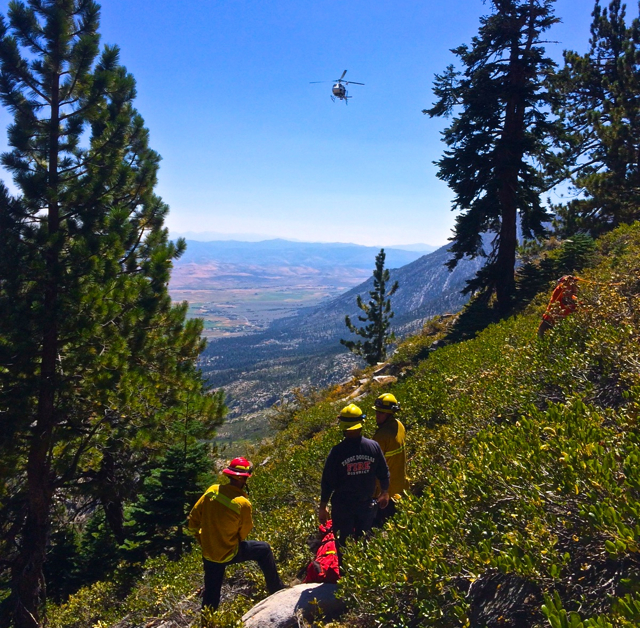
Crews work on an injured Tahoe Rim Trail worker on Aug. 25. Photo/Provided

Crews work on an injured Tahoe Rim Trail worker Aug. 25. Photo/Provided

A Tahoe Rim Trail worker was hit by a tree on Thursday afternoon.

The person was knocked down a 40 percent grade slope onto rocks.

Tahoe Douglas fire spokesman Eric Guevin told Lake Tahoe News the man sustained “multiple traumatic injuries.”

Tahoe Douglas firefighters and a search and rescue team responded to the Aug. 25 incident near the Mott Canyon chairlift in the out-of-bounds area of Heavenly Mountain Resort. The victim was working to remove a snag tree.

A California Highway Patrol helicopter out of Auburn with a long line lifted the victim to the Boulder Lodge. From there Tahoe Douglas took him to Barton Memorial Hospital.

The person’s name has not been released.

— Lake Tahoe News staff report