Rabies warning in El Dorado County

Nine wild animals have tested positive for rabies in El Dorado County this year.

The rabid animals include one fox, one bat and seven skunks. While none have been located in the Tahoe basin, that isn’t always the case.

This year the rabid animals have been in Placerville, Pollock Pine, Diamond Springs, Somerset and El Dorado Hills.

Animal Services is warning domestic pet owners that unvaccinated pets are at risk, especially those that are exposed to areas beyond their back yard.

“We find rabid wild animals every year in El Dorado County, so the need for vigilance is important,” Henry Brzezinski, chief of Animal Services, said in a statement.

Rabies is a virus spread through the bite and saliva of an infected animal and is usually fatal to pets and humans if not treated shortly after exposure.

— Lake Tahoe News staff report


Opinion: Brown’s housing plan stumbles

By Dan Walters, Sacramento Bee

California has an immense shortage of housing, and every day it gets worse because we’re not building enough to keep up with even a modest level of population growth.

Dan Walters

Dan Walters

The shortage has driven housing costs through the roof, especially for working-class and poor families, and is atop the list of California’s truly important issues with water and transportation.

However, as with those other deficiencies, another legislative session will end soon without decisive housing action.

Gov. Jerry Brown proposed a baby step toward alleviating the housing shortage – exempting certain projects from some of the red tape that plagues the housing development industry.

Read the whole story


Trump brings out Tahoe supporters, protesters

Donald Trump, sitting in the rear, is whisked from Lake Tahoe Airport on Aug. 26 to Stateline. Photo Copyright 2016 Carolyn E. Wright

Donald Trump, in rear, is whisked from Lake Tahoe Airport on Aug. 26 to Stateline. Photo Copyright 2016 Carolyn E. Wright

By Kathryn Reed

Republican presidential candidate Donald Trump spent the better part of Friday in Nevada, with Tahoe being part of his itinerary.

He landed at Lake Tahoe Airport at 6:50pm after being in Las Vegas. This was nearly an hour after a private fundraiser started in his honor at Harrah’s Lake Tahoe. His trek from the airport to the casino was the extent of his time in California.

Pat Engels of South Lake Tahoe shows holds a Trump-Pence sign. Photo Copyright 2016 Carolyn E. Wright

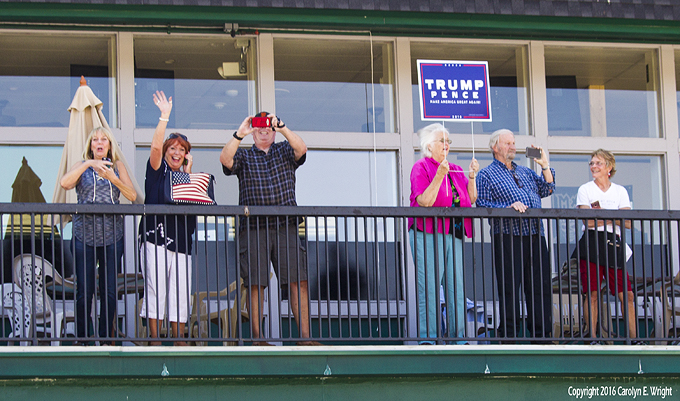
Pat Engels of South Lake Tahoe holds a Trump-Pence sign. Photo Copyright 2016 Carolyn E. Wright

The media was not allowed in the fundraiser that cost $200 per person, with priority tables going for $2,500 and VIP tables costing $5,000. All of the proceeds go to the Nevada Republican Party, and not into his campaign coffers.

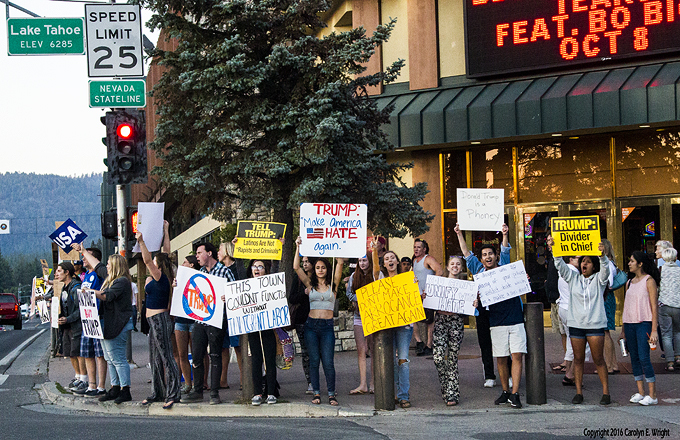
More people were outside of Harrah’s on Aug. 26 with signs protesting Trump than were at the airport welcoming his arrival.

Donald Trump lands Aug. 26 at Lake Tahoe Airport on a plane owned by a friend and financial backer . Photo Copyright 2016 Carolyn E. Wright

Donald Trump lands Aug. 26 in South Lake Tahoe on a plane owned by friend and financial backer Phil Ruffin. Photo Copyright 2016 Carolyn E. Wright

Signs read “Anyone but Trump”, “Trump: Divider in chief,” and “This town couldn’t function without immigrant labor.”

But it is Trump’s immigration policies that brought Bob and Pat Engels of South Lake Tahoe to the airport to see their candidate.

“We are so excited to be able to vote for Trump,” Pat Engels told Lake Tahoe News. The couple is eager to vote for him in November because they believe he’ll stop illegal immigration, make America great and uphold the First, Second and Fourth amendments.

Outside of Harrah's Lake Tahoe, where Donald Trump was to attend a fund-raising event Aug. 26, protesters made their opinions known. Photo Copyright 2016 Carolyn E. Wright

Outside of Harrah’s Lake Tahoe, where Donald Trump was to attend a fund-raising event Aug. 26, protesters made their opinions known. Photo Copyright 2016 Carolyn E. Wright

A couple tables down a woman brought her two young daughters to the deck at the airport restaurant.

“He’s going to build a wall,” the Caucasian woman, who didn’t want to identify herself, said. That is why she likes Trump.

Trump flew in on Phil Ruffin’s private plane, a Bombardier 420. Eight years ago Trump was the best man for the Las Vegas businessman. The two are also business partners. And Ruffin spoke at the Republican National Convention this summer.

While Trump deplaned far from the main airport building because Secret Service and local law enforcement were worried about safety, his entourage swung by the terminal so he could wave to the dozen plus people on the balcony.

This is not Trump’s first visit to Tahoe. He has played in the American Century Championship celebrity golf tournament. The first year was 2004 when he placed 56. He also played the following two years.


California’s rich-poor gap keeps growing

By Matt Levin, CalMatters

Where in California has the gap between rich and poor grown most since the Great Recession?

The Bay Area, home of your Zuckerbergs and Steyers and some of the most expensive ZIP codes in the country, seems like a logical answer. Over the past decade, what other part of California has minted as many members of the “1 percent” as Silicon Valley?

But according to research from the nonpartisan Public Policy Institute of California, income inequality in the Bay Area has worsened only marginally, at least when compared to other parts of the state. In 2007, Bay Area households at the top 10 percent of incomes made about 10.6 times what Bay Area households at the bottom 10 percent of incomes brought home. By 2014, they made about 11.6 times as much.

While that 10 percent increase in the income gap is notable, it pales in comparison to almost every other region in the state. The “90/10” ratio grew by over 30 percent in the greater Sacramento region and in the more rural counties north of the Bay Area. The Inland Empire, still reeling from its foreclosure crisis, saw the biggest jump in income inequality in the state at more than 40 percent.

Income inequality within California may not look like what you would expect. Regions such as Orange County and the Bay Area, despite their notable concentrations of wealth, are some of the more equal in the state. By far the most unequal California region is the Central Valley, where high-income households make 14 times as much as poor households.

So what gives? Are the tech barons of San Francisco relocating to Fresno and commuting via private jet?

“The recovery has happened faster in the Bay Area—that’s a big part of it,” says Sarah Bohn, a research fellow at PPIC and co-author on the study. “Incomes fell across the board during the recession, and the fastest to recover typically see better results.”


There are other important lessons to draw from how income inequality varies throughout the state, and how the pattern has changed since the Great Recession. Part of the reason why regions such as the Bay Area and Orange County stack up favorably is because recent changes in income inequality have more to do with the deteriorating incomes of the poor than the growing fortunes of the rich.

Those at the bottom 10 percent of incomes in the Inland Empire, for example, saw their income drop by 35 percent since 2007. That’s mostly why the region, which includes Riverside and San Bernardino counties, suffered a 40 percent widening of the gap between rich and poor. In contrast, equivalent low-income residents of the Bay Area saw incomes fall just 9 percent, which helps explain why income inequality increased only marginally there.

Those California regions with the biggest chasm between rich and poor typically have some of the poorest populations in the state. In the Central Valley for example, households in the bottom 10 percent of the income distribution made less than $10,000 per year (adjusted for a family of four). Their equivalents in the Bay Area made more than double that.

“When you’re talking incomes that low, you’re likely talking about people who work in agriculture and who really have highly variables incomes because they’re not at a traditional job,” says Ann Stevens, director of the UC Davis Center for Poverty Research.  “Or they may be doing temporary work or field work or running a small agricultural business.”

It’s important to note that the PPIC study does not control for the fact that low-income families may be relocating to more affordable areas of California—or leaving the state altogether. Such a migration could lower inequality ratios in more expensive parts of the state such as the Bay Area and Orange County, where housing and other costs have risen rapidly.

But across California income inequality has gotten worse since 2007. And it’s not the rich getting richer per se—it’s the already very poor getting even poorer. Incomes at  the bottom 10 percent of Californians have dropped by 26 percent since 2007. Since 2007, the rich haven’t actually got that much richer–or at least those at the top 10 percent are  not racking up more income. In fact, incomes at the top 10 percent have also dropped over the same time period, but by a much smaller amount.

“If incomes fell across the board at the same rate, then income inequality wouldn’t change that much,” says Bohn. “But because top incomes recover quicker and lower incomes don’t, that’s where the growth in inequality is coming from.”

How exactly you measure income inequality matters a great deal, both in terms of presenting the size of the income gap itself and devising the policy prescriptions to fix it—assuming you think it should be fixed in the first place.

Focusing on very rich households will yield different results than focusing on even slightly less rich households. Research from the Brookings Institute that compares higher-income households (those at  the top 5 percent) to those at  the bottom 20 percent makes the Bay Area appear much more unequal, with the greater San Francisco metro area the third most unequal region in the country.

But looking at other portions of the income distribution can be even more illuminating. The PPIC researchers also compared the median income of each region to the bottom 10 percent, which can roughly be interpreted as how far very low-income households must climb up the income ladder to reach middle-class status. They also looked at the “80/20” ratio, which captures less of the extremes of rich and poor and examines a broader swath of upper and lower-class families.

The different measures tell a broader story about which households on the income spectrum are faring well and which aren’t. By the 80/20 measure, Los Angeles County is the third most unequal region in the state. But the county does much better by the 50/10 measure, where the gap between the poor and middle class is the second lowest in California.

Any measure of income inequality also comes with a couple of important—yet often overlooked—caveats. First, by definition it counts only income and thus doesn’t account for investments, savings or other forms personal wealth. Second, it look only at pre-tax earnings or cash income, and doesn’t include the income-leveling effect of taxes on richer households, nor safety-net supports for low-income households such as food stamps and the Earned Income Tax Credit.

When counting only work and retirement income, a California household at the top 10 percent of income appears to make 17 times as much as a household at the bottom 10 percent. But factor in both taxes and safety-net supports, and that disparity shrinks by almost half—with the top tier collecting eight times the income of the bottom tier. (The shrinkage of the gap is due more to the buttressing of incomes for the very poor than to the income-reducing effects of taxes on the rich.)

That’s good news for those who believe income inequality is a problem worthy of government action. Driven by powerful macroeconomic forces such as globalization and technological change, income inequality is often framed as an intractable economic problem beyond the scope of simple policy solutions.

But the research indicates that policies such as the Earned Income Tax Credit—which proves a sizable income boost to many low-income working families in the form of an annual refundable tax credit—could do a great deal to reduce inequality in California.

“Policy to reduce income inequality is hard when you’re just looking at labor market earnings,” says Bohn. “But in reality, what families live on—there’s a lot more than just labor market earnings. We have targeted programs that are aimed at low-income families, and those are the places where policy can make a difference.”



What happens if a major quake hits Tahoe?

By Alexa Renee, KXTV 

If a major earthquake affected the region, would you be prepared?

Most people wouldn’t be ready, according to Graham Kent, who is the director of the Nevada Seismological Laboratory– as well as a professor in the Department of Geological Sciences and Engineering at UNR.

At least 120 people were killed and dozens are missing or feared dead Wednesday after a magnitude 6.2 earthquake struck several towns in central Italy, according to Italy’s civil protection agency. The mayor of one the hardest-hit town, Amatrice, told RAI-TV that he had trouble communicating with emergency responders and couldn’t reach the hospitals.

Could a similar scenario happen in our area?

Kent maps earthquake faults under Lake Tahoe. The actual fault beneath the lake is a lot bigger than the fault that led to the recent Italy earthquake, Kent said.

“Lake Tahoe has been formed by 500 to 1,000 earthquakes over a few million years,” Kent stated. “With every earthquake, the lake gets deeper every time.”

Read the whole story


Thousands in Calif. start school without vaccinations

By Jill Tucker, San Francisco Chronicle

While a new state law requires children to be vaccinated to attend public or private school, thousands of California students are filing into classrooms this month without the required immunizations.

In fact, it will be years before the law that Gov. Jerry Brown signed last year, in the aftermath of a measles outbreak that was traced to Disneyland, fully takes effect and forces all kids — save those with strict medical exemptions — to have all their shots.

What’s changed is that parents can no longer opt out of vaccinations by claiming a religious or personal-belief exemption. However, parents need to provide immunization records at only two points of their child’s school career — at the outset of kindergarten and seventh grade.

Read the whole story


Trump’s love affair with Nevada GOP

By Seth A. Richardson, Reno Gazette-Journal

Republican presidential nominee Donald Trump doesn’t have a lot of clout in Nevada’s political circles. He didn’t gain any major endorsements during the caucus and has raised only a paltry sum in the state compared to Democratic presidential nominee Hillary Clinton, but he has found a friend: Nevada Republican Party Chairman Michael McDonald.

Trump has often been at odds with the more official branch of the Republican Party, instead relying on grassroots support. Elected Republicans, including Gov. Brian Sandoval and Sen. Dean Heller, have openly decided not to endorse Trump. Even the ones who have use language like, “I will support the nominee,” or talk about the dangers of Clinton rather than state their outright support for Trump.

But with McDonald, it’s different.

Read the whole story


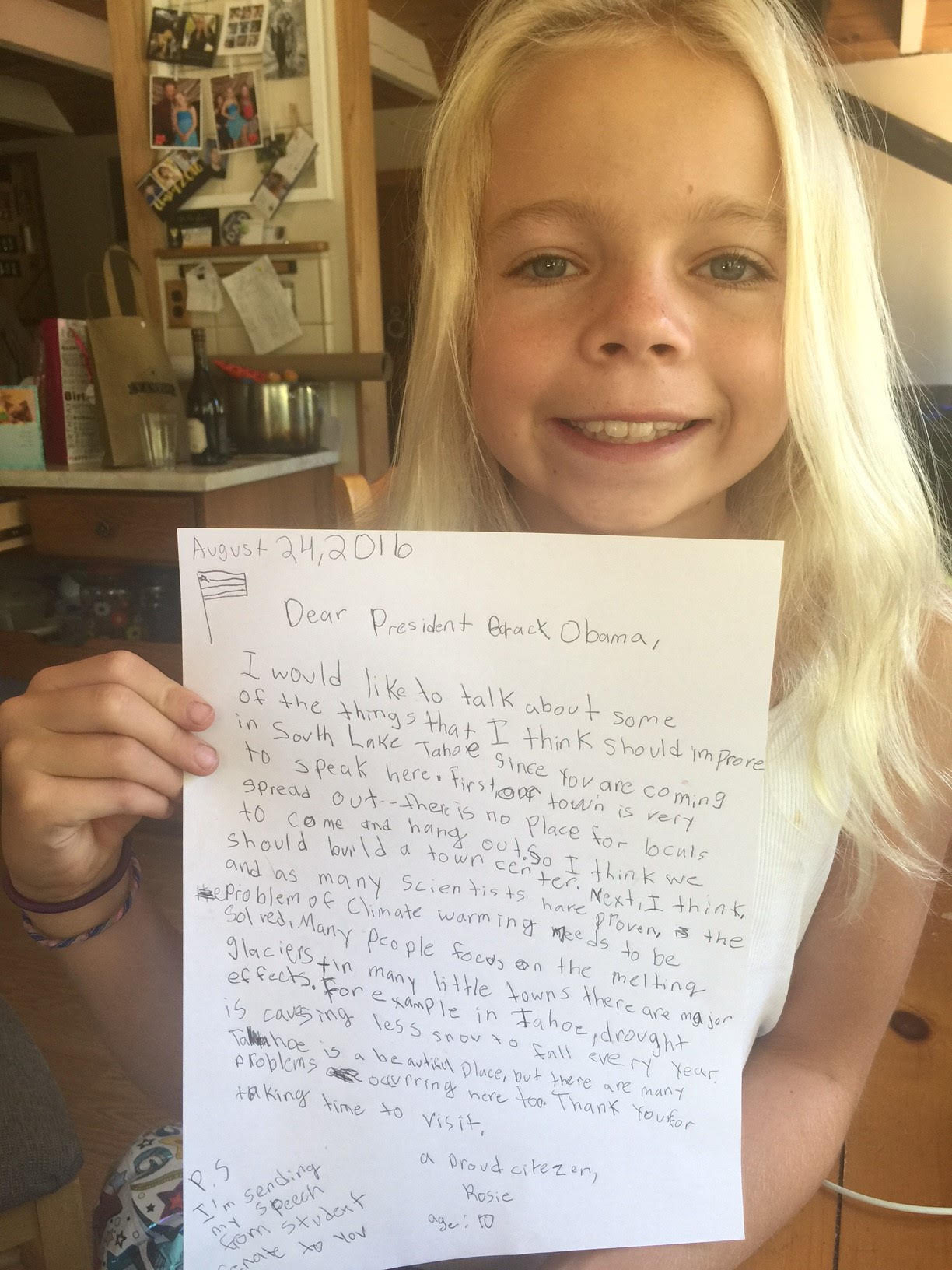
Letter: 5th-grader’s letter to President Obama

Publisher’s note: The following letters are from 10-year-old South Lake Tahoe resident Rosie Friedrich and her father, John, to President Obama.

Dear President Obama,

We’re excited for your visit to Lake Tahoe next week. I was one of your elected 2008 national convention delegates from California, and have been a strong supporter ever since.

During your first campaign, I made “Babies for Barack” buttons, which I gave to you and Michelle at events in Iowa, my home state. Our daughter Rosie was one year old at the time, and her future was my deepest motivation to get involved in your campaign.

Flash forward, and Rosie, now 10, will be in her first week of 5th grade when you visit. She’ll be attending the Lake Tahoe Summit to hear you speak.

Thinking about your visit, Rosie decided to write a letter to you. She also wanted to share the speech she wrote when running for the 4th grade student senate last year about getting solar panels for her elementary school.

She wrote her letter to you by hand, but I’m typing it for her. Thanks for reading, and we’ll see you next Wednesday!

Sincerely,

John Friedrich,  South Lake Tahoe

rosie letterAugust 24, 2016

Dear President Barack Obama:

I would like to talk about some of the things that I think should improve in South Lake Tahoe since you are coming to speak here.

First, our town is very spread out — there is no place for locals to come and hang out. So I think we should build a town center.

Next, I think, and as many scientists have proven, the problem of climate warming needs to be solved. Many people focus on the melting glaciers, but in many little towns there are major effects. For example in Tahoe, drought is causing less snow to fall every year.

Tahoe is a beautiful place, but there are many problems occurring here too. Thank you for taking time to visit.

A proud citizen,

Rosie, age 10


Star Guide: Cluster proves to be worthy objects

By Tony Berendsen

Many years ago while visiting the Museum of Modern Art in San Francisco I went on a docent tour of modern abstract paintings. There was one giant wall sized painting dedicated to a single room. It was blue, that’s all, just a blue wall. I had no idea of how to appreciate a blue wall. The docent brought to our attention that when walking into the room the blue wall changed our spatial interpretation of the room size: such is art.

Many years ago a friend showed me the Double Cluster in Perseus through his telescope. I saw two clusters, side by side, that’s all. I had no idea of how to appreciate what I was seeing. Then he explained to me that both clusters were very distant (over 7,000 light years) and were very young with lots of young brilliant blue white stars: such is astronomy.

Since then, the Double Cluster has become one of my favorite objects to view. It can be seen with the naked eye as a nebulous star, in binoculars as two distinct star clusters, and through a telescope as a stellar jewelry box filled with brilliant bluish white stars.

Both star clusters are designated as NGC (New General Catalog) objects and are only a few hundred light years apart. NGC 869 is composed of more than 200 stars with an estimated average age of 5.6 million years. NGE 884 has 175 stars and younger at an average age of 3.2 million years old. Due to there close proximity to each other they may have formed from the same molecular gas cloud.

Double Cluster is worth another look. Photo/Simulation Curriculum

Double Cluster is worth another look. Photo/Simulation Curriculum

Both clusters have been measured as blue shifted and heading toward our area of space at 49,000 mph. No worries though since they are very distant. One of the amazing things about these clusters is their brightness making them the most distant naked eye star clusters visible to the naked eye.

In comparison with the Pleiades, which is a mere 150 light years distant, if the double cluster were that close, the stars would be as bright as Vega and cover almost a quarter of the night sky.

To find the double cluster, break out your favorite astronomy app and point to the northeast to find Cassiopeia in the early evening. Two of the stars making the “W” shape of the constellation (Navi and Ruchbah) create a line to follow toward the horizon to the constellation Perseus. Look for a semi bright nebulous star on that line of site. Grab your binoculars, or telescope with a low power eyepiece, and the clusters will appear.

Gazing at the Double Cluster I’m always amazed at the size and scale of the cosmos they represent. Looking across to the next arm of our galaxy, seeing these young bright stars in the distance: such is discovery.

Tony Berendsen runs Tahoe Star Tours. He may be reached at 775. 232.0844 or tony@tahoestartours.com. 


South Tahoe seeks to renew bike friendly status

South Lake Tahoe needs people to take a survey in order to retain its Bicycle Friendly Community designation.

During this certification process the League of American Bicyclists reviews all bicycle related information submitted to them, which includes how many miles of bike paths/lanes are in South Lake Tahoe, what type of bike infrastructure improvements have been completed, how the city encourages the public to cycle, law enforcement related to cycling, educational outreach for cycling, and basic demographics of the community.

Part of the process is getting feedback from community members via an online survey. The survey takes a few minutes to complete and the results will be shared with the community. The survey is open now through Sept. 15 at midnight.