Cops being kept in dark about kid who OD’d

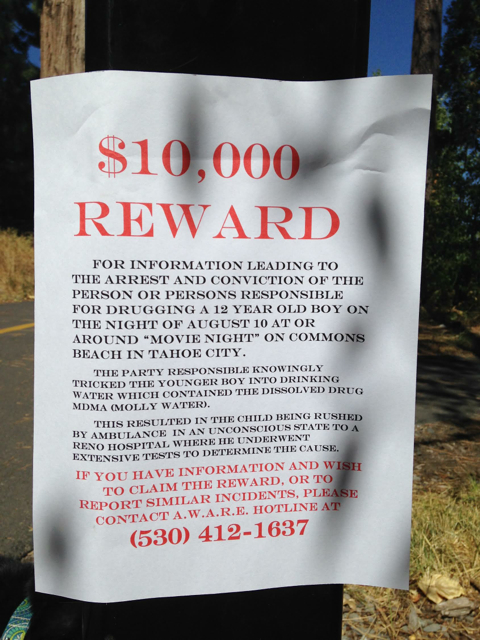
Signs about a drug incident were posted in Tahoe City before law enforcement was called. Photo/LTN

Signs about a drug incident were posted in Tahoe City before law enforcement was called. Photo/LTN

By Kathryn Reed

Placer County sheriff’s deputies are trying to get to the bottom of an incident involving a 12-year-old who nearly died after ingesting water that reportedly had the drug molly in it.

Signs were placed along bike trails in Tahoe City asking people for information and to call A.W.A.R.E.

No one from A.W.A.R.E. returned a phone call.

The sheriff’s department was sent the same flyer and also has not received a call back. They also don’t know anything about this group. Nor is it known who put up the $10,000 reward money.

What alarms the sheriff’s department is that neither the parents nor the hospital called law enforcement. It is state law that a medical facility must notify officers when a crime may have been committed. A youth under the influence of anything is an indication a crime has occurred; it could just be having access to the substance, or being a user – intentionally or not.

“We found out who the child is. We spoke to the mother. Something happened, we don’t know what happened because nobody has been forthcoming,” Dena Erwin, sheriff’s spokeswoman, told Lake Tahoe News.

It has not been determined if a crime occurred or if the youth willingly ingested the drug. The hallucinogenic can cause serious damage to a body, especially to someone not fully grown. The condition of the child is not known.

“We haven’t confirmed it was MDMA because no one has given us blood results,” Irwin said.

Allison Williams with Renown Medical Center in Reno told Lake Tahoe News it is standard operating procedure to let Child Protective Services or another appropriate agency know of a case like this. She didn’t know why Placer deputies were not alerted.

“We are not sure where the disconnect was,” Williams said.


Snippets about Lake Tahoe

·       Washoe County Sheriff’s Office is having an open house on Sept. 29 from 10am-3pm in Reno.

·       High Fives Foundation’s 8th annual Bocce Tournament at Truckee River Winery in Truckee is Sept. 18 beginning at 10am. The cost is $125 per two-person team. Space is limited to the first 40 teams to register. Go online to sign up.

·       Hunting seasons for dove, grouse and crow open in Washoe County on Sept. 1.

·       Virginia City’s Labor Day celebration includes the Great Civil War Days, Sept. 3-5 and the annual parade on Sept. 5 at noon on C Street. For more info, go online.


Tahoe woman runs over husband in driveway

A South Shore man is an induced coma after being run over by his wife in their driveway.

Teresa Anderson, 58, told El Dorado County sheriff’s deputies that it was an accident.

Investigators are still trying to determine if it was intentional or an accident. Anderson was arrested that night, Aug. 26, on assault with a deadly weapon charge. She has since posted bail.

If her husband, Tim Anderson, does not survive, she could face other charges.

Anderson, 62, is a flooring contractor in Tahoe. He has not regained consciousness so deputies have not been able to get a statement from him. He is at Renown Medical Center in Reno.

— Lake Tahoe News staff report


Energy bills driving greener Nev. weed business

By Daniel Rothberg, Las Vegas Sun

Beneath a purple glow, in a warehouse sharing the street with two indistinguishable strip malls, Kevin Biernacki is growing around 100 pounds of medical marijuana. The purpose of this facility, owned by The Grove, is no different than other cultivation sites in Nevada. Yet, the roughly 480 industrial lamps suspended over clusters of cannabis set this place apart.

Those energy-efficient lights allowed The Grove to slash its power bill. The decision to use LED lamps might seem unsexy at first, simply a marginal deduction on a complicated balance sheet. But it’s not. It is the type of business decision many experts believe can offer huge benefits in a growing market.

That’s because indoor cultivation centers, which use lamps to mimic the sun and air conditioning to keep temperatures hospitable, suck up power. NV Energy has projected that some cannabis-growing operations could use up to 5 megawatts at one time, enough energy to power about 3,000 homes.

Read the whole story


Expect traffic impacts during president’s visit

By Kathryn Reed

President Obama will be using Marine One to fly into Lake Tahoe Airport on Wednesday for the 20th annual Lake Tahoe Environmental Summit.

He is the keynote speaker at the confab at Harveys in Stateline that starts at 1:30pm Aug. 31.

The summits started in 1997 with then President Bill Clinton and Vice President Al Gore coming at the invitation of Sen. Harry Reid, D-Nev. With Reid leaving office in a matter of months, this is the last summit he will be hosting. While Clinton and Gore went out on the lake when they were here, Reid’s office told Lake Tahoe News there are no plans for Obama to tour the area.

Usually the summits are a bipartisan affair, but the scheduled speakers are all Democrats – Obama, Reid, Sens. Dianne Feinstein and Barbara Boxer of California, and Gov. Jerry Brown are on the docket.

This will be Obama’s first visit to Lake Tahoe.

President Obama is using a helicopter to get to Lake Tahoe on Aug. 31. Photo/South Lake Tahoe

President Obama will arrive in Tahoe on Aug. 31 via helicopter. Photo/South Lake Tahoe

He can’t come in Air Force One because the runway at Lake Tahoe Airport is not long enough, coupled with the density of the mountain air. Test flights were done this weekend to ensure all would go smoothly when the president is actually here.

There will be a 3-mile no-fly zone around the president. This includes CalStar, so ground transport will have to be used in all medical emergencies during this time.

With the airport doubling as offices for South Lake Tahoe, the entire building will be shut down for the better part of the day Wednesday for security reasons.

When Republican presidential candidate Donald Trump was in town last week law enforcement was scattered throughout Pioneer Trail to allow his motorcade to zip from the airport to Stateline. While the president’s route has not been disclosed, expect delays on area roads on Wednesday.

“There are a variety of contingency routes. For security they plan on a variety,” South Lake Tahoe Police Chief Brian Uhler told Lake Tahoe News. “While we are involved, the Secret Service is understandably in charge. I think it is safe to say that traffic could be affected anytime between noon and 4pm on the day he is here.”

Various protests – for or against people and causes – could also tie up traffic.

PETA is planning a protest at Highway 50 and Heavenly Village Way from 9-10:30am regarding how much water it takes to raise animals for food consumption.

Even Heavenly Mountain Resort’s gondola will be closed between 12:30-2:30pm.


Letter: United effort to help Lake Tahoe

To the community,

We welcome President Obama to Lake Tahoe, which is admired for its great depth and clarity and beautiful alpine surroundings. As Tahoe’s public water agencies, we are hard at work on a water infrastructure initiative to enhance critical preparedness needs and hazard mitigation in the wildland urban interface against the threat of catastrophic wildfire.

Our bi-state Lake Tahoe Community Fire Protection Partnership is an extraordinary collaboration between public water agencies and the U.S. Forest Service. The efforts of the partnership align with the objectives of the Lake Tahoe Restoration Act to address forest health, storm water management, invasive species management, and native fish recovery. Since 2009, the partnership has installed more than 16 miles of improved water line with 180 fire hydrants every 500 lineal feet, 10 water storage tanks with a 4.7 million-gallon storage capacity, five booster pump stations to increase water flow, and strategically placed emergency generators to provide continued water supply during catastrophic events.

This local-federal effort to enhance water infrastructure specifically to reduce the impact of wildfire is in effect an insurance policy to protect the investment from the public and private sectors since that first Tahoe Summit in 1997.  As Sen. Dianne Feinstein, D-Calif., has expressed, a catastrophic fire here – and the subsequent impact on the lake from ash, debris and sedimentation – could set efforts back years.

We join our partners here – federal, state, local, and private – in renewing their commitment to this great lake and support the passage of a comprehensive Lake Tahoe Restoration Act.

Randy Vogelgesang, South Tahoe Public Utility District board president


Sustainable wine industry a work in progress

By Kathryn Reed

INCLINE VILLAGE – Economically, wine is huge for California – it’s a $58 billion industry, attracts 24 million tourists a year and employees 30,000 people.

But it’s not the most environmentally friendly crop. UC Davis wants to change that reality.

Jill Brigham, executive director of the Sustainable Wine and Food Processing Center at UCD, gave a talk last week at Sierra Nevada College about the science of wine and how to optimize the sustainability of winemaking.

“Just with winemaking it takes six volumes of water for every volume of wine that is produced. We want to reduce that to 1:1,” Brigham said. “Irrigation and growing of grapes takes a lot more, but it varies greatly.

“We want to teach our students to respect the earth and make wine in the most sustainable way.”

While there is a vineyard and full winery on campus, none of the wine produced is for consumption or sale. Yes, students get to taste it, but it’s all part of the learning process. Lots of spit buckets are on site with the goal of not much being swallowed. (The Legislature last year approved a bill allowing students younger than 21 to be in a class with wine tasting as long as spitting was the protocol.)

It was state lawmakers who in 1880 mandated UC regents create a viticulture program at UC Berkeley. A vineyard was planted at Davis in what became the university. The program went away during Prohibition, but was resurrected in 1935 at was then UC Davis.

While the winery building on campus is green – LEED platinum – the art of winemaking has a ways to go to be as efficient.

The university is in the process of creating wine that is sustainable. This will include multiple uses for water – recycling what comes off the roof and reusing what is used in the winemaking process. How the soil and end product reacts to the grey water is being studied.

Various root stocks are being studied to find ones that use less water. Davis has 300 varietals in its vineyards.

The university is partnering with General Electric on a reverse osmosis system to create potable water.

Water is huge in the wine industry, right down to needing to sanitize the bottles.

“A big part of the carbon footprint is the bottle,” Brigham said. “Hopefully, we will see better wines put in wine boxes. Glass bottles are also heavy and it impacts transportation.”

The college is also looking at capturing the carbon dioxide that is released during the fermentation process.

Solar panels are in place to generate energy, with the excess being stored in lithium batteries. The winery is creating more energy than it uses. Solar is powering the ice machine.

One area that uses a ton of energy is refrigeration. Studies are under way to see how that consumption can be reduced.

Even though the Sacramento Valley has weeks where the mercury hits triple digits, the winery has no air conditioning. The building is that well insulated. At night windows or ventilation ducts draw in the cool air to reduce the temp inside and it stays that way the entire next day.

The goal is any innovations the university creates would then eventually be used throughout the industry.


Opinion: Trying to be American and Indian

By Rosalyn Eves

For the first few years of her life, Sarah Winnemucca, who was born around 1844, did not know that she was American. Born Thocmetony (Shell Flower) among the Numa (known among whites as the Northern Paiute or “digger” Indians), she roamed with her people over western Nevada and eastern Oregon, gathering plants and fish from local lakes. But even during her early years, Winnemucca had learned to be afraid of the men with “white” (blue) eyes, who looked like owls because of their beards.

For Winnemucca, being “American” was a complicated process of adopting the behaviors and language of people she had reason to distrust. Translating between the two cultures became her life’s work. And though she was uncomfortable with the role, her influence is still felt today: Winnemucca’s autobiography, “Life Among the Paiutes”, the first English narrative by a Native American woman, voices a thoughtful critique of Anglo-American culture while recounting the fraught legacy of federal lands, including Nevada’s Pyramid Lake and Oregon’s Malheur region, recently the site of a militia takeover. (The 19th-century Malheur Indian reservation lies immediately north of the current wetlands).

As Winnemucca grew up, she came to understand that the settlers were not leaving and she began adopting Anglo-American habits, acquiring the Christian name Sarah and mastering English and Spanish. At her grandfather’s request, she and her sister went to a convent school in San Jose, but they were only there a few weeks when “complaints were made to the sisters by wealthy parents about Indians being in school with their children.”

For most of her life, she sought to straddle American and Native cultures to help the Northern Paiutes. In 1859, land was set aside near Pyramid Lake for a reservation. Winnemucca and her family were expected to abandon their nomadic life for a settled “American” lifestyle—and make a success of farming in a dry, arid landscape without any training. Many Paiutes died of starvation at Pyramid Lake. They were only given supplies the first year, with government agents pocketing the money intended for them for the following 22 years (a practice common on many reservations).

After the first disastrous winter there, Winnemucca was driven to action, begging military leaders at Nevada’s Camp McDermit for help. Wagonloads of supplies were finally sent to the reservation. Winnemucca was hired as a military interpreter and her father and their band moved to the military camp.

Translating was a means for Winnemucca to get better treatment for her people, but she was often in an untenable position. In the mid-1870s she had to translate for Agent William V. Rinehart, whom she found to be a hard, unlikeable man. If she translated Rinehart’s words without comment, she failed to protect her people; but if she tried to convey grievances from the Northern Paiutes, she might be (and was) fired from her position. Rinehart eventually banned her from Malheur.

Winnemucca fared better in the military camps, where her knowledge of Paiute life garnered some respect. In 1878, she worked as a messenger, scout, and interpreter for General O.O. Howard during the Bannock War, a skirmish between the U.S. military and the Bannock Indians.

“This was the hardest work I ever did for the government in all my life … having been in the saddle night and day; distance, about two hundred and twenty-three miles. Yes, I went for the government when the officers could not get an Indian man or a white man to go for love or money. I, only an Indian woman, went and saved my father and his people,” she later wrote. Her courageous actions landed her on the front page of the New York Times in June 1878, but sowed mistrust between her and local tribes.

The Bannock War ended badly for the Paiutes, who were mostly innocent bystanders. In 1879, military leaders forced the Paiutes who had taken refuge from Malheur at Camp McDermit to march more than 350 miles in winter to the Yakama reservation in Washington territory.  Winnemucca was devastated; she had promised the Paiutes they would be all right if they followed military orders. In Yakama she worked as an interpreter. She argued with the reservation agent, wrote letters to military and government leaders, and in the winter of 1880, accompanied her father and other Paiute leaders to Washington, D.C., to meet with the secretary of the interior, Charles Schurz. They succeeded in obtaining a letter allowing the Paiutes to return to Malheur, but the Yakama agent refused to let them leave.

Several of the Paiutes accused Winnemucca of betraying them for money. She showed them Schurz’s letter and said, “I have said everything I could in your behalf … I have suffered everything but death to come here with this paper. I don’t know whether it speaks truth or not. You can say what you like about me. You have a right to say I have sold you. It looks so. I have told you many things which are not my own words, but the words of the agents and the soldiers … I have never told you my own words; they were the words of the white people, not mine.”

Winnemucca escalated her fight for reform. When face-to-face petitions and letters failed to improve conditions for the Paiutes, she began lecturing in San Francisco, dramatizing the plight of reservation Indians. These performances offered a carefully curated version of the “Indian princess” to various white crowds, and she often wore native dress. She told a reporter, “I would be the first Indian woman who ever spoke before white people, and they don’t know what the Indians have got to stand sometimes.” She described the abuses of reservation agents, particularly Rinehart. But her voice came at high cost: Rinehart responded by calling Winnemucca—in public and in letters to the Office of Indian Affairs—a drunk, a gambler, and a whore.

Winnemucca became famous. In 1883, sisters Elizabeth Palmer Peabody and Mary Peabody Mann, important educators, intellectuals, and members of the Transcendentalist movement, invited her to lecture in New England. The Peabody sisters also arranged for the publication of “Life Among the Paiutes” later that year. In all, Winnemucca spoke nearly 300 times throughout New England, meeting John Greenleaf Whittier, Ralph Waldo Emerson, Justice Oliver Wendell Holmes, and Sen. Henry Dawes, among others.

“The lecture was unlike anything ever before heard in the civilized world—eloquent, pathetic, tragical at times; at others [her] quaint anecdotes, sarcasms, and wonderful mimicry surprised the audience again and again into bursts of laughter and rounds of applause,” wrote a reporter from the Daily Silver State in 1879.

But despite her successful speaking, Sarah was not always as conformable as her audiences would like, and her writing about Americans often criticized their hypocrisy and challenged popular narratives about pioneers. Of the infamous Donner Party, who showed up when she was 5, Winnemucca wrote, “Well, while we were in the mountains hiding, the people that my grandfather called our white brothers came along to where our winter supplies were. They set everything we had left on fire. It was a fearful sight. It was all we had for the winter, and it was all burned during that night.” Even more cutting, she reflected in her autobiography, “Since the war of 1860 there have been one hundred and three (103) of my people murdered, and our reservation taken from us; and yet we, who are called blood-seeking savages, are keeping our promises to the government. Oh, my dear good Christian people, how long are you going to stand by and see us suffer at your hands?”

After the mid-1880s she abandoned lecturing, exhausted and disillusioned. In 1885 she told the Daily Silver State that she had fought “agents for the general good of [her] race, but as recent events have shown that they are not disposed to stand by me in the fight, I shall relinquish it.” She worked in both worlds, but was at home, ultimately, in neither. She once told an interviewer, “I would rather be with my people, but not to live with them as they live.”

She turned her energies instead toward a school for Paiute children, teaching children to read and write in English and providing them with training in marketable skills. Unfortunately, funding for the school was a persistent problem, and in 1887, the Dawes Act mandated that Native children be taught in white-run, English-only schools. And so the school was closed.

Winnemucca may have begun her life ignorant of Americans, but by the time she died in 1891, Americans were not ignorant of her—her obituary ran in the New York Times. And if her speeches and writing did not make the changes she hoped for, they remain a vivid, eloquent testimony of a life spent speaking for others.

Rosalyn Eves wrote her doctorate dissertation on 19th-century women’s rhetoric in the American West, including Sarah Winnemucca. She teaches at Southern Utah University and her first novel is forthcoming from Knopf in 2017. 


Protections for endangered Calif. frogs, toads

By Ellen Kincimeyer, AP

Two types of yellow-legged frogs, and a kind of toad found in Yosemite National Park, won extra protection Thursday when federal authorities declared nearly 3,000 square miles in California’s Sierra Nevada mountains as critical habitat for the endangered animals.

The designation by the U.S. Fish and Wildlife Service means closer controls on human activities that could threaten the Sierra Nevada yellow-legged frog, the mountain yellow-legged frog, and the Yosemite toad. The designation mainly affects federal land.

Naturalist surveys of California’s Sierra mountains from a century ago described the yellow-legged frogs as lining almost every foot of mountain lake shores, said Jeff Miller, a conservation advocate for the Center for Biological Diversity environmental group.

Over the past few decades, the frogs and toads have had to contend with a host of threats. They include the stocking of Sierra lakes with voracious trout and other non-native fish, diseases fostered by climate change and pesticides blown in from California’s Central Valley farms.

About 90 percent of the yellow-legged frogs have gone, Miller said.

“These were a very common species once. They pretty much disappeared,” said Miller.

He recently helped crews reintroduce the frogs to one Sierra waterway after workers had netted and removed non-native fish that eat the amphibians, part of a yearslong effort to remove the non-native predators of frogs.

Climate change and pesticides, as well as grazing by livestock, also have eradicated more than half of the original population of the Yosemite toad.

The three species were listed as endangered in 2014.

Wildlife officials are working with the Oakland and San Francisco zoos to raise additional numbers of the amphibians for release in the wild, said Jennifer Norris, field supervisor for the agency’s Sacramento office.


El Dorado County inmate dies in custody

A 39-year-old El Dorado County man died in his cell at the El Dorado County Jail in Placerville.

Dennis Rank

Dennis Rank

Dennis Renk was found unresponsive on Aug. 27 at 12:24am.

He had been in custody for nearly 10 months on a murder charge. Renk was accused of killing 56-year-old Langley Pratt of Camino. The two had been in a fight last November that ended in Pratt’s death, according to El Dorado County sheriff’s deputies.

Renk was taken to Marshall Hospital in Placerville where he was pronounced dead four hours later.

The cause of death is under investigation by a multi-agency team.

— Lake Tahoe News staff report