North Tahoe has grant money for events

The North Lake Tahoe Chamber/CVB/Resort Association has $50,000 in grant money to help event organizers  in eastern Placer County.

The grant funds are to support the promotion of events outside of the Lake Tahoe market in order to generate increased local and regional business revenue, create media exposure and promote overnight visitation. Specific eligible expenses covered by the grant include geographic area advertising such TV, radio, print and Internet, production and printing of promotional materials such as brochures, flyers and posters, production and printing of directional/informational signage and marketing and promotion in support of events which benefit more than one geographic area of the region, or the region as a whole.

Expenses not covered by the grant include capital investments, salaries, operational overhead, vehicle expenses, food, beverage, entertainment, transportation, supplies, equipment, security, clean up or facility rentals.

Applications must be received by Sept. 9


Star Guide: Ely — Gateway to the Milky Way?

By Tony Berendsen

On Aug. 25, I visited Great Basin National Park for the centennial celebration of the National Park System, the 30th anniversary of Great Basin National Park, and First Light of the Great Basin Observatory; a new research grade telescope located within the park.

Among the dignitaries speaking were Chairman Alvin S. Marques of the Ely Shoshone Tribe, Nevada Rep. Cresent Hardy, and Gov. Bryan Sandoval. Marques blessed the new observatory, saying it was a fitting addition allowing great views of the starry sky. The governor told of a recent camping trip to the park when he and his family spent the night at the Wheeler Peak campground at 10,000 feet elevation. He spoke with genuine passion of the park’s many attractions, and praised the observatory as a valuable asset for Nevada.

Following the ceremony there was a First Light ribbon cutting ceremony for The Great Basin Observatory. The observatory will be used for research, outreach, and instruction in conjunction with six entities: Great Basin National Park, Great Basin National Park Foundation, UNR, Western Nevada College, Southern Utah University, and Concordia University.

Stars at Great Basin National Park are phenomenal. Photo/National Park System

Stars at Great Basin National Park are phenomenal. Photo/National Park System

Will the new observatory and recent International Dark Sky Park status, coupled with many developing astronomy programs at the park put GBNP on the map as a dark sky destination? Ely, known as the gateway to the park, seems to think so, and looks forward to benefiting from an increase of dark sky tourism.

I had a chance meeting with Ely Mayor Melodi Vancamp and asked her what she thought about the potential for star gazing related tourism:

“The city could be more engaged with the park by expanding activities relating to star gazing and getting the community evolved. We are now talking about the GBNP’s importance and it’s a start, but now we have to move on this,” she declared.

“Ely is a gateway to the park, but we need to be more than a gas stop. The city has tossed around forming astronomy gatherings, starting in Ely, bringing in some businesses relating to astronomy and jump starting our dying downtown,” Vancamp said.

“By working together with the Park, providing more  star gazing activities we could make tourists experience with our dark sky more memorable, and get people to stay a few extra days and see all the other sights we have to offer or plan to come back to our area.

“Several months ago, the city formed a strategic tourism committee and brought together a different and wide variety of people, we were also trying to get younger folks involved and not the same 10 people that seem to serve on every board. Peter Wallish, from GOED also has attended.”

The mayor added, “It’s also amazing the amount of foreign visitors we have that come through town to go to the park. A park ranger told me he sees more people coming to see the dark sky than the cave its self.”

For those of us who live in the dark sky state of Nevada a star studded view of the Milky Way is not an unusual sight to behold. But for visitors from light polluted cities across the globe a trip out to the park to view our galaxy in the night sky is a memory of a life time.

Great Basin is a beautiful park and one Nevadans hold dear to their heart. The land within the bounds of the park truly represents the natural beauty found within the vast valleys and high altitude mountain ranges of the Great Basin. But, it is the night sky above the park that may become its most popular attraction.

Tony Berendsen runs Tahoe Star Tours. He may be reached at 775. 232.0844 or tony@tahoestartours.com.


EDC supes disagree on Measure E implementation

By Joann Eisenbrandt

PLACERVILLE — El Dorado County Board of Supervisors on Aug. 30 voted 4-1 not to adopt a resolution to aid in the implementation of Measure E. Supervisor Shiva Frentzen dissented.

After a contentious and often bitter election process, Measure E was approved by voters on June 7 and became the law July 29. It then became the Board of Supervisors’ responsibility to implement Measure E as the voters intended. This task has proven to be challenging.

Measure E focuses on the relationship between development and traffic, most specifically the prevention of traffic gridlock on Highway 50 and other county roads caused by large residential development projects. It isn’t a new idea, but rather it reinstates some of the provisions of Measure Y, the Control Traffic Congestion Initiative passed by voters in 1998. Measure Y prohibited residential development projects of five or more units that would cause or worsen level of service (LOS) F on county roadways. It also required developers to pay fees to mitigate the impacts of their developments and prohibited the county from using tax revenues to mitigate these traffic impacts without voter approval.

In 2008, the Board of Supervisors put forward a revised Measure Y initiative that was again approved by voters. It allowed the board to override the prohibition against developments that created LOS F by a four-fifths vote of the board and allowed the use of tax revenues as payment for road improvements caused by new development as long as these road projects were in the county’s long-range capital improvement program.

Measure E, titled by proponents as Initiative to Reinstate Measure Y’s Original Intent – no more paper roads, reversed the changes to Measure Y made in 2008 and made other additions and deletions to related policies in the county’s 2004 General Plan.

The battle over Measure E did not end when it became law. On July 29, the day it was certified, it was challenged in court. A writ of mandate to stop implementation of Measure E was filed in El Dorado County Superior Court by the Alliance for Responsible Planning. Also known as EDCARP, the nonprofit focuses on land use issues and played a large role in the vocal, organized opposition to Measure E during the campaign.

Their writ alleges that Measure E is invalid because it is internally inconsistent and cannot be implemented in a way that is consistent with the policies and goals of the General Plan and of state law. It seeks a temporary restraining order and a permanent injunction to prevent El Dorado County and the Board of Supervisors from enforcing it.

While the writ works its way through the judicial process, the county has moved forward with determining how Measure E, which is now a part of the county’s General Plan, will interact with existing policies and how it will affect the approval of future development projects.

County planning staff and the county counsel’s office have met with Measure E’s proponents to discuss the process. Staff prepared a 96-page memo for the board, which was reviewed at the special board meeting on Measure E on Aug. 9.

The length of the memo made it clear that implementing Measure E would not be a simple process. It identified what it called “potential legal conflicts, ambiguities, and internal inconsistencies relative to Measure E’s language,” and proposed ways to identify the voters’ intent, resolve any conflicts and implement Measure E in a way that was consistent with existing policies, regulations and laws.

On Tuesday, staff presented the board with a draft resolution for adoption that it believed did just that.
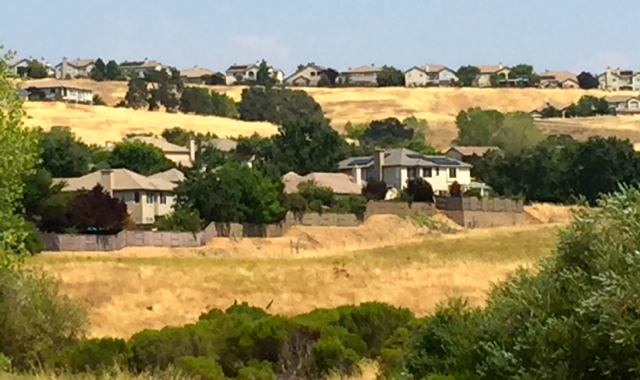
Measure E could affect future development because one of its main goals is preventing traffic gridlock. Photo/LTN

Measure E could affect future development because one of its main goals is preventing traffic gridlock. Photo/LTN

Of all the changes made by Measure E, two have been the focus of the most discussion and dissent. The first is the change in how the impacts of increased traffic created as a result of development projects are mitigated. Measure E no longer allows discretionary projects to be built and money from the county’s TIM (traffic impact mitigation) fee program or other funding to simply go into the county’s long-range capital improvement plan (CIP) to pay for needed road improvements at some later date.

These are the “paper roads” that Measure E wanted to eliminate. Even though projects were approved and built, the actual road improvements needed to offset the increased traffic they generated were only there on paper in the CIP.

Instead, Measure E requires that, “All necessary road capacity improvements shall be fully completed to prevent cumulative traffic impacts from new development from reaching level of service F during peak hours upon any highways, arterial roads and their intersections during weekday, peak-hour periods in unincorporated areas of the county before any form of discretionary approval can be given to a project.”

Opponents of Measure E called this a “taking of property” and a “de facto moratorium on building” which will not only affect developers, but will also prevent small local projects that require county approval from being built.

There are two kinds of projects: ministerial and discretionary. Ministerial projects are those that meet all the planning requirements based on their location and zoning and only need to apply for and receive the appropriate permits, pay the required fees and proceed. Discretionary projects cannot be built by right as designed at the selected location because they need a zoning change or some type of General Plan amendment. Discretionary projects are reviewed by the county and then approved by planning staff, the Planning Commission or the Board of Supervisors.

Measure E only applies to discretionary projects, and only to those that worsen or create LOS F.

LOS is the other term that is important and the other place where implementing Measure E gets sticky.

Level of service is a scale that describes roadway traffic conditions with levels of congestion ranging from A to F. Level A represents unrestricted free-flowing traffic at normal speeds and Level F is gridlock. Caltrans and the county’s Department of Transportation measure traffic flow and make LOS determinations. The problem is that they often disagree. Which data is used is important because LOS F will trigger the infrastructure-building requirements of Measure E and LOS C or D or E will not.

Measure E requires that the county use Caltrans’ calculations to determine the LOS existing on Highway 50. At this week’s board meeting, Dave Defanti, assistant director of the Community Development Agency, gave a detailed analysis of how the county determines LOS and why staff believes its methodology and figures are correct.

During public comment Don Van Dyke spoke on behalf of the Measure E Committee and handed a printout of slides to the board explaining the proponents’ view that not just volume of cars, but also speed and density need to be included for LOS calculations to be correct.

Frentzen said that those actually using the roadway frequently experience the level of congestion as much worse than what the DOT calculations say the LOS is. She expressed concern that all this “fighting with Caltrans” is counterproductive.

“What if Caltrans wants to improve roads because they are LOS F and we say, no, they are really LOS C,” Frentzen said. “In the end the county will be losing.”

The calculation of LOS is a vital component of Measure E. Initiative proponent Sue Taylor told Lake Tahoe News, “It is the backbone of our initiative. We don’t want gridlock on our freeways.”

Former El Dorado County Supervisor Bill Center noted that this issue has gone on unresolved for years and expressed the hope that proponents and county DOT traffic engineers could meet to reach some common ground. He likened the differing viewpoints to the case of three blind men describing an elephant. The one who is holding the tail says it is like a rope. The one who is touching the leg says it is like a tree, and the one touching its side says it is like a wall. None of them is wrong; they are just not feeling what the other ones have felt so they can’t come to an agreement.

Deciding how to implement Measure E has turned out to be much like that. The resolution presented to the board on Aug. 30 was intended as a way to allow everyone to see the entire elephant.

Staff proposed an interpretation of the change made by Measure E to General Plan policy TC-Xa 3 mandating that all infrastructure must be built before a discretionary project creating LOS F could be approved. If applied literally, it would be the “de facto building moratorium” that opponents had pointed to since it would be almost impossible for any individual or group to be able or agree to fund all the required improvements even before their project was approved.

Staff interpreted this policy in conjunction with General Plan Policy TC-Xf, which says that at the time a tentative map for a single-family residential subdivision of five or more parcels is approved, the county will condition that project to construct all road improvements necessary to maintain or attain LOS standards. This would mean that developers whose projects would worsen or create LOS F would not have to build the improvements before approval, but that a condition of that approval would still be the construction of the needed infrastructure. Projects built in phases would be able to also construct roadways improvements in phases as they became mandated.

Taylor told Lake Tahoe News before the election that the initiative’s intent was not to prohibit all discretionary approvals. “We want to give the board a way to say no to projects that are not compatible where they are proposed to be located.”

The hearing room in Building C at the Government Center on Tuesday was standing-room only, packed with proponents and opponents of Measure E. The meeting, scheduled on the agenda for one hour, lasted more than three.

During the public comment session, former El Dorado County supervisor Jack Sweeney and Lexi Boeger of Boeger Winery both urged that the draft resolution not be adopted. As each of them spoke, a contingent of supporters in the room rose, silently holding up signs that said, “We stand with Jack” and “We stand with Lexi.”

Craig Sandberg and Norm Brown, both representatives of development interests, spoke in support of the resolution, as did Measure E proponent Taylor. Taylor told the supervisors that she was “on board with the resolution” as long as discussions to resolve the LOS traffic levels issue continue either informally or through formation of a committee. “People have filed a lawsuit against Measure E,” she told the board, “and it is the county’s job to defend this measure.”

County Planning Director Roger Trout explained how the draft resolution was much like what was done by the board in 1998 in interpreting Measure Y and applying it to development projects coming forward.

Supervisor Michael Ranalli, who missed the Aug. 9 meeting because of a family emergency, said he appreciated staff’s efforts but, “I have some serious issues with what we are doing here … what we have here is not an interpretation, but a rewrite.”

Ranalli said more discussion was needed on the impacts of Measure E on the county’s Housing Element and budget. Opponents of Measure E had raised concerns about how it would affect the county’s ability to meet state requirements with regard to the General Plan’s Housing Element. The state requires the county to accommodate a designated portion of regional affordable housing needs and must have enough buildable land available to fulfill those needs. Opponents said Measure E would render too many needed parcels unbuildable.

Referring to the county’s interpretation of Measure E in the staff memo and resolution, Ranalli added, “What was before the voters was a measure that said give the board tools to stop big projects. What we have before us does not stop big projects. It also said no paper roads, you cannot mitigate the impacts with fees, but now we have fees.”

He suggested that instead of adopting the Draft Resolution, it would be better to, “let the courts sort out what the voters voted for.”

Board Chairman Ron Mikulaco agreed, saying that not only were parts of Measure E “as clear as mud” and a challenge to interpret but the draft resolution that county staff had presented was also vague.

Frentzen disagreed. “This is a very simple problem. Let’s just implement it to make our county better. The voters have spoken. They have voted. If this goes to court, are we going to put all the projects on hold?  We need to move forward. Let’s avoid litigation from at least one side. We have the other side litigating us and they want us to go down this path.”

The other litigation that Frentzen referred to is that which would come if Measure E were left to stand on its own, without interpretation by the board. Developers whose projects were denied because they could not afford to build roadway improvements upfront would sue the county, saying that Measure E as written was a de facto moratorium on building and thereby illegal.

Chief Assistant County Counsel David Livingston noted that there is potentially conflicting language within the measure itself. It is, he said, the board’s duty to interpret those potentially-ambiguous provisions just like the board did earlier for Measure Y. What staff presented in their memo followed direction by the courts that voter-approved initiatives be interpreted and implemented in a way that is consistent with voters’ intent and in a way that insures their validity. The draft resolution up for approval by the board is consistent with this obligation under the law. What staff has recommended, he stated, would be consistent with the eventual outcome of any court proceedings brought to challenge the initiative.

County Counsel Michael Ciccozzi told the board, “Measure E is now part of our General Plan. It is this board’s charge to interpret its General Plan and the courts give great deference to the county’s interpretation of its own General Plan.”

The board had two choices. They could either approve the draft resolution presented by staff and the interpretations of Measure E it contained while continuing discussions on the Highway 50 traffic levels issue. Or, it could reject the resolution and allow Measure E to stand uninterpreted in its actual language. Each choice would have very different consequences.

Planning Director Trout noted that staff is already processing applications with Measure E and along the guidelines as outlined in the draft resolution. If the board takes a different path, he added, it might “experience heartburn” when these projects come forward since there may then be conflicts they are not expecting.

Supervisor Ranalli said that he was, “for moving the initiative forward in its current form and current language and standing on that.” He said he could not, “get past the clear intentions of the voters  … we are not on a path that supports what was in front of the voters.”

Ranalli moved that the board receive and file the Measure E implementation documents presented and continue the resolution off calendar. The report presented on the Caltrans highway traffic calculations would also be received and filed and a copy made available to the public on the county’s website. Staff was directed to return in mid-October with more information on some of Measure E’s potential impacts on the county’s Housing Element and budget and a list of potential inconsistencies. Staff was directed to conduct board workshops to address the traffic circulation issues. The voter-approved Measure E was to be moved forward as written and as it was before the voters. Supervisor Brian Veerkamp seconded the motion.

Frentzen stated that, “If we just push this forward, then we are not implementing Measure E.” She moved to adopt and authorize the chair to sign Resolution 149-2016 and direct staff to work on the inconsistencies of the traffic interpretation of the level of service on county roadways. The motion died for lack of a second. Ranalli’s motion passed 4-1, with Frentzen dissenting.

Trout again told the board that he had been implementing Measure E since July 29, “almost exactly as you have seen it in the resolution and the Aug. 9 staff report . If you want something different, I want you to come back with a resolution to that effect. It is such a dramatic impact to impose a de facto moratorium, I want it done under your approval, not mine.”

Asked after the meeting by Lake Tahoe News for her reaction to the board’s decision, Taylor said, “We had heard that the opposition to Measure E had lobbied the Board of Supervisors to not allow county counsel and staff to create policy in which they could implement Measure E. The thinking was that doing so would make the Measure more vulnerable in court. It looked like Supervisor Ranalli decided to take that direction by stating, “Let the judge decide.” This leaves county staff in a difficult position of determining the board’s wishes for each project on a case by case basis. Even developers that agreed with the staff’s recommendations in order to have clarity, felt that they were not afforded that with this motion.”



Landmark pact to protect N. Nevada sage grouse

By Sandra Chereb, Las Vegas Review-Journal

CARSON CITY — Gov. Brian Sandoval hosted state and federal officials along with executives of a global mining company this week to sign what was hailed as a landmark agreement designed to protect Nevada’s sagebrush ecosystem and a chicken-size bird that depends on it.

The agreement with Newmont Mining Corp. covers roughly 1.5 million acres and implements the state’s conservation credit system — the cornerstone of Nevada’s plan devised in an effort to stave off a federal listing of sage grouse under the Endangered Species Act.

Janice Schneider, assistant secretary for land and minerals at the U.S. Interior Department, said the mitigation credit system is “the first of its kind” in the nation and may be used as a model for other Western states as they strive to achieve protections for the bird while allowing mining, ranching and other activities crucial to rural economies.

Read the whole story


EDC subdivision has ‘whites only’ clause

By Karma Dickerson, Fox-40

An El Dorado Hills subdivision still has a “whites only” occupancy rule on the books.

The Lake Hills community’s shocking policy put in place in 1961 policy is not, and cannot legally be enforced, but some new residents are calling for its immediate removal.

The Foster family had barely closed the sale on their new home, when they were blown away by an old rule. Their move from Folsom to El Dorado hills was just a matter or miles but, as far the neighborhood agreement they’d just signed, they might as well have been worlds or decades away.

Read the whole story


Brewfest to benefit homeless coalition

Homebrew for the Homeless is a fundraiser to support Tahoe Coalition for the Homeless.

The Sept. 24, 3:30-7pm event is for the whole family.

It will be at DDRC (Leigh Wayne Miller’s ranch) in Minden. It will include live music, homebrew beer competition, chili-cook off, face painting, horseback rides for the kids, lawn games, bounce house, a silent auction and more.

Suggested donation is $12 for general entry, which includes all activities and live music. Food and beverages provided. Cost is $20 on the day of the party. Children 2 and under enter for free.

Suggested donation for the poker run is $35 in advance, $40 that day, which includes general entry. Must be 21 to register for this event. As guests taste the home-brewed beer they will receive cards from each home brewer for a hand of poker.

All donations raised support the Tahoe Coalition for the Homeless. In its first winter, the Warm Room served 107 unduplicated individuals and provided 1820 shelter bed nights.

For more info and to buy tickets, go online.


Byer: DCSD priorities — budgets, strategy, curriculum

Publisher’s note: Lake Tahoe News asked candidates for South Lake Tahoe City Council, Lake Tahoe Community College, Lake Tahoe Unified School District, Douglas County School District, South Tahoe Public Utility District and Lake Valley Fire Protection District a series of questions. We are running the responses in the order received.

Keith Byer is one of two candidates for Area 3 of the Douglas County School District.

Keith Byer is one of two candidates for Area 3 of the Douglas County School District.

Name: B Keith Byer

Age: 53

Job/profession: Certified public accountant (Texas)

What boards, commissions, or other experience, including volunteering, do you have?: Tahoe Douglas Rotary Club member and board of directors member, have routinely volunteered at various fundraisers at lake schools, Junior Achievement-Moscow board of directors, KidSave (charity focused on placement of older orphans) Moscow fundraising chair, Anglo-American School of Moscow School Board for eight years (member of board and member of finance committee).

Why do you want to be on the school board?: I believe parents need a strong voice on the school board and that I can build consensus from diverse viewpoints.

Why should voters vote for you over another candidate?: I am a parent of a recent graduate of Whittell and a current student of Whittell. I am currently active in support of the local schools. I have deep experience in budgeting and strategy development in both business and a school setting. I am a resident of Douglas County.

What distinct experience or competency makes you uniquely qualified to lead effectively as an elected official?: I have over 30 years of professional experience, with an emphasis in finance, working in diverse groups toward a common goal. I believe boards need to provide strong governance and bring a balance to the diverse stakeholders (students, parents, teachers, administration, and tax payers) points of view.

Public agencies have been under scrutiny the last few years for lack of transparency and accountability. What will you do to ensure both?: I believe Nevada has open meeting rules for a very valid reason and conversations and debate of key issues need to occur in this open forum. When issues are discussed and decided outside public meetings, distrust arises. Often organization leadership (CEO, superintendents, etc.) bring decisions before the board for ratification rather than discussion. Boards must understand both the pros and cons of a decision, which takes time and transparency.

What stands out for you in the current budget that you support and that you would change?: Douglas County has made and will continue to make investments in technology. I believe they should leverage that technology to hold costs where possible. They must also leverage the benefit of that technology by providing training to teachers and evaluating the teachers on technology integration. I also note that Kingsbury Middle School was recently sold after many years on the market. When KMS was closed, promises were made that monies raised from its sale would be invested back in the lake schools. I want to ensure that happens.

Describe three attributes for a successful board: Transparent governance with members who fully understand the issues upon which they vote. Giving voice of all stakeholders. Strategic vision driving actions and expenditures.

What are your thoughts about public employee defined benefits?: Most voters saw their employers move away from defined benefit programs toward defined contribution programs many years ago. I believe we must move that way as well. You cannot properly budget for defined benefit plans as the costs depend on future events such as increases in life expectancy, interest rates, and health care inflation. Defined benefit plans can be used to hide the true costs of employees. Taxpayers must know the costs they are incurring each year to avoid surprises that build up. We cannot leverage our future for the current. We have seen municipalities go bankrupt partly in response to unfunded defined benefit pension and health care plans. Such situations do not benefit anyone including the educators who rely on bankrupt plans.

Please explain your position on contracting out work normally done by staff: I do not have strong positions on this matter but I believe the board has a fiduciary responsibility to spend taxpayer money wisely. I am not averse to contracting work out, but believe you must have very strict service definitions to ensure the work is done correctly and that competitive bids are received.

What is your 10-year vision for the school district?: The school has a formal strategic planning process, which is now under way that obtains inputs from all stakeholders. I value this input and believe we should approach this process with an open mind and no preconceived notions. That said, my focus is preparing our kids for the work force of the future. This will require technology skills.

What one vote in the last four years that the current board made do you disagree with and why?:  The current board was under significant financial pressure due to a reduction in state funding and has not kept up with required maintenance. The taxpayers are now being asked to fund this maintenance backlog via a special bond proposition. This bond may be rejected by voters, which will intensify the pressure on future budgets. At the end of the day, we work for taxpayers and parents.

How many school board meetings have you attended this year?: 2

What do you know about the strategic plan, finances, debt, goals of the school district?: I have read the strategic plan, budget and other publicly available documents and have a basic understanding of their contents. There must be direct linkage between the strategic plan and the budget. You will only achieve what you are willing to pay for. Linking money and objectives create honesty and transparency.

Being on the school board means working as a team. How will you work with the next board for the greater good of the community?: I have a great deal of experience working with diverse groups of people and finding common ground to move forward. Strong schools build strong communities.

What should be the three main priorities for the board?: Budgets, strategy, curriculum

What do you know about Common Core? What is your opinion about it?: I believe Douglas County and the state of Nevada are completely capable of managing their own schools. I do not believe federal funding should be tied to Common Core and the decision to adopt Common Core should be left to states and school districts as well as the pedagogy chosen to teach their curriculum. I believe parents will demand challenging curriculum for their children if provided control of their schools.

I do believe in limited standardized testing to identify schools that have a large proportion of students unprepared for college or the work force. When these issues are detected, I believe we must look at root causes. Schools may be failing their mission; but, societal factors may be failing our schools. Limited standardized testing can bring focus where focus is needed.

I do not believe we should allow personal information about students outside a school district. Our kids have a right to privacy and as minors cannot waive that right.

What is your opinion about career and technical education at the high school level?: I believe this training is vital to our students, our local businesses, and our community. Many trades have shortages of labor and many tradesmen create small business. Lastly, trades expand our students’ opportunity to make their home here in Douglas County.

Do you support the expansion of charter schools? Why or why not?: No one can be trusted to act in the best interest of students more than parents. I support school choice be that public schools, home schooling, or charter schools. We should have enough charter schools to meet the demand for charter schools. I welcome arguments from those who believe charter schools harm public schools but need strong evidence to override parental choice.

The lake seems to be underrepresented. Do you believe this is true? Why or why not?: The allocation of board seats seems quite fair to me so I don’t think it’s an issue of underrepresentation. If elected, I will represent every student in Douglas County and expect the other board members to do the same. I do not believe there is inherent bias against the lake schools. I think we have an issue that lake school enrollment has dropped and school administration has reacted. Some of this enrollment drop is caused by the lack of affordable housing at the lake which may be partially remedied as the developer who recently bought KMS may build up to 400 units. But part of the enrollment drop is self-inflicted. The board failed to continue a program, without explanation, that encouraged South Lake Tahoe students who wanted a small school environment to attend Zephyr Cove and Whittell.

The fact that your parents choose to live at the lake should not affect where you go to college or what trade you practice: that should be determined by your ambition and abilities. I believe there needs to be a minimum curriculum available to every Douglas County student and that we should develop innovative ways to deliver that curriculum. This could be e-learning, expansion of the relationship with South Lake Tahoe, development of programs with LTCC and WNC, adding key teachers, and other solutions. Several lake school parents spent hours of their valuable time looking at solutions. After more than a year, they have not had a response from the board or the administration.

If you answered yes to the question above, what will you do to change the underrepresentation? If you answered no, what will you do to change the perception?: I believe the board and administration should spend more time talking and listening to lake parents. When you look at expenditure per student, we spend significantly more per lake student than valley student; but expenditures per student isn’t how you get into the best universities or trained as a welder. The cost per student is higher because of higher facilities and operating costs. Every student in Douglas County must have an education system that allows them the opportunity to reach their full potential. If we fixed curriculum, we’d fix most of the perception issue. I would ask the superintendent to write articles, as needed, in the lake schools newsletter discussing administrative and board decisions which have a direct effect on the lake schools (past examples of such would be teaching staff reductions and art program eliminations). I would also encourage her to spend a few days each month in an office at the lake engaging lake parents, listening to lake teachers, and interacting with lake students. If you’ve ever done this, you know just how special our schools are.

Tell us something about yourself that people may not know: Many, many, years and pounds ago, I ran a marathon in under 5 hours. I’ve flown over 2 million miles, been to over 70 countries, and lived in 4 countries on 3 different continents. I’ve been a repeat guest lecturer at the University of Texas in business applications and want to teach in high school or college after I retire. I’ve had articles published over 30 times and contributed to 4 books on doing business in various countries. My high school class was less than 30, similar to Whittell.

You have said you want more technology in schools. What kind of technology and how do propose to pay for it?: I believe that every student must have a base competency in technology. Mechanics, truck drivers, and lawyers all use iPads. The high school will be providing every student a Chrome Book that I believe is a sufficient platform but they must integrate the technology into the classroom. As to paying for it, I believe leveraging technology could save money in some areas such as textbooks, reproduction costs, etc.

Douglas County is blessed to have generous businesses and engaged service clubs. I would like to see the school seek relationships with businesses and service clubs in the area to garner support of select programs in the school. You can see the generosity of GE in the Douglas County Community Center and the generosity of Tahoe Douglas Rotary in Kahle Community Center. Attend any meeting of a local Rotary, Kiwanis, Optimist, Soroptimist, or Lions Club and you’ll see their money evidence their passion for education. I believe if the school could create a vision, we’d find the sponsorship. As only one narrow example, I believe if the school created a program to engage girls in STEM, we could find engineers in the local community to serve as mentors.


Editorial: Time for all of Nevada to get along

Publisher’s note: This editorial is from the Aug. 28, 2016, Las Vegas Sun.

Between possibly attracting the Oakland Raiders to Las Vegas, expanding the Las Vegas Convention Center and making major improvements in our public transportation system, Southern Nevada could be on the cusp of an exciting new era.

But as work intensifies to bring those projects to reality, all of a sudden there’s grumbling up north over using tax dollars to fund them.

That grumbling needs to stop. Now.

It’s time for Nevada’s leaders — north and south — to work together to do what’s best for Las Vegas, because what happens here benefits the entire state.

Read the whole story


Conservation group nabs Nev.’s iconic ‘Hilton ranch’

By Benjamin Spillman, Reno Gazette-Journal

The remote desert ranch that for decades provided a scenic backdrop for flights by some of the world’s most daring aviators is under new ownership.

The Flying M Ranch, located northwest of Hawthorne, sold earlier this summer to the National Fish and Wildlife Foundation for $19.4 million.

The deal is part of an effort to direct more water to the Walker River so it can flow into the beleaguered Walker Lake near Hawthorne as part of an environmental recovery project.

Read the whole story


UNR: Math a big reason students drop out

By Siobhan McAndrew, Reno Gazette-Journal

The single biggest stumbling block for students in college is math, according to UNR Provost Kevin Carman.

He said Nevada’s struggle to graduate students from high school prepared for college is part of the problem, but it isn’t the whole equation.

Read the whole story