Arsonist being sought in spate of SLT fires
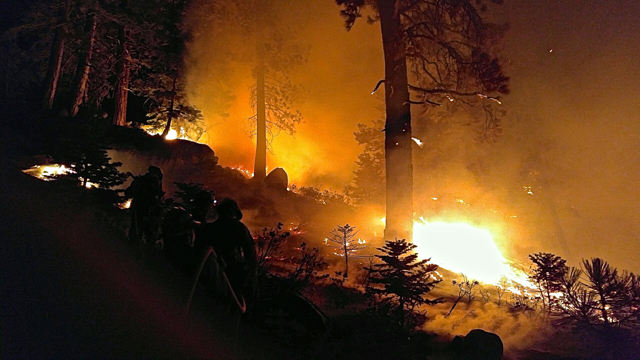
A wildland fire burns Sept. 1 in South Lake Tahoe. Photo/Provided

A wildland fire burns Sept. 1 in South Lake Tahoe. Photo/Provided

By Kathryn Reed

Someone – or multiple people – are lighting wildland fires in South Lake Tahoe, with crews having put out seven in the last week and a half.

The latest occurred Sunday afternoon in Van Sickle Bi-State Park on the California side.

It was called in at 4:02pm Sept. 4. More than an hour later smoke could still be seen from Saddle Road filtering up between the trees. In all, a swath about 25 feet by 40 feet burned.

“I don’t know,” was CalFire Division Chief Chris Anthony’s response to Lake Tahoe News when asked if there is an arsonist on the loose.

Lisa Herron with the U.S. Forest Service when asked about an arsonist told LTN, “The only thing I can share is the cause of these fires remains under investigation.”

And, yet, the definition of arson is “the criminal act of deliberately setting fire to property.” And no one is saying that is not what is happening.

Lightning has been non-existent and no power lines have fallen; this leaves humans being responsible for starting them. This spate of fires is also not being blamed on homeless camps.

The fires have been on state and federal property. Together the agencies are working to determine if one or more people are responsible.

All of the fires have been in the same general wooded area, but never in the exact same location.

They are about the same size – this has to do with crews getting a jump on the blazes and a cooling trend. The Forest Service’s Super Scooper was deployed Sunday to drop water on the fire, and on Thursday, too.

The fires have started at all times of day and night, with one being at 2 in the morning. And it’s not like the suspect had the aid of a full moon to assist him or her with a walk in the woods at that hour.

One day there were three fires.

Even if an incendiary device is found, it can be difficult to isolate who may have been lighting the fires. Still, the state and federal investigators have myriad tools to employ to ferret out the culprit.

The Forest Service expects to increase staffing in light of the rash of fires.

South Lake Tahoe firefighters have responded to all of the fires, with pictures often posted to the department’s Facebook page. Those are now gone.

“Due to the joint investigation between CalFire and the U.S. Forest Service, South Lake Tahoe Fire and Rescue was asked not to post any of the fire activity that could get in the way of the joint investigation,” Fire Chief Jeff Meston told Lake Tahoe News.

He would not comment any further about the fires.


Opinion: People of color missing from backcountry

By Nina Revoyr, Los Angeles Times

Last month, two friends and I backpacked for a week in the Sierra Nevada. We hiked through meadows dotted with wildflowers, slept beneath snow-draped peaks and met plenty of other hikers: the dad and son whose Green Bay Packers caps sparked a conversation about our mutual ties to Wisconsin; scientists from UC Santa Cruz studying flowers and rock formations; five recent college grads from Kentucky who were hiking the John Muir Trail before they scattered to begin their adult lives.

But as the days passed, I grew increasingly troubled by the people we didn’t meet.

There were a few Asian hikers, including a couple of hapas like me (I’m half Japanese and half Polish) and one of my friends was half-Iranian, but not a single backpacker who was Latino or African American.

Read the whole story


Missing woman found dead near Tahoe

The remains of a Gardnerville woman were found today near Old Kingsbury Grade.

Randi Maclean, 51, had been missing since Aug. 26.

According to law enforcement, Maclean’s vehicle was found by a bicyclist parked near Daggett Creek with the passenger door open. This person then called authorities.

Search and rescue crews found her body down the canyon.

— Lake Tahoe News staff report


Tahoe Mountain Resorts grant cycle opens

Tahoe Mountain Resorts Foundation is accepting applications with a special focus on local youth and environmental programs from local nonprofit organizations with a commitment to improving the quality of life in the Tahoe-Truckee community.

Last year, the foundation awarded more than $340,000 in grants and scholarships to 35 Tahoe-Truckee area nonprofit organizations and programs, local students and community events.

Organizations submitting a grant request must serve the geographic areas of Truckee, Donner Summit, Squaw Valley, Alpine Meadows, Northstar and the North Shore of Lake Tahoe.

Applications are due by noon on Oct. 31.

For complete grant application guidelines and process details, go online.


Study: Extreme-weather winters more common

By Rob Jordan, Standford

This past July was the hottest single month in Earth’s recorded history, but warming isn’t the only danger climate change holds in store.

Recent years have seen a dramatic increase in the simultaneous occurrence of extremely cold winter days in the Eastern United States and extremely warm winter days in the West, according to a Stanford-led study published in Journal of Geophysical Research Atmospheres. Human-caused emissions of greenhouse gases are likely driving this trend, the researchers report.

“There’s this idea that the past few winters were more extreme than usual, particularly since the conditions in the East and West were so different,” said senior author Noah Diffenbaugh, an associate professor of Earth system science at the School of Earth, Energy & Environmental Sciences and a senior fellow at the Stanford Woods Institute for the Environment. “Looking back at temperature data from the past 35 years, we’ve found that in fact 2013-2014 and 2014-2015 did have the biggest difference in winter temperature between the East and West.”

Read the whole story


SLT cops promoting pedestrian safety

South Lake Tahoe Police Department is joining other law enforcement agencies, city and state transportation agencies, pedestrian advocates and walking clubs to promote public awareness aimed at drivers and pedestrians.

Officers will step up pedestrian safety operations with focused enforcement on collision causing factors involving motorists and pedestrians. Routine traffic patrols will focus efforts in trouble spots while special targeted patrols will also be deployed to crackdown on drivers and pedestrians who violate traffic laws meant to protect all roadway users.

September is California Pedestrian Safety Month. There were 813 pedestrians killed on California roadways in 2015, accounting for nearly 25 percent of all roadways deaths in the state, up from 17 percent 10 years earlier.


Ghost hunters to appear at Nev. libraries

Northern Nevada Ghost Hunters will be presenting an informational program about ghost hunting at both branches of the Douglas County Public Library in October.

The Northern Nevada Ghost Hunters has taken part in paranormal research and investigations throughout the region. The group has explored many historic sites, including the old buildings of Virginia City. Team members have many true life ghost stories to tell; they will also discuss various historical foundations they collaborate with to keep history alive.

They will be at the Lake Tahoe branch on Oct. 1 at 2pm and the Minden branch on Oct. 15 at 2pm.

For more information, call 775.782.9841.


Nev. silver history comes to life in backcountry

The bullwheel from the Comstock era is still near Incline Village. Photo/Kathryn Reed

The bullwheel from the Comstock era is still near Incline Village. Photo/Kathryn Reed

By Kathryn Reed

INCLINE VILLAGE – Listen closely; echoes of the past seem to whisper through the pines. Is it the call of men hauling up timber from below? Or perhaps the sound of lumber splashing into the flumes?

Tucked in a remote area above Incline Village are remnants of Lake Tahoe’s storied Comstock era.

Nevada State Parks Ranger Jay Howard last month led a group of about 20 people on a excursion that was part 4-wheel drive, part hiking to see what remains of life during the mid- to late 1800s. This was when the trees of Tahoe were felled to build the mines of Virginia City.

The V flume took logs through the mountains for the mines in Virginia City. Photo/Kathryn Reed

The V flume took logs through the mountains for the mines in Virginia City. Photo/Kathryn Reed

Conservation and environmentalism weren’t part of the vernacular. Clear cutting and greed were the norm. But so were innovation and entrepreneurship.

Where the old Ponderosa Ranch was, next to Tunnel Creek Café and where the parking lot for new bike trail is being built was a mill. This is where the logs were cut into appropriate lengths that would be used in the silver mines, some of which were 3,000-feet deep.

This process started before railroads were in the basin and long before motor vehicles.

While the timber and water companies were separately owned, they worked in conjunction. An elaborate flume system transported the wood to the Washoe Valley, which was then hauled first by oxen to Virginia City and then by the V&T rail line.

Views in the area are stunning. Photo/Kathryn Reed

Views in the area are stunning. Photo/Kathryn Reed

Virginia City was bustling with 30,000 people; today the population is less than 1,000. It didn’t have water until Aug. 1, 1973, when the flume system brought it.

Through ingenuity the whole process became industrialized – at least as much as it could for the time period and location.

From the Incline mill two sets of tracks were laid going straight up, nearly 1,400 feet. A bullwheel built by Sierra Nevada Lumber Company in 1880 at the top spun the cable to bring up the carts of wood that could each hold about a half a cord.

Wood and steel from the 12-foot bullwheel are still in the forest. The wheel, while rusted, looks like it might still work.

Debris from the logging operation is scattered in the woods. Photo/Kathryn Reed

Debris from the logging operation is scattered in the woods. Photo/Kathryn Reed

Until recently this was on private land owned by David Duffield. Now the U.S. Forest Service owns it. Duffield paid for a study to be done on the bullwheel so when the government has money it can be properly restored. Only a handful of photos exist of what it looked like during operation.

Just below this, at an elevation of 7,670 feet, is where the V flume started. This is where the wood was unloaded.

Water for the flumes was diverted from nearby creeks and natural springs. Between 4 and 6 inches of water was needed to float the logs. The V shape was used so if there were a jam, the water would rise and naturally free the logs. (Box flumes were used just to carry water.)

Gravity allowed the logs to float to and through a tunnel that had been built not too far away.

Part of the tour was seeing where this nearly three-quarter mile long tunnel once was. It collapsed in 1957. Today it would be hard to know it was there without a guide to point to it.

While Howard touched on the Marlette and Hobart water systems, state park rangers give separate tours specifically about water.

Throughout the trek Howard was throwing out dates, names and locations, plus he had old black and white photos from the era. It’s a fairly thorough lesson in Nevada history that he delivers in a matter of a few hours.


Snippets about Lake Tahoe

·       South Lake Tahoe Rec Center has drop-in pickle ball on Tuesday and Thursday from 6:30-9am and Monday and Wednesday from 1-4pm.

·       For Women, By Women is the title of a free talk that doctors Clare Rudolph and Amanda Weavil from Barton Women’s Health are putting on Oct. 4 from 6-7pm in the board room at Lake Tahoe Community College.

·       Lap swimming hours at the public pool in South Lake Tahoe have been expanded to Monday-Thursday, 10am-3:30pm.

·       The 41st annual Antique and Classic Boat Society’s International Boat Show is Sept. 23-24 from 9am-4pm at Sierra Boat Company in Carnelian Bay.

·       Here is the El Dorado-Tahoe roadwork schedule from Caltrans for this week.


Letter: Temple Bat Yam works at B&B

To the community,

On Aug. 15, Bread & Broth served 125 nutritious meals at St. Theresa Grace Hall to those in our community who struggle with hunger. Thanks to the generosity of Friends of Temple Bat Yam, the dinner’s adopt a day sponsor; the diners enjoyed a tasty Mexican casserole prepared by B&B’s amazing cooks.

The dinner guests also were provided with bags filled with dairy products, fruits, vegetables, breads and pastries provided by donations from local businesses and B&B donors.

Helping the B&B volunteers to setup and serve at Temple Bat Yam’s AAD dinner were sponsor crew members Naomi and Shelly Zimbler and Debra and Eduardo Day.

All four of these crewmembers are veteran sponsor crew volunteers that made them extremely helpful in assisting with the dinner.

“Another gratifying day working with the wonderful volunteers from B&B and helping those less fortunate,” was Shelly Zimbler’s response to another stint volunteering at a Bread & Broth dinner.

B&B is gratified to have the support of this wonderful community Temple and its members.

For almost 27 years, Bread & Broth has been serving the community by providing Monday evening meals every week at Grace Hall. Seven years ago, Second Serving began serving soup and a small entrée at Lake Tahoe Community Presbyterian Church every Friday and last September food insecure K-8 LTUSD began receiving weekend food during the school year. It is our community members, exemplified by the Friends of Temple Bat Yam, who make this all possible.

Carol Gerard, Bread & Broth