More time to comment on Squaw-Alpine gondola

The comment period on the proposed gondola that would link Squaw Valley and Alpine Meadows ski resorts has been extended.

This is because the U.S. Forest Service and Placer County have decided to do one environmental document. A revised notice of preparation has been created. The deadline to comment on it is Oct. 3. Here is the new document.

For decades there has been talk of combining the resorts. One of the main stumbling blocks has always been the private landholding. An agreement was reached with Tony Caldwell in April 2015 to have the towers erected on his land near the Granite Chief Wilderness Area.

Building anything so close to a wilderness area is one of the more controversial aspects of the project. While the gondola is designed to only operate during the winter, the towers would always be there. The eight-person cars would be detachable.

— Lake Tahoe News staff report


Report: Expanding sports betting would generate $11.9B

By Las Vegas Sun

Extending legalized sports betting beyond Nevada and other states where it is currently lawful would create nearly $12 billion in gross gaming revenue in the U.S., says a report from a global gaming analyst.

GamblingCompliance Research Services’ report says the U.S. would become the world’s largest sports-betting market if a federal prohibition on sports wagering were eliminated. Revenue in the U.S. would be $11.9 billion — more than four times the amount of the United Kingdom, home of current leading market. Gross gaming revenue there is $2.8 billion.

Revenue in California alone would be $1.3 billion if legal sports wagering were expanded to tribal casinos, online and noncasino retail outlets, the report said.

Read the whole story


Snippets about Lake Tahoe

·       There will be a 7.5-mile trail run at Emerald Bay on Sept. 18. Details are online.

·       Truckee Chamber of Commerce is having candidates and tax measure forums on Sept. 14 and Sept. 15 from 6-8pm at the Truckee Town Hall. Go online for more info.

·       Truckee Tavern and Grill has named Josh Dinsmore as executive chef. Dinsmore was the restaurant’s sous chef for the past two years.

·       Squaw Valley Institute is bringing Paul Cummins to the area to talk about parenting and educating the 21st century child. The Oct. 7 event starts at 6:30pm at the North Tahoe High School theater. For more info and tickets, go online.

·       The inaugural Truckee half and full marathons are Sept. 25. Register online.


Letter: Feinstein advocates for money for dead trees

Publisher’s note: The following letter was sent Sept. 7, 2016, from Sen. Dianne Feinstein, D-Calif., to Tom Vilsack, secretary of the USDA.

Dear Tom,

I ask that you reprogram $38 million in previously-appropriated funding in order to execute 19 high-priority tree removal projects, for which environmental clearances have already been granted, that cover 38,000 acres of federal land in the three national forests most affected by California’s tree mortality crisis.

Dianne Feinstein

Dianne Feinstein

After five years of historic drought, which has led to the death of an estimated 66 million trees in California alone, my state and its people face a heightened and potentially catastrophic risk of wildfire this year and for years to come. California has already weathered several devastating wildfires this year, despite the fact that our traditional fire season has not yet even begun. Addressing the unprecedented tree mortality crisis in California is an urgent public safety issue that must be met with the most aggressive action possible.

The California Governor’s Tree Mortality Task Force, which includes federal, state, local, and private interests, has identified 19 shovel-ready tree removal projects on federal lands that are simply awaiting the necessary federal funding. The projects are located on 38,000 acres of Tier 1 High Hazard Zones in the Stanislaus, Sierra, and Sequoia National Forests that present the most severe threats to human life. The 19 projects have already received all necessary environmental clearances, including NEPA. I have attached a July 15, 2016, letter to you from Chief Ken Pimlott of the California Department of Forestry and Fire Protection describing the 19 projects in greater detail.

I recognize that the Forest Service budget faces significant pressure from the current rules governing how Congress appropriates money for wildfire suppression, as you pointed out in your August 5, 2016 letter to me, and I want you to know that I am doing everything I can to get a budget fix passed. I have cosponsored the standalone legislation introduced by Senators Ron Wyden and Mike Crapo; I have joined with Senator Murkowski to include the budget fix in the Fiscal Year 2017 Senate Interior Appropriations bill; I have sent a letter to House Majority Leader Kevin McCarthy urging him to move the budget fix through the House; and I have written letters urging the inclusion of the budget fix in the Energy bill conference report as well as in forestry reform legislation being drafted by the Senate Energy and Natural Resources Committee.

However, I want to remind you that Congress specifically appropriated an extra $600 million for wildfire suppression above the 10-year average in last year’s Omnibus and $823 million more than your Fiscal Year 2016 Budget requested for wildfire suppression. Therefore, there should be no need for fire borrowing this year or for holding back funding for critical fire prevention activities like the 19 NEPA-ready projects mentioned above. These 19 projects are the top priority for the State-Federal Tree Mortality Task Force, and I ask that you reprogram $38 million in previously-appropriated funds in order to execute the projects as quickly as possible.

Sincerely,

Dianne Feinstein


Tainted soil to be removed from ZC Resort

By Kathryn Reed

In the five years since a fuel leak was detected at Zephyr Cove Resort more than 1,400 tons of petroleum product have been extracted from the soil.

While work to clean up the site has been ongoing since the contamination was discovered in fall 2011, the next step in the process is about to begin. This will include digging a trench about 25-feet deep close to Highway 50 and back to the parking attendant kiosk.

Officials will test the soil throughout this next process, which will begin Sept. 12. The plan is to have this work done by Oct. 15. The goal is to remove even more contaminated dirt – 2,500 tons; all of which is shipped outside the basin. In the process more than a dozen trees had to be felled.

Jonathan Cook-Fisher with the U.S. Forest Service told Lake Tahoe News, “We very likely will be monitoring this site for years to come.”

The Forest Service owns the land, while Aramark operates the various businesses on site.

The commercial entities will remain open, though parking will be affected.

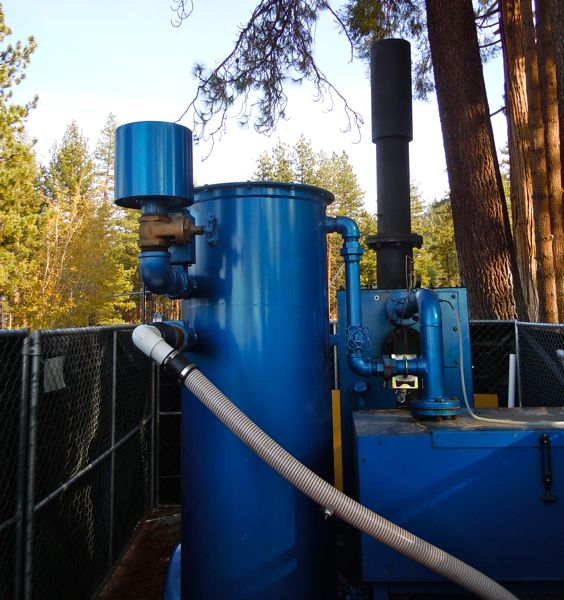
A sparge unit injects air into the soil to get the vapors out. Photo/LTN file

A sparge unit injects air into the soil to get the vapors out. Photo/LTN file

Even though the underground fuel tanks had been inspected annually, it wasn’t until five years ago that the leak was detected. It is not known how much gasoline actually escaped or how long it had been seeping out.

Cook-Fisher said the tanks were in place before the USFS owned the land. He said situations like this one underscore the hazards of underground tanks and why they are no longer in vogue.

Today the tanks are on the pier. And while this obviously puts them closer to the waters of Lake Tahoe, Cook-Fisher said it’s safer there because of the ability to conduct better tests on the equipment and the safety mechanisms that are in place. Plus, being above ground allows for the opportunity to smell and see the product.

While the plume is good size, it has not reached Lake Tahoe. It starts near where the tanks used to be (they were removed in 2012), goes under the restaurant parking lot and moves northwest toward the pier.

Monitoring of the test wells shows the extent of the contamination is decreasing, Cook-Fisher said.


Artists to take over Truckee for a day

The 2nd annual Art & Soul Downtown Truckee Art Walk is Sept. 17 from 1-6pm.

Art & Soul combines visual art, live music, artist demonstrations, craft beer tastings, small bites and more.

There will be 30 stops celebrating Truckee’s artist community. A percentage of the proceeds will go to Arts for the Schools.

Tickets are $35 in advance and $42 at the door.


Hwy. 50 high-speed chase ends in arrest

By CBS-13

Authorities say a driver led officers on a high-speed chase in the Sierra on Wednesday.

The chase began near South Lake Tahoe. California Highway Patrol officers tried to pull a 2006 BMW for speeding on Highway 50, but the driver would not pull over. The chase reached speeds of 100 mph.

The BMW swerved in and out of both lanes and into the shoulder to try and avoid officers. The driver even managed to avoid a spike strip laid out on Sly Park Road.

Read the whole story


Truckee wants input on public art display

The Band, a set of four 4-foot-by-10-foot recycled steel sculptures, have been placed along Donner Pass Road for public viewing and consideration ahead of the Sept. 13 Town Council meeting.

The sculptures, on loan from Mountain Forge Inc., are at 10250 Donner Pass Road, across the street from the former Lululemon building. While no removal date has been confirmed, the public is encouraged to submit comments in writing by Sept. 12, 2016 or speak during the public comment section of the Town Council meeting on Sept. 13 at 6pm at 10183 Truckee Airport Road.

Comments may be submitted to Dan Wilkins via email at truckee@townoftruckee.com.


Conner: Wants to be voice for average citizen

Publisher’s note: Lake Tahoe News asked candidates for South Lake Tahoe City Council, Lake Tahoe Community College, Lake Tahoe Unified School District, Douglas County School District, South Tahoe Public Utility District and Lake Valley Fire Protection District a series of questions. We are running the responses in the order received. All profiles may be found under the Special Projects listing and then the 2106 November Candidate Profiles category.

JoAnn Conner is running for one of two seats open on the South Lake Tahoe City Council.

JoAnn Conner is running for one of two seats open on the South Lake Tahoe City Council.

Name: JoAnn Conner

Age: 67

Job/profession: Small business owner

What boards, commissions, or other experience, including volunteering, do you have?: Currently serve as City Council representative to the League of California Cities, City Council representative to the lodging association, council subcommittee representative for the Senior Center and the Tahoe Coalition for the Homeless. Served on Airport Master Plan Committee, Recreation JPA, Solid Waste JPA, served on the fields subcommittee from the City Council, represented the City Council on the Bicycle Coalition. Currently serve on the board of directors for the South Lake Tahoe Cancer League, regularly attend the Tahoe Area Coordinating Council for the Disabled, am a member of the American Legion Auxiliary, member of the Tahoe Art League, member of Friends of the Library, a lifetime member of the Lake Tahoe Historical Society, past president of the South Tahoe Chamber of Commerce, past board member of Tahoe Douglas Rotary, past Neighborhood Chairperson for Girl Scouts, past co-pack master of Boy Scout Pack 594. I have done fundraisers for the Lake Tahoe Humane Society, American Legion, VFW, and Christmas Cheer, and regularly help with the beach clean up on the 5th of July organized by the League to Save Lake Tahoe.

Why are you seeking re-election?: There are a lot of projects to complete and work to be done in our community; I have met with many community members and organizations that have initiated good beginnings for our town. Many citizens asked me to run again as they feel there needs to be at least one voice that speaks for the average citizen and business owner. Many are supporting me in this race.

Why should voters vote for you over another candidate?: I have four years of diverse experience and a real understanding of the personalities involved in running the city. I would like to see the city revamp their fees and permit structure to benefit small businesses and simplify processes to encourage good growth and improvements.

What distinct experience or competency makes you uniquely qualified to lead effectively as an elected official?: I listen to the average citizen and business owner, as well as larger entities. I connect with the average citizen and respond to their needs. As a small business owner, I understand those concerns.

Public agencies have been under scrutiny the last few years for lack of transparency and accountability. What will you do to ensure both?: I will continue to speak up for greater transparency and citizen voices to be heard.

What stands out for you in the current budget that you support and that you would change?: Not enough money allocated for roads. There are several areas where I would like to see the taxpayer money spent with more care and accountability.

Do you support current legislation for $15 minimum wage? Please explain: No, across the board mandates do not work. The biggest employers in our town and nation are small business owners. Requiring a small business owner to adhere to the same standards as multi-million dollar companies is not logical. If you force them to pay more when they cannot afford it, they will lay off workers or drop benefits. For example, an unintended consequence of mandatory health insurance resulted in a number of small businesses in our town dropping the health coverage they had previously given to their employees because the mandate created higher premiums for these businesses. They increased the wages, in many cases, but it still was not sufficient to allow the employee to buy insurance on their own. How did that help? It would be interesting to explore incentives for the bigger businesses to provide housing and better wages. Bear in mind, many of the employees in our community who do not work for small business work for a government entity. That means the taxpayers fund the raise. Typically, when a mandate of this nature is issued, the prices for rent, food, goods, and services also go up, so that is not the answer to help people financially. We need to work on better wages in our community, but this is not the solution.

Do you support Proposition 55? Please explain: Our schools continue to need funding, and that is important. The sales tax portion is due to expire, so on the surface, it looks like those who make more will pay more. The battle may come in the form of people wanting their government to be more fiscally conservative instead of spending more. The issue of health care for lower income may also be muddied by the implementation of Obamacare.

Describe three attributes for a successful council: A willingness to work for the people, being willing to set personal differences aside and honor all views, dedication of time for all council members to share the responsibilities of council, without a concentration of power.

What are your thoughts about public employee defined benefits?: This is a growing concern, as the system itself may be beginning to erode as far as stability. Public employees pay into this system, as do their employers. Many times this is a trade off in lieu of raises, just as it is in the private sector. However, since it does not appear to be sustainable in the long run, looking at options now would seem wise.

Please explain your position on contracting out work normally done by staff: That depends on the work and the staff available and qualified to do the work. If we don’t have enough or qualified staff, it is necessary. Sometimes impartiality plays a role, and it is in the best interest of the citizens to use an independent firm.

What is your 10-year vision for the council?: I would like to see term limits on council service. The vision is too limited and the possibility to shut out new ideas is more likely when people have served more than two terms. Likewise, the mayor position should be rotated to allow for more diversity. Protocols should be adjusted to prohibit the concentration of power we currently have. The appearance is one or two council members are making major decisions for the majority of the council and the people. That is not healthy.

What as an elected official are the three things you are most proud of during your tenure?: Building, maintaining, and voting to keep the bike paths clear all year for our citizens who do not drive. Working with the Recreation JPA and surrounding entities to rebuild the fields at Al Tahoe School (adding one there as well) and Sierra House School, starting the new field at the LTCC site. Helping to complete the Harrison Avenue project.

Which votes would you change and why?: Paid Parking. The people did not want it.

Being on the council means working as a team. How will you work with the next council for the greater good of the community?: “Greater good of the community” should be defined by the majority of the citizens, and then the council should work for what the people want. The “power” on the council should be distributed more evenly to maximize the contributions and talents of all.

What should be the three main priorities for the council?: Maintain the roads; be the catalyst for affordable and workforce housing; be fiscally responsible while addressing the three main points for forming the city: police, fire, snow removal.

What role should government have in housing for residents?: A healthy town has a diverse workforce and housing is a huge issue. I believe there is some state money we could pursue for housing for veterans. We could offer incentives by decreasing fees for businesses that will add housing to their building projects. I believe we should open serious dialogue with the larger employers in the region and work to have them provide better employee housing. In other areas, they do this successfully.

How can the city partner with the school district to improve high school graduation rates?: We could look at an apprentice type program to help students try out different jobs and careers. Not all students will excel at academics, some are gifted in arts, mechanics, recreation. My experience teaching at-risk students showed that you will not keep them if they are frustrated or feel what they are required to learn is irrelevant to their life. We have a variety of jobs and could offer sampling of work situations.

How can local government support and expand job creation and small local businesses?: Stop over regulating and decrease fees. The sign fee was a perfect example. The sign makers could do in two or three hours what it took city staff 10 or 12 hours to do because the city added more steps and repetition to reach the same end. Involve the business owners more to actually develop the most efficient program and policy, which would be better for business and save employee time.

If you believe in the one South Shore concept, what would you do to further make this a reality? If you don’t believe in blurring the state line, why don’t you?: The one South Shore idea is great in theory, but too often, that has equated to the citizens and businesses in South Lake Tahoe and Meyers bearing more of the negative impact than the Stateline area. The conversation and planning needs to be fair and the “anti-Nevada” labels need to stop.

What are your views on:

a: Vacation home rentals: Both sides of this issue are growing more agitated and want firm guidelines. I propose a moratorium on mega houses in residential neighborhoods. The danger in not taking this step is that the residents may very well push for residential zoning laws to be enforced, which would devastate the VHR community. There has to be a strong compromise in the near future.

b: Loop road: It is still full of uncertainty and unanswered questions. Would you start to build a house without a full set of plans? It does not appear to be fully thought out, for example, where is the funding for the affordable housing? That is a huge issue. It is also unfortunate that in the effort to get the area declared urban instead of rural, the funding for bus service to Carson City has been jeopardized.

c: City streets: The city needs to direct more of the budget to the repair and maintenance of our roads before they require the much more expensive mandate of complete replacement.

d: Relationships with other public agencies: Often, it is an adversarial relationship aggravated by one of the agencies attempting power over another. Perfect example was the issue with STPUD. More communication would likely have been more effective. Everything isn’t about who can gain the most money, it is about serving the people in the best manner possible.

e. TRPA defined commodities: In my opinion, this needs to be dissolved.

f. Transient occupancy tax measure: It seems like it would help fund a better recreation complex, at the expense of the visitors. I am concerned about securing the funding to build the center. If this passes, it could bring millions to the city to fund a new complex, but our debt ratio is already high.

g. Sales tax measure: If the people wish to pay a little more, it could be designated to fix the roads or help secure more workforce housing.

h. Where do you want the additional sales tax money to go to?: Where the citizens want it to go. I suspect that will be roads and/or affordable housing, but they need to decide, not the council.

Tell us something about yourself that people may not know: My “mind matters” too.

You brought a lawsuit against your four colleagues and one of two employees you manage which cost the taxpayers about $100,000, how do defend these actions? What did you get out of this action that you didn’t have before the lawsuit?: I was not present to vote on that expenditure. The agreement answers the rest of the questions.


Opinion: EDC cheating voters out of the process

By Larry Weitzman

In my last column about financing the new sheriff facility, which the majority of the county fathers and mothers voted to initiate, I spoke of a possible prohibition against doing so without voter approval (50 percent, plus one).

The California Constitution says that any debt authorized by a legislative body greater than $300,000 shall require a vote of the people. But sharp lawyers soon found a way around this law by doing leasebacks where an entity (a straw company) builds and leases back to the government with a long term lease with ownership of the property transferring to the government at the end of the lease. Such an arrangement was up held by the courts.

Larry Weitzman

Larry Weitzman

In El Dorado County, in about 1990, the county without a vote of the people, issued revenue bonds of about $22 million for the purpose of building what is now the county government center. When that wasn’t enough money there was an attempt to issue about another $10 million in bonding. However, that was met by irate citizens who knew of the constitutional provisions of Article 16 (borrowing more than $300,000 without voter approval) and decided to put a law before the voters that prohibited the use of lease-revenue bonds with respect to lease purchase or rental agreements in connection with lease-revenue bonds that would be used to finance county facilities and improvements. This description is almost the exact language from the actual ballot. It became known as Measure A and was passed by the voters in 1990 by an overwhelming majority with nearly two-thirds of the voters (65 percent) saying yes to measure A.

To understand the concept lease-revenue bond financing is quite simple. Instead of direct borrowing by the legislative body (the BOS in this case) that would be prohibited under the Constitution, a straw corporation is set up to borrow the money and it creates a bond authority to issue municipal bonds which uses as bond security a long-term lease executed by the legislative body which effectively pays, through the lease payments, the bond interest payments including amortizing the bond principle. That is what Measure A specifically prohibited. A revenue bond means it is paid not by an increase in your property taxes like a school bond but it is paid out of ongoing general county revenues, just like a long-term lease or loan payment. But the technicality of having a straw corporation (the bond authority) to do the borrowing and not the county directly avoids the state constitutional prohibition. There is a series of case law saying this.

Because of the technicality of Measure A barring use of the façade of revenue bonds wherein a straw corporation is created to borrow the money from bond buyers as they are sold in the market place with the long-term lease signed by the county as the security for the bonds, the BOS will create a straw corporation to borrow the money, not by borrowing via the issuance of municipal revenue bonds, but a direct loan from a private or government entity, in this case a U.S. Department of Agriculture, which has a program that does this. The loan will be secured same security, the long-term lease signed by the county and not by the straw corporation and that is why the USDA required a fully balanced budget for at least five years in the future from the county because that is the security for the loan.

In talking to one of the primary supporters of Measure A, it was the intent of Measure A to require that all debt entered into by the county be approved by the vote of the people of EDC with no shenanigans. The people were saying to the BOS, if the county wants to go into debt, ask the people first.

Until this proposed new sheriff’s facility, which is sorely needed, the county has been debt free for years. Currently EDC is rehabbing the county government center built about 25 years ago, spending about $12 million. The current sheriff’s offices were built almost 40 years ago and yet the first to get new offices and fancy digs will be the BOS, even before the assessor, tax collector, county clerk and more. EDC is doing it for cash out of its capital improvement fund. It was only three years ago that the county finished the year with a cash balance of $54 million of which a good portion has been spent covering the county’s annual deficit of spending more than they take in. If EDC would have remained frugal, perhaps it could have paid cash for the new sheriff’s facility.

The county is using a slight of hand to finance the new sheriff’s buildings so it can get around the intent of Measure A. This should have gone to a vote of the people even before EDC spent about $2.7 million for the 30 acres of land for the project, even if not required by the exact wording of Measure A as the BOS is skirting the intent of the law.

There are two BOS members (Michael Ranalli, 4th district and Sue Novasel, 5th district) who will be up for re-election in two years and two other candidates are vying for the vacant District 1 seat (Beth Gaines and John Hidahl) in November. Since most are long-term residents and were old enough to vote in the 1990 General election, it would be interesting to know how they voted on Measure A. Ranalli ran as a fiscal conservative and the only thing he has voted to cut is road maintenance along with Novasel and Brian Veerkamp. In the meantime our roads continue decay.

Larry Weitzman is a resident of Rescue.