Missing Carson teens may be on South Shore

By KTVN-TV

The Carson City Sheriff’s Office says they have located two missing runway teen girls. Two others remain missing.

Still missing are 16-year-old Lindsey Hamby and 15-year-old Hailey Hamby, both of Carson City.

The girls were last seen near the Black Jack Inn South Lake Tahoe, and surrounding hotels and motels. Authorities say the girls could be in the company of 18-year-old Andrew Hernandez (who also uses the name Nathaniel Hernandez) in a black 2006 Ford Explorer with Nevada license plate 17E682.

Read the whole story


Indoor climbing gym coming to South Tahoe

By Kathryn Reed

A year from now it might not be necessary to go to Pie Shop or Lovers Leap or any of the other iconic climbing locales around Tahoe. That’s because an indoor climbing gym in South Lake Tahoe is in the works.

“My husband and I are both rock climbers. When we moved up here about three years ago one of the first things we noticed is South Lake needs a climbing gym,” Gianna Leavers told Lake Tahoe News.

She and her husband, Brad, are in the planning phase with Blue Granite Climbing Gym. The hope is by the end of the year to have done what is necessary for the city regarding permits, then hire a contractor and break ground in May, with a fall 2017 opening.

One obstacle they must overcome is getting the necessary commercial floor area or CFA. CFA is a commodity that the Tahoe Regional Planning Agency created to curb development, but which is now impeding redevelopment and thwarting a free market economy.

The Leavers bought the parcel on Emerald Bay Road where the Tahoe Budget Inn used to be; it was razed in 2007.

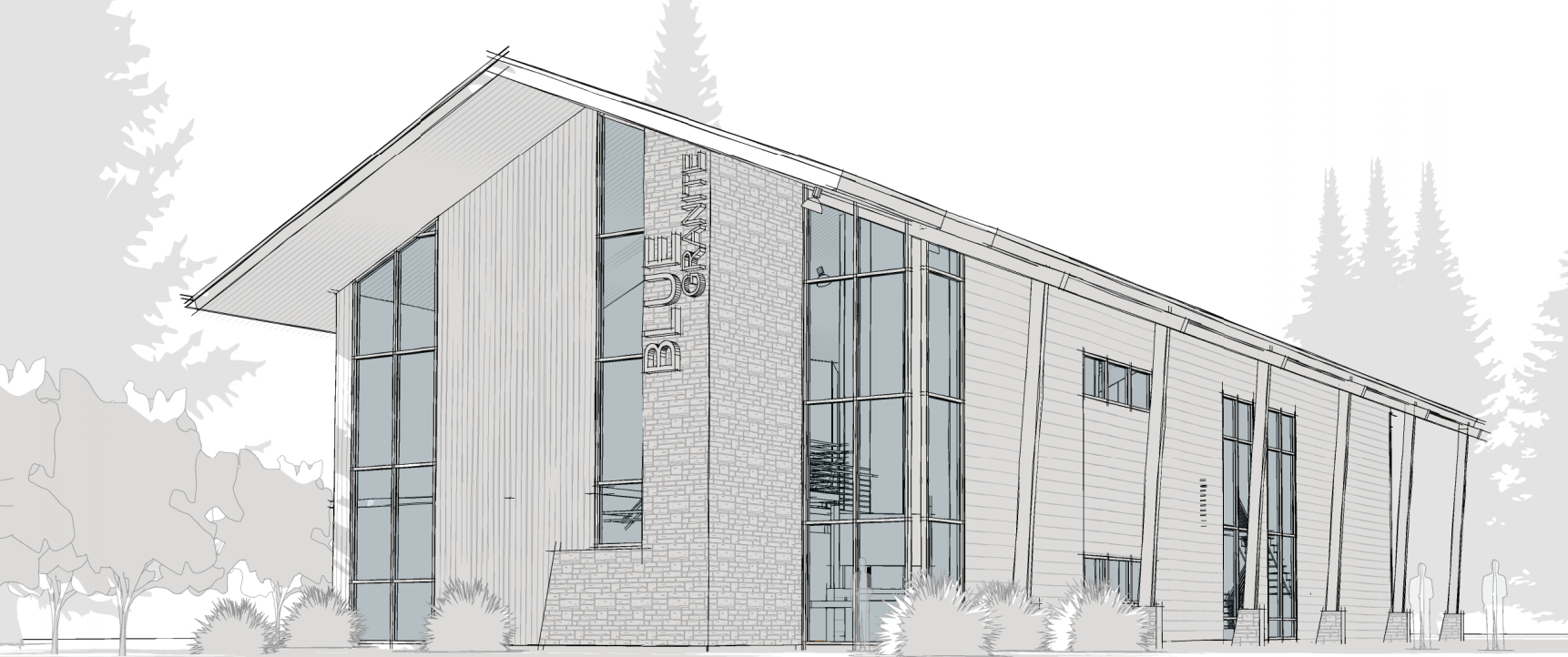
This is a rendering provided by Monarch Architecture of what the gym will look like.

This is a rendering provided by Monarch Architecture of what the gym will look like.

The building – which is intended to be built to LEED criteria – will be about 7,600 square feet. According to Monarch Architecture, it will have metal cladding, vertical glass elements and a heavy timber intermediate roof canopy.

To get around the maximum building height of 35 feet, the plan is to excavate some of the dirt in the back so a taller climbing wall – about 40 feet – can be installed.

The pitches will range from slabs, to vertical to overhangs. A smaller wall will be near the entrance, with the idea this will be used to introduce people to the sport, for kids or even groups.

There will be top ropes, leads, bouldering, a yoga room, free weights and cardio equipment.

“One of the aspects that we are interested in as climbers is that we are interested in building a community for the climbers in Tahoe,” Leavers said.

It will be a place for people to hang out as well as meet like-minded individuals.

But it won’t just be for the hard-core climbers to practice their skills. The goal is to make it appealing to all levels – where classes are taught, camps are offered, birthdays are celebrated, and after school programs take place.


Snippets about Lake Tahoe

·       The 41st annual Antique and Classic Boat Society’s International Boat Show is Sept. 23-24 from 9am-5pm at the Sierra Boat Company in Carnelian Bay.

·       Ron Kipp will be joining the Squaw Valley Alpine Meadows Race Team in the newly created position of ski team coaches education and development manager.

·       Squaw Valley Park now has pickleball courts.

·       Charlie Bamforth has been part of the brewing industry for nearly 40 years and is one of its most globally acclaimed scientists. He will give a talk and put on a beer tasting in partnership with Alibi Ale Works on Oct. 13 from 5:30-7pm at the Tahoe Environmental Research Center in Incline Village. Cost is $25.

·       Medication Safety is the title of a Nov. 7 talk at Lake Tahoe Resort Hotel in South Lake Tahoe. Barton staff will address safety issues regarding prescriptions, questions to ask your pharmacist and proper storage and disposal. It is free.


Heller makes Senate pitch for Tahoe money

By Benjamin Spillman, Reno Gazettte-Journal

With time running out on the Congressional session Sen. Dean Heller, R-Nev., made a pitch for the reauthorization of the Lake Tahoe Restoration Act.

The legislation would renew funding authorization for the original version of the act that expired in 2010.

Heller’s version of reauthorization includes up to $415 million in spending on environmental improvement projects. It would also put a line item in the federal budget for future federal spending on Lake Tahoe.

Read the whole story


Sept. 11 ceremony in South Lake Tahoe

There will be a commemorative ceremony to honor the victims and first responders of Sept. 11, 2001, on Sept. 11 at 11am at the American Legion Hall in South Lake Tahoe.

The ceremony will honor the innocent victims of the attacks on the World Trade Center, Pentagon, airline flight takeovers and the American military service personnel who have died in the war against terrorism and other service members who continue to fight and die for our freedom.

The ceremony will also recognize emergency service personnel, including firefighters and law enforcement.


For more information, contact Carol Olivas at 530.544.1306.


Collin: Collaborative, positive and optimistic

Publisher’s note: Lake Tahoe News asked candidates for South Lake Tahoe City Council, Lake Tahoe Community College, Lake Tahoe Unified School District, Douglas County School District, South Tahoe Public Utility District and Lake Valley Fire Protection District a series of questions. We are running the responses in the order received. All profiles may be found under the Special Projects listing and then the 2106 November Candidate Profiles category.

Jason Collin is running for one of two seats open on the South Lake Tahoe City Council.

Jason Collin is running for one of two seats open on the South Lake Tahoe City Council.

Name: Jason Collin

Age: 43

Job/profession: Administrative director of post-acute services at Barton Health, and owner/race director for Epic Tahoe Adventures

What boards, commissions, or other experience, including volunteering, do you have?: Sustainability Commission for city of South Lake Tahoe (2010-2012); Leadership Lake Tahoe (2010); participant Tahoe Prosperity Plan (2010-2011); Athletes United (past president 2010-2015, current secretary); Rotary Club of South Lake Tahoe (2010-2014), past president (2012-2013); Lake Tahoe South Shore Chamber of Commerce board member (2012-present), executive committee member (2014-present), past chair (2015).

Why are you running for City Council?: I want to be actively involved in the projects and initiatives that are moving, and will continue to move our city forward. We are very fortunate to live in such an amazing place and I want to see our city reflect that beauty rather than detract from it.

Why should voters vote for you over another candidate?: I’m extremely collaborative, positive and optimistic — three things I think we need a heck of a lot more of in our community.

What distinct experience or competency makes you uniquely qualified to lead effectively as an elected official?: A sincere interest in listening to all sides of issues and working collaboratively towards meaningful solutions.

Public agencies have been under scrutiny the last few years for lack of transparency and accountability. What will you do to ensure both?: True accountability is a function of culture. We need to establish a culture of open, honest communication, where the officials, and the public, are held to a higher standard of conduct. I believe in adhering to the Brown Act and will hold myself, my fellow council members and the public responsible for conducting ourselves accordingly.

What stands out for you in the current budget that you support and that you would change?: I like the conservative budget approach and the mid-year reflection that allows for prioritized investment. I also support the commitment the city is making in infrastructure improvement. In the future, I would hope to see increased funding for housing programs and economic development. As a council member, bringing quality jobs and quality housing to South Lake Tahoe will be a top priority.

Do you support current legislation for $15 minimum wage? Please explain: Tough one. I’m definitely in favor of promoting living wages for employees. However, I am concerned that with this big jump we may see businesses cut positions or find ways to automate jobs that are currently performed by employees (e.g. ordering food). I need to do more research and talk to business owners and employees before I come to a conclusion on this one.

Do you support Proposition 55? Please explain: Another tough one. Although Prop. 55 isn’t equitable and it’s not fixing the problem of why schools are broke, I do like the idea of increased funding for education and (potentially) health care for low-income families. If we’re looking at legislation for the greater good, I think Prop. 55 has more upside than down.

Describe three attributes for a successful council: Thoughtfulness, respect, sincerity.

What are your thoughts about public employee defined benefits?: I support the tough decision our city and public employees made to decrease the unfunded liability of health care and public pensions. Very, very tough thing to do but definitely in the best interest of our community’s economic well-being.

Please explain your position regarding contracting out work normally done by staff: I thrive on building teams so I strongly believe in the value of our staff. Contract work is very appropriate for certain circumstances (e.g., coverage for leaves of absence, temporary fulfillment of positions, variable need of services, specific skills that can’t be found otherwise, etc.).

What is your 10-year vision for South Lake Tahoe?: I hope that in 10 years, when my kids are coming back from college to start their careers in the vibrant economy we’ve established, and have quality options for affordable housing (so they don’t move back in with me), they will say: “I can’t believe how much progress has occurred! It’s so easy to get around now — I may not even need a car. And Highway 50 is amazing. No more run down motels and buildings. People are really taking pride in the community. It still has that laid back Tahoe charm … but now we’ve got class too. It finally feels like one community. We’re so stoked to move back home.”

What one vote in the last four years that the current council made do you disagree with and why?: I think the VHR decision may have been a bit hasty. We need to consistently enforce code before we change our policies.

How many City Council meetings have you attended this year?: 4-5

What do you know about the strategic plan, finances, debt, and goals of the city?: The city’s strategic plan establishes these priorities: economic development, fiscal sustainability, improve the built environment, partnership development, public trust and accountability, quality core services. The city’s budget reflects these priorities within each department to the community’s benefit. With regard to finance and debt, I am still reviewing the budget and developing an understanding of its many facets.

Being on a board means working as a team. How will you work with the sitting members for the greater good of the community?: It all comes back to respectful communication. We don’t always need to agree, but we need to respect each other and each other’s right to voice their opinions. We also need to avoid belaboring points, move conversations forward and be willing to make, and stand by, decisions.

What should be the three main priorities for the council?: Housing, jobs, infrastructure.

What have you done to make yourself ready to be a council member?: Learning more about people’s needs, wants and concerns is one of the most important things I’ve been doing. I will also be meeting with key city staff and agency partners to become better informed on the issues I will address as a council member.

What role should government have in housing for residents?: We have an important role in being part of the solution. A good starting point is improving our existing house stock through enforcement of residential building codes. Too many properties have been allowed to become run down in our city. If there are grants or programs that are available to public agencies then I feel we have an obligation to pursue those to create quality workforce housing like the Aspens project. The city can also have a profound impact by helping to lower barriers that prevent investors from building affordable housing.

How can the city partner with the school district to improve high school graduation rates?: First, the graduation rates at STHS and Mt. Tallac are actually really good. In 2014-15, 97.1 percent of the senior class graduated. But, getting to the heart of your question, the city can be a better partner to Lake Tahoe USD and our community’s families by creating a vibrant economy and affordable housing to reduce our issues of transiency, food insecurity and poverty. Our kids are a reflection of the values of the environment in which they live. We have an obligation to give the children in our community every opportunity we can for them to succeed.

How can local government support and expand job creation and small local businesses?: Let’s start with supporting and growing the businesses that are already here by getting out of the way. Lowering barriers (i.e., permitting) will also attract new businesses, fill vacant commercial properties and create jobs. By supporting innovation and embracing the millennial mindset of the current workforce (e.g., Tahoe Mountain Lab), the city can help pave the way for entrepreneurs and capital workforce investment into our community.

If you believe in the one South Shore concept, what would you do to further make this a reality? If you don’t believe in blurring the state line, why don’t you?: I absolutely believe we are one South Shore community. The us vs. them mentality has to stop. My friends in “the county” are just as much a part of South Lake Tahoe as my friends up on Kingsbury Grade. We all work together, shop together and play together. Let’s keep the focus on what we have in common and how we can bolster the community as a whole and everybody wins.

What are your views on:

a: Vacation home rentals: VHRs serve a critical role in our community. How many VHRs should be here needs to be figured out. We also need to keep the pressure on code enforcement.

b: Loop road: I think the project has the potential to have a very positive impact on the make-up of our community. I support the vision of a renewed state line area with improved housing, neighborhood parks, well-lit streets and improved walkability for locals and visitors alike.

c: City streets: The street, curb, gutter and sidewalk work that has been done has been great but it’s a drop in the bucket. The council needs to make it a priority to find funding to complete the sidewalks and lighting along Highway 50 that Caltrans removed from its project. It is no coincidence that private investment has occurred in areas with complete streets. From the highway, we need to move the street investment into our neighborhoods, with an annualized paving program.

d: Relationships with other public agencies: Partnerships with fellow agencies like El Dorado County, LTCC, LTUSD and STPUD are critical to making our city and surrounding areas a more vibrant place. Achieving that vibrancy requires active and good relationships with our regulatory and land partners at TRPA, TTD, Lahontan, the Tahoe Conservancy and Forest Service. Council needs to take a more hands-on approach to forging those relationships than has been done in the past. We are all incredibly interdependent.

e: Recreation: Recreation opportunities are at the core of our quality of life and also our economic sustainability. I’m excited about the Recreation Master Plan and the interest the community is showing in expanding and improving our infrastructure with projects like the renewal of Regan Beach and modernizing the recreational center complex.

f. TRPA defined commodities: I can’t claim to understand the complexity of the TRPA commodities. With environmental safeguards in place, I am in favor of decreasing regulatory hurdles.

g. Transient occupancy tax measure: Support.

h. Sales tax measure: Support

i. What do you want the additional sales tax money to go to?: Roads

Tell us something about yourself that people may not know: My ears are totally uneven. Like a centimeter off.

Your quest to stop the loop road failed. Is litigation how you believe issues should be resolved?: No. My goal was to highlight the fact that the initiative was poorly worded. If the citizens of our city are voting on an issue, we have an obligation to provide clear and accurate information.


Opinion: Why is it so hard to stop rave overdoses?

By Louis Patterson

When the music comes on at a rave, a synergetic feeling of mass escape and euphoria runs through the crowd. But this unparalleled collective high has come at a cost.

In July, three people were found dead at the Hard Summer Music Festival near Los Angeles. During the two-day festival, which drew a record 147,000 attendees, an additional six people were hospitalized. Prior to these deaths, the Los Angeles Times counted 26 rave-related fatalities in the American Southwest since 2006. That doesn’t include non-fatal overdoses, a number which could easily reach triple digits if tallied across the country.

The reaction by lawmakers in cities like Los Angeles has been to clamp down on the events, either banning them entirely or demanding strict control over the crowds. Promoters have instituted stricter security policies, while contending that at such large-scale events, drug use is inevitable. But the recent deaths suggest that these “solutions” haven’t solved anything.

Even though this latest tragedy is fresh, the problem is so familiar—and so unchanged—that an L.A. Times write-up of the Hard Summer deaths didn’t even bother to find a new doctor to talk to. They just recycled a quote from last year, in which a doctor frets that “there’s something about these events that leads to this rampant drug abuse” but is unable to put his finger on why.

I’ve been going to raves for six years, and I don’t find the current approach to addressing the problem convincing. What I am convinced of is that it’s possible to have raves without any deaths.

Why has it been so hard to “fix” raves? Because we have not accurately identified the problem, which to my mind does not stem from kids disregarding their own lives, but rather from the fact that they never learned how to handle the spectacular, seductive freedom offered by raves.

The way I see it, the danger presented at raves stems from the fact that more than a few attendees are the products of our culture of over-protective parents. These ravers grew up highly supervised without the chance to be left to their own devices. Add to that the subtly influencing hand of teenage hormones and it’s almost surprising that there aren’t more tragedies.

Our society has become increasingly afraid of letting children run wild, and young kids today don’t have the same opportunities as previous generations to venture out into the world on their own, to learn how to handle the small freedoms of youth, to take risks, make mistakes, and learn from them. Instead, children are funneled from an early age into myriad adult-monitored activities such as team sports, school dances, and summer camps.

As teenagers, these hothouse kids begin to break out of their confinement. Raves are the perfect venue for youthful experimentation. Even the word “rave” sounds new and different from the “concerts” or “shows” of which adults hold fond memories.

Rave culture has always celebrated the illicit. The very definition of the word “rave,” meaning “to talk wildly or incoherently, as if one were delirious or insane” conjures intoxication. The first raves were born as a mutation of 1970s and ’80s discotheques, the distinction being that raves were held in basements, lofts, and abandoned warehouses, rather than established venues. These parties often lasted for upward of 10 straight hours, and people could bring in their own substances hassle free.

At raves, kids are given a shot at unmonitored social interaction, and the chance to finally partake in all sorts of risk-taking away from hovering parents. Unfortunately, these are not the baby-step risks of younger years. And without past lessons to guide them, it’s easy for bad choices to escalate without anyone realizing.

The question of rave safety is not a narrow one. In the past few years, the American electronic dance music (or EDM) scene has exploded, with longer, multi-day festival events routinely pulling in crowds of more than 100,000 people. EDM has penetrated the heart of the musical world; it has its own category at the Grammys, and heavily influences the sound of contemporary pop music.

When I got into raving in 2010, I had always felt like a social outcast, but raves connected me with a group of likeminded people who I would never have met otherwise. It wasn’t long before I started going out more, getting into trouble with my parents, and having more fun than ever before.

Since then, the rave scene has become firmly cemented in the realm of popular culture. But that didn’t mean the end of drugs or danger. Even as security checks have gotten stricter, drugs have been present at every rave I’ve ever been to. And security checks haven’t prevented deaths.

The good news is that thoughtful alternative approaches have emerged. Some raves are starting to protect their attendees, often by bringing together people who understand how raves work and getting them to work together in the crowds.

The Bunk Police, a group now a few years old, built a strategy on the insight that most overdoes happen after kids at raves take mystery drugs they bought from strangers. Many of these drugs are actually harmful chemicals masquerading as popular club drugs.

The Bunk Police show up at events armed with tests kits that can tell whether a bag of powder is real MDMA, or one of the countless synthetic chemicals that have flooded the rave scene since the popularization of online drug dealing websites, such as the fabled “bath salts” scare of years past. Since their existence acknowledges the presence of drug use, festivals have tried to ban groups like the Bunk Police. Despite this, members hop fences, bribe security guards and risk jail time so that they can keep other people safe.

At Steez Promo’s Moonrise Festival in Baltimore, volunteers make sure attendees stay safe while they’re partying. They check on people who look sick or zoned out, and hand out gum, water, and fruit. The best thing about the volunteers is that they’re also ravers, and can be considerably less intimidating than the security staff. In the event of an emergency, a volunteer can help you feel better, whereas a security guard might just detain you. When things get too rough for volunteers, Moonrise is also equipped with two medical tents near high traffic areas, staffed by a team of emergency medical technicians.

While unsupervised spaces like raves inevitably invite dangerous activity, they also provide a place for youths to grow, experiment, and flourish, free to make mistakes away from the judging eyes of adult society. Regardless of what the law says, the youth will continue to party on. The best thing wecan do is to ensure that spaces they party in are as safe and nurturing as possible.

Louis Patterson is a senior at Occidental College studying English, and a summer fellow at Zócalo Public Square. 


Dogs understand tone, meaning of words

By Nell Greenfieldboyce, NPR

When you praise a dog, it’s listening not just to the words you say but also how you say them.

That might not be huge news to dog owners. But now scientists have explored this phenomenon by using an imaging machine to peek inside the brains of 13 dogs as they listened to their trainer’s voice.

The reward pathway in the dogs’ brains lit up when they heard both praising words and an approving intonation — but not when they heard random words spoken in a praising tone or praise words spoken in a flat tone, according to a report in the journal Science.

Read the whole story


Nevada tribes push for satellite polling places

By Scott Sonner, AP

Tribal leaders in Nevada asked a U.S. judge Wednesday to order the state and two counties to establish satellite polling places on reservations where they say Native Americans are being denied an equal opportunity to vote in the November elections.

Two Paiute tribes filed a lawsuit in U.S. District Court in Reno accusing Nevada Secretary of State Barbara Cegavske and Washoe and Mineral counties of discriminating by illegally refusing tribe members voting access afforded to people in wealthier, mostly white neighborhoods.

Members of the Pyramid Lake Paiute Tribe living in Washoe County say they must travel 96 miles roundtrip to register to vote or to cast ballots in person in Sparks.

Members of the Walker River Paiute Tribe in rural Mineral County say they have to go 70 miles roundtrip to Hawthorne.

The lawsuit says that’s twice as far as voters who live on Lake Tahoe’s affluent north shore would have to travel to vote if the county had not set up a satellite poll in upscale Incline Village. As a result, both tribes say their rights are being violated under the Voting Rights Act of 1965 and the U.S. and Nevada constitutions.

Voter registrars in the two counties said earlier that there isn’t enough time to set up new sites before registration closes Oct. 18 and early voting begins Oct. 22.

The lawsuit seeks temporary and permanent injunctions against the state and the counties. It alleges failure to establish satellite polls on the reservations has a “significant disparate impact” on the tribes due to socio-economic factors as well as a history of racial discrimination and hostility toward the tribes.

The current practice is an apparent effort to dilute the voting strength of tribe members, according to the suit filed on behalf of the tribes by lawyer Rendal Miller.

Similar legal battles have been waged recently in Utah, Montana and the Dakotas over a variety of issues involving the Voting Rights Acts, including access to polling places as well as unreliable U.S. mail service on reservations.

“If we have the same access and opportunities, we will be able to increase participation by tribal members,” Pyramid Lake Paiute Tribe Chairman Vinton Hawley said.

Washoe County Registrar Luanne Cutler declined to comment specifically on the suit but said in a statement Wednesday the selection of polling sites began in January based on cost, voting populations and other logistics.

“With Election Day fast-approaching, the registrar’s plan for the general election remains in place and her decision regarding this matter is final,” the statement said.

Neither the secretary of state’s office nor Mineral County immediately responded to requests for comment.


Coyote warning for Northern Nevada

By Associated Press

The Nevada Department of Wildlife is issuing a warning to Northern Nevada residents about potential conflicts with coyotes.

Urban Wildlife Coordinator Jessica Heitt said coyote pups leave their mother in the fall and start hunting on their own. That leads to more sightings and conflicts, such as attacks on small dogs and cats, but attacks on humans are rare.

Heitt says people should work with their neighbors to remove things that might attract coyotes, like pet food, garbage and fruit from trees.

She says residents should keep dogs leashed and carry pepper spray and a noise maker while walking them. She also suggested keeping small children and pets inside at dusk and at night.