Inmate crews dwindle as wildfire season grows longer

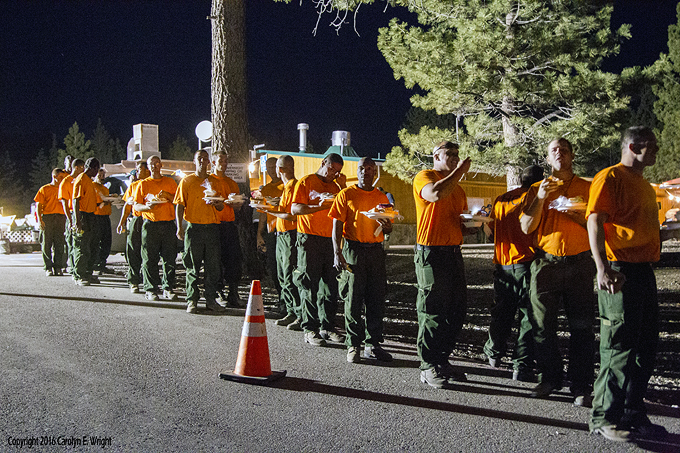
Inmate crews were used on the Washington Fire near Markleeville in 2015. Photo/Carolyn E. Wright/Copyright 2016

Inmate crews were used on the Washington Fire near Markleeville in 2015. Photo/Carolyn E. Wright/Copyright 2016

By Joseph Serna, Los Angeles Times

Already plagued by years of drought and a beetle infestation that has reduced millions of trees to kindling, California is facing yet another crisis as it enters the brunt of wildfire season: a dwindling roster of prison inmates who can battle blazes.

The gap is due largely to California’s controversial realignment law, which mandates that inmates convicted of non-serious, nonviolent and non-sexual offenses serve time in county jails rather than in state prisons.

As a result, the pool of eligible firefighting inmates has been shrinking.

Read the whole story


Placer County approves $815.8 mil. budget

The Placer County Board of Supervisors this week approved a $815.8 million budget for 2016-17.

The budget is balanced conservatively as property taxes, the county’s largest revenue source, continues to increase. In addition, sales taxes, transient occupancy taxes charges on lodging and other revenue sources tied to the economy continue to improve.

“Regarding the tree mortality dollars: I’m delighted that we were able to identify three-quarters of a million dollars for a state match grant,” said Supervisor Jennifer Montgomery, “I think this is going to become a much larger issue in the very near future and we will be having future conversations on how we’re going to identify additional dollars.”


The board will receive a mid-year review of the county finances in early 2017 and recommend any needed adjustments to further board priorities.


Squaw anticipates mid-November opening

While Boreal usually is the first Tahoe area ski resort to open, Squaw Valley is on a quest to be close behind.

Following the region’s first snow fall this week, the resort has bumped up opening day from Nov. 23 to the week of Nov. 11, weather and conditions permitting.

Following the earliest opening in more than a decade in the 2015-16 season largely thanks to early season snowmaking efforts, Squaw Valley has invested more than $1 million in snowmaking enhancements for 2016-17, adding to a total of $9 million over six years. The resort now boasts a total of 317 snowmaking guns with a fully automated system at Squaw Valley and upgraded infrastructure as well as two new state-of-the-art grooming cats at Alpine Meadows.

Once the snowmaking system is fired up crews will operate around the clock to prepare to open between Nov. 11 and Nov. 18.


Murillo — a stabilizing force for LTCC

By Kathryn Reed

A fiscally sound institution. That’s what Kindred Murillo thought she was walking into. It was just the opposite.

It took her four months after coming on board in July 2011 to figure out that Lake Tahoe Community College’s budget wasn’t what it appeared to be. Previous administrators, with the board’s approval, were carrying over $1 million every year that wasn’t projected.

The South Lake Tahoe institution was bleeding financially, with a tourniquet applied each year, but no surgeon in the house.

“I don’t do business that way,” Murillo said.

She was speaking Sept. 15 at the annual convocation before faculty and staff. In many ways, it’s like the state of the college address as well as a pep rally for the coming year.

This was Murillo’s last such talk, as she is leaving in February. She tendered her resignation earlier this year.

LTCC President Kindred Murillo on Sept. 15 talks about accomplishments during her tenure. Photo/Pat Leonard-Heffner

LTCC President Kindred Murillo on Sept. 15 talks about accomplishments during her tenure. Photo/Pat Leonard-Heffner

In her first three years about $2.5 million was cut from the budget.

“Leadership for the college used to reside in the president’s office,” she said. “It now resides throughout the campus. I think it’s important we all have some voice for what happens.”

The focus has been returned to students – what their needs are. This includes working to create a schedule that meets their needs and not the desire of those who are teaching the courses.

Murillo has established a leadership team that she says is strong, reliable and will carry the college forward – and will listen to students, faculty, staff and the community. The budget now reflects actual expenses and revenues. Strategies and goals have been developed, and are in the works to be achieved.

New programs must pass the test of whether they meet the strategic goals.

“We now have a vision. We know where we are going. We want to be a destination college,” she said.

With this area not growing, it’s attracting students from elsewhere that will help sustain LTCC. It means probably building dorms to house them. A study about student housing should be completed in November.

It means expanding distance learning. It means being creative, like the program LTCC participates in to educate prisoners.

While things have improved under her watch, Murillo said the road ahead is not going to be easy. Projections are for small community colleges to see a drop in enrollment over the next 10 years.

Toward the end of Thursday’s talk she got a bit melancholy, even appeared to be on the verge of tears, as she thanked those in the room for helping mold her into the president she has become.

“Don’t every stop being a student of life,” Murillo told them.

As she said her parting words of wisdom she was met with a standing ovation and whoops from those who call her boss.


Star Guide: Uranus, a naked eye planet

By Tony Berendsen

In the beginning there were five planets. Our ancestors watched them for millennia knowing they differed from the stationary stars in the heavens; they wandered. They were given names and mythologies to share from generation to generation and ruled the night sky as gods. Then a man with a telescope discovered another one in 1781.

Uranus had been in the night sky all along, but no one noticed until Sir William Herschel, scanning the area of Taurus with his 6.2-inch reflecting telescope for double stars, ran across a fuzzy looking object. He first thought it might be a comet, but then later he was convinced it was a planet. The planet became the sixth planet known to exist in the solar system and was eventually named Uranus, the father of Saturn. And it was bright enough to be seen with the naked eye, but just went unnoticed.

Celestial objects are rated by a brightness system. The star Vega is the standard rated at 0.0 magnitude. Objects brighter than Vega have lower numbers, and dimmer objects have higher numbers. As an example, the brightest object in the sky is the Sun at -26.74 mag. and Neptune the dimmest planet at 8.0 mag. The dimmest objects we can see with the naked eye are about 6.0 mag.

Uranus was overlooked for years, but is visible with the naked eye. Photo/NASA/Hubble

Uranus was overlooked for years, but is visible with the naked eye. Photo/NASA/Hubble

The brightness of Uranus ranges slightly depending on how close it is to the Earth, and is brightest when the Earth passes between it and the sun during opposition, but even at its brightest it’s barely visible to the naked eye observer. Currently, the planet is about 5.7 magnitude in the constellation Pisces. Uranus wasn’t noticed until telescopes were used to study the starry sky because it was so dim, and moved very slowly amongst the stars.

Uranus is the next planet out beyond Saturn and the third largest planet in the solar system. It wanders amongst the night sky repeating its path every 84 years as it orbits around the sun. Comprised of water, helium, hydrogen, ammonia, and methane, its an ice giant just slightly larger than its neighbor Neptune. Inside Uranus the pressures are extreme, possibly creating a diamond mantle surrounding a small rocky core. Also, Uranus spins on its side relative to the plane of the Solar System, and sports a very defuse ring.

Even knowing the exact position of Uranus in the night sky you would need very keen eyesight and extremely dark skies to spot it with the naked eye. Complicating the task, darker skies reveal more stars making it very difficult to identify dim Uranus from the multitude.

A computerized telescope is a great way to see Uranus. Even a modest sized scope will show the disk of the planet and reveal its bluish color, but there is a fun and somewhat challenging way to see Uranus. If you have a pair of binoculars, some patience, and a place away from bright lights give a try finding the planet with a little help from an astronomy app.

Load up the astronomy app Sky Safari on your pad or smart phone. Set the magnitude limit of the app to 8.0 and the time to 11pm. Find the planet Uranus on your smart device screen, zoom into the area around planet and notice there is a line of three stars just below (south) the planet, all of them about 6.0 to 8.0 mag., and at the top of the line the planet Uranus.

Then go outside to start hunting. Use the constellations Aries and Pieces to guide you to the correct part of the sky and use the star patterns shown in Sky Safari to guide you to the little line of dim stars with Uranus at the top. By the way, this method of finding an object in the night sky is called “Star Hopping”. It’s a method amateur astronomers use to search for celestial objects.

So happy planet hunting the naked eye planet Uranus. And while you are out underneath the stars take some time to explore the rest of the sky. There is a lot to see, even with binoculars.

Tony Berendsen runs Tahoe Star Tours. He may be reached at 775. 232.0844 or tony@tahoestartours.com.


Nev. State Parks has firewood for sale

Permits for the Nevada Division of State Park’s annual wood sale will be available beginning Sept. 17 at 8am at the Sand Harbor main office.

Permits are $65 per cord, with a limit of one cord per address/family and available on a first-come, first-served basis. The wood is a mixture of pine and fir, some seasoned and some green, and is mostly stove length, although some odd sized and large rounds are possible.

Wood is limited; 60 permits are available, with a waiting list for any additional material. Wood may be picked up from the North Canyon area of Spooner Lake beginning Sept. 24. Pick-up days are flexible and will be coordinated at the time of permit purchase.

Access into North Canyon requires navigation through areas of loose, sandy soils. Four-wheel drive or heavy duty two-wheel drive vehicles are strongly recommended. Trailers may be permitted at the discretion of State Parks personnel.

For more info, call 775.831.0494 or email tahoesp@hughes.net.


Award-winning author coming to SNC

Carolyn Forché is a poet, editor, translator, and human rights advocate who has witnessed, thought about, and put into poetry some of the most devastating events of 20th-century history.

Forché is Sierra Nevada College’s next guest in the Writers in the Wood series. She is slated to present her work Sept. 30, 7-9 ppm, with a workshop at 10am on Oct. 1. The reading is free and open to the public in the Tahoe Center for Environmental Sciences building, Room 139/141. Go online to register for the workshop.

Forché is author of “Blue Hour”, “The Angel of History”, and “The Country Between Us”, a poetry bestseller, as well as editor of “Against Forgetting: Twentieth-Century Poetry of Witness”. She is the recipient of Guggenheim and NEA grants.


Davidson: Commitment to listen, learn, and act

Publisher’s note: Lake Tahoe News asked candidates for South Lake Tahoe City Council, Lake Tahoe Community College, Lake Tahoe Unified School District, Douglas County School District, South Tahoe Public Utility District and Lake Valley Fire Protection District a series of questions. We are running the responses in the order received. All profiles may be found under the Special Projects listing and then the 2106 November Candidate Profiles category.

Anne Davidson is running for the Area 1 seat on the Lake Tahoe Unified School district board.

Anne Davidson is running for the Area 1 seat on the Lake Tahoe Unified School district board.

Name: Annie Davidson

Age: 43

Job/profession: Independent education consultant/educator

What boards, commissions, or other experience, including volunteering, do you have?: Local:

·      Tahoe Parents Nursery School board, 2015-2016

·       Parent Teacher Association board and volunteer at Sierra House Elementary, 2014-2016

·       Tahoe Women’s Community Fund member, 2015-2016

·       Warm Room volunteer and advisory board member, 2016

·       American Youth Soccer Association coach, 2015 and 2016

·       After-school enrichment program lead for Sierra House Elementary, 2015-2016

·       Marcia Sarosik’s Dance Studio volunteer, 2014-2016

Regional/national:

·       American Educational Research Association – SIG Officer 2013-present

·       National Council on Measurement in Education  – Committee chair 2013-present

Why should voters vote for you over another candidate?: ·       I am excited to serve on school board by listening, learning, and acting on behalf of all members of the South Tahoe community.

·       With my work experience and degrees from Cornell University and doctorate from University of Vermont, I have a strong working knowledge of education policy and issues. This knowledge will support the board with decision making, especially given the high turnover in the board this year. My knowledge includes experience as a classroom teacher and parent, expertise in curriculum and assessment development, and experience in education administration.

·       Because my husband Matt Lucksinger and I have two young daughters in the district, I can identify with parents – as well as teachers, administrators, and community members.

What distinct experience or competency makes you uniquely qualified to lead effectively as an elected official?: ·       I have the ability and commitment to listen, learn, and act on behalf of students and families in our community, as evidenced by my work in the South Tahoe community to date. I work with the Tahoe Parents Nursery School as a board member and co-teacher, where directors Aileen Yure and Jennifer David support my candidacy. My work in school and volunteer programs demonstrates my capacity to work on behalf of students and families and respond to the needs of the community.

·       I have a strong working knowledge of education policy and issues. My expertise and experience will help. For example, I worked for the Nevada Department of Education to address federal rules for assessment and accountability. I also worked in assessment development on behalf of the California Department of Education and many other state and local clients in various roles. I have led teams in government and in private industry with successful results. Finally, I have worked specifically on behalf of students with disabilities, English learners, and students in poverty in my 20 years in education.

Public agencies have been under scrutiny the last few years for lack of transparency and accountability. What will you do to ensure both?: ·       I commit to act with integrity.

·       I will raise questions and seek answers.

·       I hold myself accountable to all relevant rules and regulations (e.g., Brown Act, school board policy, LTUSD policy, CDE policy) and will be a resource for colleagues on these policies.

·       I will be ready to question my fellow board members if I have any concerns related to transparency or accountability.

What stands out for you in the current budget that you support and that you would change?: ·       The transition toward local control funding is an important trend – and will require new evaluation in the coming year. District and board have used LC funding to make many important and motivating decisions to support children. I am excited about the possibility of creating new opportunities for young children through expanded early childhood education by using the state funds that were previously held back.

·       I’m concerned about the rising costs of benefits (increase of approximately 10 percent in 2015-2016 over the previous year) and will work to ensure that benefits remain strong for our teachers and staff going forward. I’m also concerned about the zero percent increase in books and supplies in the 2015-2016 over the previous year. The strain on schools to cover the classroom and library needs is evident.

Do you support current legislation for $15 minimum wage? Please explain: I support a livable wage. When it comes to the district staff who work hard to ensure our children have the best environment, nutrition, and support they can have, a livable wage is the least we can do. We should do more.

Do you support Proposition 55? Please explain: Yes, I support Proposition 55. Proposition 55 provides critical funding sources for education and health care. It does not raise taxes from the current rates, and it prevents massive funding cuts for public schools.

Describe three attributes for a successful board: ·       The board must always use the filter of “Is it good for kids?” to inform all decisions.

·       The board members must be able to work together to formulate policies that make a difference for kids and support the teachers and administrators who serve them.

·       The board must be able to entertain opposing points of view to inform decisions so that we’re sure that our schools reflect the values of our community.

What are your thoughts about public employee defined benefits?: I support public employee defined benefits. I am concerned about the cost of benefits.

Please explain your position on contracting out work normally done by staff: If work that is usually done by staff can be done through contracted services, I would want to know before deciding:

1)     what the time, schedule, and cost advantages to contracting are;

2)     any ramifications to the current staff members’ roles.

What is your 10-year vision for the school district?: 1)    To develop for our teachers a comprehensive professional development plan that is aligned to the California state standards, tailored to our district, and drives toward success for all students;

2)     To attract fantastic and excited teachers to our district;

3)     To maintain and expand the compelling programs already alive in the district, such as the two-way language immersion, environmental science, sports medicine, and arts programs;

4)     To collaborate with public and private partners – including the city – to enhance the experiences that our children have to learn and grow;

5)     When the time comes, to transition successfully to a new superintendent who fits our district well;

6)     To develop a vision for the following 10 years.

What one vote in the last four years that the current board made do you disagree with and why?: I wished that the board and district had been more revealing to the public regarding the high school accreditation results of the last accreditation round. However, without more information, I would like to reserve judgment on the issue.

How many meetings have you attended this year for the board you are running for?: I have reviewed all meetings and agendas for all meetings in 2015-2016 year and have attended one meeting in person.

What do you know about the strategic plan, finances, debt, goals of the school board?: I have reviewed the following reports and documents and am happy to discuss specific questions anytime.

·       Education Technology Plan – Lake Tahoe Unified School District

·       2014-2015 budget – Lake Tahoe Unified School District

·       2015-2016 budget – Lake Tahoe Unified School District

·       Local Educational Agency Plan – Lake Tahoe Unified School District
Local Control Accountability Plan (LCAP) – Lake Tahoe Unified School District

·       Measure G Bond Projects – Lake Tahoe Unified School District

Being on the school board means working as a team. How will you work with the next board for the greater good of the community?: I will listen, learn, and act. I will raise critical questions so that all Board members will benefit from my expertise, experience, and perspective. I will also drive toward consensus when decisions need to be made.

What should be the three main priorities for the board?: 1)    Professional development plan: Ensure that all district educators are supported to provide the best instruction possible, including a well-designed and tailored professional development plan.

2)     High school accreditation: Ensure that the high school is accredited for six years in its next review.

3)     Elementary success for all: Ensure that all students in the district are achieving and growing in their learning across all school programs and with all necessary supports.

What do you know about Common Core? What is your opinion about it?:  I have worked with the Common Core state standards since they were conceived and carried out in conjunction with the federal Race to the Top initiative. I worked with Nevada educators to roll out the CCSS. I have worked with multiple state assessment and curriculum programs to build assessments aligned to the CCSS. I have volunteered in South Lake classrooms where the Common Core curriculum is in use.

As a district and board, we are not in a position to approve or decline use of the Common Core. We must align our work to the California-approved standards. If the community would like to challenge the Common Core, I am happy to listen and help formulate a statement to the California Department of Education on behalf of our South Lake community.

How can the school district partner with the city to improve high school graduation rates?: Graduation rates are a critical indicator of success and effectiveness of our district. We need to work to keep grad rates ever higher. The city of South Lake Tahoe together with the LTUSD could promote high school completion by:

·       Addressing issues of poverty that create barriers for students to complete school (e.g., transportation, academic support, mental health, nutrition);

·       Working with youth services to ensure students have the safety net and social support to finish high school;

·       Promoting high expectations for all students through mentorship;

·       Promoting various tracks to success including both college and career readiness as well as CTE;

·       Support district activities that engage students in high school (e.g., performances, sports events, cultural fairs, etc.);

·       Encouraging private internships for students in areas of their interest.

I’m sure there are more ways, too – and I’m eager to explore them.

What is your opinion about career and technical education at the high school level?: Career and technical education is a vital part of our schools’ offerings.

Do you support the expansion of charter schools? Why or why not?: I support charter schools. Here are some of my critical requirements for charters:

1)     There is a clear mission for the school that drives its creation and success;

2)     The school leadership is strong and aligned to the goals and mission of the school;

3)     The charter school holds itself accountable to the South Tahoe community for its evaluation.

What are you thoughts on the accreditation status at STHS?: The STHS must be accredited. We need to work toward the highest level of accreditation (i.e., six-year).

Tell us something about yourself that people may not know: I love to sing, create music, write songs, and perform. Look for me in a TOCCATA concert or at a local open mic.

What conflicts of interest do you anticipate between being a board member and education consultant?: Because my work as an education consultant is limited to work with clients outside the South Lake Tahoe community, I do not see this work conflicting with my work on the school board. Rather, I believe that this work will feed my work on the school board, keeping me abreast of national and state issues, current trends in education, and policy at federal, state, and county levels.



Opinion: Embrace immigrants to preserve small towns

By Diana Gordon

Once upon a time the pulse of America beat in its small towns. They were where you took your crops to market, met the trains that brought visits from Aunt Tilly, and danced with your sweetheart on Saturday nights. They served surrounding rural areas with schools and doctors and blacksmiths. Blending individualism and solidarity, their leaders took pride in hard work and valued religious faith.

But that was when the U.S. was still largely an agrarian society, and by the early 20th century urban opportunity was sucking the energy out of such places. After World War II agribusiness replaced family farms, big box stores killed local enterprises, and manufacturing jobs all but disappeared. Today, only about 9 percent of the population lives in places with fewer than 10,000 inhabitants. And the most notable features of many of those places are shuttered businesses and dilapidated houses.

So I was surprised and delighted to notice that early in the 21st century the hardscrabble Long Island village I passed through to get to my summer retreat had taken on a new look.

The tiny downtown of Greenport, N.Y., is now graced by a grassy expanse leading down to Peconic Bay, a carousel attracting young families from “up-island” and New York City, and restaurants that attest to its status as a foodie destination. The village has undergone a transformation of the kind that most small American towns gave up on decades ago.

Its success is visible everywhere: lovely old houses have been restored, yachts preen at the marina, and summer events include bowdlerized Shakespeare on the lawn and Monday evening dances en plein air. The annual Maritime Festival brings together old-time Greenporters—some are descendants of families who settled the area in the 1640s—and denizens of the new tourist economy. For the first time since 1950, the census of 2010 recorded an increase in population, to 2,190 full-time residents, with another 500 or so part-timers.

This revitalization has two principal sources. In the 1990s a vigorous and imaginative mayor found public and private support for a park that would anchor his vision of a revived downtown. And as his dream became reality, a new working class arrived to staff it—immigrants from Mexico, Guatemala, and El Salvador.

They found work in and around Greenport—landscaping, housekeeping, construction—and housing. Often these immigrants enjoyed the company of family members or friends from home who had preceded them. By 2010 they constituted one-third of village residents. “They’ve saved this town,” says former Mayor Dave Kapell, who sparked the renewal.

As I got to know (and interview) a number of the newcomers I discovered that settling in Greenport offered them more than material benefits. On several levels they appreciated the peacefulness of their surroundings. For the family from El Salvador that ran a pupuseria the North Fork of Long Island was a political haven; a Guatemalan gardener was grateful to be living among fields and vineyards. Familiarity was part of the appeal. And it seemed safe. Upon arrival in the country, many people had spent time in Brooklyn or Queens—before choosing rural life because it seemed crime-free, even if, for some, the threat of deportation loomed.

Curious about small-town immigration beyond Greenport, I started to make a list of communities with fewer than 50,000 inhabitants and large numbers of foreign-born residents. I quickly concluded that, at least where immigrants have settled, rumors of the death of the small town have been greatly exaggerated. All over the country immigrants, whether legally present or undocumented, have brought new life to towns abandoned by agriculture and manufacturing sectors.

A number of those towns are in the Midwest, especially Iowa, which is 87 percent non-Hispanic white. In Denison, with 8,390 residents in 2013, it is no longer true, as one commentator noted in the early days of the new century, that you could “nap undisturbed” on a sidewalk in the business district. Renovation of that part of town now reflects the 14 percent population increase since 2000; nearly half of the residents are Hispanic, and half of those are foreign-born. West Liberty, with 3,733 residents, up 12 percent since 2000, has the distinction of being Iowa’s first majority Hispanic community, with about one-quarter foreign-born; according to its mayor, in 2011, “If you didn’t have the Hispanic population here in town, there would be a lot more storefronts that are empty.”

While the majority of immigrants in small towns come from Mexico, with a growing presence from Central American countries, other continents are represented, too. In Dalton, Ga., almost 60 percent of the student body in the public schools is Hispanic (most American-born children of immigrants), but there are also students from dozens of countries who speak 22 languages, according to school district officials. In Huron, S.D., almost 7 percent of the population of 13,163 is Asian, from Thailand and Burma.

Immigrants from India, Japan, and China have contributed to the economic recovery of Columbus, Ind., the hometown of the 2016 Republican vice-presidential candidate Mike Pence. New tastes and cultural practices come from refugee communities, too. Ten miles from Burlington, Vt., farmers from Rwanda and Bhutan are responding to the demand for goat meat among their fellow refugees from Africa, Asia, and Eastern Europe.

Adapting to the needs of immigrants in small towns presents some challenges. English as second language teachers are expensive additions to the budgets of small school districts. Native-born citizens (including police officers) of small towns usually have little exposure to the languages and customs urban residents encounter in daily congress. Complaints about immigrants butchering animals in the backyards of Dalton or drying fish on the clotheslines of Huron are typical of neighborhood tensions. And residential crowding—families doubling up to save money and find companionship—is a general concern, as it is in cities.

But the process of adjustment to the new demographic reality in many small towns is proceeding much as it did in more traditional urban environments during the last immigrant wave a century ago—with the acquisition of English, the discovery of economic opportunity, and the rising of the next generation of Americans.

It is, of course, too much to think that an influx of immigrants can reverse the decline of the American small town or that small towns are the answer to the manifold challenges of immigrant integration. But some communities are no longer places to leave—just ask those who have recently arrived.

Diana Gordon is professor emerita of political science and criminal justice at the City University of New York. Her  book “Village of Immigrants: Latinos in an Emerging America: was published in 2015.


Nevadans to vote on breaking up energy monopoly

By Michelle Rindels, AP

A proposed ballot measure called the Energy Choice Initiative aims to deregulate electrical service in Nevada, opening up the market to providers other than NV Energy — the sole provider in most parts of the state. Here are things to know about Question 3:

How does it work?

If the measure passes this year and again in 2018, it will amend the Nevada Constitution to add the right for customers to choose their energy provider and to produce their own power to sell to others. It directs the Nevada Legislature to pass laws authorizing an open, competitive electricity market by mid-2023.

A “yes” vote supports the changes to the Constitution; a “no” vote keeps the Constitution the same.

Read the whole story