Cops confiscate 18 pounds of pot in Truckee

Chase, a K9 with Placer County, with his marijuana find. Photo/Provided

Chase, a K9 with Placer County, with his marijuana find. Photo/Provided

Nearly 18 pounds of packaged marijuana was seized in Truckee.

The California Highway Patrol called in the K9 unit from Placer County Sheriff’s Department to search the vehicle that was stopped this month on Interstate 80 near Highway 267.

Chase was able to sniff out the marijuana.

CHP has not released the names of the people involved in the arrest.

“(Interstate) 80 is a pipeline out of Northern California to back East where you can fetch a lot more money for it,” a CHP spokesman said of marijuana.

— Lake Tahoe News staff report


Turn yard waste into gardener’s gold – compost

By Melinda Myers

Save time and money by turning landscape trimmings into a valuable soil amendment.

The idea is simple, just collect disease- and insect-free plant debris into a heap and let it decompose into a fine, nutrient rich material that helps improve the soil. Don’t add meat, dairy, invasive plants, weeds that have gone to seed or perennial weeds that can take root and grow in your compost pile.

Speed things up by layering yard waste with soil or compost, adding a bit of fertilizer to each layer and moistening to a consistency of a damp sponge. Further speed up the process by making the pile at least 3-feet tall and wide.

Turn the pile as time allows, moving the more decomposed materials from the center to the outside of the pile. It’s a great work out and speeds up the decomposition. The more effort you put into composting the sooner you have rich organic matter for your garden.

Tumbler composters are great for small spaces and make loading, unloading and turning much easier. Photo/Gardener's Supply Company

Tumbler composters are great for small spaces and make loading, unloading and turning much easier. Photo/Gardener’s Supply Company

Build the pile in a location that is convenient for adding raw materials and harvesting the finished compost. Consider placing the pile near a water source to make moistening the pile easier. Avoid poorly drained locations that may lead to the pile of compost becoming waterlogged. Soggy materials break down more slowly and may smell.

Enclose the pile in a bin to keep the process neat and tidy. Purchase a compost bin or make your own from fencing, concrete reinforcement wire or old heat-treated pallets.

Single bin wire composters are easy to assemble and move. Enclosed bins keep materials out of sight and neighbors or less enthusiastic family members happy. Look for bins of sturdy UV resistant materials, ventilation for efficient composting and designed for easy loading and unloading.

Tumbler composters are great for small spaces and make loading, unloading and turning much easier. The closed system also keeps out rodents, wildlife and pets. Add garden waste, keep it consistently moist and give it a turn.  Continually adding fresh material slows the process, but you will still end up with good compost. Speed up decomposition with two tumblers. Fill one tumbler with plant waste and let it cook, while collecting fresh materials in the second.

And don’t let cold temperatures or a lack of space stop you. Everyone can convert kitchen scraps into nutrient-rich compost with the help of red worms. Convert a plastic container filled with shredded paper into a home for the worms and place to recycle plant based food scraps. Or dress things up with a stylish bin like the green Worm Farm Composter and move the worms indoors for convenient recycling.

Add finished compost to your vegetable and annual gardens every spring to help build healthy soil and a productive and beautiful garden. Or spread a one-inch layer over the soil surface of perennials gardens every year or two to keep your flowers looking their best.

As you clear out the summer garden, put all that green debris to work. Convert it to rich compost for next year’s garden. Then enjoy the many benefits it will have on your landscape.

Melinda Myers has more than 30 years of horticulture experience and has written more than 20 gardening books, including “Small Space Gardening”. Myers is a columnist and contributing editor for Birds & Blooms magazine and was commissioned by Gardener’s Supply Company for her expertise to write this article. 


SLT council candidates try to stand out

Eight of the 10 South Lake Tahoe City Council candidates on Sept. 20 make their voices heard. Photo/LTN

Eight of the 10 South Lake Tahoe City Council candidates on Sept. 20 make their voices heard. Photo/LTN

By Kathryn Reed

Watching eight of the 10 South Lake Tahoe City Council candidates answer an array of questions Tuesday night gave the voting public and others an opportunity to see who has prepared well for this four-year job and who needs some polishing.

Candidates Dan McLaughlin and Bob Topel did not attend the forum at Lake Tahoe Resort Hotel that was sponsored by Lake Tahoe South Shore Chamber of Commerce and South Lake Tahoe Lodging Association.

Moderator Evon Yakar tried to keep the candidates on point, had follow up questions to get them to actually answer the question, and asked questions they all answered and interspersed them with ones targeted to individuals. The sponsors prepared some questions, while others came from the audience.

For the most part they all agree listening is one of the best ways to learn.

Some of their responses based on the order they sat:

John Shearer:

·      Regarding how he as a business owner would increase economic opportunities: He believes the Lake Tahoe Visitors Authority and chamber do well with marketing and that the city does not need to have a role.

·      Asked to define “sensible regulations” that he says are needed to deal with affordable housing: He wants the Tahoe Regional Planning Agency to change; in particular he has issues with building allocations.

·      How important is it to meet the needs of the people living outside the city, but who are in the sphere of influence: He would like them to vote. [This would violate the Constitution.]

·      If the loop road measure passes, what should the city do: Supports the loop road. Recognizes houses won’t be torn down without rebuilding new ones. Anticipates more events in that area.

·      How to solve the traffic problem in town: Free transit; emulate successful ski towns.

Patrick Jarrett:

·      How would he grow the economy: More events.

·      How important is it to meet the needs of the people living outside the city, but who are in the sphere of influence: They should have some voice.

·      If the loop road measure passes, what should the city do: With the number of people who signed the petition, believes the public wants a say; doesn’t want project “crammed down our throats.” Doesn’t see benefits of project.

·      How to solve the traffic problem in town: Pointed out how when he lived in Germany years ago the transit was reliable; would like to see that happen here. And sync the traffic signals.

Ted Long:

·      He was asked about his 10-year vision: Tourism, he said, is a two level platform – to get them here and then to get them back.

·      How important is it to meet the needs of the people living outside the city, but who are in the sphere of influence: He wants to do more and is open to suggestions.

·      If the loop road measure passes, what should the city do: He would support the voters, but realizes that still might not be what the majority in town wants based on voter turnout. “I think people who are in charge are going to do what they want.”

·      How would you solve the traffic problem in town: Put in light rail to get people to Camp Richardson and Stateline. Focus on getting tourists out of their vehicles.

JoAnn Conner:

·      The most urgent issue in the city: Housing, with roads a close second.

·      With a contentious first term nearly over, she was asked how things would be different the next four years: “Literally hundreds of people have asked me to run again.” She said she has already put the issues behind her and that there have been many successful meetings. “I have no personal agenda.” [The reality is tension, animosity and lack of professionalism are still the norm at council meetings, and no personal agenda is disputable.]

·      How important is it to meet the needs of the people living outside the city, but who are in the sphere of influence: Meyers can vote to annex themselves. She said she understands why they would not want to.

·      If the loop road measure passes, what should the city do: Better to listen to the citizens, not the five council members. “Caltrans has assured me it will not proceed if the City Council doesn’t want it to happen.” She believes the project has too many unanswered questions.

·      How to solve the traffic problem in town: Advocate for bike trails, said she got the snow cleared from them last winter; use smaller buses.

Tamara Wallace:

·      What areas of South Lake Tahoe present an opportunity for redevelopment and what would the appropriate approach be: She wants the Tahoe Valley Area Plan to be implemented, but did not state a specific project.

·      She was then pressed to answer what she thought the city’s role in the loop road would be: She stumbled a bit, said eminent domain and easements and “things like that” would be the city’s role; then she said the council will not vote yes or not on it because it’s not a city project.

·      How important is it to meet the needs of the people living outside the city, but who are in the sphere of influence: “I think we are one community in very many ways. We will always be just a little bit separate.” She mentioned how kids in Alpine County go to Douglas County schools and she wishes Whittell students could go to South Tahoe High. [They can.]

·      If the loop road measure passes, what should the city do: Doesn’t matter if the measure is vague, it’s what the people want. “I’m against three people making a million vote.” [Earlier that day the five councilmembers made a multimillion-dollar vote when they approved the 2016-17 budget; million dollar votes are pretty routine.]

·      How to solve the traffic problem in town: Get businesses to subsidize transit.

Brooke Laine:

·      She was asked what a successful vacation home rental program looks like: She wants the laws on the books enforced, for the code enforcement officers to work more than swing shift on the weekends, bear boxes to be mandatory and for VHRs to pay the same transient occupancy tax as the redevelopment area so that added revenue could pay for enforcement officers.

·      How important is it to meet the needs of the people living outside the city, but who are in the sphere of influence: She wants to create one Tahoe county so there is a larger voice.

·      If the loop road measure passes, what should the city do: “I think it’s taking the pulse of the community.” She also believes the ballot measure is premature.

·      How to solve the traffic problem in town: Mentioned how in the 1980s the city subsidized transit; wants it to be frequent, fun and free.

Jason Collin:

·      How best to address infrastructure: “Roads are the most pressing issue.” He wants added sales tax dollars to go toward roads.

·      Purpose of loop road lawsuit: “The intent was to raise awareness to what I feel is an invalid measure. (The measure) would not allow the city to act.”

·      How important is it to meet the needs of the people living outside the city, but who are in the sphere of influence: When he was on the city’s economic development team they came up with the “One South Shore” slogan.

·      If the loop road measure passes, what should the city do: A vote for or against the measure is irrelevant because it’s vague and if it passes, there will be a court hearing on Dec. 5; plus the city doesn’t have jurisdiction over the project. Believes educating public is necessary.

·      How to solve the traffic problem in town: In the short term, work on sidewalks and trails. The trails he was on this winter were not cleared. Would like free transit, but doesn’t know how to pay for it.

Trey Riddle:

·      With his platform being all about infrastructure, he was asked which project is most important to support and why: He said the Mobility 2035 program. [This is a TRPA, not a city program.] He said his 9-week-old son would be in college by then, and that doing more now so his child could experience it as a kid would be ideal.

·      How important is it to meet the needs of the people living outside the city, but who are in the sphere of influence: Important to listen to friends and neighbors.

·      If the loop road measure passes, what should the city do: He supports democracy, and wants the public’s opinion to prevail.

·      How to solve the traffic problem in town: Rides his bike to work almost every day and doesn’t feel safe; he’d like to change that experience.




Opinion: Squeaky wheel gets the grease at nursing homes

By Paul Harasim, Las Vegas Review-Journal

What Tracy Rodgers saw — or rather didn’t see — as a young nurse treating patients in a nursing home haunts her to this day.

Paul Harasim

Paul Harasim

She still finds it difficult to believe.

“There were so many people who had no one visiting,” Rodgers said, shaking her head as she sat on the couch in her Henderson home. “Not even on Christmas or other holidays. It’s hard for me to fathom what it’s like when no one comes to visit you. I know everyone has their own lives, with families and jobs. But it’s so easy for patients to fall into a depression when they have zero contact with loved ones or people from outside.”

Out of sight. Out of mind.

That mindset held by many Americans — research done by Dr. Joyce Varner of the University of South Alabama found 60 percent of nursing home patients don’t receive visitors — can have effects far beyond the psychological.

Read the whole story


2.4 earthquake rattles Desolation Wilderness

A 2.4 magnitude earthquake shook part of Desolation Wilderness at 10:03pm Sept. 20.

The temblor was registered 9.7 miles west-southwest of South Lake Tahoe, in the woods behind Emerald Bay.

— Lake Tahoe News staff report


Not all candidates participated in LTN forum

Lake Tahoe News asked candidates for South Lake Tahoe City Council, Lake Tahoe Community College, Lake Tahoe Unified School District, Douglas County School District, South Tahoe Public Utility District and Lake Valley Fire Protection District a series of questions.

However, not all candidates chose to respond.

Not one of the four candidates for Lake Valley Fire Protection District took the time. Bob Bettencourt, board chairman, told Lake Tahoe News the board decided as a group not to do so. However, only two incumbents are running – Bettencourt and John Rice.

Bettencourt and Rice told LTN they didn’t like some of the questions. Many were the same asked of all the candidates. Specific to the fire board were:

·      How can local government support effective fire prevention and forest management practices?

·      Morale is horrible in the department, what can the board do to help fix this?

·      What will you look for in a permanent fire chief?:

·      What is your philosophy about ambulance service?

As for the other two candidates for Lake Valley FPD – Leona Allen and Tony Sears – the reason(s) for not responding are unknown.

There are three seats up for that board.

Also not answering questions were Mike Doyle running for Lake Tahoe Unified School District and Mike Kiger seeking the Douglas County School District board seat. Both said they were too busy. Their opponents, though, Bonnie Turnbull and Keith Byer, respectively, found the time.

Bob Topel, one of 10 candidates for South Lake Tahoe City Council, does not have email and did not provide a friend’s address for the questions to be sent there.

Look for endorsements from Lake Tahoe News for these offices and the three South Lake Tahoe measures to run in October. A panel of seven community members will come up with the recommendations of how voters should mark their ballots.

All of the candidate answers may be found under the Special Projects tab at the top of the Home Page, then click on 2016 November Candidate Profiles.

— Lake Tahoe News staff report


Big Sur wildfire becomes costliest ever to fight at $200M

By Associated Press

BIG SUR — A wildfire burning for nearly two months on California’s scenic Big Sur coast has surpassed $200 million in firefighting costs, becoming the costliest to fight in U.S. history, according to data released Monday.

The fire has cost $206.7 million to fight so far, the National Interagency Fire Center said in a report. And with the blaze at only 67 percent containment, there could be weeks left before the firefight is done.

That puts it well past the previous high of $165 million established by a blaze that burned in California and Oregon in 2002.

The figure does not include the actual damages done by the fire like destroyed homes, only the costs of extinguishing and containing it.

It also is not adjusted for inflation, which would put the 2002 fire and others ahead of it.

The cost is mostly attributable to the long duration of the fire, and the need to pay thousands of firefighters for their daily work, the U.S. Forest Service said. The daily costs got as high as $8 million at the fire’s peak, though they’ve settled at closer to $2 million as it has calmed.

The fire burning in the Los Padres National Forest wrought havoc on the summer tourist season in the area after it broke out because of an illegal campfire on July 22. It led to the death of a man in a bulldozer accident.

At 185 square miles it is does not even approach the largest in size in American history and does not crack the top 10 in the state.

California is seeing a relative lull in active and dangerous wildfires as it awaits its heavy fire season, but three major uncontained fires are still burning around the state as wildfire conditions continue to expand into previously safe months, and new ones break out almost daily.

They include a wildfire at Vandenberg Air Force Base about 170 miles southeast along the coast from the Big Sur blaze. It forced the postponement of a weekend satellite launch, has exploded in size and continues to burn out of control at more than 7 square miles.


Leaders try to bridge regional gap in Nevada

By Nicole Raz, Las Vegas Review-Journal

About 300 business leaders, academics and government officials are meeting Tuesday through Thursday to make the 450 miles between Las Vegas and Reno feel shorter.

“We can break down those miles through collaboration,” said Matt Westfield, founder and director of Entrepreneurs Assembly, a not-for-profit business mentoring organization based at the URN  Innevation Center.

The second annual Nevada Economic Development Conference, presented in part by UNR and UNLV, aims to create a new map for economic development.

Read the whole story


Migratory birds flocking to Tahoe basin

A female downy woodpecker does not need a wide branch to hang on to. Photo/Dale Roberts

A female downy woodpecker does not need a wide branch to hang on to. Photo/Dale Roberts

By Dale Roberts

STATELINE – For those who love Tahoe for its wildlife and natural grandeur, the Tahoe Institute for Natural Sciences has something for everyone whether they are just learning about the wildflowers surrounding their campsite to the serious student of ornithology.

Charles Hopkins from Maryland confirming a bird identification. Photo/Dale Roberts

Charles Hopkins from Maryland confirming a bird identification. Photo/Dale Roberts

The Tahoe Institute For Natural Sciences (TINS) is a nonprofit organization dedicated to bringing world-class interpretive studies and education to the Tahoe area. Its staff is comprised of individuals who are widely recognized as experts in their fields, and has a volunteer staff that draws from various naturalists and environmental scientists that live in the Tahoe area.

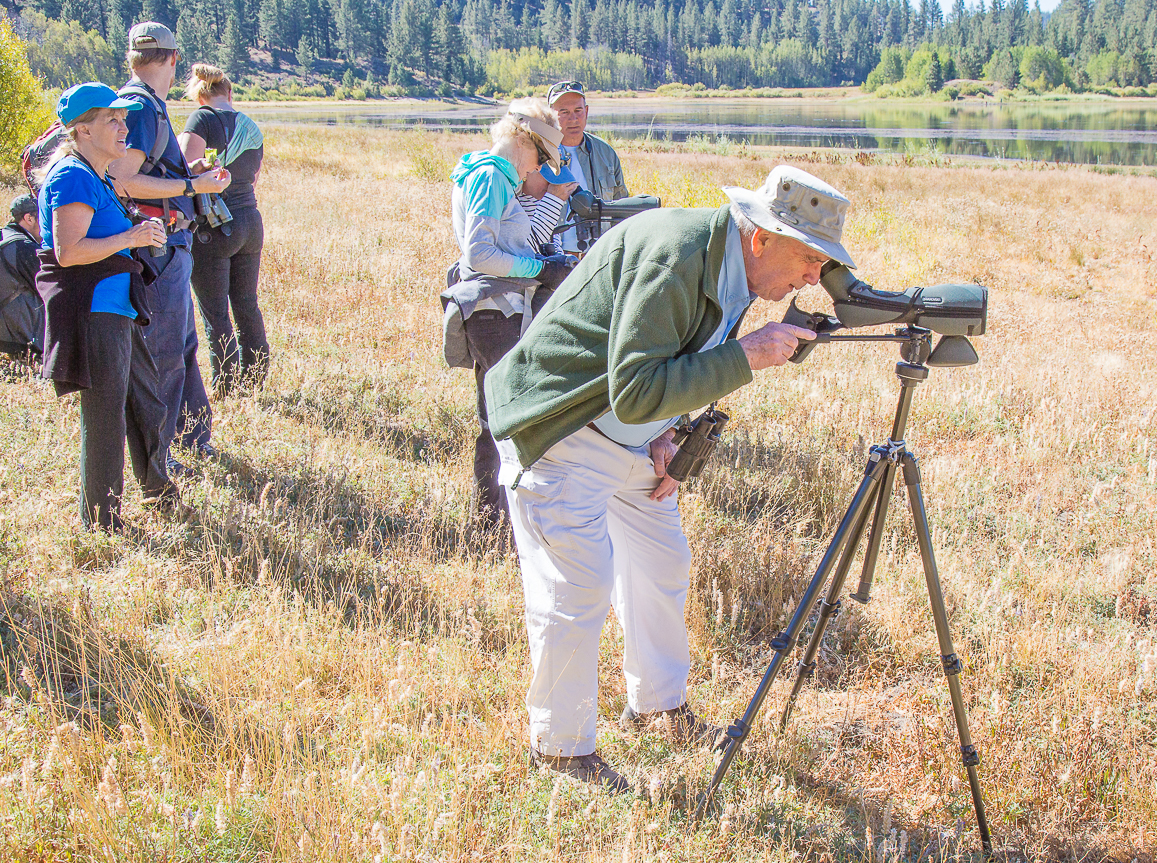
Last weekend TINS offered two bird watching walks focusing on the migratory birds of the Tahoe basin. There was also a focus on the various bird songs to help people locate and identify the various birds in their habitats.

Western gulls are a common migratory bird in the Tahoe basin. Photo/Dale Roberts

Western gulls are a common migratory bird in the Tahoe basin. Photo/Dale Roberts

Saturday’s walk at Spooner Summit was led by founding member Kirk Hardie and assisted by Rich Chambers. Sunday’s walk was at Rabe Meadows off of Kahle Drive in Stateline, and was led by Chambers and assisted by staff member Michelle Witte.

Birds were not the only animals out -- a praying mantis tries to blend in. Photo/Dale Roberts

Birds were not the only animals out — a praying mantis tries to blend in. Photo/Dale Roberts

In all, approximately 40 species of birds were identified in several habitats in both locations. Between sightings the leaders pointed out various flowers, trees and animals seen along the way. With their depth of knowledge of the area’s ecosystems, they were able to answer practically any question a participant may have had relating to the natural sciences.

Most events TINS sponsors are free and are ideal for families. Group sizes are kept small to maximize the learning experience.


Spooner State Park wildland fire contained

Updated 8:58pm:

A fire broke out late this afternoon at Spooner Summit.

A multi-jurisdictional crew of firefighters, including the Super Scooper airplane, was able to contain the fire to 0.58 acres.

The Sept. 20 fire was reported at 3:58pm. The fire was northwest of Spooner Lake right near the lake.

The cause is under investigation.

This is one of nearly a dozen fires in about a month’s period that have been suspicious. Most have been on state or federal land. In this case, it was Nevada State Parks property that burned.

Authorities are not saying if they are looking for one or more people who may have started the various blazes.


— Lake Tahoe News staff report