Conference highlights importance of rivers

By Linda Fine Conaboy

OLYMPIC VALLEY – One of the popular terms heard during the River Network’s River Rally was “citizen scientist.”

In workshop titled Restoring and Connecting a Wild & Scenic River, presenter Carrie Banks from Massachusetts said that she uses citizen scientists to prioritize projects, secure funding, document crossing and stream function, among other jobs.

Bank’s presentation was followed by another, Sierra Headwaters: Protecting and Restoring Rivers at the Source, where Rachel Hutchinson discussed the Yuba River watershed and Beth Christman from the Truckee River Watershed Council gave an informative overview of the Middle Martis Wetlands Restoration Project.

The task, to ameliorate the situation with the wetlands, started with a creek that was too small to handle the job, Christman said. The Middle Martis Creek channel was undersized for even moderate flow, there was lots of undercutting and meadow degradation, as well as highway flooding.

After bringing different entities together, they completed the job just before the advent of one of the largest water years ever recorded in the Sierra—the record-setting event of 2016-17. The restoration came through brilliantly, doing its job efficiently and with very little damage, much to their satisfaction.

Nicole Silk, president of conference host, River Network. Photo/Linda Fine Conaboy

“Besides surviving that winter, we learned that a restored meadow is able to retain much more carbon, so the project is considered a huge success,” Christman said, referring to the fact that many meadows within the Sierra are highly degraded because of their carbon-rich soils, which allow a large amount of carbon dioxide to be disseminated into the atmosphere.

More than 500 people attended the April conference at the Resort at Squaw Creek in Olympic Valley. Each year the event is at a different locale, attracting water warriors from at least 40 states and representatives from Canada and Australia. The purpose is to connect local water champions, and empower organizations and individuals with the tools, training, and resources needed for success.

“Every year we move to a new location to connect with people whom you wouldn’t know or be able to learn from,” said Nicole Silk, president of conference host, River Network. “It’s the only conference of its kind where you can connect with people who are working at the local level on healthy rivers and clean water all over the country. The conference offers knowledge to fill your tool kit; it is inspiring and we do a lot of celebrating. We step back and recognize river heroes—we don’t do that enough. We connect people to save rivers.”

She explained that this is the 19th anniversary of River Rally and that they decided Lake Tahoe and environs were the perfect environment in which to celebrate. “We knew we wanted to be on the West Coast, close to water and the snow is beautiful. Lake Tahoe is just down the road, and the water quality of the lake is extraordinary,” she enthused.

As organization president, it is Silk’s fondest hope that people come away inspired to do more for local waters and leave with more tools than they came with to get that job accomplished.

With 91 learning opportunities including six keynote speakers and plenaries, 74 workshops and 11 field trips over a three-day period, the atmosphere was definitely upbeat and inclusive. Workshops at the event included Defending the Waters of the United States; Partnering up for Conservation; Connecting People to Rivers; Water Infrastructure for a Sustainable Future, with more than 30 in all.

“We are the foremost national nonprofit connecting water-focused organizations, agencies, businesses and communities for greater local impact and healthier rivers across the U.S. We are the only national non-profit with this unique focus,” Silk told Lake Tahoe News.

Kick off speaker was author, adventurer, photographer and river master Tim Palmer, who offered his audience an enlightening overview of the Wild and Scenic Rivers Act of 1968, which is a rivers system created by Congress to preserve certain rivers with outstanding natural, cultural, and recreational values in a free-flowing, un-dammed condition for the enjoyment of present and future generations.

Palmer showed a film highlighting some of the beautiful, free-flowing rivers with scenery so stunning you definitely wanted to book a trip on the Snake, the Klamath, the Rogue or any of the other unfettered wild rivers where Palmer is privileged to navigate his boats. 

Now, there are more than 300 rivers across the U.S. possessing the Wild Rivers designation; in 1968, there were only 12.
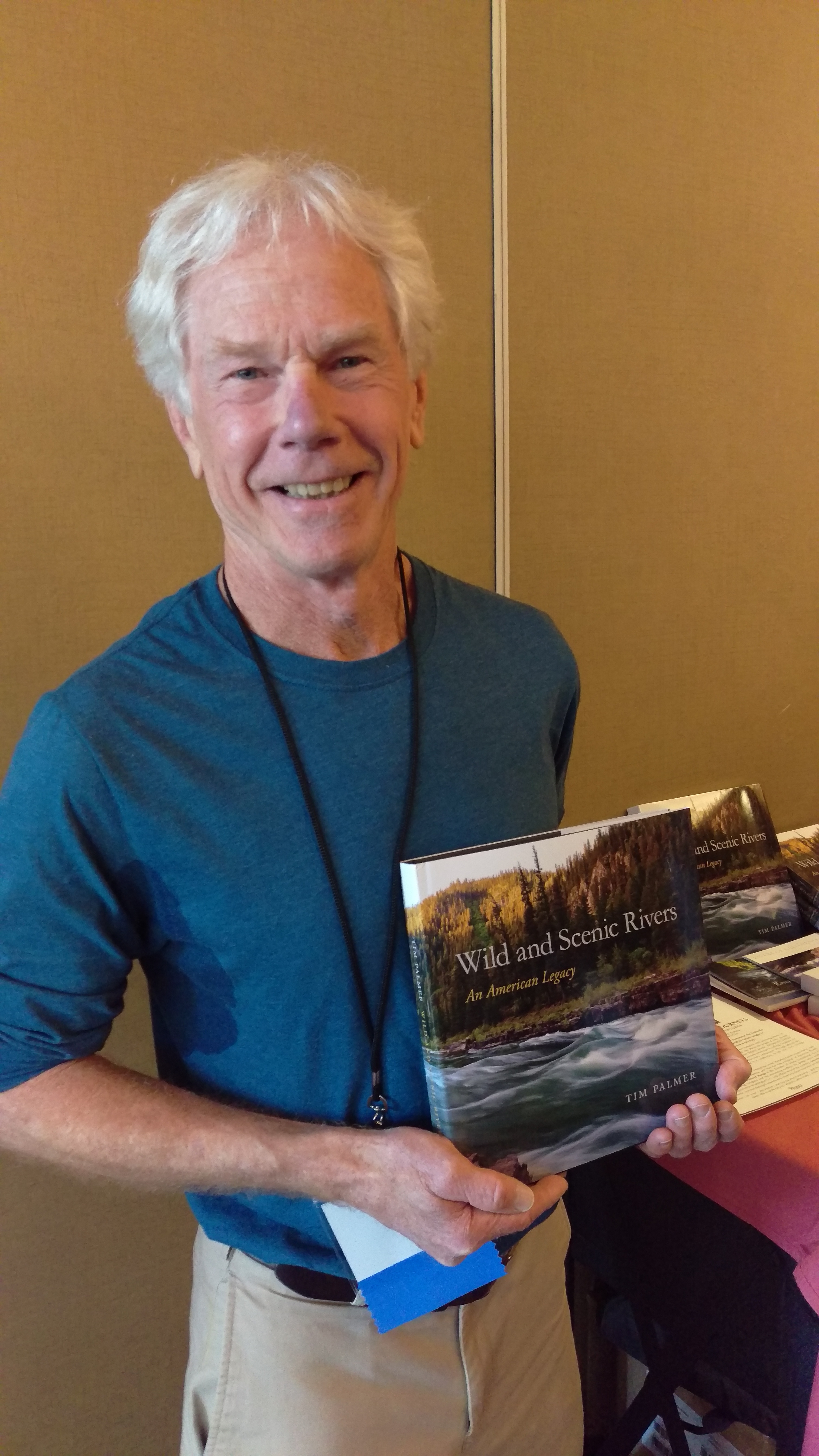
Tim Palmer is an advocate of keeping rivers wild and scenic. Photo/Linda Fine Conaboy

Palmer explained that the 1950s is also known as the era of the big dams, with many being built during that period on numerous unsuspecting rivers—this was a state of affairs not to the liking of three-term congressman from Arizona, and secretary of the Interior from 1961-69, Stewart Udall. Udall enlisted the help of then-first lady Lady Bird Johnson, who was perhaps instrumental in convincing her husband to begin the protection of rivers.

The Wild and Scenic River Act became law with its nearly unanimous passage 50 years ago. It carried two stipulations, Palmer said: 1) that the waterway be free-flowing and; 2) that it contain one or more outstanding qualities, such as unique geology.

Considering that within the United State, a water crisis looms that includes issues of security, affordability, quality and access—more than one-third of Americans are at risk of losing affordable drinking water and more than half of all of our rivers remain in poor health.

And, as Palmer said, “The advent of global warming makes it even more important to protect our rivers. That, and the push from the mining industry, which is battling to strip away designations so they can begin mining along wild rivers.”

According to Palmer, this makes it even more important to protect as many rivers as possible and provide them the protection of the Wild and Scenic Rivers Act. Many rivers, he said, are now queuing up to receive the protected designation. The good news, he reiterated, is by vision and planning, the program has grown from just 12 to more than 300.

“We are all children of the Act,” Palmer said. “Rivers are lifelines; they connect us. They deserve protection.”



Opinion: Housing ‘reform’ would deepen poverty

By Alex Schwartz, The Conversation

The Trump administration recently proposed fundamental changes to how the federal government helps low-income families pay for housing.

Housing and Urban Development Secretary Ben Carson claims his “welfare reform,” which would jack up rents on the poorest Americans and impose stricter work requirements, would promote self-sufficiency and make federal housing assistance fiscally sustainable.

As someone who has studied, taught and written about housing policy for more than 25 years, I believe the proposal would do nothing of the kind.

Housing welfare, by the numbers

About 4.8 million of the nation’s lowest-income households currently receive housing assistance from the federal government, a figure that hasn’t changed much over the past decade.

About 1 million households live in public housing, 2.5 million receive housing choice vouchers that subsidize the rents charged by private landlords and 1.3 million live in apartment buildings that are themselves directly supported by the government.

These households earn very little income. The average income of a housing choice voucher recipient, for example, is $14,454, while only 23 percent earn more than $20,000.

For decades, federal rental assistance ensured that recipients paid no more than 30 percent of their adjusted household income on rent. If income goes down, they pay less. If it goes up, they pay more. The cap is based on the notion, long shared by policymakers and the real estate industry, that housing is “affordable” when it costs no more than 30 percent of a household’s income.

The measure for income housing authorities have used has traditionally been adjusted for child care, medical expenses and other deductions.

Housing ‘reform’

The administration’s proposal would greatly raise the rents that virtually all housing subsidy recipients must pay – in three ways.

The rents for subsidy recipients who are not elderly or disabled would increase from 30 to 35 percent of their income. The government would no longer take child care and medical expenses into account in determining rents. And the minimum rent recipients must pay would triple from $50 to $150 a month.

About 423,000 subsidy recipients currently earn less than $2,000 a year and pay the minimum rent of $50. Their rent would triple to $150 a month, which would consume a whole year of income for a household earning $1,800.

Families with higher incomes would also see sharp increases as well. A single-parent family earning $25,000 but with $5,000 in child care expenses would see its rent jump 46 percent from about $500 to $729.

While the plan would keep elderly and disabled people at a 30 percent cap, their incomes would no longer by adjusted for medical expenses and child care. Moreover, in order to qualify for the exemption, every adult in the household must be elderly or disabled.

A history of ‘reform’

Most fundamentally, the Trump administration proposal would finally apply the controversial welfare “reforms” that began in the 1990s to federal housing assistance.

Welfare reform began under the Clinton administration, which in 1996 replaced a decades-old entitlement program that provided aid to poor families with kids with a new one that included work requirements and time constraints. As a result, the number of families on welfare plunged from 4.5 million in 1996 to 1.1 million last year.

The Trump administration has been pushing to extend work requirements and sometimes time limits to other safety net programs, such as Medicaid and food stamps. And now, with the latest proposal, the administration hopes to apply them to housing assistance.

Although the details are yet to be worked out, the administration’s bill would authorize public housing authorities and private owners of subsidized housing to impose work requirements and time limits – and even increase some rents above 35 percent of income.

Wider ramifications

While some policy analysts have previously advocated that Washington apply time limits and work requirements to housing assistance, these ideas have generally not taken hold. There are good reasons for this.

The United States confronts a housing affordability crisis of epic proportions. By the standard 30 percent of income measure, nearly half of all renters cannot afford their housing, and one-quarter spend at least half of their income on rent.

The problem is far worse among very low-income renters, with 83 percent spending more than 30 more percent of their income on rent and 56 percent spending 50 percent or more. With cost burdens like these, people often struggle to pay for food, transportation, health care and other essentials. They are at high risk of eviction and homelessness.

Employment is often of little help. About half of the 8 million very low-income renters who spend 50 percent or more of their income on rent do in fact work. In only 12 of the nation’s 3,142 counties can a full-time worker earning the minimum wage afford a one-bedroom home at the local fair market rent – the rent that the Housing and Urban Development department deems suitable for a modest but adequate unit.

And average full-time earnings in numerous occupations are also well below the income necessary to afford the fair market rent. For example, a child care worker in the U.S. earns an average of $30,679, compared with the $35,680 necessary under the 30 percent standard to afford the national average fair market rent on a one-bedroom unit.

Another reason welfare reform’s emphasis on employment makes little sense for housing assistance is that most subsidy recipients who could work already do. Overall, 28 percent of all housing assistance recipients in 2017 worked. Two-thirds are either elderly or disabled. And most of the rest are single mothers, many of whom already work – and those who don’t often have young children.

Moreover, the cost of implementing work requirements would be substantial. Housing authorities would need to create new data systems and devote staff time to determine which subsidy recipients would be subject to the work requirements, to monitor compliance with the requirements and impose sanctions when the requirements are not satisfied.

In short, the proposed changes in federal housing policy would neither foster economic self-sufficiency nor meaningful fiscal savings. They would deepen poverty and worsen the housing affordability crisis.

Alex Schwartz is a professor of urban policy at The New School.


Report: Legal pot not big revenue for government

By Geoff Mulvihill, AP

A report finds that legalizing and taxing marijuana boosts revenue for state and local governments, but not by much.

The credit rating agency Moody’s Investor Service says in a study released last week that legalizing recreational use of marijuana brings governments more money than it costs to regulate it.

Despite high taxes on the legal sales of the drug, the revenue accounts for a small portion of government budgets.

Read the whole story


Pilot numbers increasing in Nev., declining nationwide

By Bailey Schulz, Las Vegas Review-Journal

According to a 2017 market outlook from Boeing, North American airlines will need to hire 117,000 new pilots by 2036 to keep up with an expanding fleet of aircraft.

“We haven’t felt the effects yet,” said Hilarie Grey, the director of corporate communications at Las Vegas-based Allegiant Air. “But we know it will affect us eventually.”

Smaller, regional airlines have been hit the hardest so far, she said. But in Nevada, the number of pilots is on the upswing.

Read the whole story


Investment kick-starts Tahoe City’s economy

By Melissa Siig, Moonshine Ink

There was a time this winter when, on the surface, Tahoe City’s future looked grim. The downtown commercial core was facing a plethora of empty restaurants and storefronts. The old Zia Lina space in the middle of downtown, vacated last year, was still empty, as well as the adjoining space that once housed Subway. Moe’s Original Bar B Que, which had become a bright spot in Tahoe City since it opened in 2014, was leaving its waterfront location that hosted popular music shows. The Burrito Window was preparing to move to Kings Beach in anticipation of the demolition of the Henrikson building, the dilapidated structure at the west gateway to town whose removal seemed forever stalled by bureaucratic red tape and a lawsuit. The Boatworks Mall, which suffered severe water damage last winter, lost its two street-front businesses, making it look almost abandoned, and the Lighthouse Center has been without a major restaurant since Lakeside Pizza closed in 2014. After more than 40 years at the same location, Bank of America shuttered its Tahoe City branch in March.

Yet behind the scenes, a Tahoe City renaissance was in the works, one that is just now bearing fruit. Spurred by the investment of Kila Properties, which purchased the Henrikson building in 2013 to build the much-anticipated Tahoe City Lodge, new energy and businesses are taking root in the small North Shore town that had seen its fortunes wane as those of ski resort villages, like Northstar and Squaw Valley, and Truckee were on the rise. Along with the Highway 89/Fanny Bridge Community Revitalization project, which will improve traffic congestion and create a pedestrian area in town, and the prospects of a new, modern, community-centric building to take the place of the abandoned firehouse in the center of downtown, things have never looked better for Tahoe City.

Read the whole story


Sexual harassment regulation uncertain for Nev. gaming

By Richard N. Velotta, Las Vegas Review-Journal

With the #MeToo movement raising awareness about workplace sexual harassment, one might think adding more language to existing state gaming regulations to help prevent sexual harassment would be a slam-dunk no-brainer.

But that’s not necessarily the case.

On May 3, the state Gaming Control Board hosted its first workshop meeting on a proposed 2½-page amendment to the state’s Regulation 5, a series of guidelines for the operation of gaming establishments and businesses.

Read the whole story


Stateline fire victim struggles to rebuild life

Henry Porter and Molly

A Stateline man is struggling to get back on his feet after the mobile home he was living in on Lower Kingsbury Grade was destroyed by fire on April 23.

Henry Porter was in class at Western Nevada College in Carson City when the fire started.

The fire report is not done.

He’s having a hard time finding a place to live with a dog. For now he’s in a hotel in Gardnerville. The animal was saved that fateful day when neighbors retrieved her from the back yard.

A GoFundMe account has been set up to help Porter with replacing lost personal items. He didn’t have renter’s insurance.

— Lake Tahoe News staff report


Candidates busting perceptions of motherhood, leadership

By Jill S. Greenlee, The Conversation

Motherhood is taking center stage in U.S. politics.

Sen. Tammy Duckworth, the first United States senator to give birth while in office has been seen on Capitol Hill with her newborn nestled in her lap.

Two Democratic gubernatorial candidates, Maryland’s Krish Vignarajah and Wisconsin’s Kelda Roys, made waves with campaign ads that, in addition to touting their capabilities as leaders, also show them nursing their babies.

A Democratic congressional candidate in New York, Liuba Grechen Shirley, was just granted permission from the Federal Election Commission to use campaign funds to cover the cost of child care while she runs for office.

Plus, women are running for office in record numbers this year. Among their many experiences, roles and identities, many are emphasizing being a mom.

What does this acknowledgment of motherhood tell us about U.S. politics today? As I have discussed in my work as a scholar of gender and politics, women running for office have not traditionally made motherhood central to their candidacies.

Here’s why that appears to be changing.

Mothers of young children

In the past, women who ran for office typically did not have young children. Research shows that women who are professionally best positioned to run for office are less likely to have children than men, and that female officeholders are more likely than their male counterparts to not have children.

If female candidates did have children, they were often adult children – making their role as a mother less intensive and less central to their personal narrative at the time of their candidacy. Scholars have shown that women who hold office at various levels of government tend to do so when their children are older.

Enter Hillary Clinton, whose groundbreaking presidential candidacy made motherhood central to her political appeals and policy agenda. While Clinton fit the traditional mold of a woman by running when her child was an adult, she made motherhood a major theme in her campaign. She spoke about her own experience of raising a child. She elevated the voices of other mothers and drew attention to their concerns.

And she relied on her own daughter, Chelsea Clinton – who gave birth to her second child just weeks before the 2016 Democratic National Convention – as a key surrogate for her on the campaign trail. By focusing on motherhood in so many ways, it’s possible that her historic nomination may have empowered more women with young children to run for office.

Negotiating motherhood
 
Previously, female candidates with children had to deftly negotiate their role as a mother, rather than fully embrace it. While being a mother fulfills a strong societal expectation associated with womanhood, social psychologists have found that motherhood may be at odds with public perceptions of what strong, competent leadership looks like.

Moreover, women who highlight their children in campaigns may open themselves up to greater scrutiny. Voters may wonder, “Who is caring for your children while you are governing?”

These are the types of questions that Republicans Jane Swift and Sarah Palin faced during their political careers. These are questions that similarly situated male candidates do not receive.

Ironically, today, women without children may face the highest hurdle. There is some evidence that women running for office who do not have children are judged most harshly by would-be voters because childless female candidates violate traditional expectations of women.

Running as a woman

Scholarship, that focuses on the issues that female candidates highlight and the types of voters they reach out to, suggests that making motherhood front and center may be a smart strategy. Scholars have found that in some electoral contexts, female candidates who highlight their gender and target female voters can build a strategic advantage.

For example, as the only woman running in the Democratic primary for the Maryland gubernatorial seat, Krish Vignarajah may distinguish herself from her six male competitors when she highlights her role as a mother. Research suggests she might build an advantage if she talks more about issues that affect women and spends more energy courting women primary voters, because these same approaches may be less effective for her male competitors.

Risks and rewards

The current focus on motherhood in U.S. politics is a mixed bag.

Running “as a mom” may open some female candidates up to the negative impact of gender stereotypes. On the other hand, some recent research suggests that gender stereotypes may no longer hinder women in the ways that they previously have. Other scholars argue that while gender stereotypes shape perceptions of female candidates, many voters ultimately cast their votes for the candidate of their preferred party, making gender and its stereotypes less consequential.

Candidates who highlight motherhood risk oversimplifying their own complex motivations. They may end up perpetuating the myth that women – perhaps because of motherhood – are best at legislating on issues related to family life, thereby keeping them tethered to the home and hearth.

Moreover, images of motherhood seen in electoral politics often reflect just one form of mothering. They do not embrace many other forms of motherhood and mothering across racial, ethnic and other identity groups.

On the other hand, when we ignore motherhood altogether, we do a disservice to all women. And, importantly, we may perpetuate the myth that women cannot or should not, to paraphrase Rep. Patricia Schroeder, “have a brain and a uterus, and use them both.”

Jill S. Greenlee is associate professor of politics at Brandeis University.


Truckee may get its first dog park

By Le’a Gleason, Moonshine Ink

Tahoe is a dog paradise — a 36.15 cubic mile swimming pool and tons of space to roam certainly keep the four-leggeds happy. But the North Tahoe/Truckee area is also dotted with National Park land and divided into several jurisdictions with leash laws.

While many Tahoe-ites tend toward “let the dogs run free,” 44-year Tahoe Vista resident and top dog at Tahoe Unleashed dog park Pam Berger said leash laws aren’t all based around negativity, and this is an area where we need to reframe our thinking for modern times.

In Truckee, residents are coming together to build a park much like Tahoe Unleashed, and Berger hopes to see another public partnership happen with this project as well. Nova Lance Seghi is the co-director of Truckee Dog Park, with a board consisting of residents who are working to create a park in Truckee, partnering with Truckee-Donner Recreation and Park District.

Read the whole story


Letter: Questioning Secret Witness’ constitutionality

To the community,

I read about a man that Washoe County law enforcement officers are interestedin speaking too. This is regarding a case that might be developing into some kind of child abuse case of some kind. There are two points that I want to bring to the public’s attention about what I have read about this case that may or
may not amount to anything.

First I think it is time that I go public about how the Secret Witness program is being used unconstitutionally. I know that many of you reading this will disagree with me, but what I have to say about the Secret Witness program needs to be said. In our nation’s Sixth Amendment there is a clause which is
supposed to guarantee us a right to confront all witnesses used against us in a criminal proceeding. Secret Witness is a program run by the local governments that is designed to step around our right to confront a witness against us. It is a clever way that the local governments are violating our right as I describe here.

In the news story I’ve read, the man sought is not under any criminal charge. Also there has been a statement by the law enforcement authorities that there is not sufficient evidence to charge this man. Yet, the law enforcement authorities are issuing a statement saying, “He should turn himself in.”

I believe the facts stated in the news story are clearly describing a case that has not developed sufficiently, or will not at all. In this case, the subject person is being subjected to a clever method of defamation. He is being injured publicly by nothing more than suspicion. But more importantly, if anyone comes forward saying anything injurious toward this man, that person’s identity will not be disclosed. This is where we all should recognize the Sixth Amendment violation where we all have the right to confront our accusers.

As I said, I know that many of you will disagree with me. If you do disagree, let’s agree to disagree, and go forward.

I once sat in on a case where Dick Gammick, the Washoe County district attorney at the time, was accused of slandering a former employee named Renee Botello. What had happened was that Mr. Botello objected to the way Dick Gammick had prepped young children prior to prosecutions according to sex cases. A witness on behalf of Mr. Botello testified that the children were shown pornographic magazines and asked
suggestive questions regarding body parts. This was done so that the children’s testimony would move right in the direction Mr. Gammick wanted. Gammick was leading the children right where he wanted. When Mr. Botello objected, he quit his job, and went looking for other employment. Subsequently, Dick Gammick provided Renee Botello very bad references. Renee Botello sued according to defamation law. Dick
Gammick escaped the prosecution through claiming immunity.

That’s right, immunity. This case can be looked up. There is no honor among prosecutors. I personally sat in the courtroom and heard some of the testimony.

If you are still paying attention to me, then you will want to know more about immunity for prosecutors. In the late 70s and early 80s criminal prosecutors gained what is called prosecutorial immunity. Sometimes this is referred to as absolute immunity. When a prosecutor is now acting in a capacity of the job, the prosecutor is protected by absolute immunity. This immunity is only denied to a prosecutor when the prosecutor has acted outside of what constitutes their job duties. Even when a prosecutor has acted with malice toward a person known to be innocent, that still falls within the guidelines of the immunity statute. There was a case where a prosecutor demanded that a person go to church and confess. That did not fall within the guidelines of job duties, and in that case the prosecutor wasdenied immunity protection.

I’ve noticed that most people have faith that prosecutors will act with honor. This is not wise to believe. Nor is it wise to believe that secret witness is being used honorably.

Daniel Harvey, South Lake Tahoe