Letter: An idea for bear-people issues

To the community,

I would suggest a volunteer docent program be implemented at the Taylor Creek area — Rainbow Trail during the fall season when the kokanee salmon spawn there and create a bear buffet.

Visitors are blown away by the beauty and the idea of seeing our bears; they are just naive to bear safety. The visitor center could interact with various agencies in Tahoe (Bear League, WildLife Care, Lake Tahoe Alliance, others or even just the visitor center-Forest Service) and offer a free training to volunteers for a docent commitment at Taylor Creek during this time of year.

It would be very sad to close Taylor Creek down during this amazing time. The area is educational and beautiful. There is a solution to this problem. The Forest Service needs to get creative here, and solve the problem with docents.

Judi Allen, South Lake Tahoe


Realities of mental health challenge families

Publisher’s note: This is one of several stories about mental health issues in the Lake Tahoe Basin that will be running through October. The other stories may be accessed from the Home page under Special Projects, then click on Mental Health.

By Kathryn Reed

It never goes away. That’s the reality of living with mental health issues.

Amy Snelson is quick to admit she can’t do it alone. It takes the support of her husband, family, friends and NAMI (National Alliance on Mental Illness) to help her cope.

She has three sons; all of whom have mental health issues.

“Opening up has been good therapy,” Snelson told Lake Tahoe News. “The guilt is horrific. Had I known (the family history), I don’t know if I would have had children.” And with hindsight she wonders if she would have recognized the symptoms earlier.

Her sons are 23, 30 and 32. She lives in South Lake Tahoe with her husband, Gary, who is not the father of her kids. Snelson’s sons live in Southern California. Once a month for a week at a time she goes down there. They are at different levels when it comes to being able to function in society and needing to be institutionalized.

Snelson is actively involved in their lives, advocating for care and yet keeping a respectful distance. While being a parent can be a balancing act even when children are adults without extenuating circumstances, when health issues are involved, grey areas of intervention are even greater.

Then there is the law that can prevent parents from taking action. With one child she is his conservator, so she has more rights. But, still, it’s not always enough.

“Doctors don’t talk. There is never an open discussion and there is supposed to be,” Snelson said. “I’ve asked for a re-evaluation of medications and nothing is happening.”

Mental-ILLNESS-LOGOHer story is not unique. That’s the problem, and the sad reality.

Mental health in this country is not treated the same way as physical health. A stigma still surrounds matters of the brain. The uninformed believe people have control over mental health, or that it isn’t real, or think people are weak, even less than whole.

What can be worse is the treatment once families start to get help.

“It’s been a difficult journey because the mental health community is not cooperative,” Snelson said. “Once they get someone stabilized, they kick them out.”

Snelson has learned to be persistent, to keep pushing.

A family history of mental illness is common. So is having some traumatic event trigger an episode. That event can be anything from a car accident to being rejected by friends to violence.

Snelson’s oldest son has been diagnosed as with paranoia schizophrenia; this was 11 years ago. His biggest delusion is that he believes his food has been poisoned. He’s 6-feet-tall and weighs 121 pounds.

Her middle son tried to hang himself when he was in eighth grade. Of the three, he showed the earliest signs that something wasn’t quite right. He deals with severe depression, but believes he can overcome this on his own.

The youngest has schizophrenia affective disorder.

There isn’t a day that goes by that Snelson doesn’t think about her kids. And many days she simply breaks down. She admits the stress affects her marriage, that she didn’t expect to be buying her kids clothes and giving them gas money as this stage in their lives.

To help herself cope Snelson is involved in NAMI, which has a chapter on the South Shore. She also surrounds herself with positive people. She reads as much as she can; learning about her sons’ illnesses, how to cope and ideas for working within the system. She also sees a therapist.

“The biggest things today I need to work on is I feel embarrassed and I feel guilty for being embarrassed,” Snelson said. “How can a mother let her child wear dirty clothes or have body order?”

And, yet, they are adults and she can only do so much.

“My fear is what will happen when I’m dead in terms of their living situation,” Snelson said.


Opinion: Sierra trees dying, the forest is not

By Char Miller

The trees are dying. The forests are not.

This distinction is getting lost in all the angst over the tree die-off in the Sierra, coastal ranges and other forests of California. Players ranging from the U.S. Forest Service to CalFire to Sen. Dianne Feinstein, D-Calif., and other public officials are ignoring this key fact in their rush to do something, anything, about the dying trees.

Feinstein, in a recent letter to Agriculture Secretary Tom Vilsack, urged him to transfer the tidy sum of $38 million to the Forest Service so that it could immediately harvest thousands of red-needled pine and other dead trees in “high hazard” areas in the Sequoia, Sierra and Stanislaus national forests. “After five years of historic drought,” she argued, “which has led to the death of an estimated 66 million trees in California alone, my state and its people face a heightened and potentially catastrophic risk of wildfire this year and for years to come.”

And that request is but a drop in the bucket, according to Feinstein. In a previous letter to the Office of Management and Budget, she said federal and state officials calculated that 5.5 million of California’s 66 million dead trees posed “a particular threat to public safety and must be removed as quickly as possible.” The Forest Service’s estimate to harvest just its portion of the threatening trees (3.7 million) was $562 million. There is no way the Obama administration is going to ask for, or that Congress would provide, half-a-billion dollars for such an effort in a single state.

But really, that would be OK. Because the calculation that dead trees equals catastrophe could not be more wrong.

Although the attention-getting figure of 66 million dead trees (or “snags”) — widely publicized this summer — seems like a lot, the figure shrinks when set in its wider, arboreal context. As Doug Bevington of Environment Now has reported, there are 33 million forested acres in the state, meaning that the recent pulse of tree mortality on average has increased the number of dead trees by a mere two snags per acre: “To put that number in perspective,” Bevington wrote, “forest animals that live in snags generally need at least four to eight snags per acre to provide sufficient habitat and some species require even more snags.” In short, viewed ecologically, California’s forests suffer from a deficit of dead trees, not a surfeit.

Besides, dead trees are not bereft of life. They are essential to the survival of such cavity-nesting species as the endangered California spotted owl and the increasingly rare black-backed woodpecker. Ditto for the little-seen Pacific fisher, a forest-dweller related to the weasel whose diet in part consists of small mammals that take advantage of snag ecosystems. A host of other organisms feast on dead trees upright or fallen, so that what on the surface might seem like a patch of ghost forest in fact is a biodiversity hot spot, a teeming terrain.

While countless living things thrive off the dead trees, fire does not. This seems counter-intuitive, especially when firefighters tell the Los Angeles Times “it’s going to be much harder for us to stop a fire in these dead forests, as opposed to when they were alive.” In fact, fire-ecology research has demonstrated that snags do not burn with a greater intensity than green trees, and their presence does not accelerate the spread of fire. Nor does it increase the chance of wildfire. Even the state’s firefighter-in-chief, CalFire Director Ken Pimlott, agrees with the “emerging body of science that has found dead trees don’t significantly increase the likelihood of wildfires.”

Don’t get me wrong: There are legitimate reasons to log some snags located in portions of the wildland urban interface to ensure public safety and protect vital infrastructure. It’s entirely possible that Feinstein’s requested $38 million transfer for logging high hazard areas would be a good investment. But slicking off 5.5 million trees — or even just the 3.7 million proposed for harvest in the national forests — cannot be defended in terms of science or policy. And it would break the bank.

Instead, those kinds of harvest numbers sound disconcertingly like political logrolling. In this case, agencies and their allies may be spreading fear of imminent, ecosystemic collapse that can only be averted via a massive infusion of tax dollars that would also prop up the timber and biomass industries. (The latter turns board-feet into kilowatts, a process as inefficient and C02-spewing as coal, accelerating the planet’s warming. Not climate-smart.)

So let’s take nature seriously. Even those who mourn the loss of the iconic, pine-scented uninterrupted sweep of green trees in the Sierra should remember that the “death” we perceive in California’s forests presages their regeneration. John Muir, the troubadour of all things Sierra, said as much in 1878. After years of field research, he concluded that sequoia regrowth depended on natural disturbance. Erosion and floods, “some pawing of squirrel or bear,” and the “fall of old trees” cleared the way for successive generations to flourish. Even fire,“the great destroyer of tree life” prepares “bare virgin ground … one of the conditions essential for [sequoias’] growth from the seed.” Muir’s penetrating insight was controversial in the late 19th century, but it shouldn’t be today.

The trees are dying. The forests are not.

Char Miller is a professor of environmental analysis at Pomona College and is the author of the just-published “Not So Golden State: Sustainability vs. the California Dream.” This column was first published in the Los Angeles Times.


CalPERS poised to cut retiree pensions in tiny Sierra town

By Adam Ashton, Sacramento Bee

Patsy Jardin is used to being in the know in the small Sierra County town where she worked for more than 30 years, sometimes as its only public employee.

She understood that Loyalton had broken with the California Public Employees’ Retirement System three years ago. She just didn’t know that her former employer’s departure from the nation’s largest public pension fund.

That part of the deal was not clear until she and four of her peers received letters this month warning them that the Sierra County city’s failure to pay into CalPERS soon would lead to a reduction in pensions for her and four of her former peers.

“If I lose it, then I’m really in trouble,” said Jardin, 71.

Read the whole story


Rash of commercial vehicle thefts in Truckee

Truckee police officers are investigating a series of thefts that have occurred in the area in the past few weeks.

Several unlocked commercial vehicles have been stolen from behind secured fences on private property and subsequently used in the commission of numerous thefts.

TPD urges business owners to be vigilant in locking up their vehicles and properties. If you have an alarm at your business, don’t forget to arm it before you leave.

At this point, there are no outstanding stolen vehicles.

Anyone with information about the crimes is asked to call 530.550.2320.

— Lake Tahoe News staff report


Nev. Supreme Court suspends school choice program

By Michelle Rindels, AP

The Nevada Supreme Court has ruled that the state’s voucher-style Education Savings Accounts — seen as the broadest school choice program in the country — have an unconstitutional funding mechanism and the program should remain blocked.

Justices issued a 4-2 ruling on Thursday striking down the program — which has been on hold since the winter and never disbursed funds to families as it intended — but upholding some of its key underpinnings.

Parties on both sides of the hotly debated issue claimed victory from the 35-page decision.

“Taxpayer money isn’t to be used to support the private education of a handful of kids,” said Rory Reid, son of Sen. Harry Reid president of the Rogers Foundation, which supported legal challenges against the program. “We’re proud to stand up for that proposition.”

Proponents framed the ruling as a victory, saying it agreed with some of their most fundamental arguments and adding that the program’s defects can be fixed by the Legislature.

“After (Thursday’s) ruling, there is only one step left to take in order to make the vision of educational choice a reality for thousands of Nevada families,” said Attorney General Adam Laxalt, a Republican who enlisted a star lawyer to help him defend the program. “Fortunately, the Supreme Court has made crystal clear that ESAs are constitutional and that the Legislature can fix this funding technicality and allow for the implementation of ESAs statewide.”

Lawmakers passed a Republican-backed bill on a party-line vote last year to create the program. It would allow parents to access more than $5,000 in funds allocated each year for their child’s public schooling and apply it toward private school tuition or other qualified education expenses.

The ruling says the program authorized last spring by the Nevada Legislature did not have its own dedicated funding source and is contradicting the Nevada Constitution by drawing on money allocated for public schools in the state’s Distributive School Account.

“I’m angry and I’m disappointed,” Republican state Sen. Scott Hammond, who sponsored the original bill, said in an interview shortly after the ruling came out. “Obviously it’s going to affect thousands of kids. I’m disappointed that they’ll have to wait until they figure this out.”

But justices affirmed some central arguments from the proponents. They agreed that public money transferred to accounts for parents’ discretion are no longer “public funds” that can’t be used for sectarian purposes, such as religious schools.

One of the two lawsuits against the program argued primarily on the grounds of separation or church and state, saying the program would unconstitutionally divert money to religious schools that proselytize or can discriminate against students or staff.

Justices also affirmed that the Legislature can use its power to encourage other methods of education, and that the Education Savings Account program doesn’t violate the Legislature’s duty to “provide for a uniform system of common schools.”

Republican Assembly Majority Leader Paul Anderson, who’s leading the effort to keep his party in control of the Assembly during an election cycle more favorable to Democrats, said his candidates will use the issue to motivate voters. Democrats have fought hard against the program on the grounds that it undermines an already strained public school system, but Republican control could more easily usher in a fix that could revive the program.

“It’s disappointing that more legislators don’t believe in school choice. It should not be a Republican-only issue,” Anderson said. But the funding problem “is much easier to overcome than had they ruled differently on the other points.”


‘Great Pumpkin’ celebration at Nevada farms

Two Northern Nevada farms will commemorate the 50th anniversary of the animated classic “It’s the Great Pumpkin Charlie Brown” with custom Peanuts themed corn mazes. Lattin Farms in Fallon and the Lazy P farm in Winnemucca, are among nearly 100 farms selected for the honor.

Lattin Farms built the first corn maze in Nevada in 1998. Since then, more than 200, 000 visitors have worked their way through the twists and turns.

Working with Utah-based The MAiZE, Inc. the world’s largest cornfield maze consulting and design business, both farms have their own unique maze highlighting Peanuts characters. Lattin Farms’ maze features Snoopy as the World War 1 Flying Ace, while Lazy P depicts Charlie Brown, Snoopy and Linus awaiting the Great Pumpkin in a pumpkin patch. Both farms will also host screenings of the animated film during the month of October.

The fall festivities at Lattin Farms begin Sept. 30, with the opening of the corn maze. Additional information is online.

Lazy P Farm in Winnemucca will debut this year’s corn maze Oct. 1. Additional information is available online.


Road Beat: Camry quality continues to shine

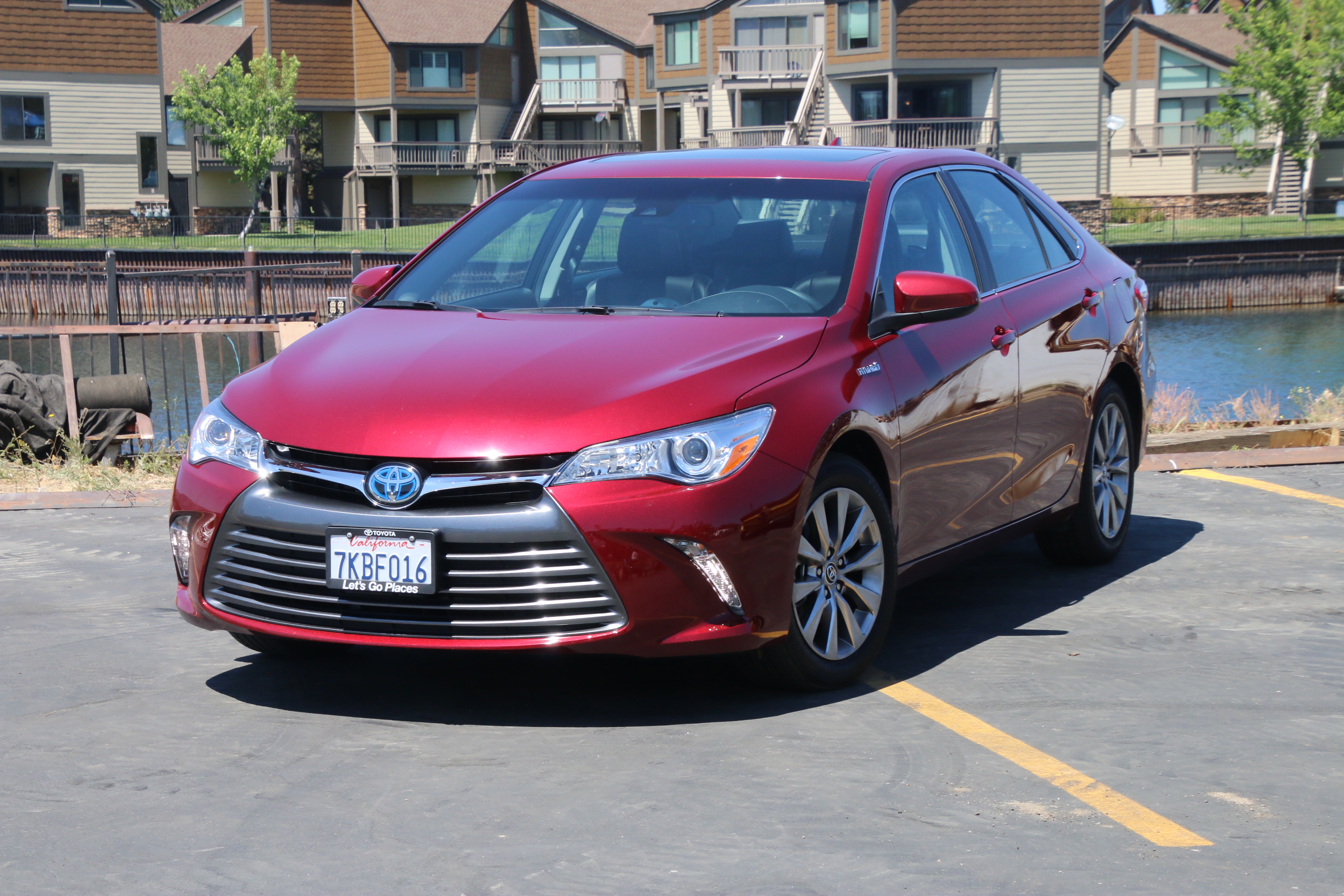
The Toyota Camry continues to evolve and be at the top of its class. Photos/Larry Weitzman

The Toyota Camry continues to evolve and be at the top of its class. Photos/Larry Weitzman

By Larry Weitzman

Now in about its eighth generation, the Camry, which holds the title of the largest selling American made car in the U.S. (about 430,000 annually), is one of Toyota’s bread and butter vehicles. It has the reputation of being bullet-proof among its quality attributes.

Having tested several recent models, it is understandable. While it may not be the best handling, most economical or best performing in its midsize class, it still is always at the top of the sales charts because of its quality reputation and because since most drivers don’t track their vehicles on the weekends or engage in autocross and club racing events, drivers appreciate the Camry’s features of comfort and quiet while still performing well in other categories. Toyota Camry is, as Bob Lutz said 10 years ago, a default brand or model. It has such a reputation; buyers don’t think about other brands as the Camry has the aura of being a great car. And it is.

Face-lifted in 2015, the Camry has an overall pleasing appearance, but the front end still looks like a big frown. From the side and rear it looks great. Another issue I have is the new side view window line, while better looking than before, it uses a metal applique behind the rear window to lengthen the line instead of more side glass. Size-wise, the Camry defines the class with a 109-inch wheelbase and a length of 191 inches. Width is 72 inches while the Camry stands 58 inches tall. Camry has a very low coefficient of drag of 0.27.

Under the hood is a Toyota synergy system of combining a four cylinder DOHC, 16 valve gas engine that puts out 156 hp at 5,700 rpm plus 156 pounds of twist at 4,500 rpm with a 141 hp electric motor (at 4,500 rpm) and 199 pounds of twist at 0-1,500 rpm. But the combined power is not 297 hp (156+141), it is a more modest 200 hp. The reason being a limitation on the electrical energy output of the nickel-metal hydride battery of just 44 hp. By tightly controlling battery discharge and recharge rates the Toyota hybrid batteries almost last indefinitely, probably outlasting the rest of the car.

Camry hybrid outperforms its conventional counterpart with a significantly quicker 0-60 mph run of 6.79 seconds putting the Camry in a class of very high performance automobiles. Passing performance in simulated 50-70 mph runs required 4.03 seconds on level ground and a very quick 5.42 seconds up a 6-7 percent grade. The standard four cylinder Camry SE had times of 7.47, 3.99 and 6.19 seconds respectively. With the Hybrid, the kick in of the electric boost sometimes took a tenth or two, sort of like turbo lag, but once online, this hybrid scoots.

I also found while braking is linear, the throttle wasn’t, sometimes giving you more power from the engine room than desired. I am sure that this just requires some more miles to dialing in the right amount of acceleration. The only other niggle is feeling a tish of roughness from tip in when the gas engine comes online. But this condition now affects most cars including BMW which have auto engine stop and start features. There is no question this new hybrid is a solid performer.
Specifications Price (base including transportation) XLE $30,140 to over $35 large loaded up. Engines 2.5L, DOHC 16 valve inline four 156 hp @ 5,700 rpm  156 lbs.-ft. of torque @ 4,500 rpm  Electric system 141 hp electric motor @ 4,500 rpm 199 lb.-ft. of torque from 0-1,500 rpm 244.8V, 6.5 a/h nickel metal hydride battery; max voltage output 650 About 44 hp of energy Combined power output 200 hp Transmissions CVT  Configuration Transverse front engine/front wheel drive Dimensions Wheelbase 109.3 inches	 Length 190.9 inches Width 71.7 inches Height 57.9 inches Track (f/r) 62.4/62.0 inches Ground clearance 6.1 inches Weight 3,305 pounds Tow capacity 1,000 pounds Passenger volume 102.7 cubic feet Trunk capacity 13.1 cubic feet  Fuel capacity 17.0  Steering lock to lock 2.85 turns Turning circle 36.7 feet Wheel sizes 7X17 inches alloy Tires 215/55X17 Co efficient of drag 0.27  Performance  0-60 mph 6.79 seconds 50-70 mph 4.03 seconds 50-70 mph uphill 5.42 seconds Top speed Do you think that any of the prior nine or so million Camry buyers in the United States really care (except for the NASCAR drivers)?  But without intervention electronic or otherwise even the four cylinder should top out at close to 130 mph (but not with me in the car). Fuel economy EPA rated at 40/38/40 mpg city/highway/combined. Expect to achieve 40 mpg in overall driving and 43 mpg plus on the highway at legal speeds.

Specifications
Price (base including transportation) XLE $30,140 to over $35 large loaded up.
Engines
2.5L, DOHC 16 valve inline four 156 hp @ 5,700 rpm
156 lbs.-ft. of torque @ 4,500 rpm
Electric system
141 hp electric motor @ 4,500 rpm
199 lb.-ft. of torque from 0-1,500 rpm
244.8V, 6.5 a/h nickel metal hydride battery; max voltage output 650
About 44 hp of energy
Combined power output 200 hp
Transmissions
CVT
Configuration
Transverse front engine/front wheel drive
Dimensions
Wheelbase 109.3 inches
Length 190.9 inches
Width 71.7 inches
Height 57.9 inches
Track (f/r) 62.4/62.0 inches
Ground clearance 6.1 inches
Weight 3,305 pounds
Tow capacity 1,000 pounds
Passenger volume 102.7 cubic feet
Trunk capacity 13.1 cubic feet
Fuel capacity 17.0
Steering lock to lock 2.85 turns
Turning circle 36.7 feet
Wheel sizes 7X17 inches alloy
Tires 215/55X17
Co efficient of drag 0.27
Performance
0-60 mph 6.79 seconds
50-70 mph 4.03 seconds
50-70 mph uphill 5.42 seconds
Top speed Do you think that any of the prior nine or so million Camry buyers in the United States really care (except for the NASCAR drivers)? But without intervention electronic or otherwise even the four cylinder should top out at close to 130 mph (but not with me in the car).
Fuel economy EPA rated at 40/38/40 mpg city/highway/combined. Expect to achieve 40 mpg in overall driving and 43 mpg plus on the highway at legal speeds.

But its fuel economy as to why most people opt for the Camry Hybrid. EPA rated at 40/38/40 mpg city/highway/combine fuel economy, you can expect to do a little better. Overall the Camry averaged between 38-40 mpg mostly in rural country driving, but its highway fuel economy averaged on a two way run at 70 mph 43.3 mpg. In a run to South Lake Tahoe and back to Placerville the Camry averaged 40.4 mpg. Those numbers show a 5-10 percent improvement over the EPA test cycle. In fact, when reviewing the recent Camry SE test fuel economy numbers, overall mileage was up by almost 10 mpg and highway mileage was up by 4-5 mpg.

My XLE tester came standard 17 inch alloys and 215/55 rubber instead of the LE’s 16-inch steel wheels and 205/65 shoes. The SE model also gets the upgraded wheels and tires. If you like good handling, opt for the XLE or SE. Suspension is MacPherson struts up front and a fully independent multilink system in the rear. Steering is performed by an electric rack that is less than three turns lock to lock. I have driven hundreds of different cars and I have to tell you unless you are doing club racing or auto crossing, the handling of this hybrid is impressive. Body roll is well controlled, understeer in mild and it has plenty of grip. In my trip up Highway 50 and other twisties, this hybrid handled so well at even slightly supra legal speeds it might impress Kyle Busch. Wait a minute, Busch drives a Camry in NASCAR racing even though NASCARs are anything but a stock car. Ninety-nine percent of all drivers will be impressed by this Camry’s handling.

But its ride and quiet where the Camry Hybrid shines. Even my brother whose normal ride is an almost new near luxury sporting sedan was impressed with its ability to handle bumps and its anechoic chamber quiet. On smooth roads while doing about 48 mph on pure electric (it’s about the max speed on pure electric) Camry becomes a magic carpet. There is no tach so engine speed at 70 mph is unknown, but considering its fuel economy it’s probably below 2,000 rpm.

Of course, safety is second to none with four wheel discs brakes and all the safety acronyms including smart stop technology. My tester had the Advanced Tech Package ($750) which gets you the pre-collision system, lane departure alert, radar cruise and auto high beams (great head lights, too). Blind spot detection and rear cross traffic alert was in another package ($500).

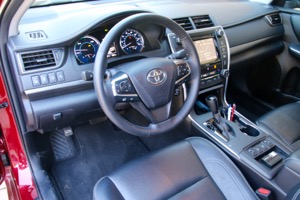
Inside was a standard leather trimmed interior and sublime seating. The instrument panel was pretty standard nowadays with a Hybrid info gauge taking the place of the tach which is separated from the large speedo by an info center and trip computer. The center stack, HVAC and sound system is a snap to use. Rear seating is good for three June Taylor dancers. About the only compromise for the hybrid system is the trunk which is 13 cubic feet (the battery system takes up a couple cubic feet).

Sticker shock is not that bad even though this is a partially electrified vehicle. A base LE is just $26,790 plus the train fare ($865) from Georgetown Kentucky. Step up to the SE (recommended) and the sticker rises to a reasonable $27,995 and my leather loaded XLE stickers at $30,140. My tester had about $4K in options including its Ruby Flare Pearl paint ($395) bring the total to $35,800 all in. Now understand that is only about $2K more than the Prius I just tested (it was about $33,800) and a nicely equipped SE with the same options as this XLE would sticker for less than the Prius. Sure the Prius gets about 10 more mpg, but 40 plus mpg day in and day out is still excellent fuel economy. And the SE gets to 60 mph over 4 seconds quicker and accelerates up a steep grade in half the time.

Unless 50 mpg is a must, the Camry Hybrid SE, which is about the same price as a Prius, would be far and away my choice. It so much more car for the money. And it’s still a Toyota using the same power system.

Larry Weitzman has been into cars since he was 5 years old. At 8 he could recite from memory the hp of every car made in the U.S. He has put in thousands of laps on racetracks all over the Western United States.



Truckee K-9, handler earn top honor

Truckee police Officer Andrew Holbrook and Trax have been named the top narcotics competitor of the year by the Western States Police Canine Association.


Holbrook and Trax competed in five of the six K-9 trials this year. They earned eight awards, including two overall first place finishes.

Trax joined the Truckee Police Department in the fall 2013 when he was 2.


For people of color, hiking isn’t always an escape

By Benjamin Spillman, Reno Gazette-Journal

Earlier this summer Jenna Yokoyama set out to plan a backpacking trip to northern Idaho.

But before committing she wanted to know if non-white hikers would be safe in a region known as a hotbed for white supremacists.

It was an important question for Yokoyama, 34, a Japanese-American and avid hiker who said several years earlier she was a target of racial taunting in Lone Pine while hiking the Pacific Crest Trail.

She posted invitations in Facebook groups for the Pacific Crest, John Muir and Appalachian trails.

Almost immediately the posts generated dozens of comments, many supportive but others accused her of everything from promoting separate trails for white people and non-white people, seeking to form exclusive cliques and even warning her to stay off the trail because she wasn’t worthy of search and rescue help should she get in trouble.

Moderators of the various trail groups sought to prevent hateful and ignorant comments, but the damage was done.

Read the whole story