Cave Rock tunnel, paving complete

Cave Rock tunnel and Highway 50 upgrades were finished one month ahead of schedule.

All travel lanes through Cave Rock are now open.

The $6 million project extended the westbound, lakeside Cave Rock tunnel entrance. The new approximately 60-foot long and 27-foot tall structure is designed to enhance safety by catching rock fall before it reaches the roadway.

Lighting and white paint were added inside each tunnel for better visibility. Two radar-activated overhead signs installed to automatically notify drivers of bicyclists or potentially icy conditions in the tunnels.


Threats against West Slope firm end with prison term

A Washington state man is going to prison for posting several threatening statements on a news website in which he expressed his intent to kill an officer of Placerville-based company Stem Express LLC.

According to court documents, Scott Anthony Orton, 57, wrote, “The management of StemExpress should be taken by force and killed in the streets today. Kill StemExpress employees. I’ll pay you for it.” Orton also identified the target of his threats by name, and wrote “I’ll pay ten grand to whomever beats me to [the target].”

The Puyallup, Wash., man was sentenced to to one year and one day in prison for transmitting interstate threats.

— Lake Tahoe News staff report


Hwy. 267 delays this week during paving

Motorists on Highway 267 can expect delays the rest of this week as Caltrans paves at Old Brockway Road and Soaring Way.

Maintenance crews will close alternate lanes and use one-way traffic controls from 7am-5pm Oct. 5-6 and possibly Friday form 7am-4pm.

Crews will grind and pave the deteriorated and cracked asphalt. New striping will also be placed after the paving operations are completed.


Douglas County collecting unwanted drugs

Douglas County Sheriff’s Office will be partnering with the Drug Enforcement Agency in hosting a drug take back on Oct. 22.

This is the public’s opportunity to prevent pill abuse and theft by ridding homes of potentially dangerous expired, unused or unwanted prescription drugs. Pet medication is also accepted.

Bring pills for disposal at the following locations between 10am and 2pm:

  • East Fork Fire Station No. 12, 3620 N. Sunridge Drive (north Douglas County )
  • East Fork Fire Station No. 4, 1476 Albite Road (Topaz Ranch Estates – south county)
  • Walgreen’s, 1342 N. Highway 395, Gardnerville
  • DCSO Tillman substation, 1281 Kimmerling Road, Gardnerville
  • Safeway, 212 Elks Point Road, Round Hill.

The DEA cannot accept needles or sharps. Only pills, patches or liquids will be accepted. The service is free and anonymous, no questions asked.


Editorial: Vogelgesang, Exline for STPUD

Publisher’s note: The following endorsement is from Lake Tahoe News after a team of seven community members gathered to discuss who should be on the South Tahoe Public Utility District board.

Water and sewer are not sexy topics. However, in today’s world water is only going to become more important. That is why it is vital the best people possible are in charge of overseeing the operations at South Tahoe Public Utility District.

The board needs to be comprised of people who understand the intricacies of the operations and have a vision for the future. Lake Tahoe News believes Randy Vogelgesang and Nick Exline have those qualities.

Randy Vogelgesang

Randy Vogelgesang

Vogelgesang is the current board chairman and is finishing his first four-year term. Being a civil and structural engineer have helped him to grasp the finer details of the largest water-sewer district on the South Shore.

He has consistently been fiscally conservative. In 2014, he voted against giving employees a raise. “I felt that I needed to try to keep any pay increases as low as possible considering the economic situation of the ratepayers,” Vogelgesang told Lake Tahoe News. While he was on the losing end of that vote, we appreciate that he was considering the people he represents – the ratepayers, not the workers. When it comes to employee benefits, he said, “I would prefer a defined contribution over a defined benefit plan as a way to control costs.”

Nick Exline

Nick Exline

Exline is a breath of fresh air. His energy is infectious and his ideas plentiful. While he is running on a platform to increase renewable energy, he will likely soon learn that economically it could be an uphill battle. Nonetheless, we applaud him for bringing ideas to the table.

After all, it is the board that is supposed to be the policymaker and staff is there to do the work. Maybe it’s time for South Tahoe PUD to look at different policies. Providing clean water and treated effluent that is near pristine are in some ways doing the minimum. That is not to take away from the hard work involved to make all of this happen. But the status quo from the board needs shaking up a bit.

There needs to be more vision. That is one reason we cannot endorse Kelly Sheehan for another term.

While South Tahoe PUD has enough water for the next 30 years, that doesn’t mean the district can ignore what is going on in the rest of the state and in Nevada when it comes to drought, domestic water and farming needs; nor can it turn its back on climate change; and it’s scary to acknowledge with the 10-year anniversary of the Angora Fire coming up next June that the service area still does not have adequate water lines for fire suppression.

There is much more for the district’s board to do than worry if a toilet flushes and if clear water comes out of the spigot. We need leaders with vision on the South Tahoe Public Utility District board. Vogelgesang and Exline fit that description.


Opinion: More people should retire like Vin Scully

By Joe Mathews

If only more Californians could retire like Vin.

Vin Scully, that is. The Hall of Fame announcer for the Los Angeles Dodgers called his last game Sunday, a month shy of his 89th birthday. That retirement has touched off a national celebration of Scully’s announcing mastery and his contributions to baseball through 67 years with the Dodgers.

Joe Mathews

Joe Mathews

But what deserves more attention—including from Californians who couldn’t care less about sports—is the smart, progressive way he planned his retirement.

In this country, retirements are often abrupt. People depart the workforce suddenly and at a time decided by numbers—a company rule, a buyout, Social Security calculations or retirement benefit formulas—not what’s best for retirees or the workplaces they’re leaving.

Scully’s retirement, by contrast, was anything but abrupt. He phased in his departure over two decades. Back in the mid 1990s, as he approached the age of 70, Scully—who in his prime announced not just Dodger games but also national football, baseball and golf—pared back his duties. He focused solely on baseball, then dropped national broadcasting. Then, a decade ago, he gradually reduced his Dodger obligations, mostly by limiting his travel to road games. In his final year, he has worked home games almost exclusively.

Describing this long phase-out, Scully once said, “I would like to disappear like the Cheshire Cat, where … the only thing left is a smile.”

The Cheshire Cat Strategy has been a success. Scully has remained robust, his sharp, wide-ranging observations carrying nine innings of a game—solo—with characteristic ease. The myriad tributes to him now emphasize how his knowledge and long memory have made him a back-office resource to the nation’s second most-valuable baseball team. And fans treasure how he’s connected them and their families across more than three generations.

Could Scully’s phased retirement be a model for other Californians? The question might seem daft. After all, this state famously thinks little about its older citizens (Scully is a special case), preferring to celebrate younger technologists and stars who “disrupt” the established. And retirement has become one of California’s nastiest legal and political minefields, especially when the conversation turns to pensions and retiree health care for government workers.

These pension wars leave little room for a conversation about how we might make the so-called golden years better for all of us—for retirees, for businesses, for governments. But that’s precisely the conversation California needs to have.

Our state is rapidly aging; the number of people 65 and older is projected to nearly double by 2030, while immigration is flat and our birth rate declining. So California urgently needs its most senior citizens to be more productive.

Instead, we watch as valuable baby boomer workers retire, leaving huge voids of knowledge and skill that can’t easily be filled. Government agencies in particular are finding it hard to hire and retain replacements for retirees who had specialized knowledge and high-level skills. New hires too often leave after they’re trained, because they can make more money in the private sector.

Part of the answer to this problem lies in Scully’s example: we must make it possible for valuable workers to stick around into late old age. The central principle is flexibility: the ability to mix varying levels of work with life in a way that makes both better.

But our retirement and work systems aren’t agile enough. To the contrary, they’re highly complicated, so full of rules that designing a flexible schedule, while legally possible, can be more trouble than it’s worth.

Legal scholars advise me that legislation would be needed to establish a new category for workers who want flexible, phased retirements in the public sector. So I hereby propose that California governments create the Vin Scully Phased Retirement Plan. When employees reach retirement age, they should be able to enter into a phased plan, subject to the approval of their supervisors, which could be altered by mutual agreement. The details could get complicated, but one goal of the Scully Plan should be to ensure that phased retirement neither hurt, nor spiked, the employee’s retirement benefits.

Phased retirements are hardly new. Just ask emeritus professors or senior-status judges. And they make sense. Why should a state that has paid employees for so long completely lose the benefit of their experience and knowledge? And maintaining connections to work and colleagues can be good for retirees, keeping minds sharp and even extending lives, some research suggests.

“Hang in there,” is cliché, in sports and life.  But it would represent real progress as a principle for reorganizing how we work late in life. “All I know,” Vin Scully recently said, “is I’m eternally grateful for having been allowed to work so many games.”

Joe Mathews writes the Connecting California column for Zócalo Public Square.



Snippets about Lake Tahoe

·       Tahoe City XC is having ski swap Nov. 12. A percentage of each sale will benefit the group’s profit programs. Bring equipment to sale to the center on Nov. 11 from 3-8pm.

·       Here is the El Dorado-Tahoe roadwork schedule from Caltrans for this week.

·       The Washoe County Sheriff’s Office Citizen Corps is offering an emergency preparedness and response training academy beginning Oct. 13. For more details, go online.

·       Karen Fink, who has been a transportation specialist at Tahoe Regional Planning Agency for more than a decade, is stepping down.

·       Ann Harmon will share information about Project Vote Smart – The Voter’s Self Defense System on Oct. 12 from 4:30-6:30pm in the board room at Lake Tahoe Community College. Then the mother-daughter duo of Del and Brooke Laine, both of whom have served on the South Lake Tahoe City Council, will talk about women in politics. The free event is being put on by the AAUW.


Elementary students learn intricacies of water

Sierra House second-grader Aeron Pettus helps his team in the water relay competition on Oct. 3. Photo/Kathryn Reed

Sierra House second-grader Aeron Pettus helps his team in the water relay competition on Oct. 3. Photo/Kathryn Reed

By Kathryn Reed

Not everyone in the world – even in the United States – has running water. And while this might be common knowledge for adults, students in Lake Tahoe Unified School District have a better understanding of that reality after hauling water from one container to another.

This is just one of the hands-on lessons that is part of Wonders of Water.

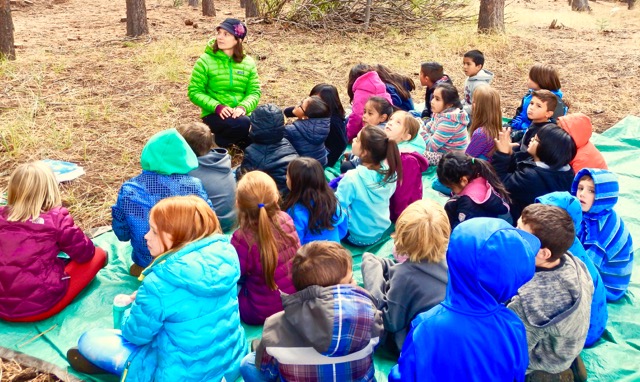
Each elementary grade level is spending time outdoors, right near their campus, learning various aspects of water.

“I learned how invasive species break the life cycle,” Aeron Pettus told Lake Tahoe News.

The Sierra House Elementary School second-grader was a tui chub. He was at the top of the food chain – eating the daphnia, which feasted on the phytoplankton. But then an Asian clam came along and disrupted the food chain.

Invasive species and the harm they can do was one lesson the youngsters learned. The importance of cleaning boats was stressed.

At another station in the wooded area beyond the playground students were asked to pay attention to what was growing nearby.

They were quick to know that “trees help you breath” and they “make oxygen.”

Maria Mircheva with the Sugar Pine Foundation talks about trees and bushes. Photo/Kathryn Reed

Maria Mircheva with the Sugar Pine Foundation talks about trees and bushes. Photo/Kathryn Reed

Maria Mircheva with the Sugar Pine Foundation explained how willows are deciduous – meaning they shed their leaves – and how the Washoe Indians used to use their branches to make baskets.

Manzanita, she told them, means little apple in Spanish. The berries on it are said to look like apples. It falls into the evergreen category, just like the towering pines.

Donielle Morse with South Tahoe Public Utility District explained how most of the water used in South Lake Tahoe comes from wells. But then she got into what happens if you don’t have a faucet. That’s when the students participated in a relay race to see what it was like to haul water from one area to another without spilling, but still doing so quickly. This was to simulate what it might be like to haul water from a lake to a dwelling.

Other agencies helping on Oct. 3 were the U.S. Forest Service, Tahoe Regional Planning Agency, Sugar Pine Foundation, and Lake Tahoe Humane Society. Lake Tahoe Educational Foundation and the Optimist Club helped to fund the districtwide program.

All of the instruction meets the state science standards. Each year Beth Quandt, science outreach coordinator for LTUSD, works with teachers and presenters to improve on the stations.

At Sierra House a fence that was just beyond the playground has been removed, which has created an outdoor classroom of sorts.

“Now that the teachers know some of things that are out here they can bring their classes out here to continue the learning,” Quandt told Lake Tahoe News.


Letter: Kirkwood gives back at Bread & Broth

To the community,

On Sept. 12, Tim Edison, a member of Kirkwood Mountain Resort’s security team, spent three hours volunteering at Bread & Broth’s dinner serving folks who struggle with hunger.

“Having this opportunity to help the community and the less fortunate, has been an amazing experience,” said Edison. “Bread & Broth sends people away with a full belly and a smile. This is an experience I will always remember and want to do again.”

Due to Kirkwood Mountain Resort’s Adopt A Day sponsorship, Edison along with fellow sponsor crew members Jarret Morgan, Chris Hostnik, and Verge Soteco volunteered to work alongside B&B’s volunteers to provide a hearty meal featuring a chicken cacciatore entree served with roasted cauliflower, cheesy roasted potatoes and green and fruit salads. In addition to serving dinner, this enthusiastic crew helped dry dishes and stayed until after 6pm helping with the dining and kitchen area cleanup.

Thanks to the generosity of Kirkwood Mountain Resort and this very helpful sponsor crew, B&B was able to help food insecure folks in our community. Unfortunately, folks who live on fixed incomes, work at minimum wages jobs, struggle with physical and mental issues or have fallen on difficult times often desperately need help obtaining just the basic needs in life. B&B Adopt A Day sponsors are the heroes in their lives.

For more B&B information, contact me at 530.542.2876 or carolsgerard@aol.com.

Carol Gerard, Bread & Broth


‘Mountain of Storms’ captures storied Patagonia trip

“Mountain of Storms” documents the storied 1968 road trip adventure of five friends: Yvon Chouinard, Doug Tompkins, Dick Dorworth, Chris Jones and Lito Tejada-Flores. Piled into an old sketchy van, the group embarked on a 5,000-mile journey from California to Patagonia to attempt a new route on Cerro Torre’s infamous Fitz Roy.

Along the way the friends found surf, skiing and climbing as they headed southward toward the then still-mythical land of Patagonia.

Though the friends did not know it at the time, “Mountain of Storms” would inspire and pave the way for the modern-day adventure film category. At the time of the adventure they were merely seeking a better way to tell the story to their friends upon returning home. Accordingly, the group shot film on hazy 16mm film to a soundtrack of contemporary folk-rock; the result was a cult classic that has endured the test of time and inspired generations of adventure seeking “fun hogs.”

In addition, each individual from the trip would go on to play a prominent role in the outdoor industry, as founders of Patagonia, The North Face and Black Diamond Equipment. The road trip would forever change the lives of each person in the group and help ignite a golden era for new and cutting-edge outdoor companies. Each one of these men would continue as pioneers of the outdoor industry, stewards of the environment and land conservationists.

“Mountain of Storms” van adventurer Dick Dorworth will be the featured guest at the film premier on Oct. 19 at 7pm at Tahoe Art Haus & Cinema in Tahoe City. Tickets are $13 in advance and $15 at the door.