Sierra’s snow-skateboard course goes national

By Susan Wood

Athletes who make their living on boards appear to never be bored.

And television viewers may get a glimpse of why when they tune in this Sunday to ABC’s weekly “World of X Games” show at 1pm.

A 22-minute short film is embedded in the show highlighting a first-time double snowboard-skateboard course constructed at Sierra-at-Tahoe last May.

SuperSnake, as it’s aptly called, features competitive and professional skateboarders and snowboarders slithering down the board-and-snow, 1,000-foot-plus course on the Broadway run to the base of the Tahoe area ski resort.
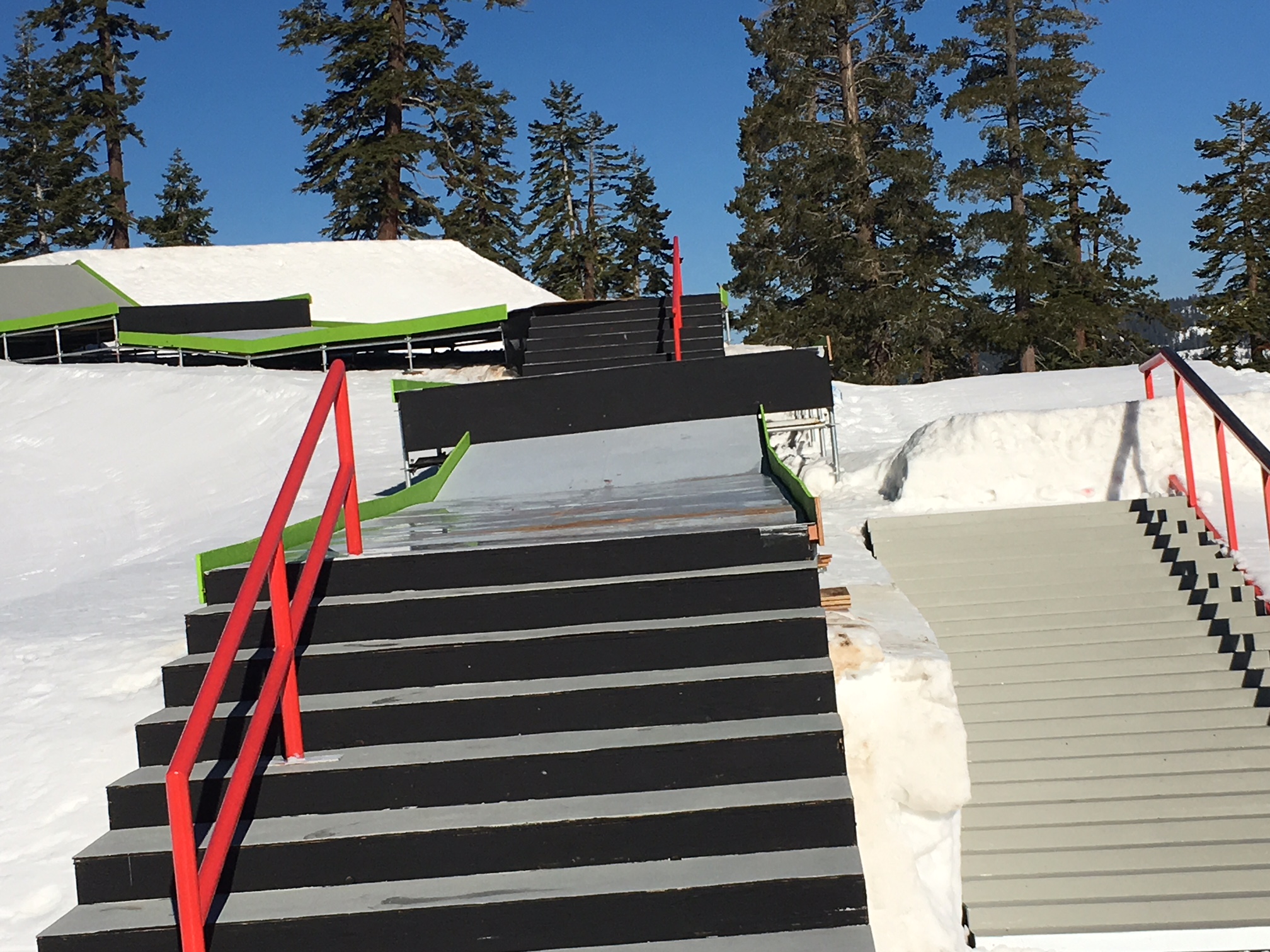
Sierra-at-Tahoe briefly became a skateboard park after the resort closed last spring. Photo/John Rice

Sierra-at-Tahoe briefly became a skateboard park after the resort closed last spring. Photo/John Rice

The customized course took two weeks to build, with more than 2,500 man hours and 20 tons of snow. It has combined skate and snow park features, including jibs, hips, quarter pipes and volcanoes in a boarders’ paradise.

The brainchild of the adrenaline junkie’s drink Mountain Dew, the Sierra-at-Tahoe venture with Snow Park Technologies and CA RampWorks remained somewhat hush-hush since all this occurred after last year’s ski season.

“Coming off such a great season for snow, we had the ability to create the project and show off the resort. The build is a story unto itself. The TV show made for the ‘World of X Games’ will focus on the creativity of the project from vision to execution, as well as highlight the challenges of blending the two board sports,” Sierra-at-Tahoe General Manager John Rice told Lake Tahoe News.

The players had worked together before, so the trust was already there, Rice declared.

“The World of X Games’ special and the online show were spot on with our brand strategy for reaching the demographic,” he added.

Indeed. Lauren Machen of Fuse, who handles Mountain Dew marketing, dictated a 16-34 young male millennial as the target audience. There’s also the propensity to reach a slightly broader audience by simply having the show run on ABC.

Machen said competitors in these action sports “like to do new things,” otherwise, they feel “they can get stale.”

“We like to figure out ways to keep it fun and fearless,” she said. “This is the trend. Mountain Dew has instigated creativity in action sports for over 20 years.”

The soft drink company is preparing to put on the well-known Dew Tour at Breckenridge, Colo. in December – but other events featuring boarders will become more pronounced in the coming years.

For big-time starters, skateboarding and surfing were announced as new sports in the 2018 Summer Olympics in Tokyo. Machen predicts viewers will see more side-by-side events as elite athletes thrive on watching other moves from their fellow competitors.

About a dozen skateboarders and snowboarders took part in the inaugural project – including Olympic snowboarder and Dew rider Danny Davis of Truckee.
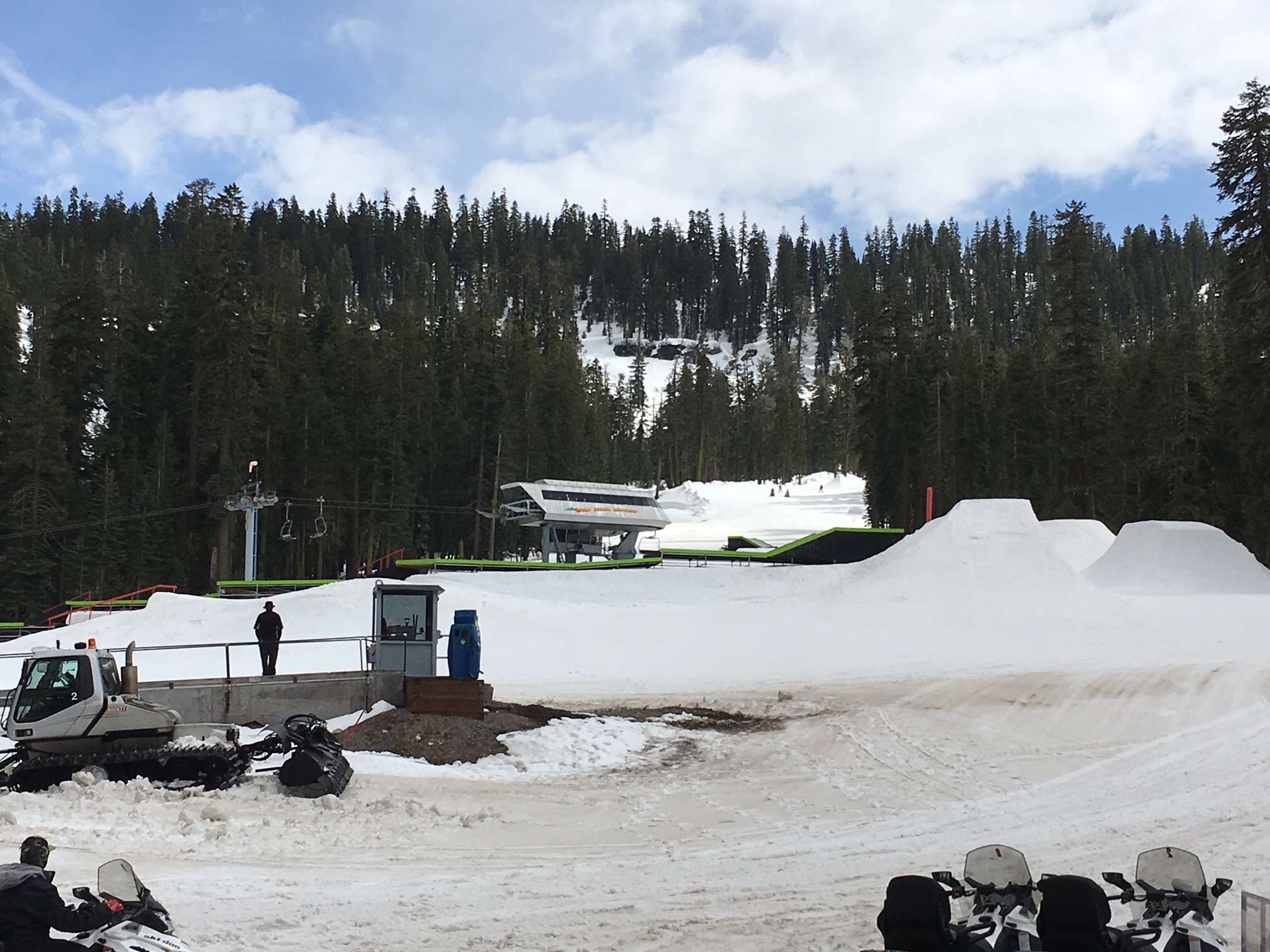
Skateboarders and snowboarders compete together at Sierra-at-Tahoe. Photo/John Rice

Snow is moved to create a one-of-a-kind snowboard and skateboard venue at Sierra. Photo/John Rice

“It’s really awesome to have skateboarders and snowboarders come together on one course,” said Davis, who was considered one of the top 10 riders of the year by Snowboarder magazine in 2008. “SuperSnake pushes the creativity and stylistic riding through the athletes’ visions and the course builders’ innovations and expertise. But most importantly, it’s always about progressing the sports and having fun.”

Davis is joined by professional Mountain Dew skateboarder Sean Malto and competitive snowboarders Jeremy Jones and Scotty Lago. Dew skate athletes Trevor Colden, Chris Colbourn, Jordan Maxham, Nick Tucker and Micky Papa are also in the mix.

The trailer shows a sense of camaraderie and appreciation for each other’s skills among the athletes.

Moreover, the sports do represent a good time for the fan base as well.

“SuperSnake’s concept showcases Mountain Dew’s ongoing support of creating original, fun and progressive opportunities for both our athletes and fans to enjoy,” Mountain Dew Senior Vice President of Marketing Greg Lyons said.



Opinion: How librarians quietly shape the future

By Ian Collins

“Librarians? They’re still around?”

It’s one of countless sarcastic jokes about my profession that I’ve heard for years, each of them landing with all the comedic force of late-period Carrot Top props. If you search online for the combination “libraries” and “dead” you’ll find various articles proclaiming the same sentiment.

I get where this perception comes from. Google and Wikipedia can answer a lot of basic questions that we librarians used to tackle. Issues arising from unglamorous arguments over budgets or the government have also made times difficult for libraries, librarians, and other information professionals. But now that we’ve acknowledged those truths, it’s important to mention another: That librarians today influence the cutting edge more than ever before. We use our skills to bring pieces of the future to wherever you are.

Perhaps that’s why ours has become one of the professions that fixed-gear, bike-riding, tattooed hipster types have moved to in droves, as reported in an obnoxious style section article in the New York Times. Maybe that’s why some of our profession’s lingo, words like “metadata” and “curation,” have now found their way into the popular culture and lexicon. Seriously, you can’t throw a stone and not hit someone who is a “curator” of some obscure material or pursuit.

In any case, the idea of the librarian just sitting there in a quiet large building, wearing a cardigan and waiting for you to visit, is the only thing that is caught in the past. Even though we do love a good visit, and always have a cardigan ready for when the building’s climate control inevitably lets us down.

This might even be a golden age for librarians, sometimes now categorized as “information professionals.” Our culture seems to have reached peak curation, where almost every form of content is carefully chosen and presented for consumption, and the tech world is rushing to organize (and monetize) the insane amounts of information available at our fingertips. We librarians are right at the middle of it all, collaborating on all sorts of new projects and applications.

Look no further than Spotify, the streaming music application used by millions every day. It collects and provides access to millions of songs, features a searchable catalog, and curates quality choices that cut through the maddening amount of material that’s available. That sure sounds like the kind of things librarians do every day.

So it shouldn’t be a surprise that companies like Spotify and Facebook do in fact have librarians (more than one even!) on staff who collaborate with developers and other bright people to cultivate an experience that has become embedded in your daily internet habits. Of course, they may or may not be called “librarians” in these positions, but the skillset is the same. Cataloging, curation, metadata creation, data management, programming. From the visual presentation of the app, the extensive organization of the information, down to the algorithm that selects songs for your Discover Weekly playlist—our fingerprints are appearing in the core of these new media applications.

Librarians are also innovating via new initiatives within more traditional spheres, pooling our resources and brainpower to build systems and applications that bridge past ideals with current trends and future possibilities. One result of these efforts has been a push to build portals that harness existing digitization efforts to make archives and special collections materials more available to people where they live, via mobile phones and the internet. This offers researchers the information equivalent of one-stop shopping.

Take the creation of the Digital Public Library of America (DPLA), a major leader in this realm. Using metadata records as its engine, this portal brings together millions of items from museums, academic libraries, and public libraries from all over the country in one searchable site. For example, if you were searching for information about the Gold Rush, you could pull whatever materials are available via your local library or university catalog, but DPLA gives you the opportunity to find materials documenting different experiences via libraries in California, Washington, or beyond with one search.

Furthermore, all of the data is open-access, which means any librarian anywhere can grab it and transform it to develop new applications and unique experiences for users. Omnia, for instance, merges all of DPLA’s data with all the entries from another large European library portal, creating a searchable timeline.

Silicon Valley companies have enviable research and development budgets, but they often lack the collaborative spirit and greater-good mentality that drives public-sphere librarians. In the meantime, many libraries, especially in public and academic institutions, have money to keep the lights on and provide key services like reference and outreach, but don’t always have the means to innovate or build new projects. We have to hunt for outside funding opportunities, competing to score grants to push new initiatives. A frustrating number of good ideas can’t find funding and miss their window of opportunity.

Burnout from this battle for dollars is one of the most significant threats to public sector librarianship as it currently stands, dis-incentivizing librarians to dream up creative ways to make knowledge and information available to the wider world. Yet we’re a more resilient bunch than you think. We’ve already survived the transition to the computer age, Google, even e-books—what’s another set of challenges?

It’s officially time to toss those old jokes into the vortex where Borat impressions now reside and allow our perceptions of the librarian to evolve. We’re constantly adding new skills, services, and technologies to our expansive toolkit, even if sometimes we have to implement them in the scrappiest way possible. This gives us the ability to move across various industries and shape them with our influence.

I’m not sure where it’s written in the ancient library tomes just how much flexibility and evolution this profession actually requires. But the nature of our work ensures that, despite claims to the contrary, we’ll never be stuck in the past. For librarians, the future is always right now.

Ian Collins is an American writer with a British name and is currently the digital services librarian at the University of Illinois at Chicago.


America’s hardiest hikers blaze new long-distance trails

By Benjamin Spillman, Reno Gazette-Journal

It’s tough to find a tougher hiker than Mary Kwart.

The 64-year-old former wildland firefighter has tackled some of America’s roughest routes, including the Pacific Crest, Grand Enchantment and Hayduke long distance trails.

But Kwart, of Ashland, Ore., nearly met her match last year in the Siskiyou Wilderness, a 180,000-acre swath of remote mountains and forest in northwestern California.

That’s where she found herself dragging her backpack while crawling beneath dense brush during a through-hike of the newly-designed Bigfoot Trail.

Such is life for people at the forefront of hiking and backpacking in America, many of whom gathered recently in Nevada City for the American Long Distance Hiking Association West’s annual get-together.

Read the whole story


Martis Valley West approved; lawsuit possible

Placer County supervisors on Tuesday voted 4-1 to approve the controversial Martis Valley West project.

Supervisor Jennifer Montgomery, where the 760-unit gate community would be built, voted no.

Opponents, of which there are many, have 30 days from Oct. 11 to file a lawsuit to stop the project. Many expect the courts to eventually weigh in regarding the validity of the environmental document as well as state law.

The supervisors initially voted last month to approve the project.  A few details needed to be worked out, which required the vote today.

County counsel has said the environmental document is sound and is not worried that the Attorney General’s Office said otherwise.

Mountainside Partners of Truckee, the developer, and landowner Sierra Pacific Industries have been working on this project for at least 10 years. Build out is expected to take 20 years.

The project has been controversial because it takes undeveloped land in Truckee that borders Lake Tahoe and turns it into a subdivision for second homeowners. The proponents have said they expect 20 percent or less full-time occupancy.

“The Martis Valley West project is a combined conservation and development plan that serves to complete a remarkable vision,” developer Blake Riva said in a statement. “The project relocates future development to an area adjacent to an existing resort, significantly reduces the amount of allowable density, protects highly coveted open space in the heart of Martis Valley and provides outdoor recreation opportunities for the community.”

Tom Mooers with Sierra Watch stated, “Today’s approval was a vote against everything we love about Martis Valley and North Lake Tahoe. It was also illegal, and we’re committed to take action to defend Tahoe’s incredible scenery and the clarity of the lake itself.”

— Lake Tahoe News staff report


West Slope control burn blowing smoke to Tahoe

Smoke in the Tahoe basin is being blamed on a controlled fire in Eldorado National Forest, according the U.S. Forest Service.

Not only is the smoke visible, but the smell is strong.

The feds plan to continue the burns more days this week. A couple hundred acres are being treated.

— Lake Tahoe News staff report


Climate cracks showing in Nev. pine nut harvest

By Henry Brean, Las Vegas Review-Journal

BAKER — Along a dirt road just north of Great Basin National Park, Dayer LeBaron plucks a cone from a pinyon tree and shakes its contents into his calloused hand.

The pine nuts almost shine in their varnished, dark-brown husks, but all he can see is their size. These are Nevada soft-shelled pine nuts; they’re supposed to be bigger than this.

“There’s definitely something going on,” says LeBaron, a commercial harvester from El Paso, Texas. “Being in these mountains for 40 years, I’ve seen it with my own eyes. I know something’s going on.”

But the work isn’t easy, and the yields aren’t what they used to be. All it takes is an insect invasion or a sudden change in the weather to turn a good year bad. LeBaron says he’s been seeing more of both lately, something he blames on climate change.

Read the whole story


Snippets about Lake Tahoe

·       The nonprofit Tahoe Figure Skating Club is sponsoring a Halloween event, with free skating for the community donated to by Tahoe Sports and Entertainment. There will be free skating in costumes, an exhibition by local skaters, and more free skating on Oct. 29 starting at 3pm.

·       Washoe County Sheriff’s Office Citizen Corps is offering an emergency preparedness and response training academy beginning Oct. 13. The training is free and trainees are not required to become a Citizen Corps volunteer to participate. For more info, go online.

·       Mount Rose ski resort is planning an Oct. 31 opening.

·       Barbells for Boobs is Oct. 15 from 9am-noon at South Tahoe Crossfit on Dunlap Drive. It’s an opportunity for people who are not familiar with the gym to try and a fund raiser for cancer. For more info, call Daunelle at 530.541.2341.

·       The Fire & Wine Harvest Festival in Fair Play is Oct. 29 from 5-7pm. For more info, go online.


Workshop to focus on Millennials, Gen Z

As the first digital generation, Millennials are known for being entrepreneurial, tech savvy, collaborative multitaskers – but Generation Z is the first generation of mobile technology – raised in the era of smartphones. Many do not remember a time before social media.

The Sierra Human Resources Association is presenting Millennials Rising – Gen Z on Deck on Oct. 25 from 8:30-10am at Truckee Tahoe Airport.

Gen Z will take multi-tasking to a new level — think five screens at once, instead of two screens like Millennials. At just less than 21 years old, they’re on deck.

The speaker is Laura Moriarty, nationally known corporate trainer and president of Tahoe Training Partners.

Register online. The cost is $39 for SHRA & SHRM members, $49 for chamber and NTBA members and $59 for non-members. Seating is limited.


Money Matters: Plan for stages of retirement

By Nic Abelow

Although many Americans now plan for a retirement up to 20 years, your retirement may last much longer.

Nic Abelow

Nic Abelow

Believe it or not, living nearly a century may someday soon be almost commonplace. As a result, rather than thinking of retirement as the final stage of life, a more realistic approach may be to view it as a progression of phases, such as early, middle, and late. This involves taking a fresh look at retiree expenses and income, as well as withdrawal and estate planning strategies.

The need for flexible planning

Traditionally, retirees were advised to project income needs over the length of time of retirement, add on an annual adjustment for inflation, and then identify any potential income shortfall. But the planning required may not be that linear. For example, research suggests that some retirees’ expenses — other than health care — may slowly decrease over time.

That means many retirees — depending on personal expenses — may need more income early in their retirement than later. That’s why it’s critical not just to determine a sustainable withdrawal rate at the outset of, but also to periodically evaluate that withdrawal rate.

Or consider another trend: The desire to remain active means many people are continuing to work part time or starting new businesses in retirement. In fact, some psychologists and gerontologists believe that many people don’t really want to retire, but instead want to reinvent themselves through a mixture of work and leisure. As a result, older men and women may be inclined to jump back into the workforce – and possibly enjoy the most productive years of their lives.

Early years: Income and tax decisions

Keep in mind that adding employment earnings to your retirement “paycheck” requires careful planning because it may impact other sources of retirement income or bump you into a higher tax bracket. For example, in 2014 retirees who collect Social Security before the year of their full retirement age will see their benefits cut $1 for every $2 earned above $15,480. Also, depending on adjusted gross income, you might have to pay taxes on up to 85 percent of benefits, according to the Social Security Administration.

The need to potentially stretch out income over a longer period than previous generations also means that some people may not want to tap Social Security when they’re first eligible. Consider that for each year you delay taking Social Security beyond your full retirement age until age 70, you’ll receive a benefit increase of 6 percent to 8 percent, depending on your age. One caveat: If you do decide to delay collecting Social Security, you may want to sign up for Medicare at age 65 to avoid possibly paying more for medical insurance later.

Also plan ahead as to how you’ll pay for health care costs not covered by Medicare as you age. Remember that Medicare does not pay for ongoing long-term care or assisted living and that qualifying for Medicaid requires spending down your assets.

If you have accumulated assets in qualified employer-sponsored retirement plans, now may be the time to decide whether to roll that money into a tax-deferred IRA, which could make managing your investments easier. A tax and financial pro can also help you decide which accounts to tap first at this point in your post-retirement planning — a situation that could significantly affect your financial situation.

Finally, don’t overlook any pension assets in which you may be vested, especially if you changed employers over the course of your career. Pensions can supply you with regular income for life. Annuities may also play a role in helping you generate steady income.1

Middle years: Distributions and lifestyle realities

By April 1 of the year after you reach age 70½, you’ll generally be required to begin making annual withdrawals from traditional IRAs and employer-sponsored retirement plans (except for assets in a current employer’s retirement plan if you’re still working and do not own more than 5 percent of the business you work for). The penalty for not taking your required minimum distribution (RMD) can be steep: fifty percent of what you should have withdrawn. Withdrawals from Roth IRAs, however, are not required during the owner’s lifetime. If money is not needed for income and efficient wealth transfer is a goal, a Roth IRA may be an attractive option.

Also, consider reviewing the asset allocation of your investment portfolio. Does it have enough growth potential to keep up with inflation? Is it adequately diversified among different types of stocks and income-generating securities?

Later years: Your legacy

Review your financial documents to make sure they are true to your wishes and that beneficiaries are consistent. Usually, these documents include a will and paperwork governing brokerage accounts, IRAs, annuities, pensions, and in some cases, trusts. Many people also draft a durable power of attorney (someone who will manage your finances if you’re not able) and a living will (which names a person to make medical decisions on your behalf if you’re incapacitated).

You’ll still need to stay on top of your investments. For example, an annual portfolio and asset allocation review are important. Keep in mind that a financial advisor may be able to set up an automatic rebalancing program for you. And finally, be aware that some financial companies require that you begin taking distributions from annuities once you reach age 85.

Preparing for a retirement that could encompass a third of your life span can be challenging. Regularly review your situation with financial and tax professionals and be prepared to make adjustments.

Points to remember

  • By April 1 of the year after you reach age 70½, you’ll generally be required to begin making annual withdrawals from any tax-deferred accounts.
  • Match living arrangements to changing lifestyle needs and plan ahead for how you’ll pay escalating health care expenses.
  • Make sure that financial documents are true to your wishes and beneficiaries are consistent.
  • Regularly consult with financial and tax professionals and be prepared to make adjustments, depending on how your life and needs change.


Nic Abelow is a LPL Financial Advisor with Abelow, Pratt & Associates Financial Advisors and Wealth Management.


Letter: Casino HEROs return to Bread & Broth

To the community,

Harrah’s/Harveys’ HEROs hosted Bread & Broth’s evening meal on Sept. 26, providing the funds and help to feed the 103 dinner guests who came to St. Theresa Church Grace Hall for the weekly Monday evening dinner.

For over 27 years, the hungry of the Tahoe South Shore community know that every Monday a hot, nutritious meal will be provided to everyone who attends the dinner. For the last seven years, the meals have been funded by B&B’s Adopt A Day of Nourishment sponsors like the HEROs.

The HEROs have sponsored many AAD dinners over the years and B&B truly appreciates the support our program receives from the Harrah’s/Harveys’ employees’ organization. Representing the HEROs at the dinner was first time volunteer Jeff Colameco and his seasoned sponsor volunteer crew members Jacalyn Andrews, Stephanie Bartholomew, Pat Frega and Darlene Winkelman. It is always a pleasure to see returning sponsor volunteers who enjoy their time spent with the dinner guests and B&B volunteers.

“Everyone was very helpful contributing to a very well run operation,” observed Bartholomew. “There were healthy food choices, seconds and food for the people to take home. It is very hard to see so many in our community in need, but grateful that B&B can help them.”

Kudos to the Harrah’s/Harveys’ and their HERO employees and all of B&B sponsors for making the meals and food available to the those struggling in our community.

For more B&B information, contact me at 530.542.2876 or carolsgerard@aol.com.

Carol Gerard, Bread & Broth