Court slows West Slope tribe’s project

By Joann Eisenbrandt

Completion of the Shingle Springs Village project, a gas station/convenience store complex on tribal lands of the Shingle Springs Band of Miwok Indians, has been slowed by a stay granted Oct. 7 by El Dorado Superior Court Judge Curt Stracener.

The project has been quickly taking shape just off Highway 50 south of Red Hawk Casino in Shingle Springs.

It is being built on land held in trust for the tribe by the Bureau of Indian Affairs (BIA). Tribes can purchase privately owned lands not directly attached to their Rancheria and then request they be put into trust, thereby removing them from local jurisdictions’ tax rolls and regulations. While the title to the land rests with the federal government, the tribe retains control over its use. Development of projects on these lands are not subject to county planning regulations, but are controlled by NEPA, the National Environmental Policy Act. No NEPA document was required or prepared for Shingle Springs Village.

The loss of local control over what the Shingle Springs Band of Miwok Indians has chosen to do with their lands has been a source of ongoing concern as far back as the construction of Red Hawk Casino. Recent requests by the tribe to put additional land they have purchased into trust have only exacerbated local residents’ fears.

When the tribe originally requested the federal government put the gas station complex parcel and others around it into trust, the paperwork they submitted to the BIA indicated they would be used for needed tribal housing and a health facility. Instead, a gun range and motocross track were constructed and now the gas station/convenience store complex is well under way. Tribes are allowed to change the use of lands put into trust as long as they develop them in accordance with federal guidelines.

County residents on surrounding parcels, mainly zoned 5-acre rural residential, have been vocal about being upset not only with the tribe, but also with the county Board of Supervisors, who they believe could have done more to protect their interests. The character of their neighborhoods is changing; the peaceful rural lifestyle they enjoyed is being lost and they have been powerless to stop it. El Dorado Council (EDCI), a local nonprofit advocacy group, has been among the most outspoken.

While the county cannot control what is built on tribal lands, it can control “encroachments” from them onto county lands or roadways. The tribe was required to obtain a county encroachment permit for construction of the one driveway entrance to the gas station property and, after receiving approval from EID (El Dorado Irrigation District), the installation of pipeline extensions and connections for water and sewer service to the property.

Shingle Springs Village continues to take shape on tribal lands just off Highway 50 on the West Slope. Photo/LTN

Shingle Springs Village continues to take shape on tribal lands just off Highway 50 on the West Slope. Photo/LTN

The Board of Supervisors approved the tribe’s encroachment permit on June 28. EDCI believes the county’s environmental review was insufficient. They filed a lawsuit alleging the mitigated negative declaration the county prepared violated the requirements of CEQA (California Environmental Quality Act) because it did not fully analyze the environmental impacts of the entire project.

Because the facilities themselves are on tribal land, the lawsuit did not prevent the tribe from continuing to construct the fueling bays and commercial buildings as they waited for the legal process to play out. Lawsuits take time, as the lengthy administrative record is prepared by both parties, briefs are submitted and settlement conferences are scheduled. El Dorado Council requested a stay which would prevent the county and EID from moving forward with any actions related to implementing the encroachment permit itself—the disturbance of any county roadways to construct the permanent driveway access to the property or for the installation of connections to existing EID water and sewer lines offsite.

At issue is what the actual scope of the Shingle Spring Village project is, what potential impacts on traffic, noise, aesthetics, water and sewer capacity it will have, and whether the county’s environmental review before granting the encroachment permit was legally adequate.

As requested by the county, the tribe provided a complete project master plan as part of their encroachment permit application. It showed the gas station/convenience store complex as Phase I and a restaurant, retail and office space fast-food establishments, an entertainment venue and an 80-room hotel and conference center as Phase II. A traffic impact analysis was prepared which outlined how both phases of the project would affect traffic circulation in the immediate area, but the county’s review of environmental impacts and needed mitigation measures only focused on Phase I. Analysis of the impacts of Phase II was deferred to a later time. Such segmentation of the environmental review process, EDCI contends, violates CEQA; a full environmental impact report analyzing the impacts of the entire project is required.

What concerns El Dorado Council is that the admittedly more significant impacts of Phase II have not been taken into account and that the county may not ever get another chance to do so.

Speaking for the tribe and its development corporation, attorney Matthew Adams told the court Phase II of the project was, “a long-range concept, a hypothetical plan submitted by the tribe at the county’s request.” He added that the tribe has not planned or budgeted for it. He added that before Phase II of the project could take place, there would have to be additional environmental review by the county.

Attorney Marsha Burch, representing EDCI, disagreed. The environmental analysis the county just completed might be, “their only opportunity to address all of the project’s impacts … the idea of a second (encroachment) permit process is not supported by fact,” Burch contended. If the tribe did not request approval for additional encroachments to access the property or changes to the pipes needed to supply water and sewer for Phase II, then there would be no further county review.

Phase II as presented in the Master Plan, or an even bigger project, could be built with no opportunity to mitigate the increased traffic and other impacts. The traffic impact analysis indicated that Phase I would generate 807 new daily vehicle trips, but that Phase II would generate 8,549.

Lake Tahoe News asked El Dorado County Development Services Director Roger Trout what would trigger additional review of the Shingle Springs Village project by the county. Trout pointed to the provision in the motion made by District 4 Supervisor Michael Ranalli at the June 28 board meeting which included the stipulation that, “Future encroachments onto right-of-way from APN 319-220-18 shall require board approval.”

Right now, Trout added, there is the approval of one encroachment for the fueling station. If the tribe later adds relatively small commercial development, such as a restaurant, then the existing encroachment permit will be adequate.

“If they build something bigger, they will need more encroachments and they will have to approach us. That’s what the board action on June 28 said,” Trout said.

The county also has the option of revoking the existing encroachment permit should the tribe do something that abuses the agreements under that permit.

In addition to the county’s encroachment permit, the project also requires an environmental review under CEQA by EID and their approval to provide water and sewer service to the property.

EID requested the tribe include the potential water and sewer demands of all phases of the project right at the beginning. A March 16, 2015, letter from EID supervising civil engineer Michael Brink to Tamara Murray-Guerrero, chairperson of the tribe’s business development corporation noted, “Service is only requested for Phase I of an apparent multi-phased development. Based on the conceptual site plan provided, it appears future phases (hotel) will have a much higher demand than the proposed Phase I retail/fuel station.”

Some concern was expressed in that letter whether EID’s then-existing sewer system could accommodate the demands of Phase II.

Brink told Lake Tahoe News that is not an issue now. “The pipes (on the project site) are sized to meet all anticipated demands of all phases of the project as we know them. We do have the capacity to serve their needs. There is no expansion needed at the Deer Creek Wastewater Treatment Plant in Cameron Park.”

Judge Stracener questioned Adams on this same point. Adams responded it was, “in the public interest” to put in the larger pipes now as it would avoid tearing up country roadways a second time and be less expensive for everyone should there be a Phase II. He added, “We are speculating about the future. CEQA says that since the county can’t shape the project, environmental review is meaningless.”

Stracener called this “Wizard of Oz logic.” “Pay no attention to the man behind the curtain. Pay no attention to the large water and sewer lines put in just in case we build something bigger, because it’s more cost efficient. Ignore the fact it can feed all of Phase II because we haven’t decided on this.” Phase II, he added, “Is more than a gleam in someone’s eye.”

EID has not yet given its final approval to the tribe’s request for water and sewer service. Brink explained that EID has submitted its final comments and is still awaiting a resubmittal of site plans from the tribe’s engineering firm, Baker Williams Engineering of Sacramento. Plans and revisions have been going back and forth since March 2015. As of Aug. 31, 2016, EID did its final review and is ready to sign off once they receive the project’s final site plans.

EID will also issue a notice of determination regarding their CEQA environmental documentation.  Brink noted that they are using the county’s mitigated negative declaration from the encroachment permit as the basis of their review.

It is the effect of the Shingle Springs Village project on the “public interest” of El Dorado County residents that is at the heart of the controversy surrounding it. El Dorado County Deputy Counsel Breann Mobius told the court on Oct. 6 that it “cannot issue a stay against the public interest.” She added, “There is already constant litigation in this county. If the stay is allowed, no one can rely on their permits.”

Stracener responded, “Isn’t the public interest involved in the impact of that project on all of that outlying area?”

El Dorado Council co-founder and spokesperson Carol Louis agrees.

“The judge made a good ruling (granting the stay) for the families and businesses surrounding the Casino Tribe’s Village project,” she told Lake Tahoe News. “The tribe’s chairman, Nick Fonseca, his tribal council, and the Board of Supervisors have taken an adversarial position toward the families in this community. All citizens of El Dorado County both Indian and non-Indian are suffering from bad leadership which forces the residents to act on their own behalf to protect their constitutional rights.”

Stracener’s Oct. 7 minute order reads, “After careful review of the moving and opposing papers and further consideration of the arguments of the parties following oral argument, the court adopts its tentative ruling as the final ruling on the submitted matter.” That tentative ruled concluded, “The court finds that it is in the public’s interest to stay the encroachment project approval/encroachment permits pending a judgment in this action.”

Fonseca, chairman of the Shingle Springs Band of Miwok Indians provided this statement to Lake Tahoe News: “The judge’s decision issuing a stay on the utility and road construction portion of the Tribe’s gas station project is disappointing. However, the Shingle Springs Band of Miwok Indians is continuing construction on its trust land and will work through the court process to resolve the judge’s outstanding concerns. The tribe continues to be excited to provide the gas station services to the community.”

El Dorado County Counsel Michael Ciccozzi had not yet reviewed the minute order, but noted via email, “We have not yet seen the judge’s ruling, but will review it when received and advise our board accordingly.”

Only actions by the county or EID with regard to the encroachment permit are halted by the minute order until it is either appealed or the lawsuit filed by EDCI is settled. An appeal would be filed with the Third District Court of Appeals. Continued construction of the gas station complex onsite is not affected.



Opinion: The Carpinteriazation of banned bags

By Joe Mathews

Next month, California might almost catch up with Carpinteria.

The small beach town in Santa Barbara County, population 13,500, is rarely cited as a leader in anything. But when it comes to the California cause of eliminating single-use bags—a cause responsible for two measures on the November ballot—Carpinteria is our model city.

Joe Mathews

Joe Mathews

Carpinteria boasts California’s broadest ban on single-use bags. It doesn’t just bar getting plastic at the grocery store or other larger retailers; it’s the only place in the state that prohibits paper bags as well. By contrast, the proposed state ban on bags—which voters are being asked to approve by the referendum known as Proposition 67—prohibits only single-use plastic bags and allows people to get their groceries in a paper bag for 10 cents a pop.

The debate over plastic bags may seem like a narrow policy question on whether the benefits of keeping plastic bags out of the environment outweigh the inconvenience of having to bring your own reusable bags to the grocery store.  But the bag ban is actually part of a much broader story about how, even in the grandest of states, it’s still possible for a few individuals in a small place to make an outsized difference.

The roots of the bag ban in Carp (as some locals weary of saying the five-syllable name call their town) lie in the 1990s recession. As vacancies in the small downtown rose and graffiti became more common, several residents incorporated the all-volunteer Carpinteria Beautiful civic organization. Then, as now, it had no dues and no rules for members. It started with graffiti removal and then took on all kinds of local projects, from litter pickups and bus bench painting, to maintenance of the millstone fountain in Seaside Park and the Linden Beach Ping-Pong table.

Carpinteria Beautiful and other groups were active in environmental causes, including fighting to protect Carp’s distinctive seaside bluffs from development. The interest in plastic bags dates to 2007, when Santa Barbara City College students and faculty presented at a City Council meeting on the environmental problems caused by plastic bags ending up in Carp’s creeks and the ocean. Other Californian coastal cities were pursuing bag bans, but Carp’s city government was wary of the high legal costs of defending the city against inevitable litigation from bag manufacturers. Carpinteria Beautiful, instead, began a community campaign to encourage citizens to switch voluntarily to reusable grocery bags; it won some converts, but not as many as a ban would.

In 2011, the conversation changed. The local Albertsons grocery store was undergoing renovations to make the story greener, in everything from lighting to refrigeration, so its manager Ahmed Jahadhmy, a longtime Carp resident, announced that Albertsons would go “bagless” and worked to convince people to switch to reusable bags. Fortuitously, the California Supreme Court a few months later found for the city of Manhattan Beach in a lawsuit over its own bag ban; that gave Carpinteria the confidence to enact a ban in 2012.

The impact was clear. Volunteers who pre-ban had found 40 to 50 plastic bags during creek clean-ups were now finding one or two.

“The beauty of it was the community,” said Jahadhmy. “The people here are just so understanding and patient, and all the groups and the businesses in Carpinteria were involved in the whole process.” (Word of Carp’s green Albertsons has spread beyond the town and the state, to the powers that be in Washington—the store has received visitors from the U.S. Department of Energy and even the White House.)

Locals say the ban —and all the other beautification work—renewed the city and created momentum for tougher fights, including against an effort to permit new oil drilling in Carpinteria. Going forward, the success of the ban could provide momentum to efforts to introduce commercial composting, improve water quality, and get the city government of Carpinteria certified as a green business.

As California debates whether to approve the single-use bag ban statewide, the picture can seem complicated. It doesn’t help that there’s a second bags-related measure, Prop. 65, which involves where the fees consumers pay for paper and reusable bags go but was put on the ballot by the plastic bag industry to create voter confusion about Prop. 67, the referendum on the statewide bag ban. And with so many municipalities having followed Carp’s lead —by one count, there are 122 local ordinances covering 151 jurisdictions banning single-use plastic bags in the state— Californians have varying experiences with such bans.

So why not keep it simple and think only of that beach city south of Santa Barbara? What, after all, could possibly be wrong with making California a little bit more like Carp?

Joe Mathews writes the Connecting California column for Zócalo Public Square.


Nev. receives no bids to supply lethal-injection drugs

By Sandra Chereb, Las Vegas Review-Journal

CARSON CITY — Nevada prison officials said Friday the state will have to explore its options to carry out executions after it received no bids from pharmaceutical companies to supply drugs for lethal injections.

The state issued 247 requests for proposals on Sept. 2 after its stockpile of at least one drug used in executions had expired. Not one response was received.

“We are confident the Purchasing Division solicited thoroughly for vendors,” James Dzurenda, director of the Nevada Department of Corrections, said in a statement. “Now we will work closely with the attorney general, the governor and the Legislature to examine our options and decide the best course of action moving forward.”

Read the whole story


Small-business employment in Nev. sets record

By Alexander S. Corey, Las Vegas Review-Journal

In the first quarter of 2016, small-business employment in Nevada reached an all-time high, according to the Nevada Department of Employment, Training, and Rehabilitation.

In Nevada, companies with fewer than 100 employees added 13,600 jobs year-over-year in the first quarter of 2016, according to the employment department.

In the fourth quarter of 2015, employment in small businesses fell by 6,300 due to the usual slowdown following the holiday season, the employment department reported.

Read the whole story


Letter: Measure P makes sense for everyone

To the community,

There are many important issues concerning the nation, California and South Lake on the Nov. 8 ballot. Not only we will decide on who the next president is, but we’ll also be voting in two city officials, who some could argue will actually have a greater impact on our daily lives than the nation’s leader.

Another vote that will have a huge impact on our community is Measure P. Measure P is seeking to increase the tourist occupancy tax in the city of South Lake by 2 percent, which in turn will bring in an extra $2 million in revenue each year that will 100 percent solely tied to recreational initiatives. A win win for our local community – without the community paying for it. The first benefit to that community will be the redevelopment of the recreation center on Rufus Allen Boulevard – turning it from a one level, 40-year-old, decaying monster into a two level, state of the art, community facility. Once that is complete, beaches, bike paths, parks will also get to benefit from the extra tourist dollars.

Now $2 million a year is a lot of money, and reading this I know that some of you are thinking that the money would be better spent on fixing the potholes, putting in new bike paths or building affordable housing. And indirectly, by voting yes on Measure P, you will be putting more money toward those other vital projects. Because the rec center, and all the other city managed recreation, cost the General Fund millions of dollars each year and those costs are only going to go up. Due to its age the swimming pool can’t hold a consistent temperature, the dome roof is falling apart and every week there is a new maintenance issue to contend with. If Measure P fails, rather than $2 million of tourist dollars to put toward the building, the city will have to take funding from other projects and initiatives, and that way no-one wins.

And for those concerned that a 2 percent TOT increase will discourage tourists, do not worry. The Lodging Association is 100 percent behind the increase and as astute businessmen and women they would not support an increase that would hurt their business. Tahoe will still have a lower TOT than many other California destinations; including Napa, San Diego and San Francisco and the more recreational opportunities we can offer our tourists, the more they will want to come.

Measure P will build the facility that our community deserves, without costing the citizens a dime; and instead the city can put our taxes to work on other essential projects.

Doug Williams, South Lake Tahoe Lodging Association 


Nev. agencies submit $8.2B in budget requests

By Sandra Chereb, Las Vegas Review-Journal

CARSON CITY — Nevada state agencies submitted budget requests totaling $8.2 billion for the upcoming two-year cycle, $800 million more than the current spending level, administration officials said Friday.

The release of agency requests is one step in a complicated budget-building process and likely will not be reflected in the final executive budget that Gov. Brian Sandoval recommends to lawmakers early next year before the Legislature convenes in February.

The requests include 5 percent budget cuts that Sandoval asked agencies to prepare for in March. Without those, the total is $8.5 billion.

Read the whole story


Emerald Fire acreage reduced; now 90% contained

Crews on Oct. 14 make an assault on the Emerald Fire. Photo/Taylor Flynn/Tahoe Mountain News

Crews on Oct. 14 make an assault on the Emerald Fire. Photo/Taylor Flynn/Tahoe Mountain News

Updated 8:52pm:

The Emerald Fire burning near Cascade Lake has increased to 90 percent containment, with the acreage burned reduced to 176 acres.

“Debris continues to impact the roadway due to the high winds and torrential rains. Fire suppression repair continues on the fire where safe. Liberty Utilities is working to restore power to the area,” CalFire said.

The National Weather Service in Reno has issued a flash flood warning Saturday night for burn scar. Rock slides and debris flows are possible.

A high wind warning today from 11am-11pm and a high wind advisory from 11pm Oct. 15 to 8pm Oct. 16 could hamper firefighting efforts, as well as create spot fires. The National Weather Service in Reno is calling for winds this afternoon and evening to be 25-35 mph, with gusts of 70 mph.

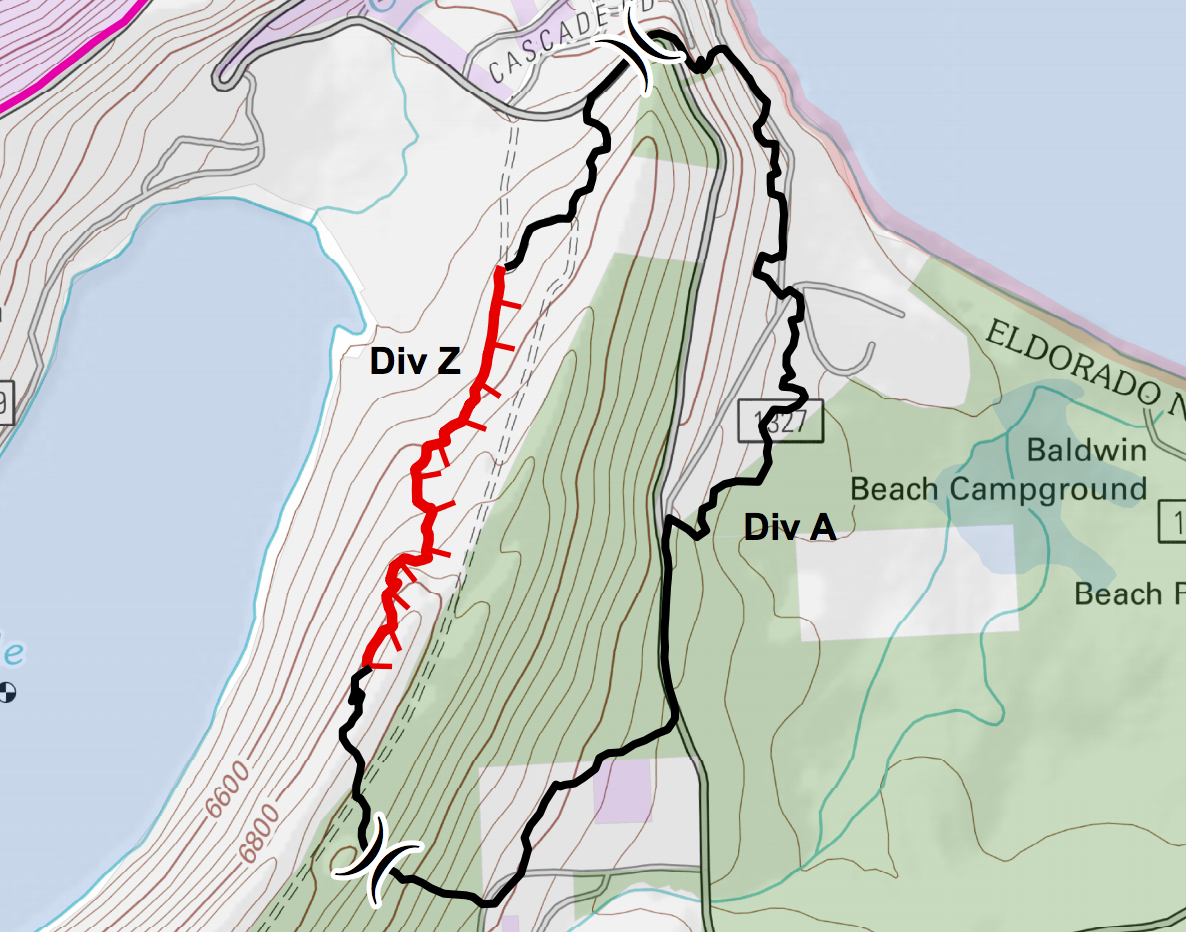
The black line represents the completed fire line, while the red is the controlled fire line. Source/USFS

The black line represents the completed fire line, while the red is the controlled fire line. Source/USFS

The fire started in the early morning of Oct. 14.

Two hundred structures remain threatened. Evacuations are still mandatory for Spring Creek, Cathedral, west shore of Fallen Leaf Lake, Cascade Properties and Cascade Lake.

Highway 89 remains closed from Fallen Leaf Lake Road to Bayview Trailhead. Until the hazardous trees are removed, it will remain closed. This could be through the weekend. Caltrans plans to re-evaluate the situation at noon Sunday.

The cause of the fire is under investigation.

— Lake Tahoe News staff report


Meeting to discuss Caltrans South Shore projects

Caltrans is hosting a meeting on Oct. 20 regarding its plans for a bridge replacement project on Highway 50 over Echo Summit.

The event is scheduled from 5:30- 7:30pm at Lake Tahoe Airport.

Community members will have the opportunity to view displays and ask questions from Caltrans staff members. A project presentation is scheduled for 6pm.

The $9 million project’s draft environmental document is currently circulating and comment cards will be available.

In addition, there will be an opportunity to provide comments and ask questions about the Meyers Intersection Improvement Project. The $3 million project proposes to convert the intersection of Highways 50 and 89 into a three-legged roundabout.

Both projects are scheduled to start construction in 2019.


Food bank needs volunteers in S. Lake Tahoe

The Food Bank of El Dorado County is in need of eight to 10 volunteers on Oct. 26 from 9:30-11:30am to help with the mobile food pantry in South Lake Tahoe.

Volunteers will be assisting in handing out food and signing people in. The distribution site is the American Legion parking lot. This is a monthly event to provide food to those in need.

To volunteer, call 530.621.9950 or email volunteer@foodbankedc.org.


South Shore garbage rates expected to climb

Plan to pay more for garbage on the South Shore starting Jan. 1.

South Tahoe Refuse is asking South Lake Tahoe and Douglas County to approve a 1.96 percent increase. The percentage is expected to be a little less in El Dorado County.

The garbage company did not raise rates this year. In 2015, South Lake Tahoe and Douglas County’s rates increase by 2.88 percent and El Dorado County rates went up 2.66 percent.

Jeff Tillman, president of STR, told Lake Tahoe News the increase is needed to expand programs so the company can meet the California mandate of having 75 percent of waste diverted from landfills by 2020.

STR is looking to expand food and green waste programs to accomplish this goal. About 65 percent of STR’s waste does not go to a landfill today.

Tillman said it is going to be difficult, though, to reach the new state regulation.

— Lake Tahoe News staff report