Nev. gun laws inching closer to Calif.’s

By David Montero, Los Angeles Times

Joe Leal says he knows the good ones from the bad. He’s been doing this for decades. He trusts that his brown eyes — narrowed beneath a furrowed brow — won’t deceive him.

He looks down at the shiny silver handgun under a glass case. Next to it is an all-black one. Criminals don’t want guns like this, he explains. They’re expensive and only the serious enthusiast will lay down more than $2,000 for such a weapon. Even his lower-end guns fetch at least $600.

He’ll check their identification to make sure they’re a Nevada resident. If he gets a bad vibe, he’ll walk the customer over to a table where a federally licensed gun dealer can run a background check. That’s if he even decides to go that far. When he’s suspicious, the 82-year-old former U.S. Army lieutenant and long-time Nevada resident simply refuses to sell.

Leal is a private seller who might move 15 firearms a year. He calls it his “hobby jobby” and doesn’t believe he needs the government telling him when to run a background check — as is now being proposed on the November ballot. It’s not the Nevada way, he explains.

Read the whole story


Barton looking for patients to be on advisory panel

Barton Health is seeking past patients and their families to share insights and offer input to improve the patient experience.


The Patient Family Advisory Council is being formed where people share the experience they had at Barton Memorial Hospital.

The council’s advisors will play an active role in implementing constructive changes to the hospital’s quality and safety.

Members will attend monthly meetings at 4pm and serve on a patient experience-related committee. Adults of all ages and backgrounds are welcome. All council advisors will be  prescreened and must undergo a background check. Members must be 18 or older and cannot be related to a Barton Health employee.

For more information, call Natasha Schue at 530.543.5537 or go online.


Search continues for missing aircraft

The search for a missing plane is expected to resume this morning.

El Dorado County search and rescue teams started looking for the Cessna on Monday, but to no avail. Weather prevented a helicopter from assisting.

The pilot of a Cessna flying from Idaho to Sacramento has not been heard from since Saturday.


The last contact with the aircraft was when it was over the mountains southwest of South Lake Tahoe.

— Lake Tahoe News staff report


Snippets about Lake Tahoe

·       Emerald Bay Towing is now owned by Welcome’s Auto Body and Towing of South Lake Tahoe.

·       Drug Take-Back Day is Oct. 22  at the Truckee Safeway from 9am-1pm as well as from 9am-noon at the Old Fire Station in Tahoe City above Commons Beach.

·       Truckee will be hosting Big Truck Day and Open House on Oct. 22 from 11am-2pm at the town’s corp yard and animal shelter at 10969 Stockrest Springs Road.

·       Douglas County Public Library’s Halloween Party will be Oct. 24 from 5-6:30pm at the Minden Library. The event is for grade school children and will include games and snacks. Wear a Halloween costume and participate in a costume contest.

·       Al-Anon meetings are Mondays at 7pm and Fridays at 5:30pm at Unity Church, 1195 Rufus Allen Blvd., South Lake Tahoe and at Sierra Community Church (1165 Sierra Blvd., South Lake Tahoe) on Wednesdays at 7:15am.


Sports center will redefine medical care in Tahoe

The multi-million dollar health facility in South Lake Tahoe will be treat every day and elite athletes. Photo/Provided

The multi-million dollar health facility in South Lake Tahoe will treat everyday and elite athletes. Photo/Provided

By Susan Wood

The Robert Maloff Center of Excellence is as much about Tahoe’s past as it is building a solid future for sports medicine on the South Shore.

“Since 2003, we started talking about this. It’s wellness, fitness and sports performance all in one – something we always needed to do, we just needed to know how to do it,” physical therapist and project coordinator Chris Proctor told Lake Tahoe News. He is also the administrative director of Barton Health’s Tahoe Center for Orthopedics.

Proctor has built a reputation by concocting creative means to work different areas of the body that athletes either need to strengthen or fix. They’re referred to as the “MacGyver-type” mechanisms thrown together for optimum performance. (This reporter witnessed a creative harness device in which the athlete had to pull Proctor, who stands well over 6 feet.)

Given its one-of-a-kind nature, the center will have leading edge equipment. Touch-screen activation will dominate the sometimes makeshift-style methods of working the muscular-skeletal system.

The Robert Maloff Center of Excellence will have space for elite athletes and include partnerships with the U.S. Ski and Snowboard Association. It will be the first to place orthopaedics, rehabilitation and sport performance training services under one roof.

Complementary medicine such as acupuncture, nutrition, meditation and yoga will also have roles in the treatment of the mind and body.

Barton Health is busy constructing the unique, 26,000-square-foot facility that is designed to prevent and treat sports-related injuries in this athletic community. It broke ground Aug. 23 on the east side of Barton Memorial Hospital; the foundation is laid and the footings are going in. It should be done in a year.

Lisa Maloff donated $10 million to the building of the facility in her husband’s name, a rewarding gesture she admitted.

“We all went to Barton,” the longtime resident told Lake Tahoe News.

She and her late husband, Robert, came to South Lake Tahoe in 1958 “when we didn’t have a hospital,” she said, chuckling.

“He always wanted to give to the hospital, so I did it in his honor,” Maloff said.
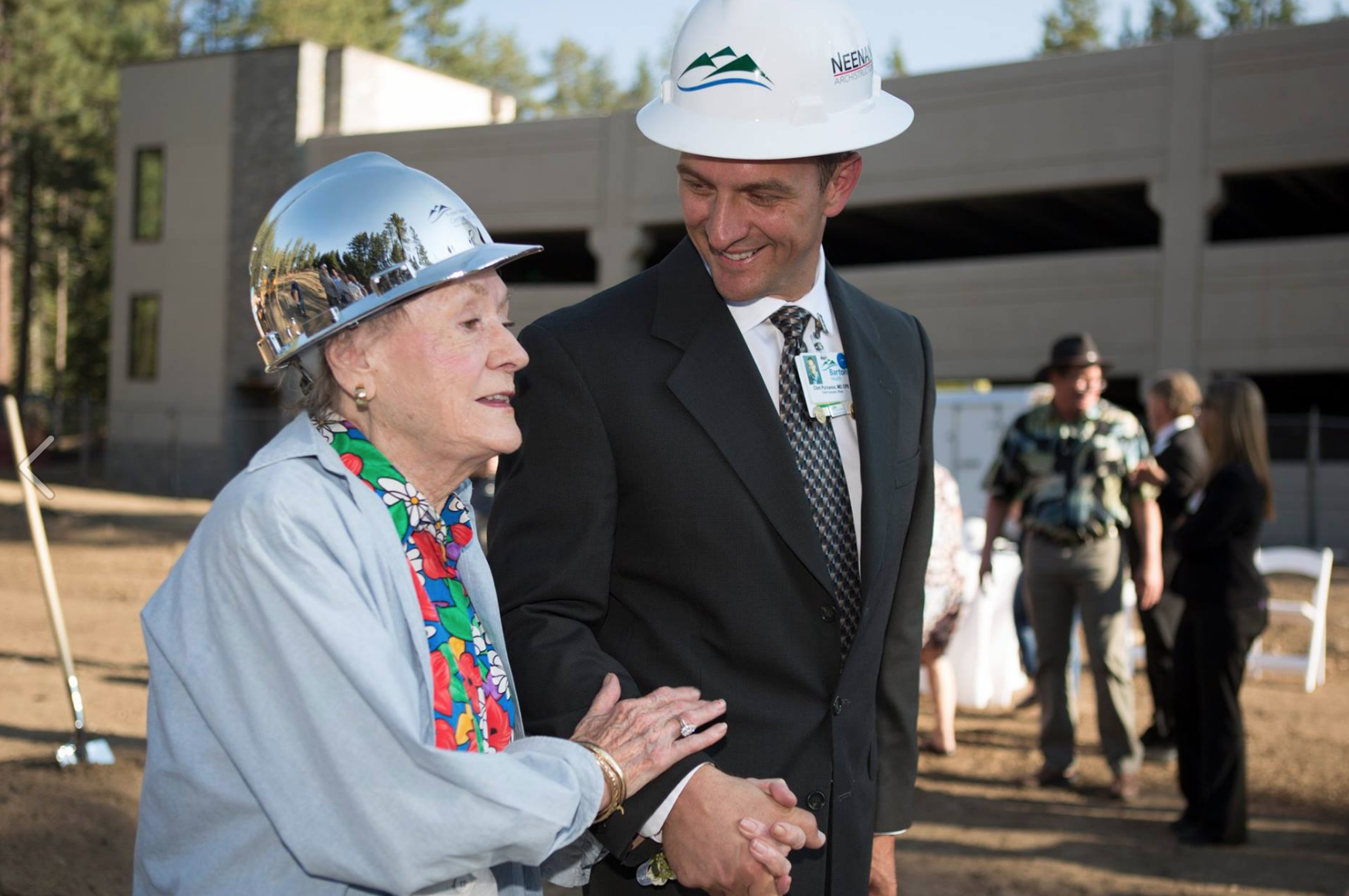
Lisa Maloff with Barton Health CEO Clint Purvance at the center's groundbreaking in August. Photo/Barton Health

Lisa Maloff with Barton Health CEO Clint Purvance at the center’s groundbreaking in August. Photo/Barton Health

The future

In the grand scheme of things, this 12-month period is a short span in comparison to when the visionaries connected to the health care system dreamed up the $30 million-plus, two-story facility.

The center is designed to focus on wellness and be proactive with an amateur or professional athlete’s health. Memberships to the Center of Excellence will be available.

The second floor will be dedicated to classroom settings for sports performance education.

The health care system will evaluate in the coming months who of the 900 employees and 150 on the medical staff will work there.

Tahoe and orthopaedics

It is a well-known fact that if you have a skiing, biking or running injury – especially those involving delicate knees – you want to be in South Lake Tahoe. Some of the finest orthopaedists alive have graced these mountains.

Terry Orr, for one, has spent years as one of the U.S. Ski Team physicians.

“Part of it is what I envisioned – and it’s a whole lot better than that now,” Orr said of the center. As a renowned orthopaedist, Orr plans to move his practice into the center when it’s ready.

“When someone comes in, we’ll look at the whole body. We’ll see people from start to finish,” he said. The first order of business will be to look at the athletes’ goals and tailor a program to get them to where they want to be physically.

Why is this important?

“People who move up here, live here and visit here – a good proportion of them are here because they want to be active, and they want to stay active. We have world champion skiers at 80 years old,” he said.

On the flip side, there’s a whole other market, too.

“We’ve got a whole group of youth coming up who aspire to be in this active life. These kids are doing big tricks,” he said.

The idea is to strengthen their vital joints ahead of time – and not just during rehabilitation after the fact.

“If they’re stronger, they’re going to be safer,” he said.

At least one prominent South Shore Olympic athlete could relate to that theory.

Olympic gold medalist Jamie Anderson is revered for her death-defying feats of big air snowboarding. She supports a place in Tahoe that strengthens the body more than ever before.

And it’s personal as an athlete prone to injury. She broke her collarbone last December.

“I think it’s an awesome idea for Lake Tahoe. It’s going to bring a lot of good to the community – something we’ve needed for a long time,” Anderson told Lake Tahoe News. 
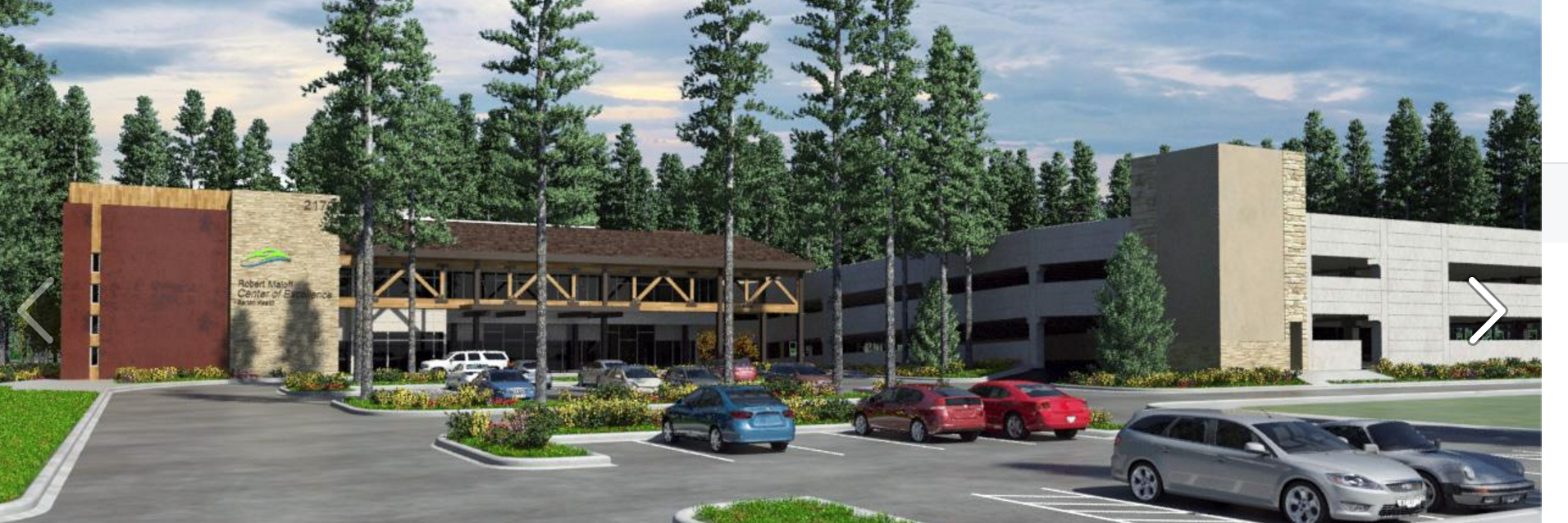
The Robert Maloff Center of Excellence will open in 2017. Rendering/Provided

The Robert Maloff Center of Excellence will open in 2017. Rendering/Provided

Tahoe’s medical history

As Barton heads to the future of treating athletes and enthusiasts, it embraces the foundation of its recreation-oriented past.

First of all, it had the early innovative thinking of knee specialist Richard Steadman, who worked alongside the late Paul Fry in their orthopaedist practice in South Lake Tahoe. (Fry donated funds for the Barton Maloff Center.)

Steadman, thought of as a champion for coordinated care, wanted to build a similar center in Tahoe in the 1980s. He was turned down at the time, but that didn’t stop his quest.

He donated his services at what became the first U.S. Olympic training center in Squaw Valley. He also started the nonprofit Steadman Sports Medicine Research Foundation here in 1988.

Steadman became a preeminent source for focusing on disorders of the knee, developing a treatment for injuries to the anterior cruciate ligament. It became known as the “healing response.”

The revolutionary ways to get athletes to heal have come a long way from when Steadman would put a hard cast on and have the patient stay still.

Movement is now key.

Steadman moved his expertise in 1980 to Vail to open a clinic bearing his name. There he expanded his level of research and sports clients. Some are famous – as in U.S. downhill skier Lindsey Vonn.

He wishes those involved with Barton’s Center of Excellence well and has no doubt the facility will thrive as his has over the years.

South Lake Tahoe’s has an even larger wellness component.

“They should have good success with the operation. I think the people who are continuing there are excellent people with the best of intentions,” Steadman told Lake Tahoe News, mentioning Orr by name.

Steadman insisted there are no hard feelings about wishing Barton would have supported this type of facility in the past. Things tend to work out the way they’re supposed to, he said.

“I’m not critical. I think the (Barton) people at that point were not thinking about this,” he said.

At age 79, Steadman has recently retired from his clinic, but not from being active. He hikes every day in most seasons and straps on the snowshoes in the winter.

“It used to be that as we advanced in age, people felt we were supposed to just sit down. From my era, we figured out that was not the right thing to do,” he said.

Steadman, who was also pleasantly surprised by his facility exceeding his expectations, fashioned his clinic’s rehabilitation after working to help the athlete “not just get back, but to get back to a higher level,” he added.

The same outcome is what stakeholders of the Barton center hope to achieve.


Opinion: The mob, the mayor, and pinball

By Michael Schiess

Soon after I founded the Pacific Pinball Museum, an ex-police officer contacted me, offering to sell a rare artifact that was once confiscated by the Oakland police force.

The object in question was a Bally Bumper pinball machine from 1936. For many, this machine is the quintessential pinball experience. You launch a ball up a slanted table and try to get it to bounce off as many targets as it can before it drains back off. Bumper was the first machine to have electric targets that added points to your score when hit, and a totalizer that kept track of your score.

The officer took me to the Alameda garage of his recently deceased twin brother, who had also been a cop. The Bumper game was dusty, but looked like it still worked. The officer said that the machine had been set up here since they first got them, and that he had an identical one in his crawlspace. I asked when they received the machines and he replied, “My brother and I were Alameda police in 1936, when the Oakland cops confiscated these and gave them to us Alameda cops as gifts.”

Many people are stunned that pinball could ever have been considered gambling. However, if you play a couple of games on Bumper, which I quickly purchased from the police officer, you will see that even at a nickel a game, it’s horribly addictive and could quickly drain your pocket change.

What really made pinball gambling was awarding a prize for reaching a high score. In 1931, America was introduced to coin operated pinball. Almost overnight, pinball machines began replacing trade stimulators, which were mechanical games of chance that awarded gum or a cigarette that were designed to lure people into businesses, so they might buy something.

Pinball machines showed up everywhere—candy stores, bars, smoke shops—and many forms of award were given as prizes: cigars, free drinks, game credits, and of course, money. The payout didn’t happen like a slot machine. Instead, the proprietor of the establishment would handle the awards. Even if the card on the machine said, “For amusement only!” everyone knew the storekeeper would pay up.

With Prohibition winding down, organized crime was eager to take on pinball as a more acceptable alternative to the highly illegal slot machines of the day. It was a cash business, and it was a good one. For almost 30 straight years, pinball made more money than the entire motion picture industry. To the public of the 1930s, it was a welcome escape from the dismal economic climate and offered a chance of instant redemption.

Nationwide demand was so high for pinball machines that companies could not keep up. During that time, over 150 manufacturers got into making the “marble games.” And it would be David Gottlieb’s 1931 Baffle Ball machine that cornered that market, as he developed an assembly line process for making the game.

Despite manufacturing advances, demand was so high that Gottlieb soon was unable to meet his distributors’ requests. One of the frustrated distributors, Ray Maloney, decided to make his own machine, “Ballyhoo,” named after a popular gentleman’s humor magazine. The game was so successful, his company name—formerly known as Lion Mfg. Co.—was changed to Bally. Although all the manufacturers were cognizant of the gambling aspect of pinball, nobody pursued it as enthusiastically as Maloney, who allegedly developed ties to the Mafia.

The most famous opponent of organized crime’s pinball racket was New York Mayor Fiorello LaGuardia. He had run on a ticket that opposed the corrupt Tammany Hall political machine and would serve for three terms, from 1934 to 1945. Living up to his promise to “Clean up New York City” he quickly declared war on slot machines. And after dumping thousands of confiscated devices into the Hudson from barges, he turned his attention to pinball.

LaGuardia campaigned so relentlessly against pinball’s evils that it seemed like he had a personal vendetta against the game. He loved publicity, and posed for photos in which he wielded a sledgehammer, smashing the now illegal games amidst crowds of law officers. LaGuardia boasted that the hardwood legs from the machines were being fashioned into police billy clubs, perfect for beating the heads of the nefarious operators.

Of the many pictures of the mayor posing with his “Sledgehammer of Decency” the one that really caught my eye was not obviously posed. Here, LaGuardia is seen pushing over a pinball machine that seemed strangely familiar. Upon closer inspection, and after comparing various photos, I concluded beyond a doubt that the machine in question was none other than my favorite game, Bally’s Bumper.

In 1942, after the Japanese bombed Pearl Harbor, the New York mayor had his final victory over pinball. He argued that pinball was a misuse of precious resources needed for the war effort, and successfully lobbied the federal government to ban the making of pinball machines in America. After the war, pinball manufacturing was allowed to resume, but the game had lost much of its appeal because of its bad rap.

Then, in 1947, pinball got a boost, thanks to the invention of the flipper, which was introduced by Gottlieb’s engineer Harry Mabs. Before the flipper was invented, the game was more akin to bagatelle, a French invention of the late 1700s, which was played with a cue stick; the concept was to shoot the ball up an incline and arch it over a barrier to attempt landing it in scoring pockets. Bagatelle and successor versions depended on the initial shooting of the ball. Before flippers, the player had no way to interact with the descending ball and thus it was much more a game of chance than skill.

Ironically, LaGuardia died one month before the introduction of the flipper, which brought on another pinball craze. But LaGuardia’s legacy was so powerful that pinball remained banned in New York for nearly 30 more years. In 1976, responding to pressure from the industry, the New York City Council heard arguments about how the flipper had transformed pinball into a game of skill. The council chamber had two machines brought in and had a ringer come in and display how he could beat the game using his flipper skills. The ban was lifted and Gottlieb made a limited run of games re-titled “New York” to celebrate the decision.

But the flipper’s invention did not stop Bally’s Ray Maloney from pushing a new design that would bring back the gambling aspect to pinball. Enter the Bingo pinball machine in the late 1940s. Early models were founded on the goal of getting the balls into certain holes for game credits, but that quickly evolved into a Bingo card format where the flipperless playfield was strewn with rubber ringed posts and 25 holes to catch the balls. The idea was to light three or more numbers in a row to get awarded credits. Whenever you see a pinball game that has a three-digit credit counter, you can safely assume it was designed for gambling.

The way it worked was, if you racked up a significant amount of credits, you would tell the bartender or shopkeeper and he would cash you out by paying you for all the unused credits. The bartender or shopkeeper would then push a “knock off” button that would count down all the credits and zero the game for use by the next player.

These machines were soon declared to be gambling. And in 1950 came the biggest single blow to pinball: the passage by Congress of the Johnson Act. That law banned interstate shipment of “gambling devices” (including repair parts, manuals, etc.) except to states in which the device was legal. So, it now was a federal offense to ship slot machines, “one-balls,” and pinball devices into any state which did not allow them. This should have been quite a deterrent to the manufacturers and distributors.

But the game was too popular, and it thrived in the many states where machines were legal, and even those where they weren’t. Enforcement was uneven at best. In San Francisco, where pinball was never illegal, the Bingo games were singled out as unabashed games of chance that were draining men of their paychecks. But the police could not keep up with all the secret rooms and payola protecting the operators.

Complaints from angry spouses eventually convinced the powers that be to declare that Bingo pinball machines had to be adapted to play only one game per coin. Players hated the decision but mostly surrendered; a few removing the modifications to make them play as originally intended.

Every time I get a chance to play a game on my Bumper, I look up at the museum’s poster of Mayor LaGuardia toppling the game. And I take a deep breath, pull back the plunger, and thank my lucky stars that his sledgehammer did not come down on my precious machine.

Michael Schiess is the founder and CEO at the Pacific Pinball Museum in Alameda. He wrote this for What It Means to Be American, a partnership of the Smithsonian and Zócalo Public Square.


Hotels meet threat of bad reviews

By Julie Weed, New York Times

Pam and Larry Willis had recently purchased the Gables Wine Country Innin California’s Sonoma wine region four years ago when they received it: their first TripAdvisor threat.

“A guest pulled me aside and said he didn’t get the level of concierge service he expected and was going to write a negative review online if he didn’t get his money back,” Larry Willis said. “It was pretty bold.”

Willis told the guest he was sorry but the complaint did not warrant a refund. Ultimately, the guest took no action. But the episode put the Willises on guard.

The threat of a bad online review on TripAdvisor, Travelocity or other consumer-advisory sites has become an increasingly common form of guest leverage, lodging executives say.

Read the whole story


Burning Man army returns desert to pristine state

By Jenny Kane, Reno Gazette-Journal

A little more than a speck of evidence remains of Black Rock City.

Where about 70,000 people rode lobster-shaped cars, danced witch-like in the moonlight and set up camp for a week straight, now there is only dust. Most of the people that participated in the week of artful libations known as Burning Man packed out their couches, skate parks, igloos, six packs of Bud Light, jungle gyms and crepe makers. They inevitably, though, left behind tidbits of waste.

The reason that leftovers are so trace from this annual hoopla is because of a group of 125 volunteers and workers known as the “Resto” crew among Burners. The Resto, or restoration, team cleaned the earth for two weeks as though tidying a living room before a visit from the in-laws.

Read the whole story


Truckee going after TOT from short-term rentals

A study shows that 412 properties in Truckee that are being used as short-term rentals are not paying transient occupancy tax.

This summer Host Compliance was hired by the town to assess which properties were paying TOT. A short-term rental is considered 30 days or less.

The company said 979 short-term rentals were available in Truckee, with 567 of them paying the hotel tax. Truckee’s rate is 10 percent plus another 2 percent for the Truckee Tourism Business Improvement District.

If property owners don’t come into compliance this fall, they face penalties and interest.

— Lake Tahoe News staff report


U.S. does a poor job predicting extreme weather

By Michael Behar, New York Times

At 11 o’clock on the night of Sept. 29, the National Hurricane Center in Miami posted an updated prediction for Hurricane Matthew. Using the latest data from a reconnaissance aircraft, the center’s computerized models led meteorologists there to conclude, in a post on the center’s website, that “only a slight strengthening is forecast during the next 12 to 24 hours.” Their prediction proved to be astonishingly amiss: The following day, Matthew exploded from a Category 1 into a Category 5 hurricane, with winds gusting to 160 miles per hour, strong enough to flatten even the sturdiest homes.

This was hardly the first time that United States government forecasters significantly underestimated a storm’s potential.

It’s a situation that deeply troubles Cliff Mass, a meteorologist and professor of atmospheric sciences at the University of Washington. Mass, who is 64, has become the most widely recognized critic of weather forecasting in the United States — and specifically the National Oceanic and Atmospheric Administration, which manages the National Weather Service and its underling agencies, including the National Centers for Environmental Prediction, where the nation’s weather models are run. Mass argues that these models are significantly flawed in comparison with commercial and European alternatives.

William Lapenta, who heads the centers, welcomes the criticism: “His job through his blog is quite honestly to provoke people to respond and hopefully take action,” he says. Indeed, Lapenta told me that the National Centers for Environmental Prediction, which directs the National Hurricane Center, might never have obtained additional funding from Congress to buy new supercomputers had Mass not drawn public attention to the center’s inadequacies in the aftermath of Hurricane Sandy.

Read the whole story