USFS: Reconstructed river weathers storms

According to the U.S. Forest Service, the weekend storms did not adversely impact the multi-million Upper Truckee River rerouting project.

“Flows in the Upper Truckee River (UTR) came up over the design capacity of the pumped diversion system, as well as the design capacity of the new channel on Sunday night,” Theresa Cody, a hydrologist with the U.S. Forest Service, told Lake Tahoe News. “Most of the UTR  flows followed the bypass channel we built into the newly constructed channel. Some over bank flows extended into the project’s temporary access road and existing channel backfill before re-entering the new channel. However, these overbank flows were shallow with low velocity.”

Cody there were no signs of “accelerated erosion,” but added crews will further assess the situation as the water level dissipates.

“We also will be downloading the data from our turbidity meters, and will be able to determine differences in turbidity measurements collected above and below the project, throughout the event. Data will be reported to Lahontan, per our permit requirements,” Cody said.

The goals is to complete the existing channel backfill and the last channel connection by the end of the month.

— Lake Tahoe News staff report


Study: SLT economy on positive trajectory

By Kathryn Reed

South Lake Tahoe isn’t the same city it was just a few years. And that’s a good thing.

Economic indicators point to a rebirth of sorts, but there is still plenty of room for improvement. That was the message delivered Oct. 18 by David and Jamie Orr to the City Council.

The Orrs, who own the Tahoe Mountain Lab, were part of the economic development task force the city convened in 2014. They were then hired to study the economic situation in the city.

“Leadership must be able to make bold investments in the future,” Jamie Orr said.

Partnerships will be key – whether it’s the city working closer with Lake Tahoe Community College or the private and public sectors collaborating more. It’s about being better connected – as in reliable cell and Internet service. Millennials take it for granted that they can reach whoever they want 24/7 and not at dial-up speeds.

Enticing businesses to move here is getting easier. To keep this up there needs to be a consistent message.

“We need to market our strengths. We need to tell authentic stories,” David Orr said.

South Lake Tahoe hasn’t always had a great reputation. At the height of the recession the boarded up, rundown buildings were more prevalent than thriving businesses. That has turned around. And it’s not just restaurants, questionable massage parlors and T-shirt shops opening.

Now more young professionals are calling the area home instead of just the transient liftie. They are helping define the types of businesses that are opening – like breweries, and Internet based firms.

While some people are doing well, Heidi Hill Drum with the Tahoe Prosperity Center, said per capita income in the city is just less than $25,000/year.

Small businesses are usually the backbone of most towns and South Lake Tahoe is no different. The Orrs pointed to their own business as an example of the burgeoning entrepreneurial spirit. Within their walls on Harrison Avenue are a multitude of workers – some more traditional, some just getting started, but all sharing a work space.

“Their presentation (Tuesday) made it perfectly clear, the city’s investment of $20,000 is an excellent return on the investment. The business incubator idea is blossoming at Tahoe Mountain Lab and looks to be an idea they have launched on their own; the relationships working with regional and national partners to bring attention to entrepreneurs to South Lake Tahoe is clearly been successful and resulted business start-ups coming to town – as well as helping South Lake Tahoe gain attention from other mountain communities promoting small entrepreneur businesses,” City Manager Nancy Kerry told Lake Tahoe News. “They’ve expanded business into the field of workforce education, an area needing attention in South Lake Tahoe and they are reaching local youth to inspire and encourage interest in creative entrepreneurship business. They’ve done a great job at developing regional partnerships.”

The cost of this study was much less than other expenditures the city has made in the name of economic development. More than a decade ago the city had two staff members whose job was to grow the economy. Basically they studied other people’s numbers and did nothing to spur growth, all at cost of about $250,000/year.

The Orrs noticed that access to capital is a real issue, especially for small entrepreneurs. A micro loan program might be the solution.

The couple looked at what is going on throughout the basin, as well as Truckee and Reno. Truckee is ahead of the South Shore when it comes to the arts, especially by creating shared spaces. Reno is bursting with businesses, which is apt to have a ripple effect in the basin as that area grows.

The council is expected delve further into the Orrs’ recommendations at the February strategic focus workshop.

“We will work with the 2016-18 City Council to shape the next two years of the city’s work plan, develop a clear set of priorities, goals and expectations and performance measures to ensure we stay focused on all that we can do to improve the business climate on the South Shore,” Kerry said.

And if ultimately the goal is to attract more people to the area, housing is going to become an even greater problem. Today it’s hard for the average worker to find a decent place to live. But the fact that 70 percent of the housing stock is not occupied by full-time residents is a 20-plus-year-old issue with no solution, especially when there is a limit to new construction.


Opinion: Calif.’s education architecture failing

By Joe Mathews

Is California abandoning its poorest students?

That question would be dismissed as absurd by our state’s education leaders, especially Gov. Jerry Brown and the state Board of Education. For years, they have been building a new educational architecture they say will do more for the poorest kids in the poorest schools.

Joe Mathews

Joe Mathews

But as the many elements of this architecture are put in place, they have grown so complicated that the entire structure seems incoherent. It’s possible that this new architecture could undermine public accountability, resist public engagement, and obscure how disadvantaged students are really doing.

The new architecture is built on a foundation known as the Local Control Funding Formula, a multi-piece formula designed to give more money and authority to school districts, especially those with concentrated poverty. That formula is accompanied by the new Local Control and Accountability Plans, intended to give parents and communities more say in how money is spent. The state also adopted Common Core standards for math and English along with a computer-based testing system to better track individual students.

Last month, the State Board of Education wrapped all these elements together in a new accountability system to track their progress.

But the way that system was approved exposes the complexity, and shoddiness, of the new architecture. The system introduces six statewide indicators for measuring schools that go beyond test scores and local factors, like parental school climate. But it could be years before such measurements are a reality, since much of the required data does not currently exist.

Even worse, the board resisted urgent calls from child advocacy groups to boil down this new system into a rating that the public might be able to understand. Instead, the board, defiantly, released a sprawling draft built around a confounding color-coded grid. “Making sense of it is practically impossible,” the Los Angeles Times editorialized.

Fixing this accountability system isn’t just a matter of redesign. The trouble is that it is built upon the other pieces of the new architecture, and those are similarly confusing. The new local control formula encompasses eight priorities, myriad sub-priorities, and different grants. The Local Control and Accountability Plans aren’t local or even really plans. They are longwinded, technical answers to technical questions required by the state; the resulting “plans” run to hundreds of pages.

And if all that doesn’t give you a headache, the new system is soon to get even more complicated. California’s new architecture does not mesh with the federal government’s own new process to identify the worst-off schools, and improve them. Last week, Gov. Brown vetoed a bill, overwhelmingly passed in the legislature, to require the California system to align with the federal one. Eventually, there could be not one but two accountability systems for California schools—one answerable to Sacramento, the other to Washington.

In watching this process, I can’t help but wonder if all the confusion isn’t cynically deliberate. Throughout, the state has followed the advice of its powerful teachers union, the California Teachers Association, which has opposed any system that offers coherent ratings, and thus meaningful comparisons, of schools.

What does that mean for making sure poor kids are actually making progress? It means they may be on their own. Gov. Brown gave the game away in an interview with the policy website CALMatters earlier this year when he questioned whether the achievement gaps between disadvantaged and other students can be closed, even with the help of his Local Control Funding Formula (LCFF).

“The gap has been pretty persistent, “ he said, “so I don’t want to set up what hasn’t been done ever as the test of whether the LCFF is a success or failure. I don’t know why you would go there.” Closing achievement gaps is “pretty hard to do,” he added.

The defenses of the emerging system are equally lame. State Superintendent of Public Instruction Tom Torlakson has argued that the complexity of the new system is a virtue—since education, and life for that matter, is complex.

The State Board of Education president Michael Kirst, a Stanford scholar whose writing on educational systems is distinguished by its clarity, has in this instance taken to issuing uncharacteristically foggy pleas for delay. We’re still ironing out the kinks and the whole system will evolve continuously, he argues. “Concluding now that the system is too complex,” he wrote for the website EdSource, “would be no different than arguing that people would not be able to use a smart phone based on the engineering specifications when the device is still in development.”

Kirst is right about the need for patience, in a way. It will take at least until 2019, when California finally gets a new governor, before Californians will have any chance to stop construction on this incomprehensible mess, and to focus coherently on our poorest students.


Study: Earth soaking up less carbon

By Chelsea Harvey, Washington Post

It might sound strange, but scientists believe the ground we walk on can be a huge weapon in the fight against climate change. That’s because the earth’s soil is serves as a giant carbon reservoir, containing trillions of tons that would otherwise end up in the atmosphere.

Currently, soil is believed to be a carbon sink, meaning it’s still taking up more carbon than it’s releasing into the air, and models have suggested that it will keep sucking up carbon through at least the end of the century. But according to research, scientists may have been seriously overestimating the extent to which this is going to happen — and that could be a big setback in our global climate efforts.

The study, published this month in the journal Science, used carbon dating to help figure out how quickly carbon can be stored in the ground and how long it stays there — information that informs scientists’ estimates of how much carbon will be sequestered by the earth’s soils through the next 100 years.

Read the whole story


Goodwill not done expanding into region

By Cathie Anderson, Sacramento Bee

In three months’ time, Goodwill Industries has opened three stores, in Placerville, South Lake Tahoe and on Sacramento’s Alta Arden Expressway, but regional CEO Joseph Mendez told me that the store debuts aren’t over yet.

Goodwill soon will open its first store in Elk Grove and a second in Sparks.

In Placerville, for instance, Goodwill has worked for years with the El Dorado Food Bank to offer services, but it wanted a physical presence in the county where it could provide on-the-job training. It opened Thursday at 3868 Forni Road.

Read the whole story


Storms raise Lake Tahoe by 3 inches

In what seemed liked three days of uninterrupted rain in the basin amounted to 11 billion gallons of water dropping into Lake Tahoe.

All that moisture meant Lake Tahoe’s level increased by 3 inches, according to the National Weather Service in Reno. The lake is still 2 inches below its natural rim. This means in Tahoe City at the dam no water is flowing into the Truckee River.

Some canals in the Tahoe Keys in South Lake Tahoe that were almost dry now have measurable water.

The Friday-Sunday storm system was part of the remnants of Typhoon Songda.

The next chance of moisture is set for Oct. 24, with the Weather Service saying there is a “slight chance.” Until then, highs will be in the upper 60s, with overnight lows in the 30s.

— Lake Tahoe News staff report


Pilot’s body found near plane wreckage

Search and rescue teams board an Air Force Blackhawk helicopter on Oct. 18 at Lake Tahoe Airport. Photo/LTN

Search and rescue teams board an Air Force Blackhawk helicopter on Oct. 18 at Lake Tahoe Airport. Photo/LTN

The pilot of a missing plane was found deceased outside the wreckage of the aircraft this afternoon.

A large contingent of search and rescue personnel from El Dorado and Douglas counties left Lake Tahoe Airport on Tuesday afternoon via transport from military helicopters.

The 1960 Cessna 182 was located at 4:25pm Oct. 18 southwest of Lake Schmidell in what officials called a “rugged area.”

Tyrell Kremer, 52, was flying alone. The Wilton man was returning Saturday to the Jackson Airport in Amador County from a trip to Idaho. High winds along with snow and rain were coming down when the plane lost contact.

— Lake Tahoe News staff report


Business couple chastise SLT councilwoman

By Kathryn Reed

It was a war of words at today’s South Lake Tahoe City Council meeting, with David and Jamie Orr voicing their anger about their perceived treatment by Councilwoman JoAnn Conner.

The Orrs, who own Tahoe Mountain Lab, had a contract with the city do an economic report. They had been reluctant to make the presentation while Conner still sat on the council because they felt threatened by her.

The alleged threats began in January on the public Facebook page called South Lake Tahoe & Around the Lake. The couple passed out a copy of the exchange to the council members at the meeting.

David Orr, in reading from prepared comments on Oct. 18, was clearly not comfortable doing so. The comments came after the couple had delivered the economic development report.

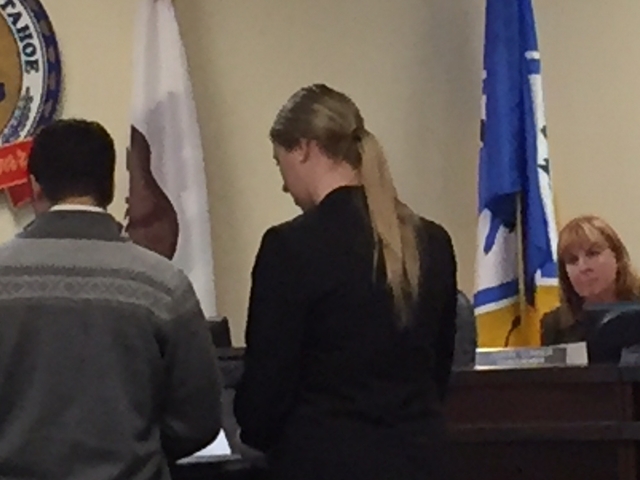
South Lake Tahoe Councilwoman JoAnn Conner, right, listens as David and Jamie Orr complain about her behavior. Photo/LTN

South Lake Tahoe Councilwoman JoAnn Conner, right, listens as David and Jamie Orr complain about her behavior. Photo/LTN

“The reason I’m bringing this up is because in our opinion it would seem that Councilmember Conner sought to use our contract with the city, and the ‘favors’ she had done for us as a way to keep us from publicly denouncing her actions,” Orr told the council. “Councilmember Conner’s comments made us feel small. It made us feel intimidated and threatened.”

Conner throughout Orr’s short statement kept interrupting him, saying it was “illegal” and “against the law” to repeat the words she had typed onto what she called a “closed forum.”

The page is public. And, really, nothing on social media is private. Plus, Conner’s statements were clearly coming from her capacity as an elected official and not a private citizen, thus making them unquestionably public.

Conner, in her outbursts, said, “This is not public comment time” and that this was a “shameless political speech.”

Conner is up for re-election, neither of the Orrs has run for local political office.

On the Facebook exchange the context of the conversation was Tahoe Prosperity Center had just released the Indicators Report. What the Orrs took issue with in particular was this item from Conner, which he read into the record:

“David and Jamie Orr, what exactly is your issue with me? I supported your business and referred people to you when you first came to town. I suggested you be considered for and supported you for those thousands of dollars you received from the City of South Lake Tahoe to help business owners. You obviously have a great loyalty to our employee, the city manager. For some reason, and it is disappointing to see you resort to hateful attacks with no substance. You often criticize the very city that gave you a lot of money  – you want them to do more for small business and the citizens. Perhaps you could tell the people here what you have accomplished for business and the citizens. Perhaps you could tell the people here what you have accomplished for businesses; where their money has been put to use. It seems to me you could help with some of the things you keep saying the city should do. I hear you criticize a lot, but I don’t hear solutions offered. What are your ideas and how would you make them happen?”

Orr told the council, “This interaction made it incredibly difficult for us to want to come to you today.”

He added, “For the record, we worked very well with the city. We have been working incredibly hard at fostering and bringing change to this community to spur economic development.”

After the awkward exchange the mayor called for a brief recess. The Orrs left and the council went about its business without a word about what had just transpired.


Tahoe Fund collecting seed money for Venture Trust

The Robert and Dorothy Keyser Foundation gave a $50,000 matching grant to the Tahoe Fund. The money will go into the new Environmental Venture Trust, a program designed to provide early stage seed funding for innovative projects around the Tahoe basin.

Tahoe Fund is now seeking donations to secure the full matching grant so it can begin soliciting ideas for innovative pilot projects. The Keyser Foundation will double every donation until Dec. 31, up to $50,000

The focus will be on the areas of highest concern in Tahoe, including dealing with the 66 million dead trees in the Sierra Nevada forests, aquatic invasive species, lake clarity, transportation challenges, outdoor recreation expansion and stewardship.

The Tahoe Fund launched the Environmental Venture Trust with a $5,000 grant to the Tahoe Resource Conservation District for a pilot project that will analyze the use of UV light to kill aquatic invasive weeds in Lake Tahoe. The Tahoe Fund’s grant will help the Tahoe Resource Conservation District secure more than $350,000 in public funding for the project. If successful, the technique could be deployed around Lake Tahoe and beyond.

For more information about how to contribute to the Environmental Venture Trust to help meet the Robert & Dorothy Keyser Foundation match, go online.


Woman dies in Douglas County Hwy. 50 crash

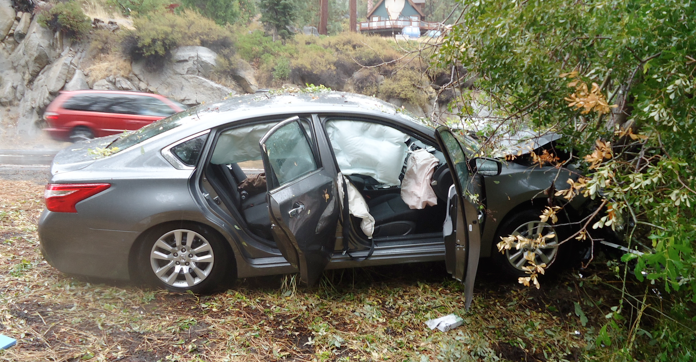
One person died Oct. 16 in Douglas County on Highway 50. Photo/Provided

One person died Oct. 16 in Douglas County on Highway 50. Photo/Provided

A woman visiting Lake Tahoe from Taiwan died Sunday in a car accident in Douglas County.

Pao-Yi Tseng was taken to Barton Memorial Hospital where she was pronounced deceased.

The woman’s 72-year-old husband, Jiann-Juh Tseng, was driving west on Highway 50 in the slow lane when the vehicle drifted off the road and then struck a tree near mile marker 6. This was Oct. 16 at 3:10pm.

Also in the vehicle was the couple’s daughter. She was taken to Barton Memorial Hospital where she was treated for non-life threatening injuries.

Impairment is not suspected. Tseng was wearing his seat belt; it is not known if the passengers were, according to the Nevada Highway Patrol.

— Lake Tahoe News staff report