Tips for a safe Halloween

We would like to encourage everyone buying costumes for Halloween to check the labels and make sure they are made of flame retardant materials. Materials made of 100 percent polyester are best suited for a Halloween costume.

The use of commercial flame retardant sprays is not recommended.

Avoid Halloween costumes that are loose or baggy to prevent fabric from coming in contact with any open flames. The use of masks which obstruct vision should be avoided. Costumes should incorporate reflective tape in their design so children can be easily seen at night.

Children should carry flashlights or use battery operated lights.

Jack-o-lanterns that have an open flame device should be placed up off the ground so that long or full costumes and young trick-or-treaters’ hands cannot come in contact with the flames.

Trick or treat while it’s still light outside, and stay in your neighborhood, visiting only the homes you know.

South Shore also has fun and safe events going on for other trick-or-treat options.

Finally, always check your children’s candy before allowing them to eat any of it.

Have a fun and safe Halloween.

— Sallie Ross-Filgo, South Lake Tahoe Fire Department


Truckee arts group raising money via ‘non-event’

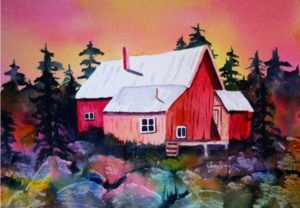
Eva Stramer Nichols’ watercolor “Sunset at the Cabin.”

Eva Stramer Nichols’ watercolor “Sunset at the Cabin.”

Tickets are on sale now for the anti-social event of the season – the Truckee Public Arts Commission’s No-Go Gala.

Each ticket, which raises funds for public art and education in Truckee, enters purchasers in a raffle to win prizes. The ticket itself is a limited edition piece of art. The ticket for the inaugural event is a signed and numbered print of “Sunset at the Cabin” – a watercolor by local artist Eva Stramer Nichols.

What makes this fundraiser different is there isn’t actually any event to go to.

Each ticket sells for a minimum $25 donation. Only 300 tickets will be sold.

Tickets may be purchased through Nov. 25 at the Truckee Donner Community Recreation Center, Gallery 5830’, Backstreet Framers and online. Tickets will also be available at the opening reception of Truckee Summer Snapshots, a community photography exhibit on Oct. 21 from 5-7pm at the Truckee Community Recreation Center.

The Truckee Public Arts Commission builds community through collaboration, promotion and advocacy for public art. To date, the Truckee Public Arts Commission has put on tri-annual art shows at the Truckee Community Recreation Center and installed five art bike racks in Truckee.


Limited warming room to operate in Truckee

Truckee officials are in the process of ensuring the Church of the Mountains in downtown Truckee operates as a warming shelter this winter.

Truckee Town Council next week is expected to approve the second reading of an an amendment to allow the temporary shelter to operate. It could then open 30 days later.

The permit stipulates that the shelter can only operate when temperatures drop below 15 degrees or more than a foot of snow in the forecast.

Last year 28 people and four dogs took advantage of the warm room.

— Lake Tahoe News staff report


Winter outlook not good for California

By Seth Borenstein, AP

Federal forecasters predict this winter may paint the U.S. in stripes of different weather: Warmer and drier than normal in the south, and colder and wetter than usual in the far north.

The National Weather Service winter outlook , issued Thursday, gets murky in the nation’s middle belt, with no particular expectation for trends in temperature or precipitation.

Still, some nasty storms might make the winter there memorable, said Mike Halpert, deputy director of the weather service’s Climate Prediction Center.

The major driver of the winter forecast is a budding La Nina, a cooling of the central Pacific that warps weather worldwide and is the flip side of the better-known El Nino, Halpert said.

For the South and California, “the big story is likely to be drought,” Halpert said.

And that’s not good news for California, which is in year five of its drought. The winter is the state’s crucial wet season when snow and rain gets stored up for the rest of year. Halpert said the state’s winter looks to come up dry, especially in Southern California.

“It’s probably going to take a couple of wet winters in a row to put a big dent into this drought now,” said weather service drought expert David Miskus. He said it will take “many, many years and it’s got to be above normal precipitation.”

The northern cold band that the weather service predicts is mostly from Montana to Michigan. Maine is the exception, with unusually warm weather expected.

The prediction center’s track record on its winter outlooks is about 25 percent better than random chance for temperature and slightly less than that for precipitation, Halpert said.

Private weather forecasters are predicting quite a different winter. They foresee a harsher one for much of the nation, including a return of the dreaded polar vortex, which funnels cold Arctic air into the U.S.

Judah Cohen of Atmospheric and Environmental Research in Lexington, Massachusetts, forecasts an unusually cold winter for the eastern and middle two-thirds of the nation, especially raw east of the Mississippi River.

Cohen, whose research is funded by the National Science Foundation and closely followed by meteorologists, links North America’s winter weather to Siberian snow cover in October.

He agrees that Maine will have a warm winter, and also predicts a warm Southwest.

The private Accuweather of State College, Pennsylvania, calls for frequent storms in the Northeast, early snow in the Great Lakes, bitter cold in the northern tier and occasional cold in the middle. Like other forecasters, it predicts a warm and dry southwest, with some hope for rain and snow from San Francisco northward.


Letter: Reasons to vote for Collin

To the community,

As the election race for the two available City Council seats approaches I wanted to send out my support for candidate Jason Collin.

I met Jason in 2010 when we were both serving on the city of South Lake Tahoe Sustainability Commission. At the time, the commission’s mission was “to create a healthy and sustainable community for current and future South Lake Tahoe residents and visitors.” We supported this mission through the implementation of the city’s sustainability plan.

During our term, Jason came to our discussions prepared and he attentively listened to the public. Jason focused on initiatives in our work plan to improve energy efficiency through streetscape lighting retrofits and to create incentives for business owners to improve their properties. Jason also led a subcommittee that worked with city staff to invest in cost-effective sidewalk and bike path capital improvement projects along Highway 50.

Jason continues to serve on local boards and volunteer with small business groups. Through these efforts, he has proven he exhibits the qualities of a dedicated and committed leader. He has a vision and the ability to turn ideas into plans, he is an excellent listener and consistently seeks feedback, he is prepared for meetings and facilitates good discussions, and he offers a fresh perspective on issues.

Jason also knows South Lake Tahoe. He is a family man, a friend, an outdoor enthusiast, and a devoted citizen who is accessible, respectful, ready, and excited to serve on our council. Please vote for Jason this November.

Juliana Prosperi, Meyers


Tahoe resorts not popular with Ski readers

Lake Tahoe area ski resorts didn’t fare well in the annual readers’ poll by Ski magazine.

The October issue talks about the top 50 ski resorts. It’s divided between the West and East coasts. Whistler-Blackcomb took top honors for the West, while Tremblant in Quebec was the East’s best.

Mammoth – which clearly isn’t a Tahoe resort – is the top California ski area at No. 22.

Heavenly Mountain Resort came in at No. 24. The top three strengths listed were scenery, off-hill activities and après. The main weaknesses were snow, challenge and terrain variety.

Squaw Valley-Alpine Meadows was No. 25. Strengths include challenge, terrain variety and après, while weaknesses were service, snow and overall satisfaction.

At No. 27 was Northstar. Positives included kid friendliness, grooming and terrain parks; while negatives were character, scenery and terrain variety.

Tahoe resorts didn’t do well in the individual categories either. Not one made it in the top 10 for accessibility, character, dining, lifts, lodging, service, snow or value.

Top 10 finishes included:

·      Après: Heavenly – No. 6

·      Challenge – Squaw – No. 9

·      Grooming – Northstar – No. 10

·      Kid friendliness – Northstar – No. 9

·      Off-hill activities – Heavenly – No. 4

·      Scenery – Heavenly – No. 3

·      Terrain variety – Mammoth – No. 8; Squaw – No. 10.

— Lake Tahoe News staff report


Snippets about Lake Tahoe

·       The Bush show originally scheduled for Nov. 3 at Harrah’s Lake Tahoe has been canceled due to a scheduling conflict with lead singer Gavin Rossdale’s upcoming role as a coach on the TV program “The Voice UK.”

·      On Oct. 21 from 9pm-2am Cold Water Brewery in South Lake Tahoe will be hosting a benefit and asking the community to support Rose Parker, wife of brewmaster Ryan Parker. She has Rose esophageal cancer. All proceeds go to the Parker family.

·       Lake Tahoe South Shore Chamber of Commerce is hosting a forum on the loop road on Nov. 3 from 5:30-7pm at Lake Tahoe Resort Hotel in South Lake Tahoe.

·       Dave Rathbun is now the chief marketing officer for Sugar Bowl ski resort.

·       Tom Feiten has been promoted to vice president of marketing and business development at Squaw Valley Alpine Meadows.


Safety driving Meyers roundabout, Echo bridge

By Kathryn Reed

By the end of the 2020 construction season motorists should be driving over a new bridge near the top of Echo Summit and through a roundabout in Meyers.

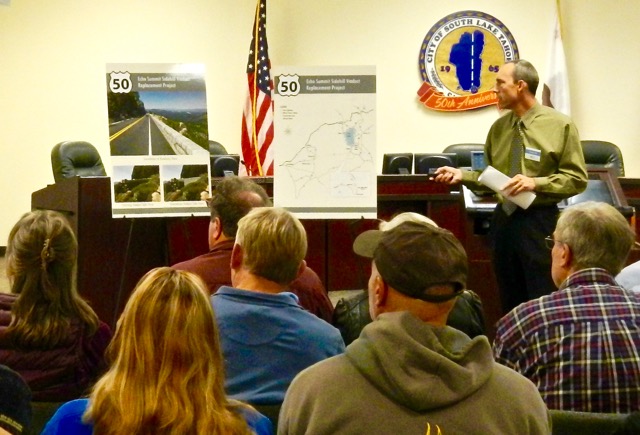
Caltrans on Thursday night spent a couple hours telling the more than 30 people at an informational meeting about the two projects.

The bridge is needed to replace the one built in 1939. It’s located 7 miles west of South Lake Tahoe. It is crumbling, rebar is showing, steel is rusting and structurally it is unsound.

Today it has three spans; in the future it will be one. Travel lanes will go from 11-feet to 12-feet wide.

Clark Peri, Caltrans project manager, talks Oct. 20 about the Echo Summit bridge project. Photo/LTN

Clark Peri, Caltrans project manager, talks Oct. 20 about the Echo Summit bridge project. Photo/LTN

Three alternatives plus a no build are being studied, with comments on the environmental documents being taken until Nov. 3 (Details are online.)

The cost ranges from $6.5 million to $8.2 million.

What concerned some in attendance is that with all of the alternatives the highway would have to be closed for at least 10 consecutive days. Johnson Pass Road will be accessible with a permit, otherwise most people will be getting to western destinations going Highway 89 to Highway 88. At other times there will be one-way control.

In 2011, the highway over Echo Summit was closed for the retaining wall replacement. A Caltrans official on Oct. 20 said during that time it’s estimated the South Shore lost $1 million a day. With tourism rebounding, the economic impact could be even greater this time.

The bridge project is expected to take place in 2019 and 2020.

Public outreach will be part of the protocols.

Alternative 2 calls for a little wider roadway so a bike route could be added. Alternative 3 would have the cast done onsite.

Caltrans looked at repairing the bridge instead of replacing it. It was determined this would cost more money, and with the possibility of unknown issues arising, this could add to the expense and time to complete the project.

A geological study still needs to be completed.

One attendee asked whether building a tunnel had been study; it wasn’t.

During the first year of bridge construction Caltrans intends to build a roundabout at the intersection of highways 50 and 89 in Meyers. This discussion was the most heated, with many people flummoxed that it is already a done deal.

Caltrans said the 21 accidents, eight of which involved injuries, between 2007-12 triggered a safety study. A roundabout was determined to be better than adding stop signs or a signal.

What worries Brad Zlendick, battalion chief with Lake Valley Fire Protection District, is being able to get up Echo Summit, particularly in winter. Instead of going through the roundabout, it will be more expeditious to head into oncoming traffic even though this is more dangerous. He and Caltrans officials agreed to talk more.

The 135-diameter roundabout will be a single lane of traffic. What will be a bit unique is there will be a passing lane of sorts going west.

Pedestrian and cyclist crossings will be incorporated into the design.

On the original maps the legacy tree deemed worthy of protection during the Meyers Area Plan meetings was slated for removal. That is no longer the case. The large Jeffery pine on the southeast corner will not be harmed.

Tom Brannon, deputy director of the local Caltrans district, admitted the backups during peak times are not going to be alleviated with the roundabout. This particular roundabout is for safety, not traffic flow.


Opinion: Housing is a communitywide issue

By Joanne Marchetta

Like many communities that are highly-desirable places to vacation and live, Lake Tahoe has affordable housing problems. Two recent studies commissioned by the Tahoe Prosperity Center and Tahoe Truckee Community Foundation clearly illustrate the housing challenges our region faces.

Median home prices of more than $500,000 on the North Shore and nearly $400,000 on the South Shore are simply too high for our region’s low wages, putting the cost of home ownership and even rent out of reach for many working people.

Joanne Marchetta

Joanne Marchetta

Lake Tahoe has been a world-renowned recreation destination for decades, a short day drive from major metropolitan areas like Sacramento, the Bay Area, and Reno, all of which are growing and have affordable housing challenges. This proximity to areas with much more diverse economies and much higher wages is reflected in our housing stock, as more than half of the houses in the Tahoe basin are vacation homes. Many are used only occasionally by their owners and sit empty the rest of the year. Others are rented out as short-term lodging for vacationers.

Full-time rentals are scarce and often unaffordable for many people who live and work at Lake Tahoe, and for other people who must commute into and out of the Tahoe basin each day because they cannot find affordable housing or adequate employment here. Hundreds of deed-restricted affordable housing units have been built at Lake Tahoe, but they are at full occupancy, with waiting lists of one to two years for new tenants.

Affordable workforce housing is a complex, challenging issue here at Lake Tahoe and elsewhere. We are not alone in facing these issues and there’s a renewed spirit today in Tahoe to tackle the challenge.

California is wrestling with this difficult topic as we speak. At a summit in Los Angeles this month, local governments, housing advocates, and state leaders met for a broad forum on California’s housing woes. In many areas, housing has not kept pace with population and job growth. A shortage of affordable workforce housing now threatens to hamper the state’s economic recovery. It is also creating environmental and transportation problems as people commute long distances to and from work.

A shortage of workforce housing options is having similar impacts here at Lake Tahoe. Thousands of people commute into and out of the Tahoe basin each day because they work here but can’t afford to live here, or because they live here but can’t find adequate employment at Tahoe. Companies and agencies struggle to recruit and retain workers because of high housing costs. Many of our full-time residents are struggling financially to stay in their communities, with housing prices and rents continuing to climb even as wages remain low and stagnant.

These housing challenges are not unique to Lake Tahoe, or even to California, which had a median home price of $514,000 in September, according to the California Association of Realtors. Many mountain communities in the American West depend on tourism as their main economic driver and have comparatively low service sector wages like Lake Tahoe. Many also have high land and utility costs, high construction costs, and limited areas available for any new housing development to occur, all of which make building affordable workforce housing a challenge.

Lake Tahoe has some unique challenges in providing affordable housing. Some point to our development rights system and the allocations needed for housing, commercial, and tourist lodging projects as one obvious barrier. These systems were put in place decades ago to protect Lake Tahoe’s unique natural environment from overdevelopment. TRPA is leading an initiative to fully examine and improve the development rights system, not only for housing, but to help spur the type of redevelopment projects we now need to restore our environment, revitalize our economy, strengthen our communities, and improve the overall quality of life here for everyone.

The 2012 Regional Plan took clear steps to allow the coverage and density needed for new housing and mixed-use redevelopment projects in our town centers. Affordable multi-family housing projects do not require any development allocations, and there are hundreds of housing bonus units available for these types of projects. These incentives are used only sparingly, indicating that while we do need to improve Lake Tahoe’s unique development rights system, there are clearly also other issues involved in solving our workforce housing challenges, including the need for economic revitalization to increase wages and career opportunities for working families.

We at TRPA are encouraged to see a growing conversation about affordable workforce housing at Lake Tahoe, and to see people pushing for continued dialogue and solutions. The Tahoe Truckee Community Foundation is working to form a regional housing authority to help address workforce housing issues on the North Shore. We hope to see that initiative succeed and be mirrored on the South Shore. Challenges and solutions will likely differ around the lake.

TRPA stands ready to help solve Lake Tahoe’s affordable workforce housing challenges, and to partner with local governments, nonprofit groups, and residents to find creative solutions. There is no one silver bullet to solve these complex issues, and no one agency or group that can fix them all on its own. But by strengthening our collective will to work together on this important issue and be creative, we can make needed change happen.

Joanne Marchetta is executive director of the Tahoe Regional Planning Agency.


Message in Vonn’s book not as powerful today

By Blair Braverman, Outside

Champion skier Lindsey Vonn’s new book, “Strong Is the New Beautiful”, is all about healthy body image, but you wouldn’t know it from the trailer, which features a mostly naked Lindsey wrapping herself in cloth, posing with ski poles, and smiling coyly in black heels under bright studio lights.

vonn bookIt seems more like a behind-the-scenes promo for a magazine shoot than an ad for a book about nutrition and strength training. But in the age of the ESPN Body Issue—an age where shiny, nude, athletic bodies have become nearly cliche and a sexy woman in a sports bra seems nearly chaste—the trailer straddles a fine line between pinup and power, one that warrants the headline “Vonn Takes It All Off” while at the same time burnishing Vonn’s image as a female role model.

This is “athlete nude,” and Vonn has executed it masterfully.

Vonn can put her strength on display without much backlash, in part, because she still fits into conventional beauty standards.

Read the whole story