‘Nobody’ matters in Nevada elections

By Seth A. Richardson, Reno Gazette-Journal

In Nevada, nobody is somebody.

The Silver State, being the king of quirk in the nation, has a unique option for those wanting to register a protest vote this election with the “none of these candidates” choice.

It is the brainchild of former Assemblyman and state Sen. Don Mello, a Democrat from Washoe County.

The first time “none of these candidates” won was in 1976 when Nevadans preferred literally no one to both of the Republican candidates for the at-large congressional seat. (The second place winner Don Earhart was crowned the nominee. He lost to longtime Democratic Rep. Jim Santini in a landslide.)

Most recently, it played a role in the 2014 gubernatorial elections. Democrats didn’t care for their candidates for governor and instead picked “none of these candidates.” (Bob Goodman won the nomination, going on to get crushed in the general by incumbent Republican Gov. Brian Sandoval.)

Read the whole story


Letter: Exline best bet for STPUD board

To the community,

I first met Nick Exline at a climate coalition meeting. I was immediately impressed by his passion and knowledge for making a difference to our community, our environment and our economy.

He is highly qualified for the position, holding a master’s degree in land use planning. He has lived in our community for nine years and is dedicated to preserving the environment and improving the infrastructure.

He is a proponent of sustainable land practice and renewable energy and will work to implement projects that will have long-term environmental and economic savings for the community.

Nick practices what he preaches and will work to make our community a great place to live. Nick deserves your vote

Susan Chandler, South Lake Tahoe


Tahoe memorial honors 5 firefighters who died

By Susan Wood

CARSON CITY – If you don’t think wildland fire is on the back of Clear Creek residents’ minds, just look at road landmarks.

One of which was just established on Highway 50 east of Spooner Summit where the Tahoe Douglas Fire Protection District, with its brethren, came out a few weeks ago to memorialize the five firefighters who died during the 1926 Clear Creek Fire.

More than 40 people attended the ceremony on Sept. 28, the 90th anniversary. A version of “Taps” played while people reflected on the five unmanned helmets to signify George Brown, J.E. Mitchell, Bryant Whitmore, Arthur Sunday and Ross Morres.

A little-known permanent plaque on a cement block describing the horrendous fire has been installed at the Highway 50 turnout. The memorial overlooks the “Double Barrel” turn in the canyon where the three inmates, forest ranger and V&T railroad gandy dancer, respectively, were trapped there by swirling Zephyr winds.

These represent the same notorious winds residents in the sleepy neighborhood southwest of Carson City were keeping their eyes on earlier this month. On Oct. 13, a wildland fire broke out east of the canyon.
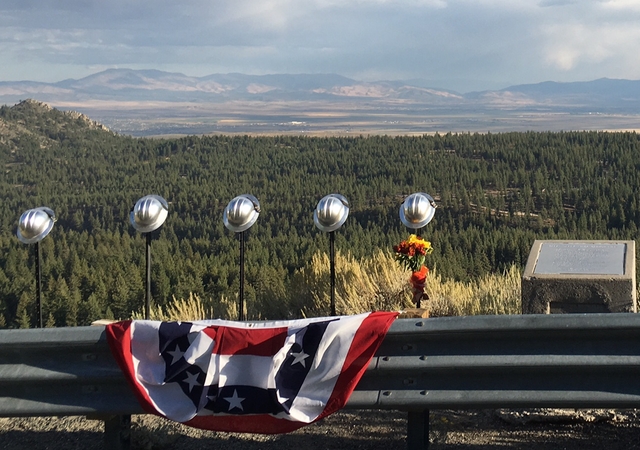
Five helmets just east of Spooner Summit on Highway 50 represent the firefighters killed in 1926. Photo/Provided

Five helmets just east of Spooner Summit on Highway 50 represent the firefighters killed in 1926. Photo/Provided

The men and women who defend the area are fully aware of the danger and know the possibility of another tragedy like the 1926 fatal fire exists when strong winds and drought conditions are combined with a dangerous topography like Clear Creek.

During the 1926 fire that started at 4am, those notorious winds kicked up and a fire was sparked, with the results disastrous.

“The wind shifted three times on them,” Tahoe Douglas Fire spokesman Eric Guevin said while looking over the canyon.

“Their lives were spent saving resources important to Nevada,” Guevin pointed out, referring to the forested area.

As the modern-day firefighter glanced out on the perch overlooking the valley, an ominous haze lay hanging above the valley floor from an El Dorado County prescribed burn.

“This was our largest fatal wildland fire in this area. The fire went downhill, then came back up when the winds shifted. I think they thought to go into a defensive mode, but caught too much fire. It must have been difficult,” Guevin told Lake Tahoe News. “Our crew was named the Zephyr crew from those winds. (That 1926 fire) was definitely fanned by those winds.”

He admits the protective equipment has improved dramatically, including the uniform, goggles and masks. Ninety years ago, firefighters wore water-soaked bandanas – but they would get fatigued breathing into them.

What hasn’t changed are the winds known to shift dramatically. Another constant threat — more people live in what’s called the wildland fire urban interface – meaning on the edge of the forest.

Guevin described the memorial ceremony as having a somber mood mixed with a fitting sense of camaraderie. “A lot of our younger guys didn’t know about it. So having them there standing brother to brother was a neat feeling for something so well deserved.”

Three of the firefighters died at the scene. The other two succumbed to burns on 80 percent of their bodies in the hospital.

Consequently, two of the inmates were pardoned.

“They gave the ultimate sacrifice,” Guevin summarized.

Residents to this day are constantly worried about another fire.

“We worry about people starting fires up here,” contractor Steve Cote told Lake Tahoe News.

The 20-year resident has put a lot of money and effort behind keeping his 12 acres maintained. He has a large mower and other heavy equipment designed to manage the brush around his property.
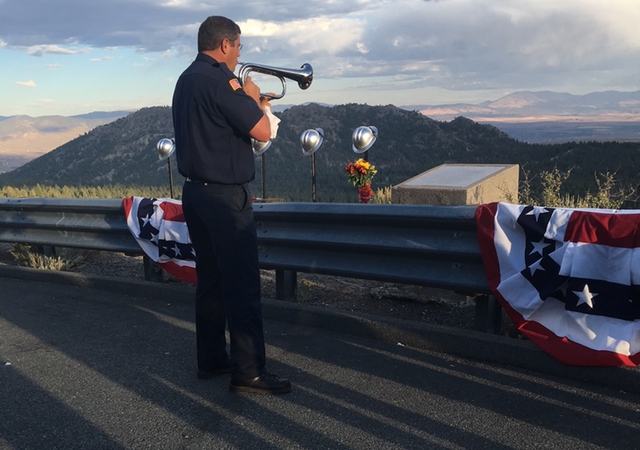
Tahoe Douglas firefighter Eric Guevin plays the bugle during the ceremony this fall honoring those who died 90 years ago. Photo/Provided

Tahoe Douglas firefighter Eric Guevin plays the bugle during the ceremony this fall honoring those who died 90 years ago. Photo/Provided

“These (firefighters) are heroes, but sometimes (the fires) get away,” he said outside his home perched on a hill as strong winds blew the vegetation in the distance. “Sparks can even cause one.”

Cote was referring to power equipment, adding he doesn’t run his when it’s really hot outside.

If a fire is sparked, vigilant neighbors are on hyper alert.

“We all kind of look out for each other here,” he said, pointing out how he saw the lightning strike for another fire sparked closer to Jacks Valley months ago.

Down his driveway to the privately-owned Clear Creek Road, signs of every sort are placed on the road to remind residents and the limited visitors who drive the seldom-used road to be extra careful.

One sign reads: “Beware of Fires.”

Others declare a list of “fire safety rules” as in no “off road activity, camping, campfires, fireworks, outside smoking and open flames.”

Another homemade plywood sign at a fork in the road marking a development even notes the emergency exit.

To a longtime resident like Dixie Busch, there’s no messing around or leniency when it comes to the threat made by the careless. The intrepid senior who’s lived at her Clear Creek Road home for 30 years has even stood up to a stranger trying to camp in the canyon telling him to move along.

“I asked him where he lives,” said Busch, who lives on a road named after her family. When the man answered, she said: “Good, then I’ll come camp on your lawn.”

“We’ve been lucky this year. We’ve had more rain, and that’s helped a lot. But it’s still dangerous,” she said.

To alleviate the threat, Busch has much of her property mowed down like Cote. But beyond the Busch estate, she wished some of her neighbors on the other side of Clear Creek Road took the same extra care. The canyon is heavily forested, with ladder fuels blanketing the area.

When the strong Zephyr winds roar through, residents like Cote and Busch become even more sensitive to traffic on the road. Their stranger danger threat could be someone setting a fire.


Opinion: The future of libraries

By Jim O’Donnell

So what will libraries be like in 2100?

That’s not so very far away. The next time you see a tiny baby, bear in mind that she or he has a very good chance of living to see the 22nd century. What will the world of libraries look like then? Nobody can know—but perhaps we can talk about what libraries should be in that imaginable future.

For instance, how many libraries will there be? I can think of two good answers, both of which I hope are correct—and one very bad answer, which I hope is entirely incorrect.

The first correct answer is simple. There will be a library: one library, globally comprehensive and globally accessible.

That vision means we think of libraries as collections, which is one thing they are. The old model depended on physical collections of material widely and strategically distributed in locations where communities or institutions could create, sustain, and support them. If consulting the “Encyclopedia Britannica” was a good thing, then every library worth its salt had to buy a set periodically and figure out what to do with the old edition it replaced.

Now the “EB “and many other resources are available online. Yet libraries continue to “purchase” (it’s more like a rental at this point) such things, one at a time, at prices they feel are too high and publishers think are too low. The sheer inefficiency of such duplication is preposterous. We continue that way as much out of habit as out of necessity. The necessity that persists is that we cannot think of another way of funding the creation and dissemination of complex information resources except by distributing the cost widely among institutions and users.

That has to change. Once an encyclopedia or a book or a journal or a database is in digital form, there is no good reason why it should not be made as universally and freely available as possible, and no good reason why it should not be centrally held and maintained. Right now, major university libraries harbor knowledge riches galore, astonishing things, really—and we cannot share them. Most people who live on the planet today are unable to have access to sources of knowledge that, from a technical point of view, could be reached on their smartphones today—literally today, within the next hour of the moment you read this, if the provider made the choice to allow the access.

If that has to change, it will change. We will see the consolidation of collections and a consolidation of the technical infrastructure of presenting those collections. (Oh, there will be redundancy and backups, just as there is now for things like Google searches, hosted on many servers in many locations, transparently sharing the load. Such distribution speeds service and improves the resilience in case of disaster or emergency.) And we will see the emergence of business models for paying for what we now think of as “publishing” that allow completely free and open access to the contents of this global library.

The second correct answer to my original question is a little more complicated: There will be 3 million libraries.

Precise arithmetic is beside the point, but I got that number by taking the American Library Association’s estimate that there are now 119,000 libraries in the United States and extrapolating. There is some reason to hope that the growth of human population will top out gently at about 9 billion in the next decades, and so at the per capita rate we now enjoy in the U.S., that works out to 3 million libraries—one for every 3,000 people, which sounds good to me.

But these libraries will have changed. Their physical collections will all be what we now call “special collections”: unique materials they possess uniquely because of where they are and what their history might be. At Arizona State, where I am the university librarian, we have the public papers of Sen. Barry Goldwater. There will never be more than one copy of those papers, but they will retain historical value and we will cherish them. At some point we may also digitize them, but if we do, there will be no good reason not to deposit the digitized version in the global central library and make it universally accessible.

Readers will still make their way to the 3 million libraries to see whatever unique collections they have, but readers will also find in those places much of what they now go there to find: intelligent people engaged in the work of knowledge and the work of community. Librarians will be there as coaches, mentors, guides, facilitators, and other members of the public will be there as knowledge-seekers, knowledge-sharers, entrepreneurs of the spirit, and entrepreneurs of the world of business. Libraries are the ideal “third place” for a free society and will never lose that powerful attraction.

How confident am I that my first two answers are correct? I surprise myself when I say “mostly.” (I thought I was more cynical than that.) The good news is that if I am correct, then a lot of really good things will have happened to humankind. A single global collection universally accessible will mean that the human family has made great strides to overcome factionalism, division, sectarianism, and political pathology. If the library I envision is accessible to everyone who lives in what we now call North Korea, we’ll know the world is a better place.

I did say I had a third bad answer to offer, the one I hope is wrong. That answer would be a deeply pessimistic one: zero.

There are a lot of ways that pessimism could come true. Disastrous interplay of nuclear weapons, asteroids, and a collapsing climate—the loss of libraries would be one lesser symptom of ruination in a dystopian future. We could also lose libraries to hubris and shortsightedness. “We don’t need libraries any more; it’s all digital”—we’ve all heard some version of that peremptory dismissal, entirely worthy to be heard on the stage of a debate among presidential candidates.

But we do need libraries. In a world of superabundant information, they curate and collect and discriminate and care for the good stuff—the stuff really smart people have worked to create and preserve, the stuff you can rely on when you want to understand the world deeply and accurately, the stuff too complicated to come into existence by crowdsourcing, too unpopular to be foisted on us by corporations or politicians. Librarians—smart, professional, dispassionate about everything but the truth—are the Jedi knights of our culture’s future and deserve to be respected for that.

And libraries as places will be no less valuable than they are today. For however optimistic I may seem to be, it still seems prudent to realize that good people and smart people and idealistic people will still not be the only people on the planet. They will value then as they do now the opportunity to pursue knowledge and share insight in the company of others.

If we let ourselves be taken in by techno-optimism and carelessness and if we then let libraries fade away, we will be in a poorer place. There are many historical explanations offered for the disappearance of the great ancient library of Alexandria, but my personal judgment is that it did not fall victim to Julius Caesar or Christian monks or Islamic warriors. Libraries are more likely to disappear because the responsible leaders of a community deprive them of support, take them for granted, treat them dismissively.

But I can still be optimistic. The ancient library of Alexandria vanished somewhere in the first centuries of the common era, but it has in fact come back. With all the political, religious, and social challenges facing Egypt today, a gleaming new building on Alexandria’s harbor now completes its second decade as a place to meet, and a place to talk, and—most important of all—a place to read. We’ll always need a place to read.

Jim O’Donnell is professor of historical, philosophical, and religious studies and university librarian at Arizona State University. His most recent book is “Pagans” (HarperCollins 2015).


NHP first state agency approved to fly drones

By Raven Jackson, Las Vegas Review-Journal

The Nevada Highway Patrol announced Friday that it is the first law enforcement agency in the state to fly small unmanned aerial vehicles — commonly known as drones — after gaining approval by the Federal Aviation Administration.

The patrol has begun using small UAVs weighing less than 55 pounds after fulfilling federal, state and local requirements, including education and training, to safely, securely and legally fly the aircraft, Trooper Daniel Marek said at a news conference in Las Vegas.

The UAVs can capture images using a 13-megapixel camera while flying at elevations of between 50 and 400 feet, he said. Marek said the agency refers to the aircraft as UAVs because the public tends to think of drones as weapons, such as the missile-equipped Predators the Air Force and CIA use overseas.

Read the whole story


Liability for Little Valley Fire could be big for Nev.

By Anjeanette Damon, Reno Gazette-Journal

The estimated market value of the 23 homes destroyed in the Little Valley Fire ranged from $542,000 to $3.8 million, according to a Reno Gazette-Journal analysis of data obtained from the Truckee Meadows Fire Protection District on Thursday.

The data suggests the state of Nevada could face a significant liability if investigators confirm the wind-swept blaze started as a result of a controlled burn the Nevada Division of Forestry conducted in the days before the fire started.

The Reno Gazette-Journal obtained market estimates from Zillow.com for 18 of the 23 houses destroyed in the fire based on the addresses provided by Truckee Meadows Fire. The value totaled $26.1 million. The average value of the homes was $1.4 million.

The estimate did not include the value of the 17 outbuildings that also were lost to the blaze.

Terry Taylor, an independent fire investigation consultant, said that based on his professional opinion, the value of the property loss could exceed $80 million when outbuildings, vehicles, personal belongings and landscaping is taken into consideration.

Read the whole story


Makerspaces expanding influence in Tahoe-Truckee

Lake Tahoe School in Incline Village opened a makerspace last year. Photo/Provided

Lake Tahoe School in Incline Village opened a makerspace last year. Photo/Provided

By Laura Read, Moonshine Ink

With the imminent arrival of the Truckee Roundhouse membership-based workshop, set to open at the Truckee Tahoe Airport Dec. 1, the region joins ranks with places around the world that offer work spaces where anyone can construct the projects of their imaginations.

But Truckee Roundhouse isn’t the only local enterprise that’s sharing resources and costs to bring brains and brawn together under one roof.

Like in similar communities, Tahoe area locals have been building things together for years: A house construction site is a makerspace where people of different skills make objects on a single site in order to build a shelter; Riverside Studios, in its original form on Riverside Drive, was a makerspace where in a collection of low-rent buildings several artists created work for sale; North Tahoe Arts in Tahoe City has held artisan classes for both hobby and sale in a large room above its downstairs galleries.

Read the whole story


Talk to focus on being healthy on the slopes

Barton Health is putting on a free lecture about maximizing on hill performance.


The talk will be Nov. 1 from 6-7pm in the board room at Lake Tahoe Community College.


Presenters will be: Terry Orr, Jeremy Vandehurst, Jeff Brown, Nick Ward, and Beachy Orr.

They will talk about:

·         Injury prevention

·         Concussion recognition and care

·         Preseason conditioning and demonstrations

·         Strength training to maximize the season

·         Importance of wellness and fitness.


STHS doubles team wins state title

Louis Marin and Mickey Sullivan

Mickey Sullivan and Louis Marin

South Tahoe High’s boys’ tennis team defeated Boulder City in the finals 6-1, 6-2.

Louis Marin and Mickey Sullivan beat Truckee in the semifinals 6-3, 6-3, and went on to become the champions.

Marin finishes his high school tennis career as one of the most decorated South Tahoe high School tennis players. He has won a singles regional championship, two doubles regional championships, and a doubles state championship.

Sullivan returns next year with two doubles regional championships, and a doubles state championship.

Head Coach William Davenport said, “Years of hard work paid off for Louis and Mickey when they dominated the opposing teams today. They are now recognized as the champions they have always been. I’m proud of what the entire team accomplished this year.”

— Provided to Lake Tahoe News


Queen to be hauled onto land before winter

The Tahoe Queen's future is still being decided. Photo/LTN file

The Tahoe Queen’s future is still being decided. Photo/LTN file

Crews are working on the Tahoe Queen to make it ready for winter.

The paddle-wheeler sustained extensive damage Aug. 16 when it caught fire. Welders and painters were working in the same vicinity when flames erupted.

A yellow boom still surrounds the vessel. This is just precautionary, according to officials.

“We were taking steps to further secure the vessel, given the change in seasons, with plans to move it to dry dock in a few weeks,” Dave Freireich, spokesman for Aramark, told Lake Tahoe News.

It will sit in the parking lot until Aramark decides what to do with it. A decision about whether is will be salvaged or scrapped is not likely to be made until it is out of the water.

Aramark owns the boat. It is still tied up to the dock at Zephyr Cove and has not moved since the fire. Even though Aramark has a permit to operate the boat out of Ski Run Marina it has not been there for more than a year because of the low lake level.

“The salvage company has been in contact with TRPA about getting the Tahoe Queen out of the water, and staff are working out the details of how that would happen, but nothing has been decided yet,” Tom Lotshaw, spokesman for the Tahoe Regional Planning Agency, told Lake Tahoe News.

The Tahoe Keys Marina is likely where it will be pulled out of the water.

— Lake Tahoe News staff report