Free Halloween party for South Shore kids

The 14th annual Halloween Treat Street event, an indoor trick or treating option hosted by radio station KRLT and KOWL radio stations, will take place in and around Lake Tahoe Community College’s physical education building on Oct. 31 from 5-8pm.

This free event is open to all children and their parents.

There will be plenty of candy handed out, much of it donated by local businesses and organizations. There will also be a Mad Scientist laboratory hosted by LTCC math and chemistry instructors Bruce Armbrust and Sean Ryland, gruesome games to play created by several LTCC student clubs, a haunted house with just the right amount of “haunt” for little children, hijinks and fun with LTCC’s coyote mascot, creepy Halloween music, loads of festive and spooky decorations, and more.

A portion of the loop road in LTCC’s main parking lot will be closed in front of the PE building starting at 4pm.

For more information, contact Diane Lewis at 530.541.4660, ext. 716 or  Lewis@ltcc.edu.


Most Nev. casinos post revenue increases

Lake Tahoe casinos helped the state post a revenue gain for September.

The Nevada Gaming Commission today released its figures showing the state took in nearly $948.49 million, which is a 3.55 percent gain from September 2015.

On the South Shore the win was 2.27 percent higher than the previous year at $21.7 million. The North Shore casinos did even better with a 6.37 percent year-over-year increase.

— Lake Tahoe News staff report


No shortage of housing woes on North Shore, Truckee; solutions harder to identify


Placer County electeds hope an action plan comes out of the housing report. Photo/Linda Fine Conaboy

Placer County electeds hope an action plan comes out of the housing report. Photo/Linda Fine Conaboy

By Linda Fine Conaboy

KINGS BEACH – A study commissioned by the Placer County Board of Supervisors underscored what most people already know – housing is a problem.

Results from the Tahoe Truckee Housing Needs Assessment were presented to the board on Oct. 25.

Here are some of the statistics for the North Shore and Truckee areas:

·      80 percent of housing units are single-family homes

·      65 percent are vacant and used mostly for vacations

·      Nearly half were built before 1979

·      Median household income is $67,000, but median home pricing is $538,000 (2015 statistics)

·      The maximum affordable home price for a family of four in a low-income bracket is $235,000

·      76 percent of residents spend more than 30 percent of their income on housing (statistically, more than they can afford)

·      The wait list for affordable housing is six months to 2 years

·      To house the future workforce, 12,160 housing units will be needed

·      Nearly 60 percent of employees commute to work

·      Nearly 50 percent of residents commute outside the basin for work

·      Nearly 50 percent of the region’s residents sit between very low to moderate income levels.

It was in January 2015 that supervisors approved $76,000, Placer County’s share of the $172,000 project cost, to develop a housing needs assessment in conjunction with Nevada County, Truckee and the Tahoe Truckee Community Foundation. TTCF was charged with preparing and presenting the housing needs assessment, and Bay Area Economics was hired to complete the study, prepare findings and make recommendations.

Stacy Caldwell, TTCF chief executive officer said, “This is hard stuff. We’re not just talking about housing, we’re talking about people.”

She called the assessment a regional collaboration and a good opportunity to focus on next steps and solutions. Additionally, TTCF said on its website that the study represents all aspects of housing issues in the North Lake Tahoe region.

Caldwell said now that the facts have been gathered, the community is looking at how to move forward. She said there is widespread community momentum, hopefully eliminating the possibility that yet another study will be left to gather dust on a shelf in someone’s office.

“We need to move forward in a collaborative manner,” she said, stating that the Community Foundation has established a $10,000 housing fund to get the donation ball rolling.

She suggested to the board that permits that raise housing costs considerably could be deferred. “There’s a desire for people to use their property to circumvent these barriers.”

District 5 Supervisor Jennifer Montgomery said perhaps expensive fees could be waived or deferred. “But it’s a challenge because of all the fees,” she said. “It is also complicated by TRPA and their rules.

In an Oct. 21 Lake Tahoe News opinion piece, Joanne Marchetta, executive director of TRPA, expressed her concerns about the same topic, saying full-time rentals are scarce and often unaffordable.

In her piece, Marchetta said, “Affordable workplace housing is a complex, challenging issue here at Lake Tahoe and elsewhere. We are not alone in facing these issues and there’s a renewed spirit today at Tahoe to tackle the challenge.”

Additionally, Marchetta expressed a willingness to solve workforce problems. “There is no one silver bullet to solve these complex issues … but by strengthening our collective will to work together on this important issue and be creative, we can make needed change happen.”

For her part, Montgomery said, “I want to get all of the districts together to determine a solution. Let’s take all of our resources to get something done. This just can’t sit on a shelf.”

“There are untapped resources,” Caldwell said. “Like HUD financing. We have baseline information now and we need to gather our resources together.”

Supervisor Kirk Uhler wondered how the town of Mammoth solved its housing problems, intimating that Lake Tahoe is not the only resort area to have reached this crisis.

Uhler also likes the idea of encouraging longer term rentals rather than seasonal. “If there is an inventory of short-term housing, what is it?” he asked. “Maybe people might want to rent their vacation homes to seasonal workers.” He proposed that older homes be rehabilitated and he likes the idea of turning larger homes into multiple housing units as well as freeing up homes that sit vacant.

Montgomery said she would like to see the Contractor’s Board and the Board of Realtors get involved in the conversation, a statement that cued representatives from both the Realtors and contractors’ boards to step forward to pledge their groups’ support.

Several other organizations and private citizens told their stories about housing and promised support.

Montgomery capped the meeting, saying, “We need to move from words to action and no longer have circular conversations. I would like to see more money for this problem. This is not unique to Placer County, it is nationwide. But we don’t want to create large pockets of low-income areas. We, as a community, must come together to support the project—quickly—in the next few months.”



Opinion: Californians want more from neighborhoods

By Joe Mathews

California is a state of large things: A 1,100-mile coastline, giant mountain ranges, and big cities. In such a sprawling place, how much could people care about their own little neighborhoods?

Answer: An awful lot.

Joe Mathews

Joe Mathews

This is a state of neighborhoods. And Californians are very devoted to their own. We identify ourselves as residents of neighborhoods more frequently than as residents of towns and cities. While surveys show we are mostly satisfied with our communities and our lives, we also want more from our neighborhoods.

Much more.

Californians’ hunger for neighborhoods that offer more opportunity is demonstrated in an extensive “Advancing Wellness” poll of Californians from the California Wellness Foundation and the Field Research Corporation. That love, and that hunger, bind the 30-some stories, including this column, that comprise a Zócalo series on California and the health of its neighborhoods.

If you consume national media, you might think America is an especially anxious and pessimistic country. But in the Advancing Wellness poll, about 90 percent of Californians are at least somewhat satisfied with how things are going in their lives; 91 percent of us are at least somewhat hopeful about the future.

Such hope and optimism begins at home. Majorities of us see our own communities as healthy places to live, where people of diverse backgrounds get along and where we can find the parks, schools, public safety, groceries, and race relations we want.

But the picture is far from golden, particularly if you’re light on gold.

It is not news that California, by some measures, is our most unequal state. We lead the country in billionaires and are home to America’s richest region (the Bay Area), but we also have the nation’s highest poverty rate (when we measure the value of public assistance and the cost of living).

These differences are most intimately felt at the neighborhood level. Californians worry that the problems of their neighborhoods will determine their own fates. If your neighborhood is polluted and you don’t know your neighbors, will you have health problems and be disconnected from the institutions—in education, in health, in the economy—that might change your circumstances?

There are big income-related differences in how Californians see neighborhoods, the poll suggests. Seventy-three percent of upper-income Californians describe their community as at least very good on being a safe place to live; among low-income Californians, that figure is only 40 percent.

The poll shows that people’s ambitions for their neighborhoods are high across the spectrum. One big ambition: Californians desperately want their neighborhoods to help them find jobs.

That’s not conventional wisdom. Public conversation about jobs tends to link employment to the national, international, or larger regional economy, and to trends outside the control of your neighborhood, from technology to education to trade. But millions of Californians have become unhappily accustomed to long commutes—from the places where we live to the places where we work. “Can your neighborhood get you a job?” is a fresh question.

It’s a question Californians want answered. Fewer than half of those in the survey—44 percent—rated their own community as a good or excellent place to get a good job; 52 percent offered a negative rating. And just 28 percent of Californians said their community was good at offering job opportunities for those who most need them, like at-risk youth or the Californians returning to the labor force after doing prison time.

A neighborhood weak on jobs has a snowball effect. Among the top threats to community health identified by Californians in the poll were extended unemployment by residents, employment in high-stress jobs, or people having to work multiple jobs.

While conversation about community health often centers on quality-of-life questions, Californians see community health as fundamentally economic. And they’re right. And if our state can find answers to their concerns, we’d also be building a more cohesive California with higher incomes, better and more affordable housing, more accessible education, and smarter treatment of chronic health problems.

Of course, Californians don’t all want exactly the same things from their neighborhoods. Other surveys and rankings of the most popular Californian places to live are striking for the variety of cultures, economies, geographies, and climates people prefer, in neighborhoods from Folsom to Poway.

But the Advancing Wellness data show a strong correlation between how people feel about their own health and the level of opportunities they see in their very own neighborhoods. We want a rich mix of offerings—from schools to parks and especially to jobs—and we want them close by.

These days, the biggest California dreams begin at home.

Joe Mathews writes the Connecting California column for Zócalo Public Square.


Women runners turn to technology to feel safe

By Amanda Loudin, Outdoor

Erin Kelly, 34, has been running since she was in the fifth grade. Over the years, the teacher from New Hampshire has logged miles on streets and sometimes trails in France, Morocco and all over the United States. She is devoted to a sport that keeps her mentally and physically fit, and she will run wherever and whenever she has the opportunity.

But like many female runners these days, she also runs with caution in mind. High-profile stories of women who have been assaulted or even murdered while running can make the sport feel risky. Expecially for those like Kelly, who have no choice but to get out before the sun has fully risen and their workday begins.

These days, many women are also turning to technology to improve their sense of security. Kelly is a case in point. Her high-tech tool of choice is the smartphone app Road ID, specifically its “e-crumb” feature. “Users can pick up to five emergency contacts to enter,” says P.J. Rabice, director of marketing at the app’s company, which is based in Erlanger, Ky. “The contacts can then follow their runner via text or email as she heads out the door and along her route.”

Read the whole story


Can bettors trust that e-sports aren’t fixed?

By Thomas Moore, Las Vegas Sun

The challenges of getting e-sports into sports books and onto casino floors were the focus of two sessions of a conference on the popular form of competition Tuesday in Las Vegas, with discussion focusing on how gaming operators could ensure bettors that the outcomes weren’t being manipulated.

“My question is how will these sports be regulated and how do we ensure their integrity,” said Chuck Esposito, director of Sunset Station Race and Sports Book. “I don’t know if I can watch an e-sports event now and know if something is right or wrong.”

Esposito put the question to two e-sports industry experts during a panel session at the conference, being held through today at SLS Las Vegas. Both said they weren’t especially worried about fixing or other integrity issues.

Read the whole story


Storms bring flood risk to fire ravaged areas

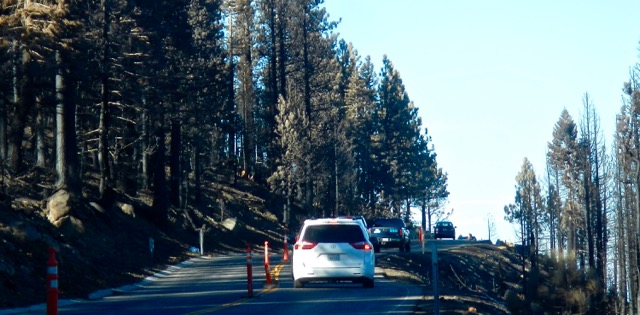
The Emerald Fire scorched trees on both sides of Highway 89. Photo/Kathryn Reed

The Emerald Fire scorched trees on both sides of Highway 89. Photo/Kathryn Reed

By Kathryn Reed

All the moisture that is in the forecast for the next week is a mixed blessing.

Five years of drought in California and western Nevada have left so many areas parched. The tinder dry brush has also contributed to horrendous fires throughout both states.

Now potential flooding is the major threat.

It is so worrisome to California officials that the state Department of Water Resources in conjunction with CalFire and the National Weather Service this week issued flash flooding warnings for not just this week, but the entire wet season.

“With an increased number of burn areas comes increased potential for flash flooding in those areas,” Bill Croyle, deputy director of Statewide Emergency Preparedness and Security for DWR, said at a press conference Oct. 24. “Flood preparedness is even more important this year due to widespread wildfires the state has experienced.”

Crews have been busy laying down tightly woven straw bales to prevent the burned hillside of the Emerald Fire along Highway 89 from washing down. The fire earlier this month burned nearly 200 acres on both sides of the highway, though mostly it was on the west side of the roadway.

DWR uses monitoring tools that synthesize multi-agency data to understand detailed, real-time ground conditions, helping to inform officials of developing areas of flood concern. The NWS is responsible for issuing flood watches and warnings. CalFire at different burn locations has taken measures to stabilize several slopes, including straw-mulching and installing early warning system rain gauges linked to local government emergency response systems to trigger evacuations.

As of Oct. 15, California had experienced 6,726 fires burning a total of 560,888 acres.

According to the National Weather Service in Reno, heavy precipitation is headed for Lake Tahoe on Thursday night. There will be a break Friday afternoon before the rain begins again Saturday afternoon and should last through Sunday.

Snow levels are expected to drop Saturday night to about 7,000 feet.


Truckee wants free bus service during holidays

Truckee is working on having a free shuttle service in place during the December holidays.

Traffic is always a challenge between Christmas and New Year’s Eve, often to the point of gridlock.

Town staff will be looking to create partnerships to make the shuttle a reality. It’s estimated to cost at least $40,000, but could reach $70,000. It all depends on how many buses operate and how often.

Plus, an operator still needs to found. The local service, Tahoe Area Regional Transit, does not have enough buses to operate this temporary service.

— Lake Tahoe News staff report


Snippets about Lake Tahoe

·       Reno‐Tahoe International Airport is beginning a 16‐month master planning process that will address airport growth, aviation industry changes, and FAA standards for the next 20 years. The first meeting is Oct. 27 at 10am. Meet at the ski statue at the airport.

·       The Douglas County Public Library in Minden and Zephyr Cove will be closed Oct. 28 and Oct. 29 for Nevada Day.

·       Check this out about a missing dog.

·       “Before the Flood,” a National Geographic documentary about climate change featuring Leonardo DiCaprio, will be at UNR Nov. 3 at 6pm in the Davidson Mathematics and Science Center. RSVP online.

·       Gary Romano is teaching Organic Farming in the Sierra on Nov. 5 at Western Nevada College. The $45 fee includes a copy of “July and Winter: Growing Food in the Sierra” (Bona Fide Books, 2016).


K’s Kitchen: Eggs in a muffin pan

By Kathryn Reed

Easy. That can be one of the best breakfasts, especially when guests are in the house.

Eggs are one of my go-to morning meals for visitors. Scrambled is the usual. But they are also boring.

Besides being tasty and different, the possibilities are endless with this recipe. Any vegetables you would put in a scramble or omelet will work here. I would pay attention to the color scheme if you are serving them to others. Presentation – it makes a difference.

The one thing I won’t do again is make them in a non-stick muffin tin. One of my guests earned her keep by cleaning that pan. I was ready to toss it.

This recipe made 12 muffins. The number of eggs could easily change based on how much other stuff you add to the tin. They tasted great as leftovers, too.

      egg dish   Muffin Eggs

2 C spinach

2 small tomatoes, chopped

18 eggs

Salt and pepper

Salsa, optional

Grease muffin pan. Divide spinach and tomatoes evenly in the tins. Whisk eggs, add salt and pepper. Pour into muffin tins.

Bake at 375 degrees for 20-30 minutes, until eggs are not runny.

Serve with salsa on the side.