Emerald Fire aftermath plagues area residents

Updated Oct. 28, 6:53pm: Power has been restored to Spring Creek. However, power will off Nov. 2 adn Nov. 3 from 8am-5pm to make final repairs. 

By Kathryn Reed

The 137 cabins in Spring Creek tract are still without power because of the Emerald Fire. Water is also an issue.

Liberty Utilities is hoping the lights will be back on by Nov. 4 at the latest. Multiple poles were reduced to ash when a fire swept through this area of the South Shore on Oct. 14. Replacement poles were flown in last Saturday.

“We are scheduled to pull wire in this week, but we are worried about the weather if the helicopter can fly,” Randy Kelly with Liberty told Lake Tahoe News.

While the cabins are on U.S. Forest Service land, the cabin owners are responsible for their own water.

Spring Creek Tract Association water manager Dave Braheny did not respond to an email inquiry from Lake Tahoe News.

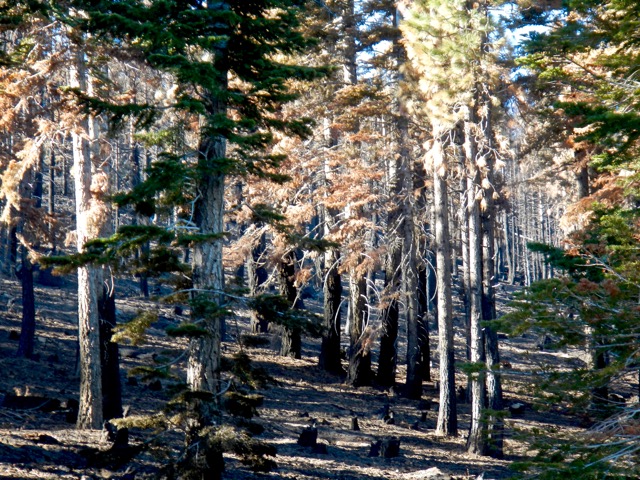
The Emerald Fire singed nearly 200 acres on the South Shore. Photo/LTN

The Emerald Fire singed nearly 200 acres on the South Shore. Photo/LTN

A generator is being used to access the water from the old tank. This is causing some residents to have water pressure issues. (A few people use the cabins year-round, while most of the 176 cabins are used seasonally. Legally, the cabins cannot be a primary residence.)

“The water supply for the Emerald Fire came from the hydrant system at Spring Creek,” Lisa Herron with the Forest Service told Lake Tahoe News. “According to our fire managers, there were no issues with water flow during the Emerald Fire.” In some areas the fire burned on both sides of Highway 89.

Spring Creek has 12 fire hydrants and more than three miles of 8-inch diameter and smaller distribution pipe. There is also a new 80,000-gallon water tank, but that water cannot be used for human consumption.

Residents started the water tank replacement project in 2008, with it being erected in 2015.

“We had to add a few more braces, anchors to the tank because earthquake codes changed,” Jay Tripathi told Lake Tahoe News. He has a cabin there and used to be on the community’s board of directors. “The interior of the tank got compromised so we had to seal it up.”

This meant draining, cleaning, sealing and refilling.

When the fire hit, the housing tract was close to being at the end of the waiting period for the water in the new tank to have settled and for tests to be taken to determine if it is potable. That is why residents are relying on the old tank for drinking water.

Driving through the main area of the housing tract the fire is not evident – just a major thinning project.

“I think all the fire folks did a phenomenal job of keeping us in the loop. It was scary,” Tripathi said. “If it hadn’t rained, I think it would have gone through our tract.”

While CalFire has yet to release an official cause of the fire, evidence points to electrical wires during high winds sparking the wildland fire.


Opinion: A hungry child cannot learn


By Larry Elwell

Eric had multiple cavities and several abscesses. His younger sister Madeline was not in much better shape.

“He has something wrong with each tooth,” the dental student said in amazement. “He has to be in constant pain.” I nodded my agreement, not really surprised by the news.

I’m the principal of Victoria Elementary School in San Bernardino, where the dental student was assessing Eric’s oral wellness as part of the annual fall screening we bring to all 500 children in our student body. In partnership with Loma Linda University’s dental school, which triages the worst cases and then follows up weekly with their mobile clinic, this program treats our students throughout the school year. For many kids, it’s the only dental care they receive.

Eric had a bright, cheerful demeanor and near perfect attendance, making it all the more incredible to learn that he’d been living in pain. Thankfully, the dental school put Eric and his sister at the top of their patient list— after two years of treatment, their dental health is finally approaching normal.

Eric and Madeline’s circumstances are not unique at our school. In our ZIP code, half of the children live in poverty, according to the U.S. Census. Almost monthly we have students undergoing extractions of abscessed teeth caused by bacterial infections, which, left untreated, can spread to the jaw, neck, and brain causing even more serious medical conditions.

To me, Eric’s teeth represent a problem in the way we measure whether we are providing economically disadvantaged students with educational opportunities on par with their wealthier peers. In addition to academic support, we must factor in the many needs of our children beyond the classroom. Are they hungry? Did they sleep? Basic necessities cannot be assumed when dealing with poverty because we know that hungry and tired children do not perform well in class.

In 2013, Gov. Jerry Brown shifted state educational funds to allocate more per-pupil to students from low-income families, and to increase local control. This shift will enable Victoria to expand the range of services to support our students. Starting this school year, we now have a person dedicated to following up with students in everything from school work, basic needs, and most important, emotional support for the psychological effects of poverty.

I was introduced to Victoria Elementary seven years ago, when a colleague called it a “hidden gem.” Through a fluke of geography, Victoria is located in San Bernardino, but it’s part of the neighboring Redlands school district. The differences are stark. Redlands, a city in the top 100 best places to live in California, is a “destination district.” It’s where teachers want to teach, students want to learn, and parents want their children to go to school. Transfer requests are many and successful transfers are highly coveted. San Bernardino, on the other hand, is third from the bottom on that same list of 240 cities. Poverty is high. Security is uncertain, both in terms of personal safety and food security.

Given the unmet needs in this community—needs as fundamental as food, clothing, and shelter—I consider myself lucky that when I took the principal position at Victoria, I inherited a Family Resource Center (FRC) on my campus. The FRC is our hub for community outreach. Originally funded through California’s Healthy Start Initiative, Redlands Unified has retained four FRCs across the district. Staffing duties are shared by a case manager from a local charity and a school worker.

Working in a community where many lack the basics, I’ve come to learn that poverty doesn’t mean impoverishment. The families that make up the Victoria community are generous with what they have. Neighbors often walk each other’s children to school. It’s also common for them to open their homes to one another so that parents have a place where they can leave their children before starting their early morning commutes to work. Even with this esprit de corps, more is needed.

Addressing hunger is one of the most vital issues we deal with. The school, formerly surrounded by orange groves and strawberry fields, now lies in the middle of a food desert. Many of our families don’t have cars, and public transit is both slow and sporadic, especially on weekends. There’s a liquor store nearby, but the nearest market is a five-mile round-trip walk.

More than 90 percent of Victoria’s students participate in the National School Lunch Program and receive free or reduced meals. Every Wednesday, a local church brings in bread donations from the Panera restaurant chain, which the children are free to take home. On Fridays the kids start the weekend with bags of groceries provided through the United Way’s Backpack Program. Sometimes it isn’t enough, so we run our own food pantry to help families who run into emergencies.

Several years ago we transformed an unused space outside a kindergarten classroom into a vegetable garden. Through local grants and the tireless efforts of several teachers and our after-school coordinator, children helped plant and sow lettuce, chard, and cauliflower. We use the fruits of their labor in our school cafeteria and we send some home with the families who help keep the garden maintained.

Some of our families cannot afford to buy their children shoes. Seeing first- graders shuffle around in adult-sized shoes is not uncommon. At the start of this school year, Kim, the assistant principal, stopped at a local Payless to buy a fifth- grader and her brother new shoes. The last time they got new shoes was when she and I took them to an Assistance League-sponsored shopping trip last March.  I think these are the only times these children have had new shoes.

The emotional effects of poverty are more hidden, but no less insidious. Simply put, poverty hurts—physically and emotionally. With a school full of young children, we see a lot of separation anxiety, which our staff is well equipped to handle. But for deeper emotional trauma we seek outside help. When Nathan’s mother was battling cancer, I would fish him from her car and Kim or I would sit him in the office. Some days we could get him to class; other days we couldn’t. It was only after our case manager from the Building a Generation charity arranged counseling that his anxiety got better.

Families do what they need to survive. Often, this means doubling or even tripling up in a house. This creates a host of scenarios I never encountered as a solidly middle-class kid growing up. At the milder end, it means their children are left in the care of older siblings or roommates with whom families have banded together to pay rent. At the more extreme end, arguing or abuse in the home in one form or another can result. We work with students and parents who themselves are working through their varying levels of anxiety or depression or worse. Some families handle it well and others struggle. Some self-medicate.

I tell our teachers that we can’t control what happens at home, but we can control how we react to it. The first thing we remind each other is: “Don’t confuse issues of poverty with issues of morality.” Simple things like homework completion need to be viewed through that lens. Does the student have someone who can help her with her homework? Does she even have a place where she can work? More than a few teachers let students stay after school to do their homework. Every child needs a champion.

The daily encounters with our parents and students are as important as any academic, medical, or social service at our school. I am often outside at arrival and dismissal times. Not only is this a great way to welcome or say goodbye to students, it gives our parents easy access to the “person in charge.” For every sit-down meeting I’ve had with a parent I’ve had two curbside conferences. The level of familiarity is important. Not only does it relieve parents to know that I watch over their children, but it helps create a sense of community that everyone belongs here.

It’s easy to get lost in the enormity of the conditions in which we operate. Many of the problems, such as affordable housing and jobs with livable wages, are beyond our power to solve. However, a sense of belonging is what gives us the tenacity to not only carry on but to help our students be resilient. Poverty makes it harder to succeed, but it is by no means an insurmountable barrier. Parents understand that we are on their side and their gratitude is evident every Teacher Appreciation Day when there is no shortage of flan, pan dulce, or tres leches cake for the staff.

Larry Elwell is the principal of Victoria Elementary School in San Bernardino. This essay is part of a Zocalo Inquiry into what makes a healthy neighborhood, produced in conjunction with the California Wellness Foundation’s Advancing Wellness Poll. 


Younger, diverse voters reshaping Calif. politics

By Michael R. Blood, AP

Come Election Day, California could legalize pot. Its new U.S. senator will be black or Hispanic — a first for the state. And voters could end the death penalty and revive bilingual education in schools.

The outcome of voting on Nov. 8 is likely to reflect long-term trends that have seen the nation’s most populous state become increasingly diverse and firmly Democratic in its politics.

A new wave of voters — many young, Hispanic or both — are poised to contribute to generational, demographic and cultural shifts that are reshaping California. Over half of new voter registrations this year are millennials — younger people who tend to be more liberal than older Californians.

The election also could strengthen the argument that California is becoming a one-party state. Most of the new voters are registering as Democrats or independents. And the number of voters aligned with no party is on track to eclipse Republicans, whose registration numbers are in freefall.

A key indicator of the change is the race to replace U.S. Sen. Barbara Boxer, who was first elected in 1992. The contest is a matchup between two Democratic women, Attorney General Kamala Harris, whose father is black and mother is from India, and Rep. Loretta Sanchez, the daughter of Mexican immigrants.

“I think that says a lot about where we are moving,” said political scientist Larry Gerston, professor emeritus at California State University, San Jose.

In addition, policies from past decades, when the state electorate was overwhelmingly white, could be recast or reversed. Voters are being asked to repeal the death penalty, which was reinstated in the 1970s but has not been carried out since 2006.

They could also dial back a 1998 voter-passed law that largely dismantled bilingual education at a time when illegal immigration was surging.

Through mid-October, more than 4 million people registered, or reregistered, to vote in California. Half signed up as Democrats, a meager 19 percent as Republicans and the rest primarily as independents, according to an analysis by nonpartisan research firm Political Data Inc.

Millennials represented over half of the new registrations. Latino registration, barely out of single digits a generation ago, represented nearly 30 percent of new voters, the data showed.

Democratic pollster Ben Tulchin, who worked for Bernie Sanders in the presidential campaign, said the influence of the new voters is being felt in competitive congressional races, where Republicans in a handful of once-safe districts are being threatened.

For Republicans, the rising influence of Hispanic voters is especially troubling in a year when their presidential nominee is Donald Trump, who has vowed to deport millions of people living in the country illegally.

The GOP’s troubles with Hispanic voters in California can be traced to 1994, when voters, with encouragement from Republican Gov. Pete Wilson, approved Proposition 187, which prohibited immigrants in the country illegally from receiving public health care, education or other social services.

The law was overturned, but it left lingering resentment with many Hispanics at a time when the Latino population was becoming increasingly important in elections. It’s also played a role in the prominent Democratic tilt to a state that sent Republicans Ronald Reagan and Richard Nixon to the White House but now doesn’t have a single Republican elected to a statewide office.

State figures released earlier this month showed the percentage of voters registered as Democrats had increased by 2 percentage points since the 2012 presidential election, while those aligned with the GOP dropped over 3 points. The share of independents, who tend to vote like Democrats, also increased.

The shift can be seen in places such as Riverside County, where Democrats now hold a thin registration edge in what once was Republican turf.

“You can track the progress Democrats have made in registration, and you can quantify the impact,” Tulchin said.

Republicans shuddered after the U.S. Senate primary in June. None of the party’s little-known candidates broke out of single digits in the vote count, allowing two Democrats to claim the two runoff spots in November, a first in the modern era.

In the late 1960s, most Californians wanted tougher laws against marijuana use or strict enforcement of the rules on the books. Over time, those views softened.

Pollsters say millennials are far more likely than other age groups to support passage of the proposal to legalize pot. Most Democrats and independents favor legalization, while Republicans are divided.

Nearly two decades ago, when the state was facing an influx of immigrants who entered the U.S. illegally and couldn’t speak English, Californians voted to dismantle most bilingual education programs in schools. Supporters said the initiative would help newcomers assimilate by forcing them to learn English.

This year, with scant visible opposition, voters are expected to repeal much of the law.

“California is always one of the leading indicators of social and demographic change, and this year seems to be a prime example,” said Darrell M. West, director of governance studies at The Brookings Institution and author of recently published “Megatrend,” which foresees rapid, dramatic political and social shifts in the 21st century.


Letter: Re-elect Vogelgesang to STPUD board

To the community,

As the election nears, I feel compelled to write a quick note expressing my endorsement for Randy Vogelgesang’ re-election to the STUPD board.

The members of our community that sit on the board make decisions that play a critical role on how our community thrives both from the standpoint of infrastructure and STUPD’s role in creating an agency that adds high quality employment to our town. The complexity of decisions made on the board need to be weighed by looking at history and precedent but at the same time there needs to be a vision for the future. Always balancing where we’ve been with where we intend to go.

Randy has been a local for over 30 years and has always been an active member in our community. Having already served on the board; including as chairman; he has the background and experience and has exceled as a board member.

I have known and worked with Randy for over 15 years and he has always shown exceptional judgment. He has an ability to analyze a complex problem and provide a creative and reasonable solution. As a structural engineer that has built a successful business based off of smart, no nonsense engineering principles, he carries those same values with his decision making on the board.

Randy has been a valuable asset as a member of the STPUD board. He is capable of making decisions and creating solutions that are in the best interest of our community.

It is for these reasons on Nov. 8 I will be voting for Randy Vogelgesang.

Best,

Brooke Martone-Ballachey, South Lake Tahoe


Letter: Caesars helps homeless coalition

To the community,

Tahoe Coalition for the Homeless (TCH) would like to thank Caesars Foundation and Harrah’s & Harveys Lake Tahoe for their support. In September the Caesars Foundation awarded TCH with a $10,000 grant to operate the South Lake Tahoe Warm Room.

These funds will help provide overnight refuge from the elements to individuals and families experiencing homelessness in the winter months.

Additionally, the Harrah’s Employees Reaching Out (HEROs) were very helpful in our pilot season by providing volunteers and donating supplies.

Tahoe Coalition for the Homeless is looking for groups to run supply drives and for volunteers for the 2016-17 winter season. We can be contacted at tahoewarmroom@gmail.com or 775.573.0822.

Sincerely,

Marissa Muscat, executive director


Research could help predict ‘flash droughts’

By Mallory Pickett, Forbes

Debasish PaiMazumder moved to Boulder, Colo., in the winter of 2012 to work as a climate scientist at the National Center for Atmospheric Research. PaiMazumder had spent the past three years in snowy Montreal, so he was pleasantly surprised to find winter in Boulder dry and warm. He was out hiking in shorts and a T-shirt in February, with no snow in sight.

But locals were quick to inform him that this was not a typical Boulder winter. Months later, this strange winter was followed by more exceptional weather: the “flash drought” of 2012-13 that started over the Rockies and went on to devastate agriculture in the Midwest, causing $30 billion in damage. It was one of the costliest natural disasters in recent history, and no one saw it coming.

The sudden onset and relatively short duration made the 2012-2013 dry spell a “flash drought.” Currently, scientists have no good way to predict these kinds of droughts, which can be devastating to farmers.

But in a paper published in Journal of Geophysical Research-Atmospheres this week, PaiMazumder reported a new method that could significantly increase forecasters ability to predict flash droughts. His idea was partly inspired by his warm, snow-free hikes in the winter of 2012.

Read the whole story


Snippets about Lake Tahoe

·      TAMBA crews are working to clear trees on Corral, Armstrong Connector and Tahoe Mountain. Email info@tamba.org to help or report areas needing work. Include the size of tree and location.

·      California is putting together a state Bicycle & Pedestrian Plan. Contribute by taking this survey.

·       Washoe County Sheriff’s Office will offer free Halloween candy X-ray screening at the Washoe County Courthouse and the Mills Lane Justice Center on the day after Halloween.

·       North Tahoe PUD is having a meet the candidates night on Nov. 1 from 5:30-7pm at the North Tahoe Events Center in Kings Beach.

·       Harry Weis, CEO of the Tahoe Forest Health System, is hosting a free talk titled Fact & Fiction- Health Care 101 on Nov. 1 from 6-7:30pm at the Truckee hospital.


Road Beat: Mazda CX-5 AWD, an all-in-one

The Mazda CX-5 AWD handles well and gets good gas mileage. Photos/Larry Weitzman

The Mazda CX-5 AWD handles well and gets good gas mileage. Photos/Larry Weitzman

By Larry Weitzman

About a year ago, the Road Beat tested the new generation Mazda CX-5, a mid-size CUV. It was a FWD edition with the 2.5L Skyactiv DOHC, 16 valve inline four. But perhaps the more important model, especially to my readers, is the AWD issue of the same vehicle necessary for the weather and terrain we live in. Even flat landers who frequent the Sierra should opt for this simple single speed AWD system.

There have been no significant changes from 2015 to 2016. The Takeri-themed body remains the best looking in its class, although it is getting some competition from the new Hyundai’s in this compact CUV class. The marvelous, aggressive front end remains with its curvaceous lines ending in its tapering rear end. The co-efficient of drag is a reasonable 0.33.

Its length of 179 inches with a generous width of 72 inches and height of 66 inches places the CX-5 directly into the aforementioned compact CUV class. Its sleek design hides its ability to hold 65 cubic feet of cargo behind the front seats.

Specifications Price $22,675 to about $34,000 Engine 2.0L inline four 16 valve, DOHC 155 hp @ 6,000 rpm 150 ft-lb of torque @ 4,000 rpm 2.5L inline four 16 valve, DOHC 184 hp @ 5,700 rpm 				185ft-lb of torque @ 3,250 rpm Transmission Six speed manual Six speed torque converter automatic Configuration Transverse front engine/ FWD/AWD  Dimensions Wheelbase 106.3 inches Length 178.7 inches Width 72.4 inches Height 65.7 inches Track (f/r) 62.4/62.5 inches Ground clearance 8.5 inches Weight 3,589 pounds GVWR 4,566 pounds Steering lock to lock 2.7 turns Turning circle (wall to wall) 38.4 feet Wheels 19X7 inch alloys Tires 225/55X19 Cargo capacity (second row up/down) 34.1/65.4 cubic feet Fuel capacity 15.3 gallons	 Co-efficient of drag 0.33 Performance 0-60 mph 7.83 seconds 50-70 mph 4.26 seconds 50-70 mph uphill 6.75 seconds Top speed (mfg) 127 mph Fuel economy EPA rated 24/30/26 mpg city/highway/combined. Expect 28-29 mpg in rural country driving. 31 mpg on a level highway at legal speeds.

Specifications
Price $22,675 to about $34,000
Engine
2.0L inline four 16 valve, DOHC 155 hp @ 6,000 rpm
150 ft-lb of torque @ 4,000 rpm
2.5L inline four 16 valve, DOHC 184 hp @ 5,700 rpm
185 ft-lb of torque @ 3,250 rpm
Transmission
Six speed manual
Six speed torque converter automatic
Configuration
Transverse front engine/ FWD/AWD
Dimensions
Wheelbase 106.3 inches
Length 178.7 inches
Width 72.4 inches
Height 65.7 inches
Track (f/r) 62.4/62.5 inches
Ground clearance 8.5 inches
Weight 3,589 pounds
GVWR 4,566 pounds
Steering lock to lock 2.7 turns
Turning circle (wall to wall) 38.4 feet
Wheels 19X7 inch alloys
Tires 225/55X19
Cargo capacity (second row up/down) 34.1/65.4 cubic feet
Fuel capacity 15.3 gallons
Co-efficient of drag 0.33
Performance
0-60 mph 7.83 seconds
50-70 mph 4.26 seconds
50-70 mph uphill 6.75 seconds
Top speed (mfg) 127 mph
Fuel economy EPA rated 24/30/26 mpg city/highway/combined. Expect 28-29 mpg in rural country driving. 31 mpg on a level highway at legal speeds.

As with my FWD test vehicle, the same 2.5L, 184 hp at a low 5,700 rpm and 185 pounds of twist at just 3,250 rpm, resides in the engine bay of my top of the line Grand Touring edition. This same powertrain is optional in the compact Mazda 3 and 6. With a weight increase of about 150 pounds for the AWD system to 3,589 pounds, there is a small penalty in 0-60 mph time to 7.83 seconds or about six-tenths of a second when compared to the FWD CX5. Fifty to 70 mph passing times also increase insignificantly to 4.26 seconds on level ground and to 6.75 seconds up a steep grade (FWD times were 4.17 and 6.56 seconds, respectively). Performance is still at or near the top of the class.

EPA numbers show fuel economy losses of a couple of mpg, rating the AWD version at 24/30/26 mpg. But overall I averaged the same 28-29 mpg overall as I did in the FWD version in rural country driving, reflecting the efficiency of the Skyactiv system of direct injection and the use of the Atkinson cycle system of an extremely high compression ratio (13:1) and late closing intake valves.

Power is transmitted to all four wheels via a slick shifting six-speed torque converter tranny.

Handling is a forte in all Mazdas and as with FWD version, it only improves in the CX-5 with the addition of AWD. Suspension is state of the art fully independent in all four corners with MacPherson struts up front and a multi-link system holding up the rear. Both ends have stabilizer bars and coils are the springs of choice. The steering rack is electronically assisted that is a quick 2.7 turns lock to lock and the turning circle is a tight 36 feet. Standard 19 x 7 inch alloys are shod with lower profile, wide 225/55 tires. The results are handling feel and feedback of a sporting sedan, ripping through the twisties with aplomb as Mazda does emphasize handling qualities in all their vehicles with well controlled body roll, super accurate steering, mild understeer and a backend that stays planted.

But that doesn’t necessarily mean a loss in ride quality. Strong, stiff construction enhances both ride and handling. While firm, it is still quite compliant that is a good balance as CX-5 handles both big and small bumps well. Wind noise at speed is non-existent and the tires are quiet on all but the coarsest roads. Engine speed is a reasonably low 2,200 rpm at 70 mph, the same as the FWD model as it also uses the exact same gear ratios through the gears.

Braking is excellent, repeating the 41 foot stop of the FWD model from 40 mph. Safety is second to none with standard rear cross traffic alert, a rear view camera, available lane departure warning, radar cruise control, smart braking (I-Activsense package $1,500), LED front headlights (and LED lights everywhere else) that are adaptive with auto high beam. CX-5 also has Smart city braking and more (Tech package $1,155).

Inside are gorgeous standard leather seats that sit as good as they look. A precision, Swiss watch type instrument panel has all the appropriate gauges including a tach and speedo plus a trip computer. However, the center stack if you can call it that still uses a mouse like system that needs work, plus a screen that looks like an afterthought. It needs to be improved.

Rear seating is a pinch for three if the trip becomes more than an hour, but cargo volume is about average for the class, plenty for a Home Depot run.

Pricing for my top of the line CX-5 AWD Grand Touring model stickers for $29,870 which includes the Nav system. The two option packages plus a few small items like $300 for the Soul Red paint brought the total to $33,685 plus $800 for the boat from Hiroshima, Japan. CX-5 remains at the top of its class which has some pretty heady competition like the RAV4, CR-V, Rouge, Escape, Jeep Cherokee, Kia Sportage and more. However, the new Hyundai Santa Fe Sport 2.0T may be its equal and a bit more. Both were tested back to back, but you be the judge.

Larry Weitzman has been into cars since he was 5 years old. At 8 he could recite from memory the hp of every car made in the U.S. He has put in thousands of laps on racetracks all over the Western United States.


Registration open for annual bird count

The Christmas Bird Count, widely regarded as the largest and oldest citizen science project in the world, will be Dec. 17 in South Lake Tahoe.

Each year, Dec. 14-Jan. 5 tens of thousands of volunteers throughout the world head out into the winter to count birds for a day. This tradition goes back to 1900, and in the intervening years, these birders have built a database on bird populations that is unmatched by any other wildlife census.

TINS co-founder Will Richardson has coordinated the South Lake Tahoe count since 2004.

Meet at Alpina Coffee Cafe on Emerald Bay Road at 8am. The group will bird at Cove East before splitting into groups to bird at other areas. A pizza party, complementary of TINS will conclude the day.

To register, go online.


‘Mother of Nevada Wilderness’ Marge Sill dies

Marge Sill's conservation efforts took her to places all over Nevada. Photo/Friends of Nevada Wilderness

Marge Sill’s conservation efforts took her to places all over Nevada. Photo/Friends of Nevada Wilderness

By Henry Brean, Las Vegas Review-Journal

The wilds of Nevada have lost their matriarch.

Through more than five decades of conservation work, Marge Sill came to be known as the mother and, later, the grandmother of Nevada wilderness.

“It was a title she embraced fully and loved,” said Shaaron Netherton, executive director of the Friends of Nevada Wilderness, a nonprofit advocacy group that Sill helped found in 1984. “She’s just been a force in Nevada conservation for a long time.”

Sill died Sunday at her home in Reno at age 92.

Read the whole story