Sierra’s yellow-legged frogs are making a comeback

By Louis Sahagun, Los Angeles Times

In the 1950s, California wildlife authorities used to fly over remote lakes and creeks in Yosemite National Park and deliver precious cargo: hatchery-raised trout.

The policy was great for fishing enthusiasts. But for the yellow-legged frogs that shared those waters, the arrival of hungry trout was a disaster.

These days, wildlife officials are using helicopters to transport the fist-sized frogs to some of the very same waters, which are now being rid of non-native trout.

It’s part of a strategy that has helped the frog population grow at a rate of 11 percent a year since 1991, according to a report this month in the Proceedings of the National Academy of Sciences.

Read the whole story


LTCC providing help for adult learners

Lake Tahoe Community College’s adult education consortium, Advance, is partnering with local workforce development specialists to launch shared informational sessions.

Participants in these sessions may work toward getting their high school equivalency, or sign-up for workforce readiness programs, or explore individualized career and educational pathway planning, or all of the above.

The first session is Nov. 9 from 10am-1pm in LTCC’s Aspen Room (library building). At this session participants may connect to work-based learning opportunities including financial assistance for workforce training, as well as learn about educational and other supportive services. Participants can determine which programs are most relevant to them and their pathway, and take the next step in finding the best fit. At the conclusion of each session, participants will be able to schedule follow up appointments or begin the pathway building process.

For more information or to reserve a spot, contact Alexis Foley at adfoley@ltcc.edu or 530.541.4660, ext. 192.


Tahoe Tails — Adoptable Pets in South Lake Tahoe

Lilly

Lilly

Lilly is a 10-week-old kitten who is available for adoption now. How can you resist that face?

She is a brown tiger and white shorthair cat who is very beautiful, and of course energetic and playful.

Lilly is spayed, microchipped, tested for FIV, and vaccinated. She is at the El Dorado County Animal Services shelter in Meyers, along with many other dogs and cats (including other kittens) who are waiting for their new homes. Go to the Tahoe animal shelter’s Facebook page to see photos and descriptions of all pets at the shelter.

Call 530.573.7925 for directions, hours, and other information on adopting a pet.

For spay-neuter assistance for South Tahoe residents, go online.

— Karen Kuentz


South Shore cycling advocates seek upgrades

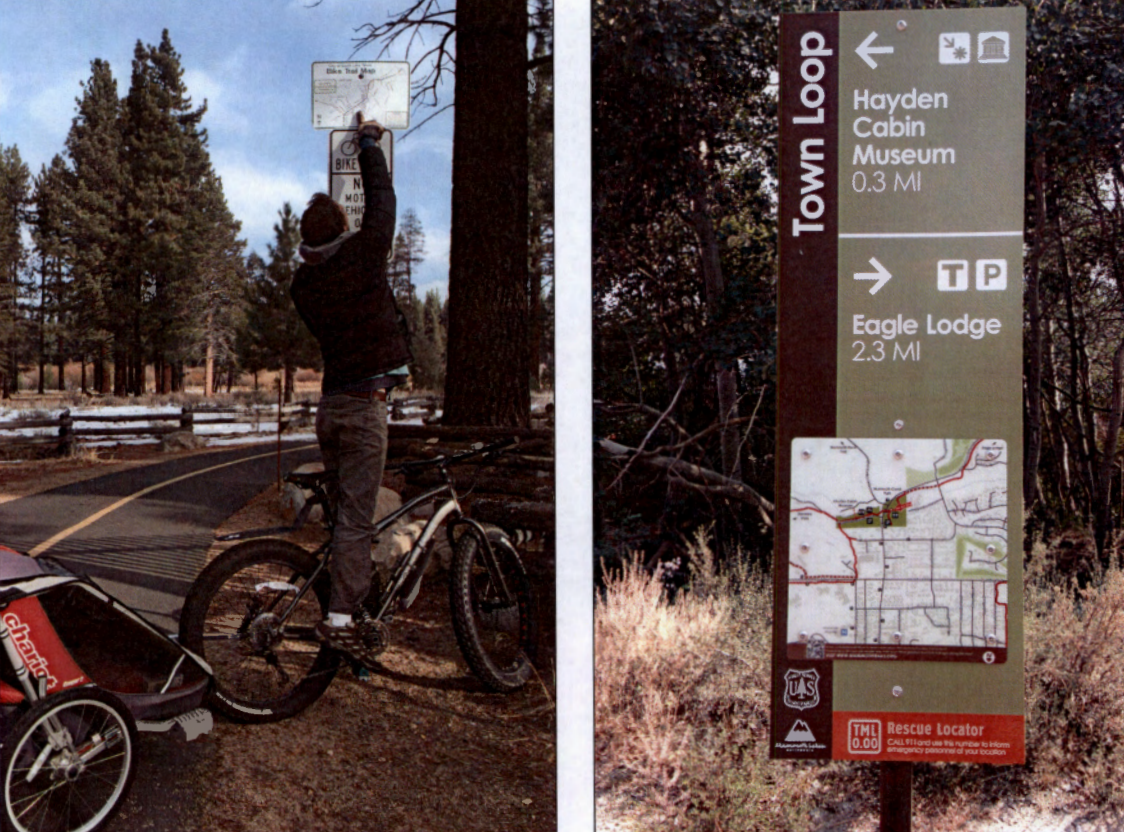
Scott Valentine, left, tries to read a bike route sign in South Lake Tahoe. At right is signage in Mammoth. Photos/Provided

Scott Valentine, left, tries to read a bike route sign in South Lake Tahoe. At right is signage in Mammoth. Photos/Provided

By Kathryn Reed

Signs don’t do much good if no one can read them, and recreation amenities don’t do much good without staff to manage and maintain them. Those were two of the overriding messages delivered this month by the South Lake Tahoe Parks and Recreation Commission to the City Council.

Commissioner Scott Valentine, who is about 6-feet-tall, showed a picture of himself standing on his bike pedals, arm outstretched trying to read the tiny print on a mounted trail sign in the city.

“It’s 8-point font on an 8 x 10-inch tin,” he told the council. “I’m not sure how many people can read a sign that is 10 feet off the ground.”

The commission acts as an advisory body to council about all things recreation. Signage, connectivity and staffing were the three points stressed during this annual report.

“Clear and consistent signage will improve visitor enjoyment and enhance traffic flow and resolve safety issues,” the report states.

Valentine, who is chairman of the commission, suggested adding QR codes to signs so people with smart phones could get an automatic link to information.

The commission recommended better signage at:

·      Tahoe Keys Boulevard-Eloise Avenue

·      Springwood trailhead

·      Viking Road trailhead

·      Al Tahoe Boulevard-Pioneer Trail

·      Tahoe Keys Boulevard-Venice Drive.

In terms of trails that will help get people around the area better, Valentine said the most important one is the Greenway. While ultimately it will go from Meyers to Stateline, it is being built incrementally from the center outward. The California Tahoe Conservancy is the lead on this project.

In 2015, 0.42 miles of the Greenway was built between Herbert Avenue and Glenwood Way. Future sections include going from Herbert to Ski Run Boulevard, and then from Ski Run to Van Sickle. When those are completed the trail will be 3.86 miles long.

A few of the improvements the commission would like in the near future include:

·       Connecting the old Alta Mira building to Ski Run Boulevard;

·       Continuing the trail at Viking Way-Lake Tahoe Boulevard to the Y;

·       Creating a spur from the trail behind Fitness Evolution-Scusa to Sierra Boulevard.

“We can’t recommend any of these additional projects without first addressing our staffing needs,” Valentine said.

He said the ongoing maintenance is an issue. People are needed to maintain these trails.

The council did not discuss anything that Valentine presented that day.


Opinion: Being in good health saves money

By Zócalo Public Square

It might seem odd to try to attach a dollar value to health—like trying to quantify love or happiness. But, in fact, a recent study did attempt to measure the value of the health created or supported by California’s county public health departments.

Led by UC Berkeley Health Economist Timothy Brown, the study noted  that a year spent in good or excellent health instead of poor or fair health could be valued at nearly $42,000. The study, published in the American Journal of Public Health, is part of a larger project Brown is leading to quantify how investing in public health returns benefits individuals and communities. For this Zócalo inquiry into what makes a healthy neighborhood, produced in conjunction with the California Wellness Foundation’s Wellness survey, Brown explains how he conducted the study, why the findings surprised him, and how it’s possible to measure the value of bad health outcomes that don’t happen.

Q: What is the most important finding of the study?

A: With every year of public health funding, more than 200,000 people in California will improve their general health status, and of these people, more than 29,000 will not die. These are causal effects. The value of one year of improved health has been estimated to be equivalent to receiving $42,000 in additional income for the person whose health is improved. The value of a life saved has been determined by the federal government to be worth almost $10 million. Therefore, I conservatively estimated that every dollar invested in the California county public health system returns $67 in improved health. To put that in perspective, every dollar invested by Medicare in programs to treat heart attacks, type 2 diabetes, stroke and breast cancer returned from $1.10 to $4.80 of improved health, depending on the condition.

Q: Were you surprised by what you found? If so, why?

A: I was quite surprised. I did not expect county public health programs to have such a large impact on population health. But I think that is simply a function of how difficult it is to see the effects of public health activities. Public health activities primarily prevent bad health outcomes from happening and this effect cannot be easily seen without careful investigation.

Q: What was your objective in undertaking this study?

A: I wanted to determine the return on dollars invested in the county public health system. That is, how valuable is the entire county public health system in terms of the health that it produces? The impact or effectiveness of the county public health system is difficult to see, since unlike medical care, public health interventions are usually aimed at preventing illness in populations rather than curing sick individuals.

For example, the effectiveness of a medical intervention to cure food poisoning would be easy to evaluate because we would start with a clearly identifiable group of individuals with food poisoning. We could then determine how many of these individuals quickly recovered from food poisoning due to our medical intervention. In contrast, an analogous public health intervention would be designed to prevent food poisoning. One such public health intervention is the inspection of food service establishments. In this case there is no easily identifiable group of individuals who may have been poisoned if the inspection had not taken place. In other words, it is easier to count how many individuals with food poisoning recovered because of a medical intervention than to count how many individuals never experienced food poisoning in the first place because of a public health intervention. The latter can be done; it is simply much more difficult.

Q: Can you briefly describe how the study works? 

A: We estimate the causal relationship between the amount of money spent by California county departments of public health and deaths from any cause. We also estimate the causal relationship between the amount of money spent by California county departments of public health and changes in the general health status of individuals.

When examining mortality, we are able to obtain an accurate count of all the individuals who died during a given year in each county, since mortality is carefully recorded by the state. When examining changes in general health status, we analyzed a carefully collected representative survey of individuals in each county, which gave us an accurate description of the percentage of individuals in each of five different general states of health (poor, fair, good, very good, excellent). This simple self-reported measure of health is actually very predictive of actual health.

We then used sophisticated statistical techniques to mimic what would happen to mortality and general health status in a randomized controlled trial in which counties were randomly given increases in their public health budgets. We expect those counties with higher public health spending to have lower mortality and higher general health status. We do not actually perform this randomized controlled trial for ethical reasons, but are able to mimic it statistically using data on what actually happened.

Q: What are the responsibilities of a county public health department? When we give them more funding, what are we getting in return?

A: Many people do not have a clear understanding of the broad array of activities of their county department of public health engages in. The 10 essential services of public health include: 1) monitoring population health status to identify problems; 2) investigating health problems and hazards; 3) educating people about health issues; 4) mobilizing community partnerships to identify and solve health problems; 5) developing policies and plans that support individual and community health; 6) enforcing health-related laws and regulations; 7) linking people to needed personal health services and assure the provision of health care when otherwise unavailable; 8) assuring a competent health care workforce; 9) evaluating the effectiveness, accessibility, and quality of personal and population-based health services; and 10) researching for innovative solutions to health problem.

Most of the services provided by county departments of public health benefit the average person, without their even being aware of it. The average person may not get sick during flu season because other people received flu shots provided by the public health department thus reducing the possibility of being exposed to the virus. The average person may not get food poisoning because the restaurant they like to eat in was brought up to code by a conscientious health department inspector. The average person may not become ill from long-term exposure to second-hand cigarette smoke due to public health efforts to establish non-smoking policies. The average person may start to eat more fruits and vegetables due to the influence of a friend who was involved with a public health nutrition program. The average person may not contract a sexually-transmitted disease because of public health programs to reduce sexually-transmitted diseases that someone else participated in. The list goes on and on.

Q: Do county departments of public health save money for counties?

A: I think that is the wrong question to ask. Many public services exist not to cut local government costs, but to improve the quality of life in the county. Examples of public services that are provided primarily to improve quality of life rather than to cut local government costs include public libraries, public parks, bike lanes, the enforcement of building codes, and fire services. These services make an area a nicer place to live in, which indirectly improves property values, allows local businesses to thrive, and over the long term, increases county tax revenues. Many counties are known as desirable areas whose residents have excellent health as can be seen on websites like http://www.countyhealthrankings.org/. Well-funded county departments of public health are an important reason why some counties have better health than other counties.

Timothy Brown is a health economist on the faculty of the School of Public Health at UC Berkeley. His current research areas include public health systems and services, the economics of chronic pain, and reference-based benefits in health insurance. 



An Airbnb for workers?

By Hang Nguyen, San Diego Union-Tribune

It’s like a big Airbnb house you’d share with friends except it’s specifically for workers.

About 18 months ago, Emmanuel Guisset created Outsite, a place where people can go to work remotely, share a home with other professionals, stay overnight and play. He picks beautiful locations with a lot of stuff to do outdoors. Its first house was in Santa Cruz, where the business is headquartered. Outsite also has houses in Lake Tahoe; Napa Valley; Stinson Beach, and Costa Rica.

Guisset came up with the idea partly after staying in a hacker house while working in San Jose.

A hacker house is “like a hostel for developers and entrepreneurs,” he said. “They fit eight people in a dorm. It was dirty and I was traumatized. I wanted to create an upscale place where (people) can work and live and also be close to nature and the beach without the stress of a big city.”

Read the whole story


K’s Kitchen: Apple cider for adults

By Kathryn Reed

Sometimes even adults need treats instead of tricks.

If you like your calories and sweets in the form of alcohol instead of candy, this is the drink for you.

While drinking around lots of kids might not be the best scenario, this is a recipe to keep for the long winter ahead. This will also give you a reason to load up on cider from Apple Hill.

The problem is that it goes down way too easy.

drinkAdult Hot Apple Cider

2 shots bourbon

4 shots apple cider

1 tsp nutmeg

1 tsp ginger

2 cinnamon sticks, optional

Bring apple cider, nutmeg and ginger to a boil. Remove from heat and add bourbon. Divide into two glasses.


Tahoe Donner tennis team reaches nationals

Tahoe Donner’s men’s 55 and over 9.0 tennis team made it to the semifinals of the national championships.

This is an all doubles league where the combined USTA rating of the players must be 9.0 or less.

The team took fourth place in the Oct. 30 competition in Arizona.

The Truckee team was made up of John Wlcek of South Lake Tahoe, Marty Briesach of Truckee, Zeke Straw of Truckee, Dave Condon of Truckee, Alain Kovaltchouk of Reno, Tren Nolan of Reno, Andy Biederman of Reno, Barry Young of Fairfield, Michael Fischer of Fairfield, Russell Jilot of Auburn, Paul Phillips of Auburn, Terry Vander Ploeg of Grass Valley, Randy Havens of Weimer, and Jim Kooler of Modesto.

— Lake Tahoe News staff report


Call center industry flourishing in Nevada

By Nicole Raz, Las Vegas Review-Journal

Amid Nevada’s economic slowdown between 2008 and 2013, the call center industry settled in the state.

What it found was a gold mine of talented, unemployed labor.

Most industry settlers came in the form of high-end call centers that require specialized training, boosting today’s average call center hourly wage to $14.86 statewide.

“The (contact center) companies who we talk to now, we’ll tell them if you are not paying $15 an hour, good luck finding a workforce (in Northern Nevada),” said Mike Kazemierski, CEO of the Economic Development Authority of Western Nevada.

Read the whole story


Planners to discuss condo project near bi-state park

The Gondola Vista Estates condo project is going before the South Lake Tahoe Planning Commission on Nov. 10.

The 20 condos would be built on Lake Parkway between Heavenly’s gondola and the state line.

Planning commissioners will consider a major design review permit, negative declaration addendum, and a variance from the city’s trash enclosure ordinance.

The meeting will be at Lake Tahoe Airport at 3pm.

For more info, contact John Hitchcock, city planner, at 530.542.7472.

— Lake Tahoe News staff report