Farmers’ market vouchers available for seniors

The El Dorado County Area Agency on Aging has a limited supply of senior farmers’ market check booklets available for qualified El Dorado County seniors.

Each eligible senior will receive one booklet that includes five checks redeemable for $4 each to be used at certified farmers’ markets for the purchase of fresh, unprepared, locally grown fruits, vegetables, cut herbs and raw unprocessed honey.

Distribution of the check booklets will take place as follows:

  • July 11, from 8am-noon at the Burke’s Junction Farmers’ Market, Coach Lane at Strolling Hills Road, located in Cameron Park.
  • July 14, from 9am-noon at the People’s Mountain Market, Garden Valley Park, located at Garden Valley Road and Marshall Road in Garden Valley.
  • July 17, 2018, from 8am-1pm at the South Lake Tahoe Farmers’ Market, American Legion Parking Area, located at 2748 Lake Tahoe Blvd (Hwy. 50) in South Lake Tahoe.
  • July 25, 4pm to dusk at the Main Street Farmers’ Market, near the Bell Tower, located at 385 Main St. in Placerville. 

Farmers’ Market check booklets will be distributed to seniors who are at least 60 years of age and meet income guidelines (one person household with annual income less than $22,459 or $1,872 per month or two person household with income less than $30,451 or $2,538 per month). Checks are good for all certified farmers’ markets in California.

Quantities of the booklets are limited and will be distributed on a first come, first served basis. Seniors may designate an individual (proxy) to receive their booklet and make purchases at the farmers’ market on their behalf. A proxy form must be completed by the eligible senior in advance so the proxy can pick up the booklet during the booklet distribution. For more information, or to request a proxy form,  call 530.621.6251.


Success of Tahoe to be subject of talk

How collaboration, citizen science and community participation in conservation has kept Lake Tahoe blue will be the subject of a talk on May 23 in Reno.

This is part of a lecture series created by DRI and The Discovery.

Lake Tahoe’s global successes in environmental research and conservation are credited to collaboration between nonprofit organizations, community members, and scientists. Speakers will touch on those relationships, discuss the ecological history of the lake, key policies, and education programs that have made these successes possible.

Darcie Collins from the League to Save Lake Tahoe, Alan Heyvaert from DRI, and Sudeep Chandra from UNR will share their experiences in citizen science, community engagement, and stewardship.

Doors open at 7pm, presentation begins at 7:30pm at Patagonia Outlet, 130 S. Center St., Reno.


Boil water notice for Douglas County districts

A precautionary boil water notice has been issued for the Cave Rock Water and Skyland System in Douglas County due to a computer error at the Cave Rock Water Treatment Plant.

The notice is expected to last through Monday.

Water samples are being taken regularlyl. Once this process is complete and samples are clean officials will rescind the boil water notices.

The boil water notice is only precautionary at this time.


Confederate landmark near Tahoe could get Native American name

By Mike Moffitt, San Francisco Chronicle
 
A distinctive peak near Lake Tahoe may not keep its controversial name much longer.

Alpine County supervisors have recommended that Jeff Davis Peak be renamed “Da-ek Dow Go-et,” a name proposed by the Hung-A-Lel-Ti Woodfords Washoe tribe. “Da-ek Dow Go-et” means “saddle between points.”

The proposed name change was made to the U.S. Board on Geographical Names, which has final say in the matter.

Read the whole story


Proper bike fitting has multiple benefits

By Harrison Brown

Being ready to enjoy summer on your bike doesn’t only mean getting or being fit, it includes having your bike fit. With temperatures warming up, this is the perfect opportunity to get your bicycle ready for the season.

Anyone who enjoys riding should have their bike fitted. At Barton Health, bike fitting is geared toward clients who road bike, mountain bike, or compete in triathlons – all with the goal of optimizing body position to maximize performance, based on the rider’s recreational or competitive goals and history of injury.

Discomfort from a poorly fitted bike is one of the most common reasons people will avoid riding, but fixing a poorly-fit bike is a solution. Both the casual and competitive cyclist benefit from a properly fitted bike, and Barton Rehabilitation and Sports Medicine offers fitting services from all ability levels of those who enjoy riding the phenomenal roads and trails in our own backyard.

As a certified bike fitter and physical therapist at Barton, many of the patients I see feel medical conditions limit their ability to ride a bike, however, many medical issues can be accommodated and even corrected by a properly fitted bike. A bike fitting entails an initial two-hour appointment with a certified bike fitter and physical therapist like myself. The rider’s initial evaluation begins on their bike, where they can describe any problems they experience when pedaling. Next, the rider moves to Barton’s Performance Laboratory where they ride the bike trainer to have everything from foot, knee, hip, shoulder, elbow and wrist position analyzed and addressed.

An important component of analysis is ensuring proper cleat position and wedging. Unlike most fitting services, Barton offers a one-hour follow up appointment to make sure the initial fit is dialed in. In addition, patients are referred to local bike shops to find products that will improve their biking experience.

Being more comfortable on your bike will allow you to be more efficient and more likely to get outside and enjoy the beauty Lake Tahoe has to offer. Barton Performance by ALTIS members get a discounted price from the otherwise $250 two-session bike fitting. Current patients can sometimes use their insurance to cover the cost with the proper referral from their doctor.

Harrison Brown is a certified bike fitter and physical therapist at Barton Rehabilitation and Sports Medicine.


Traffic-clogging light at Camp Rich nixed

The controversial light in Camp Richardson that ended up backing up traffic more than it helped pedestrians has been discontinue indefinitely.

Caltrans and its transportation partners are working on other ways to manage traffic through the corridor, including using flaggers for traffic control at the intersection on busy weekends, installing new crosswalk signs and implementing new entry and exit procedures for local beaches this summer.

The light will remain off until at least after the Highway 89 Recreation Corridor Management Plan is completed in 2019.


EDC supe candidates face off in debate-style forum

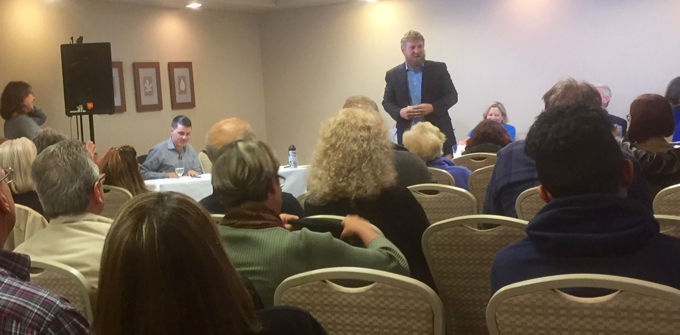
Devin Middlebrook moderates the May 16 candidates forum in South Lake Tahoe. Photo/Susan Wood

By Susan Wood

Come June, it appears the South Shore constituency wants the winner among the four candidates running for the El Dorado County District 5 seat to think quick on his or her feet.

By the way – Kenny Curtzwiler, Sue Novasel, Norma Santiago and Jeffrey Spencer (in alphabetical order), if elected, people also like you to:

·      Do your homework

·      Care more about us than you

·      Escalate representation in a diverse West Slope-centered board

·      Make the tourists behave themselves, but leave their money here

·      Advocate responsible development; yet maintain the beauty and charm of Lake Tahoe living

·      Solve all of this small-town region’s myriad big problems ranging from housing (permanent and vacation) as well as development to cannabis and mental health

·      As an experienced government representative, keep the momentum of the solutions going; yet, as a bit of a maverick outsider, enact change in the way we do things.

And so it goes for the two women and two men from varying backgrounds, when asked pointed questions in rapid-fire succession at Wednesday night’s candidates’ forum at Hotel Azure in front of about 80 attendees. Some groaned, laughed, applauded and mumbled at times. Many had to pay attention at the forum hosted by the Tahoe Regional Young Professionals. 

The town hall resembled a quasi-quiz show, which moderator Devin Middlebrook told Lake Tahoe News afterward was established because the conventional Q&A seemed old and tired.

It was difficult not to feel a little sympathy for the candidates, who held their own and as a testament to their good graces, were quite respectful of each other. This was notable, despite the questionnaire set-up to incite a tight-ship debate in 30-, 60- and 90-second increments. Questions, which came from TRYP and the audience, were framed as hot-button issues with the majority designed to that specific candidate.

Novasel, as the incumbent, could have guessed that she’d be on the hot seat given the other three want her job, and it’s easy to find things wrong in the county.

At one point, she read from the Fair Political Practices Commission regulation that explained why she needed to recuse herself from the Meyers Area Plan. That conversation was biting as expected, with Curtzwiler taking issue with her not telling voters her property ownership’s role before she was elected. Then the other candidates joined in on a debate whether real property ownership in the area in question, (whether commercial or residential), should keep elected officials from representing their constituency.

“He would have to recuse himself or he would be breaking the law,” Novasel said of Curtzwiler’s and Spencer’s holdings. To that, the latter candidate jumped in saying he owns property outside the plan area.

Santiago assisted Novasel in clarifying “the caveat is (whether there’s) personal gain,” and the key is to create a sense of community that can dictate a solution.

Speaking of representation, all three challengers want the Board of Supervisors to visit, vote and vie for Tahoe more often. To this, the incumbent declared the panel has come up in an unprecedented three times in a year under her leadership – which has now expanded to vice chairwoman.

In between the “thank you” nudges to wrap up or cease speaking by TRYP panelists Middlebrook and Matt Palacio, Novasel wasn’t the only one on the defensive at times.

Santiago, a community consultant who had the supervisor job for over two terms after Dave Solaro retired, found herself explaining why she sued the county she wants to work for. She explained that she joined in the lawsuit with Supervisor Ron Briggs as a way of questioning the legal process and interpretation of the compensation rules.

On monetary matters, Santiago – in her quest to advocate for new types of revenue-generating industries from broadband to biomass – jumped on Curtzwiler’s claim that his tree-removal and roofing business tried and did not find new revenue opportunity in it. 

Curtzwiler was put to task with a direct question about whether he had time for the supervisor job given his commitment with his company K&K Services and his desire to be the “Ski Bum.”

He both grinned and winced as he pledged being a fulltime supervisor, turning the business over to his children and bypassing “a powder day” for an agendized workday.

Novasel quickly countered, saying the job has her working 60 hours a week – including trips to Placerville twice a week. She got in 10 ski days last year.

Spencer, who has listed a who’s who of nonprofit and other pertinent boards for experience, was still able to keep a lower profile. But how does that get one elected when voters are driven by familiar faces like his other three opponents in the public eye?

Like Novasel, the planner may take the stance of an experienced background – but of a different kind. Instead of continuing with the progress at hand as laid out by the incumbent, Spencer supports a change in direction – especially in the area of transportation. He contends growth is “putting too much stress on infrastructure.”

After the debate, Lake Tahoe Unified School District trustee Bonnie Turnbull told LTN she attended the meeting to do some fact checking. The quick responses provided a glimpse of the public’s attention span, and she declared issues are “more complex” than soundbites. Nonetheless, she admitted the debate was “a nice change” sending her “home to process.”

For those of you seeking the same experience on the candidates displaying more of a premeditated style of thinking and less spastic one-liners, you may read the profiles on Lake Tahoe News for Curtzwiler, Novasel, Santiago and Spencer.



Opinion: It’s up to everyone to be fire safe

By Joanne Marchetta

Nevada and California suffered destructive wildfires last year. Nevada saw 768 fires burn more than 1.3 million acres. California experienced the deadliest, largest, and most destructive wildfires in its history. Just a few hours-drive from Tahoe, more than 40 people died and thousands of homes were destroyed in the wine country and North Bay last October. In Southern California, the Thomas Fire ravaged communities and forest lands last December with damaging flooding and landslides piled on after the fire subsided.

Joanne Marchetta

California’s five largest fire years since 1950 have all occurred in the last 12 years, and we know that climate change is making forests and communities more susceptible to catastrophic wildfire. The last four years were all among the hottest on record in California. Wildfire season in the Western United States is now two months longer than it was 40 years ago, making a devastating wildfire possible any time of the year.

Unprecedented tree mortality from the recent five-year drought, the most extreme on record in California, continues to increase the threat of large, damaging wildfires. There are now more than 129 million dead trees in the state. Forests in the Tahoe basin are faring better than forests in the foothills and Southern Sierra, but the number of dead trees on national forest land at Tahoe has grown each year from 35,000 in 2015 to 72,000 in 2016 and 168,000 in 2017.

The Angora Fire in 2007 remains our starkest reminder of the risk wildfire poses at Tahoe, and how quickly our lives can change in a matter of days, if not hours. We must keep the threat of wildfire in mind and prepare now, before the next fire ignites.

Agencies are working together to reduce the wildfire threat on Tahoe’s public lands. Since 1997, partners on the Tahoe Fire and Fuels Team have treated more than 70,000 acres to thin forests and reduce the amount of hazardous fuels in them, particularly in the wildland urban interface where forests and communities meet. This work is critically important for healthy, resilient forests, improved ecology, and to reduce the risk of catastrophic wildfire. Partners are working to treat the remaining 50,000 acres of wildland urban interface at Tahoe over the next 10 years.

We are also working on innovative projects like Lake Tahoe West, a multi-agency partnership to speed up forest thinning and fuel reduction projects on 60,000 acres of the West Shore and incorporate other projects to improve water quality and recreation opportunities.

The Tahoe Fire and Fuels Team is showing how agencies can partner and work together across jurisdictional boundaries to promote healthy forests and reduce wildfire risk. But agencies cannot prepare Tahoe communities for wildfire on their own. There are important steps that visitors and residents can and must take.

First among them is preventing wildfires. More than 90 percent of wildfires at Lake Tahoe are caused by people. An illegal campfire left unattended started the Angora Fire that quickly burned more than 3,000 acres and 254 homes. Please be mindful of this risk while recreating at Tahoe.

There are important steps homeowners and residents can take today to prepare for Tahoe’s next wildfire. It’s not a matter of if we will have another wildfire, it’s a matter of when. If you have not already done so, call your local fire district to ask for a defensible space evaluation and then manage the vegetation on your property to help protect your home from a fire. Rake up the pine needles in your yard each spring, removing them from roofs, decks, and brush. Have an evacuation kit ready to go and an evacuation plan for your family. Sign up for emergency notifications from your county, including not only your cell phones but any land line phones. This will help ensure you receive accurate, timely, and actionable information during an emergency.

Finally, consider joining the Tahoe Network of Fire Adapted Communities. This program, run by the Tahoe Resource Conservation District, is recruiting volunteers to work with their neighbors and local fire agencies to boost wildfire preparedness and create fire adapted communities at Lake Tahoe.

Wildfire is a serious risk at Lake Tahoe, but it is also a natural and important part of our landscape’s environment. By continuing to work together and preparing now, we can minimize the amount of damage that Tahoe’s next wildfire will do to communities and the environment. Please join us today in this important work to keep Tahoe fire safe through what is expected to be another dangerous fire season.

Joanne Marchetta is executive director of TRPA.


Shampoo, hair spray, skin lotion may be polluting the air

By Matthew Coggon, The Conversation

Millions of Americans apply personal care products every morning before heading to work or school. But these products don’t stick to our bodies permanently. Over the course of the day, compounds in deodorants, lotions, hair gels and perfumes evaporate from our skin and eventually make their way outdoors. Now there’s evidence to suggest that these products are major sources of air pollution in urban areas.

For decades, motor vehicles were considered the primary source of air pollutants in major U.S. cities. Vehicle exhaust contains multiple pollutants that worsen air quality, including nitrogen oxides, particulate matter and volatile organic compounds (VOCs) – a group of reactive gases that contribute to smog formation.

Thanks to advances in catalytic converters and improvements in fuel economy, combined emissions of common pollutants from cars have decreased by 65 percent since the 1970s. Air pollution is still a problem in urban areas like Los Angeles, but only a fraction of it can be attributed to vehicles. Today, scientists are finding that other non-combustion sources – including common household products – are also major contributors.

A unique fingerprint

In a recent study with U.S. and Canadian colleagues, our lab found that these sources can include personal care products. We analyzed urban air in two cities: Boulder, Colo., and Toronto, Canada.

In Boulder, our lab had recently invested in new instrumentation, which we wanted to use to measure wood stove emissions during winter months. For five weeks we sampled air from the roof of the NOAA David Skaggs Research Center in hope of measuring air parcels contaminated with smoke from residential wood stoves. Surprisingly, we noticed a signal that stood out unexpectedly from all the other data. This compound, which we identified as decamethylcyclopentasiloxane (or D5 siloxane), contains silicon, which uniquely differs from the organic compounds we normally detect.

By reviewing scientific literature, we learned that pure D5 siloxane is produced mainly as an additive for deodorants and hair care products. On average, people use products that contain a total of about 100-200 milligrams of D5 every day – roughly the weight of half an aspirin tablet. Some fraction of these products end up going down the drain when we shower, but the majority of what remains on our bodies ends up in the atmosphere. D5 can also be found in many other places, including soil, oceans and the tissues of fish and human beings

Many labs have studied the environmental fate of D5, but from our perspective it is particularly useful because it acts like a fingerprint. If we detect D5 in the atmosphere, we know that the air mass we measured was influenced by emissions from personal care products. By comparing the amount of D5 in the atmosphere to other fingerprint markers, such as compounds present in vehicle exhaust, we can estimate how important personal care products are as an emissions source relative to better-understood sources.

Emissions spike during morning rush hour

In Boulder and Toronto, we found that D5 was present in urban air at mass concentrations comparable to those of benzene, a chemical that is a marker for vehicle exhaust. (Benzene is a known carcinogen and is also found in industrial emissions and cigarette smoke.)

D5 concentrations were highest in the morning – the time when most people shower, apply personal care products and then leave the house to commute to work. We also observed a peak in benzene emissions in the morning, when people drive to work. During morning rush hour, we found that emissions of D5 and benzene were almost equivalent.

In other words, at this time of day, people emitted a plume of organic compounds that was comparable in mass to the plume of organic compounds emitted from their vehicles. Researchers still have a lot to learn about how these chemicals react in the atmosphere to form smog, so the air quality implications of these morning emissions remain unclear.

Benzene emissions remained high throughout the day as people drove around the city, but D5 emissions eventually tapered off as personal care products evaporated from users’ skin. We estimate that, on average, the entire population of the city of Boulder emits 3 to 5 kilograms (6 to 11 pounds) of D5 per day, and that their cars emit about 15 kilograms of benzene in vehicle exhaust.

VOC emissions from your medicine cabinet

While these numbers may seem surprisingly high, our findings support recent modeling work conducted by Brian McDonald, a co-author of this study, which showed that personal care product VOC emissions in Los Angeles now rival VOC emissions from gasoline and diesel exhaust. Taken together, these two studies demonstrate that our urban air is remarkably different from what it was decades ago. Cars today emit fewer smog-inducing organic compounds, while other sources are now becoming important contributors to air pollution.

D5 is only one component of personal care product emissions, and many other compounds could be emitted with it. To fully assess how seriously these emissions may affect the environment and human health, researchers have to answer many more questions. What other compounds enter the atmosphere after we apply personal care products? Once in the atmosphere, what happens to them? Are they capable of contributing to smog formation? Our lab and others around the country are considering these questions now in hopes of improving our understanding of urban air pollution.

Matthew Coggon is a research scientist at University of Colorado.


Illegal sports betting in U.S. is not really a $150B business

By Jay L. Zagorsky, The Conversation

The Supreme Court on May 14 struck down a 25-year federal ban on sports betting outside of Nevada.

The big question on many minds – particular state officials and companies like MGM Resorts and DraftKings looking to cash in – is how much money is at stake. Many of the articles on the decision cite the same eye-popping figure: Americans wager an estimated $150 billion in illegal sports bets every year.

As a macro economist, I am used to dealing with big numbers. Still, $150 billion struck me as much too high. To put it in perspective, that’s 14 times more than Americans spend going to the movies, twice as much as they put into grooming and feeding their pets and about the same as they pay for fruits, vegetables and dairy products.

The figure comes from the American Gaming Association, which represents the U.S. casino industry and works to reduce restrictions on gambling. It says it based this number on a 1999 government estimate of about $80 billion in illegal sports betting. The group, which describes this as “the most conservative estimate,” then adjusted it to 2017 dollars using GDP growth.

I’m not the first to find fault with these figures. A 2014 article in Slate questioned an even higher estimate, $380 billion, drawn from the same report. An examination of the underlying study showed that such estimates were not based on serious research.

While the figure has no real basis, it does have real impact. Numerous states need more tax revenue. If the potential dollars are big enough, then many states will rush to allow sports betting – as almost 20 are already doing, including New Jersey, which was behind the lawsuit that resulted in the high court ruling.

Real-world examples

As I know from my work in economics, there are better ways to make estimates than pulling numbers out of thin air.

The first thing you do in such cases is look for a real-world example. In this case, data from the U.K., which has allowed sports gambling for decades, with thousands of betting parlors offering odds on everything from Premier League matches to when royal babies are born.

The U.K.’s Gambling Commission tracks betting statistics and issues an annual report. The one released in January shows that Brits placed about 10 billion pounds in bets in the latest fiscal year.

To get a comparable estimate for the U.S., that figure needs to be adjusted by population and currency. The U.K. has only about 66 million people, compared with 327 million in the U.S. And the pound was worth $1.36 on May 14.

After making both adjustments, this suggests that if people in the U.S. are allowed to make bets at the same rate as in the U.K., the size of the industry would be about $67 billion a year. While enormous, that’s a far cry from $150 billion.

Will legal sports gambling be big business? Yes, but not as big as its proponents want you to believe.

Jay L. Zagorsky is an economist and research scientist at Ohio State University.