Lawsuit filed to stop Martis Valley West project

A lawsuit has been filed to stop the Martis Valley West project.

The Davis-based nonprofit California Clean Energy Committee on Oct. 26 filed the suit against Placer County.

The group contends the county did not adequately address California Environmental Quality Act regulations because the environmental documents were inadequate.

The California Attorney General’s Office had weighed in before the vote saying the documents were substandard as well. The county multiple times said the documents are solid.

Mountainside Partners of Truckee, the developer, and landowner Sierra Pacific Industries have been working on this project for at least 10 years. Build out is expected to take 20 years.

The project has been controversial because it takes undeveloped land in Truckee that borders Lake Tahoe and turns it into a subdivision for second homeowners.

— Lake Tahoe News staff report


Housing dominates loop road forum discussion

By Jessie Marchesseau

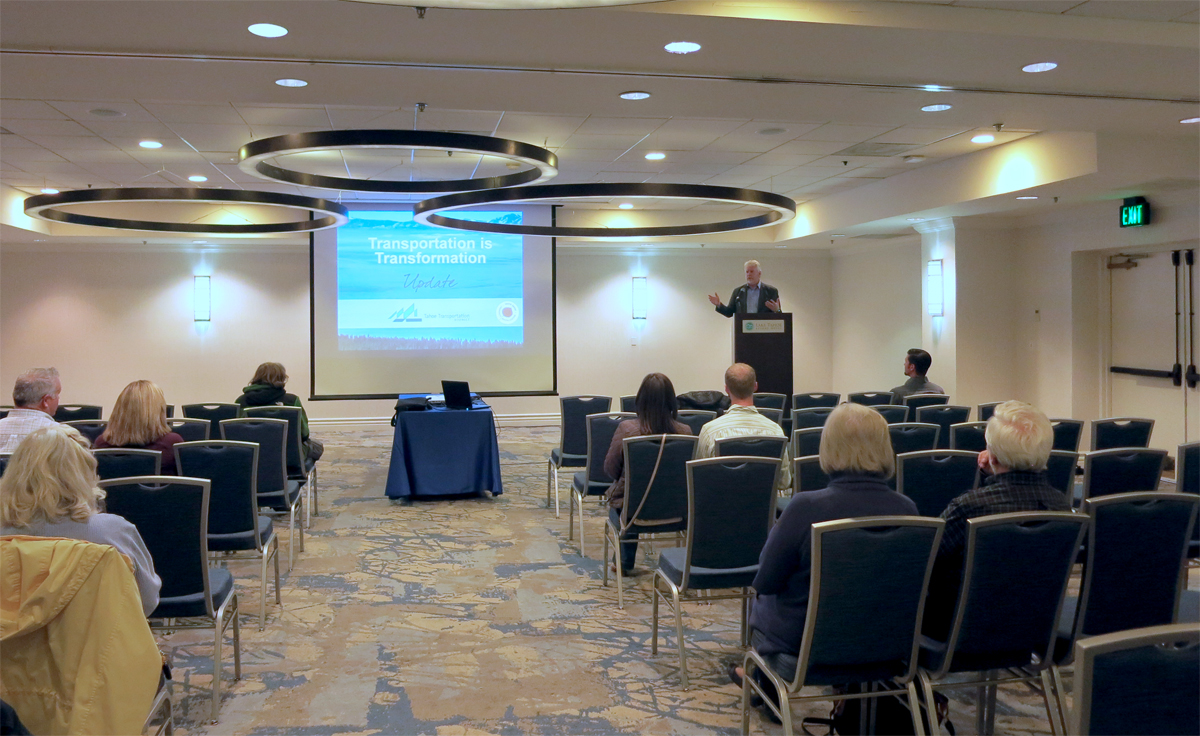
The loop road has been a hotly debated topic in recent years. As such, it was surprising to see more empty seats than filled ones in the conference room at Lake Tahoe Resort Hotel on Thursday night.

About 35 people were in attendance to hear Tahoe Transportation District’s District Manager Carl Hasty talk about the logistics of the loop road project and what his organization views as the benefits of it.

Hasty began by explaining that even though the plan for this project has been in discussions since the 1970s, the TTD believes the need for it now is much greater than it was then. As evidence of this, he pointed to traffic problems such as how people are cutting through residential neighborhoods to avoid congestion along Lake Tahoe Boulevard, an issue the TTD believes will be resolved by the loop road. He also pointed out that the casinos are not providing the draw for tourists the way they once did, and suggested having a pedestrian-friendly resort-style commercial core may help attract more visitors.

However, the issue which earned the most talk time for the evening was South Lake Tahoe’s housing woes.

Hasty mentioned time and again how hard it is for residents, especially people wanting to move to the area, to find affordable housing. He asserted that this project will help with that issue.

Carl Hasty, head of TTD, talks about the loop road on Nov. 3. Photo/Jessie Marchesseau

A sparse audience listens to Carl Hasty, head of TTD, talk about the loop road on Nov. 3. Photo/Jessie Marchesseau

For the preferred project plan which was presented at the forum, 76 current residential units would be removed. The intent is to replace those with the same number of new residential units, most likely in the form of apartment buildings along the new highway. Hasty said there is “potential” for additional housing units, but the plan as of now only includes replacing the ones being removed.

Of those 76 new residences, more than half would be designated low-income housing, and some would likely be senior housing. Hasty presented a few options for where new apartment buildings may be erected. The area behind Raley’s which is currently a parking lot is one of those options, as is the area where Naked Fish currently sits.

Hasty told attendees building this new housing would be the first step in the construction process. Before any houses are torn down, the new ones will be up, he said. Only after the housing is ready would demolition and construction of the actual road begin. Traffic would continue as usual on the current Highway 50 until the new road is completed, so traffic should be affected minimally, if at all, by the construction.

From approval to finish, Hasty estimates it to be about a five-year process.

the project is still a ways from approval. The TTD is hoping to release the draft environmental impact study for public review and comment before the holidays, which means no major decisions would be made on the project before late spring 2017.

After the presentation, attendees were encouraged to submit written questions for Hasty to answer. Many of the questions concerned the housing and existing property issues:

·       Would there be any new low income housing in Nevada? It’s not planned, but could be possible down the road.

·       Would they be looking for money from HUD? Yes, and also California’s Cap-and-Trade Program.

·       Who would own the new residential units? The TTD initially, but “TTD is not looking to be in the long-term landlord business,” Hasty said. They would look at other long-term options such as a land trust or companies designed to own and manage such housing.

·       Would residents, both residential and commercial, be compensated for the inconvenience of construction? TTD would try to minimize the impact of construction, but Hasty said he was not sure how they could compensate a non-commercial resident for something like that.

·       Would the property be acquired by eminent domain? Technically, yes, but fair market value will be offered for all parcels, and they hope to have willing sellers. Hasty said they do not want to force anyone to sell.

Other questions involved parking issues, roundabouts, overhead walkways and the upcoming election.

When asked whether he thought this project, 35 years in the making, was actually going to happen, Hasty offered an emphatic, “Yes.” He said if projects like the one in Tahoe City and the bike path on the Nevada side could finally come to fruition, this will, too.

The draft EIS for the U.S. 50 South Shore Community Revitalization Project will be available for public review sometime in the upcoming months. The Nov. 3 forum was hosted by the Lake Tahoe South Shore Chamber of Commerce.


Letter: Leadership qualities key in who to support

To the community,

As we collectively hold our breath to see who will lead our nation, our city, our public school system and our local utility district, it is a great time to define leadership.

I learned about leadership while serving on many boards over the last 40 years, starting with Tahoe Parents Nursery School, graduating to school site councils and youth sports boards, then on to community boards, at the county and local level. I have observed many great leaders and learned what leadership is and is not.

Wendy David

Wendy David

I have learned that leadership is not the loudest voice, or the most frequent voice. It is not harsh, unkind, self-centered or presumptuous. It does not bully or belittle others to make oneself feel superior. It is not closed minded and disrespectful of others for their differences. It is not petty and small minded.

Yet we are seeing candidates, even at highest level of government exhibit these very traits. As voters, we have not only the opportunity but, more importantly, a responsibility to vote for true leaders. Especially at the local level, we know that whom we select to put in our elected positions will make a difference.

When choosing whom to vote, please consider what leadership skills that person can bring to their position. For the school district, consider Annie Davidson. She has demonstrated to me some great leadership skills, and she also has children that will be going through our district for many years. She has a real stake in the future of public education in our community. I respect each of the candidates running, but believe we need to have at least one board member that has children currently in the district. Annie is that person.

For City Council, please consider Brooke Laine and Jason Collin. Brooke is a tireless community advocate and has proven to be a collaborative, strong, positive leader. She leads by bringing out the best in each person she works with, honoring their input, their ideas and their abilities. I look forward to working with her on the council. Jason has demonstrated his leadership abilities through his work, his history already as a positive community leader and by being an independent risk taker for what he believes. I honor that in him.

For STPUD, I am supporting Kirk David. Besides being a terrific son, he is smart and thoughtful, he is wise and reasoned in his decision-making ability. He will bring a fresh voice and the outlook of someone who cares about the future of our community. As a small business owner, and a long-time local who has raised his family here, he cares as deeply as I do.

Leading by life example is the best quality that each of these candidates will bring for our community and each of these candidates has demonstrated these qualities through their commitment to family, jobs, volunteering in their community and always demonstrating their care for others first. Their examples of leadership will shape our city and our community for years to come.

Wendy David, South Lake Tahoe mayor


Future of Tahoe’s shore zone being debated

By Kathryn Reed

STATELINE – What if motorized boats were no longer allowed on Lake Tahoe? That’s what one table at a workshop proposed.

That idea was one of many discussed Thursday night when the public got together to work on the Tahoe Regional Planning Agency’s shore zone plan.

Piers and buoys have long been controversial at Lake Tahoe. When the bi-state regulatory agency adopted the shore zone plan in 2008 the League to Save Lake Tahoe and the Sierra Club that same month filed a lawsuit challenging it. Two years later TRPA challenged the court’s ruling which had sided with the conservation groups. Then in 2012 the Ninth Circuit Court of Appeals partially ruled in favor of each side.

That in part is why the TRPA is conducting more outreach and is in the process of updating this segment of the Regional Plan

Shore zone issues are discussed Nov. 3 in Stateline. Photo/LTN

Shore zone issues are discussed Nov. 3 in Stateline. Photo/LTN

Sitting at tables, the more than 30 people on Nov. 3 discussed piers, low lake adaptation, access, boating and marinas. Their comments along with those from the more than 70 people who attended a similar meeting on the North Shore in September will be considered as the bi-state regulatory agency moves forward.

Many of the issues are interrelated. Several of the 14 marinas (12 are in California, two in Nevada) are struggling to provide access to boaters because of the low lake level. Piers can’t be extended per current rules, but floating docks could be the answer.

Marinas are dealing with slips that no longer fit boats as they keep increasing in length. Piers-docks are inaccessible because the lake is so low.

While being able to be on the lake itself is an economic driver for the entire basin, protecting this national treasure from an environmental standpoint is also a concern. Part of the shore zone plan components will be to balance those two issues which at times can be conflicting.

Suggestions that came out of the discussion Thursday night included:

·      Needing to allow marinas to expand;

·      Enforcing the 600-foot TRPA mandated no wake zone, and the 200-foot California zone;

·      Storage for watercraft on and off the water;

·      Signs talking about rules of the water and pointing to where access is;

·      Multi-use piers, including ones that can accommodate water taxis;

·      Paying attention to public health and safety;

·      Reviving the bus that went around the lake so people can get to the water without driving themselves;

·      Figure out how low the water level must get before people stop trying to adapt to it;

·      Making sure non-motorized boats have access;

·      Education;

·      Streamline permitting process;

·      Speed limit on the lake;

·      Working more cooperatively with various agencies and landowners.


Opinion: Thankful to live in an indirect democracy

By Andrés Martinez

Suppose we ask all Americans to vote on whether anyone whose first name starts with the letter “A” should to pay an extra tax, giving everyone else a tax break. The appalling measure would probably pass.

From the perspective of us A-listers (sorry, couldn’t resist), that would amount to a classic case of the kind of “tyranny of the majority” our Founding Fathers were so eager to avoid, illustrating why certain filters, or brakes, on direct democracy are desirable. The idea was that people shouldn’t legislate themselves, but instead leave that up to their representatives.

And even if the people’s representatives get carried away, our political system has other checks and balances to insulate it from too much democracy: Congress itself is split into two bodies; unelected judges protect the Constitution from lawmakers; our nation’s monetary policy is set by an “independent” (undemocratic, that is) Federal Reserve Board. We’ve also developed a stable of technocratic agencies like the Food and Drug Administration and the Federal Communications Commission to govern areas of American life at a dotted-line remove from the democratic process.

All these checks on democracy, together, constitute the genius of American democracy. We pride ourselves on our freedom to do as we damned please, but at the same time we’ve locked away all the chocolate and given the key to a friend, and warned him not to listen to us if we call to ask for it urgently late some night. Of course we then complain about how the system doesn’t work, about how we can’t binge on chocolate whenever we want.

Such complaints are the fuel of the term “populism.” The word wasn’t current in the era of the Founders, and it remains vaguely defined in ours, but it’s precisely what our republic’s designers were intent on protecting against: The danger that over-indulging majority passions could overwhelm and subvert the system at any given moment.

This is the election year of mad-as-hell-and-not-going-to-take-it-anymore populism (to cite the Howard Beale character from the classic “Network” movie), with Bernie Sanders and Donald Trump railing against how bankers, Washington, the Federal Reserve, foreigners, and conspiring elites are holding back “the people.” Those are familiar rants, yet, there is something novel about the threat posed by today’s populism: The real threat nowadays is a potential tyranny of an agitated minority, more so than a potential tyranny of the majority.

The two dangers are easy to confuse because agitated minorities can look very much like a majority now that they can mobilize via once unimaginable communications technology and dominate wall-to-wall cable TV news coverage. Who knows how far William Jennings Bryan or Eugene V. Debs would have gotten with a Twitter following, a YouTube channel, and the ability to call into CNN?

Let’s tweak our imagined tax referendum to illustrate what a tyranny of the minority looks like. Suppose that instead of asking Americans whether people whose first name starts with an A should pay more taxes, we ask them to vote on whether A-listers should be exempted from ever again having to pay any taxes.

This measure, if uncoupled from any other balloting in a low-turnout vote, might conceivably pass. Why? Because we A-listers would turn out to vote in droves, and most everyone else would have little incentive to vote, or to speak out against the measure.

It’s an extreme hypothetical, but too much of American political life has become vulnerable to hijacking by intensely motivated and agitated minorities. It’s why teachers unions can control school board elections, why the gun lobby can punch above its weight in Washington, and why we haven’t fixed our broken immigration system.

The danger of not appreciating the threat posed by an extremely motivated minority, as opposed to an untrammeled majority, is that our society is enabling the former threat with its overzealous vigilance against the latter. So, for instance, while a bicameral Congress and the separation of powers that allots the executive a veto and the courts judicial review are good brakes on majority rule, the Senate’s filibuster rules and the so-called “Hastert Rule” observed by House Republicans go too far in empowering agitating minorities.

The Senate’s longtime filibuster rules were infamous in delaying the adoption of needed civil rights in the 20th century, long after a majority of Americans were ready to go along. This was a case of an aggrieved minority—white Southern Democrats—subverting the will of the majority to protect said minority.

The Hastert Rule in the House is a more recent, and less formalized, tradition in the House of Representatives that has similarly served to block immigration reform favored by a majority of Americans, and by a majority of their representatives in Congress. The policy, enunciated by Dennis Hastert when he was the Republican Speaker of the House (long before he was revealed to be a child molester), and loosely followed by some predecessors and successors, is that proposed legislation should not be brought for a vote on the floor of the House unless it is supported by a majority of the party’s own caucus.

As speaker in recent years, John Boehner set aside the rule at key times to allow for bipartisan votes to keep the government open when some far-right Republicans were threatening to close it down, and that’s one reason Boehner is no longer in office. But he did not allow the House to vote on a sensible immigration reform bill passed by the Senate in 2013, which would have legalized the status of the millions of undocumented workers in this country. The bill could have passed in the House with the support of Democrats and more moderate Republicans (as it did in the Senate), but the Hastert Rule stood in the way.

The Founding Fathers intended for both chambers of the Congress, as well as the president and the judiciary, to all wrestle with thorny issues like immigration—balancing the will of the people with the Constitution. It’s a perversion of their design for one faction within the House to hijack the process, and allow for an agitated minority of anti-immigration nativists to become the arbiters of what constitutes a proposal worth voting on.

Immigration and international trade feature prominently in this election cycle’s populist discourse, but it’s inaccurate to portray these issues, as the media often does, as pitting elites against “the people.” Opinion polls consistently show that a majority of Americans view trade in a positive light and favor immigration reform along the lines of what the Senate passed three years ago (as opposed to mass deportations and a wall).  It’s easy to lose track of that reality, though, given the asymmetry of passion and interest between supporters and opponents of immigration and free trade.

Richard Nixon’s odes to the concept of a “silent majority,” whose support he cherished, were often mocked by pundits in his day but it’s a concept worth revisiting. Today there is a silent majority that thinks it’d be insane to deport millions of hard-working, law-abiding immigrant workers. But, like many other insane ideas out there, this one isn’t going to keep most people from going about their daily business. It’s the supporters of the insanity who likely consider immigration the issue of our times, and can be found screaming at rallies and pestering their members of Congress, threatening to have them “primaried” if they work with Democrats on the issue.

The dangers posed by agitated minorities are not merely an American phenomenon. They are wreaking greater havoc in other western democracies, like Colombia and Britain, that have ill-advisedly put big questions to a public vote in 2016. Elites in London and Bogotá were seeking additional legitimacy for their decisions to stay in the European Union and reach a final peace settlement with a vanquished narco-insurgency by engaging their silent majorities in the process. In the end, sizable impassioned minorities prevailed.

Trump’s populist campaign narrative of elites pitted against “the people” is off.  Today’s politics is pitting elites and a silent (or quieter) majority against a loud, angry, mobilized faction of people susceptible to a populist pitch. The question on Nov. 8 is whether the silent majority makes itself heard, or whether it will cede the electoral battleground to the more clamorous minority.

Andrés Martinez is the executive editor of Zócalo Public Square.


Wildlife decline since 1970s reaches nearly 60%

By Jane Onyanga-Omara, USA Today

Wildlife populations around the world have declined nearly 60 percent since the 1970s, with elephants, wolves and salamanders among the creatures affected, a new environmental report warns.

The numbers of mammals, birds, and fish fell by 58 percent between 1970 and 2012 while freshwater species declined by 81 percent during the same time, the World Wildlife Federation (WWF) and the Zoological Society of London (ZSL) said in their The Living Planet report.

Read the whole story


Calif. pension dollars at work in Las Vegas

By Dale Kasler, Sacramento Bee

CalPERS is betting big on Las Vegas real estate, purchasing a glitzy retail and nightlife complex on the Strip where entertainers such as Britney Spears and Jennifer Lopez regularly perform.

California’s giant public pension fund recently bought Las Vegas’ high-profile Miracle Mile Shops for a reported $1.1 billion. It’s one of the largest real estate deals CalPERS has made since the property bubble burst nearly a decade ago.

CalPERS purchased the 200-store mall, next to Planet Hollywood Resort & Casino, through a company called Institutional Mall Investors LLC. Institutional Mall, which owns 21 shopping centers, is a partnership between the California Public Employees’ Retirement System and Chicago-area real estate firm Miller Capital Advisory Inc.

Read the whole story


Letter: Vogelgesang deserves another term

To the community,

I am endorsing Randy Vogelgesang for re-election to the STPUD board. Randy is a long time local, having lived in the South Lake Tahoe community for 30 years raising a family with his wife, Cathy, and running a successful engineering firm as a small business owner.

During the 20 years that I have known Randy and his family, I appreciate the honesty and integrity he has always displayed both personally and professionally. Randy is truly invested in the community in which he lives, and brings not only his professional engineering experience to the board, but also the respect he has for his fellow community members and neighbors.

I admire the balanced approach he brings to decision making, and the fact that he was always mindful of the impact to ratepayers the board’s decisions would have during his first term with STPUD. The fact that he successfully collaborates with other board members with differing opinions speaks to his strength as a team player, and his measured, fiscally conservative ideals are key to his responsible approach to rates and spending.

I hope you will join me in re-electing Randy Vogelgesang to the STPUD board on Nov. 8.

Sincerely,

Linda Mueller, South Lake Tahoe


DMV releases Home Means Nevada license plate

By Reno Gazette-Journal

Every good Nevadan knows that home means Nevada, home means the hills … now they can wear their state pride by putting silvery rills on their grills.

The Department of Motor Vehicles has released a Home Means Nevada license plate. Beginning this week  motorists can request the Home Means Nevada plate when registering a vehicle or ordering a new plate.

The Home Means Nevada plate can fit up to since characters, the same as the Nevada Sunset design standard plate, which has been in use since 2001. Personalized plates with the “Home Means Nevada” design will be available beginning early next year.

Read the whole story


Sierra, Northstar part of 15 ski resort sale

By Lake Tahoe News

Florida-based CNL Lifestyle Properties is selling Northstar and Sierra-at-Tahoe ski resorts to EPR Properties of Kansas City, Mo.

“CNL has had the profile for sale for a while, Booth Creek Resort Properties owns the management contract with them. I work for Booth Creek and nothing will change for Sierra when and if the REIT sells. Northstar is owned by CNL as well, and Vail holds the management contract,” John Rice, general manager of Sierra, told Lake Tahoe News last year when a sale was pending. “Each ski property in their profile has continued to operate under their management contracts as they did prior to CNL purchasing the ownership. It is correct nothing will change with resorts like Sierra who are under long-term management contracts.”

The 15 ski resorts in the deal are selling for $374 million, while other entertainment properties have a $456 million price tag.

The other ski resorts are: Brighton Ski Resort, Utah; Crested Butte Mountain Resort, Colo.; Cypress Mountain, British Columbia; Gatlinburg Sky Lift, Tenn.; Jiminy Peak Mountain Resort, Mass.; Loon Mountain Resort, N.H.; Mount Sunapee Mountain Resort, N.H.; Mountain High Resort, Calif.; Okemo Mountain Resort, Vt.; Stevens Pass, Wash.; Sugarloaf Mountain Resort, Maine; Summit-at-Snoqualmie Resort, Wash.; and Sunday River Resort, Maine.

No operational changes are expected at any of the resorts.

The deal is expected to close in the second quarter of 2017.

“We are extremely pleased to announce this transaction, which is the culmination of a two-year process of disciplined underwriting, due diligence and negotiations,” EPR President-CEO Gregory Silvers said in a statement. “This portfolio of high quality ski and attractions assets builds on our expertise in the Recreation segment, where we have a track record of delivering consistent and reliable cash flows. The transaction is not only expected to be immediately accretive, but it will also diversify our portfolio with proven, durable assets that are aligned with the positive trends we are seeing in the experience economy.”